H100 GPU Price Trends and Buying Guide for AI Workloads in 2026
The h100 gpu price has become a hot topic among data scientists, AI developers, and cloud infrastructure managers as demand for…
H100 GPU Price Trends and Buying Guide for AI Workloads in 2026
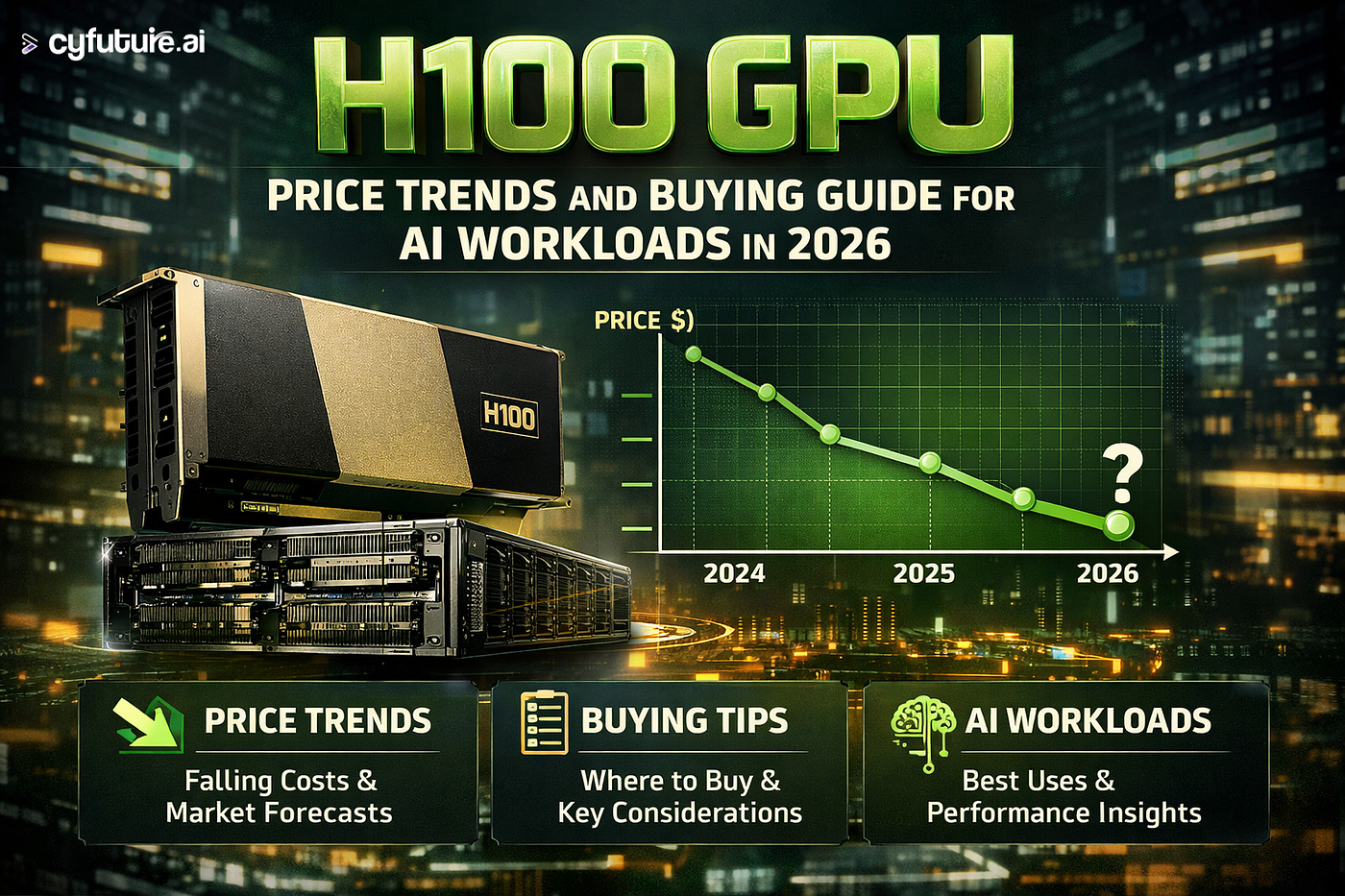
The h100 gpu price has become a hot topic among data scientists, AI developers, and cloud infrastructure managers as demand for high-performance computing surges. With AI models growing more complex and training workloads demanding unprecedented parallel processing power, these GPUs stand out for their ability to handle massive tensor operations and transformer-based architectures. Priced in a premium range, they reflect the high-end capabilities needed for large language models, generative AI, and scientific simulations. Understanding current pricing dynamics helps teams budget effectively for on-premises setups or cloud rentals.
Current Market Pricing for H100 GPUs
As of early 2026, the h100 gpu price typically starts at around $25,000 to $40,000 per unit for new hardware in standard configurations. This range accounts for variations in memory capacity — such as 80GB or 94GB HBM3 variants — and features like PCIe or SXM form factors. Bulk purchases from enterprise resellers often yield discounts of 10–20%, bringing costs down to $20,000-$30,000 per GPU for orders exceeding 10 units. Used or refurbished options appear on secondary markets at 40–60% lower prices, around $10,000-$18,000, though warranty limitations and potential wear from prior mining or training runs pose risks.
Cloud providers offer rental models that sidestep upfront costs, with h100 gpu price per hour ranging from $2.50 to $8.00 depending on the platform and instance type. Spot instances can drop to $1.50/hour during low-demand periods, making them ideal for bursty workloads like model fine-tuning. Over a year, renting eight GPUs for continuous training might cost $150,000-$300,000, often comparable to buying outright when factoring in maintenance and power draw.
These figures stem from supply chain recoveries post-2025 chip shortages, but geopolitical tensions and raw material costs keep prices volatile. Track aggregator sites or API-driven marketplaces for real-time quotes, as h100 gpu price fluctuates weekly based on inventory levels.
Factors Driving H100 GPU Price Fluctuations
Several elements influence the h100 gpu price. First, raw compute performance: these GPUs deliver up to 4 petaFLOPS in FP8 precision, enabling 5–10x faster training than prior generations on the same power budget. High-bandwidth memory (up to 3.35 TB/s) and NVLink interconnects justify the premium for multi-GPU clusters scaling to thousands of units.
Manufacturing yields and semiconductor fab capacity play key roles. Limited production slots prioritize hyperscalers, pushing spot prices higher for smaller buyers. Energy efficiency also factors in — each unit consumes 700W under load, translating to $5,000+ annual electricity costs per GPU at industrial rates. In regions like India, where power tariffs average ₹8/kWh, this adds 15–20% to total ownership costs.
Demand from sectors beyond AI, such as autonomous vehicles and drug discovery, sustains upward pressure. Conversely, emerging competitors with similar tensor core architectures could cap prices, as seen in late 2025 when alternative high-end GPUs entered the market at 20% lower entry points.
Comparing H100 GPU Costs to Alternatives
To assess value, stack the h100 gpu price against mid-range options. Consumer-grade GPUs with 24GB GDDR6X handle prototyping at $1,500-$3,000 but falter on memory-intensive tasks, requiring 4–8x more units for equivalent throughput. Mid-tier datacenter GPUs (48–80GB HBM2e) cost $8,000-$15,000 each, offering 60–70% of H100 performance at half the price — suitable for inference-heavy apps but slower for full training runs.

Large-Scale Training
For cloud users, hybrid strategies shine: prototype on cheaper instances, then scale to H100 rentals for final training. Total cost of ownership (TCO) calculators from providers reveal H100 clusters amortize faster for workloads exceeding 100 petaFLOPS-days.
Strategic Buying Tips to Optimize H100 GPU Price
Negotiate smarter by bundling with servers or liquid cooling kits, which can shave 15% off the h100 gpu price. Enterprise agreements lock in volume discounts and priority access during shortages. Consider GPU-as-a-Service (GPUaaS) platforms in India, where local providers offer H100 instances at $3–5/hour, undercutting global giants by leveraging lower data center costs.
Evaluate resale value — H100s retain 50–70% after two years if lightly used. For sustainability, opt for providers with renewable energy offsets to mitigate rising carbon taxes. Finally, benchmark your workload: tools like MLPerf show if H100’s price premium delivers ROI via 2–3x speedups on diffusion models.
Future Outlook on H100 GPU Pricing
Looking to mid-2026, expect h100 gpu price stabilization around $22,000-$35,000 as next-gen architectures ramp up, easing supply. However, AI’s explosive growth — projected 40% CAGR — may sustain premiums for proven silicon. Teams should monitor fab announcements and trade in older hardware proactively.
In summary, while the h100 gpu price demands careful planning, its unmatched efficiency for AI at scale makes it a cornerstone for competitive edge. Whether buying, renting, or hybridizing, align choices with your workload to maximize returns.
메타데이터
- post_id
- 3f868b67ff3f
- slug
- h100-gpu-price-trends-and-buying-guide-for-ai-workloads-in-2026-3f868b67ff3f
- url
- https://medium.com/@cyfutureai/h100-gpu-price-trends-and-buying-guide-for-ai-workloads-in-2026-3f868b67ff3f
- canonical_url
- https://medium.com/@cyfutureai/h100-gpu-price-trends-and-buying-guide-for-ai-workloads-in-2026-3f868b67ff3f
- author_url
- https://medium.com/@cyfutureai
- status
- ok
- fetched_at
- 2026-06-17 08:20:12