How a 5% Supply Shock Moves Global Diesel Markets
A Case Study in Commodity Market Intelligence
How a 5% Supply Shock Moves Global Diesel Markets
A Case Study in Commodity Market Intelligence
By Skyra CIP — Commodity Market Intelligence
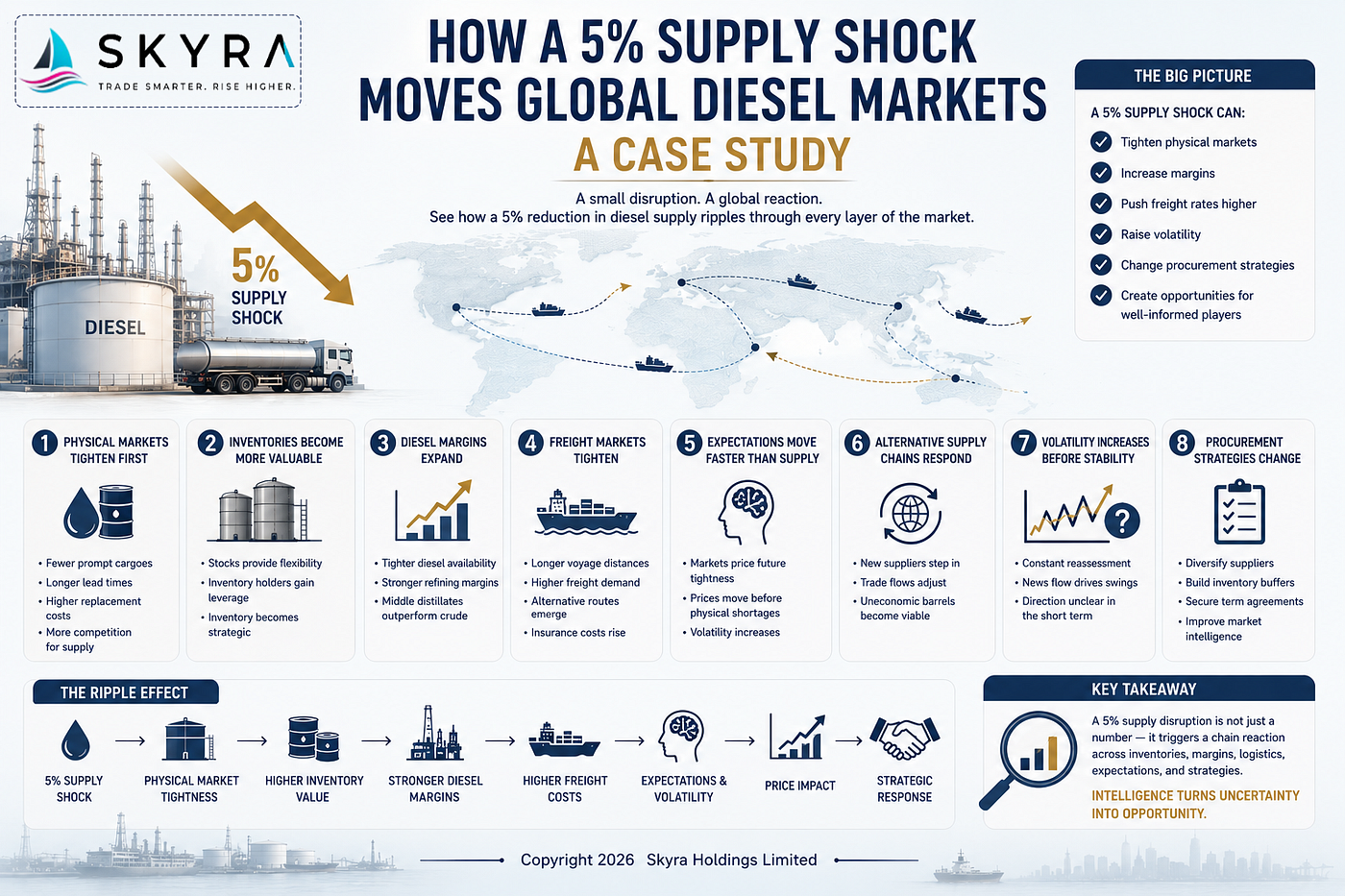
A 5% disruption in global diesel supply may not sound dramatic.
In many industries, a 5% reduction would be manageable.
The reason is simple:
Global diesel markets operate with limited spare capacity, complex logistics, and highly interconnected supply chains.
This case study explores how a hypothetical 5% reduction in global diesel availability can influence pricing, volatility, inventories, and trade flows — not because the numbers are catastrophic, but because expectations and market structure amplify relatively small physical disruptions.
The Scenario
Assume global diesel availability suddenly declines by approximately 5% due to a combination of:
- Refinery outages
- Export restrictions
- Shipping disruptions
- Geopolitical tensions
- Maintenance delays
Importantly, demand remains relatively stable.
No panic buying occurs initially.
No major economic recession changes consumption.
The only change is a modest reduction in available supply.
Step 1 — Physical Markets React First
The first reaction is rarely visible in crude oil prices.
Instead, physical diesel markets tighten.
Market participants begin noticing:
- Longer delivery lead times
- Reduced spot cargo availability
- Higher replacement costs
- Increased competition for prompt deliveries
Storage operators become less willing to release inventories.
Refiners evaluate production schedules.
Large buyers begin reviewing procurement strategies.
This tightening often occurs before broader financial markets fully recognize the shift. Inventory behavior has long been recognized as a key driver of petroleum price dynamics.
Related Insight
The Hidden Structure Behind Global Diesel Pricing (EN590 Explained)
Step 2 — Inventories Become More Valuable
Inventories suddenly serve a different purpose.
Yesterday they represented storage.
Today they represent optionality.
Companies holding physical diesel inventories gain flexibility.
They can:
- Delay purchases
- Meet contractual obligations
- Reduce exposure to spot market volatility
Organizations without inventories lose negotiating power.
Inventory is no longer just stock.
It becomes strategic leverage.
Academic research likewise shows inventories act as a shock absorber, particularly during tight market conditions.
Related Insight
The Complete Guide to Commodity Market Intelligence in 2026
Step 3 — Diesel Margins Expand
Refiners quickly recognize tighter middle-distillate markets.
If crude supply remains relatively available while diesel availability tightens, refining economics change.
Middle-distillate margins frequently strengthen faster than crude prices.
This explains why diesel markets can outperform crude during supply disruptions.
Recent market episodes have shown diesel shortages driving exceptionally strong refinery margins even when crude markets remain comparatively stable.
Related Insights
Why Diesel Margins Are More Important Than Crude Prices
https://medium.com/@SkyraCIP/why-diesel-margins-are-more-important-than-crude-prices-c502d25cb0af
Crack Spreads Explained: How Refiners Actually Make Money
https://medium.com/@SkyraCIP/crack-spreads-explained-how-refiners-actually-make-money-e36587f36387
Step 4 — Freight Markets Tighten
The next adjustment appears in logistics.
Buyers begin sourcing diesel from more distant suppliers.
Shipping distances increase.
Alternative trade routes emerge.
Freight demand rises.
Insurance premiums may also increase if geopolitical risks contributed to the disruption.
In commodity markets, logistics frequently amplifies the original supply shock.
Rather than disappearing, barrels often travel farther and cost more to deliver.
Related Insight
The Truth About FOB vs CIF Pricing in Global Trade
https://medium.com/@SkyraCIP/the-truth-about-fob-vs-cif-pricing-in-global-trade-4b09e3d85fc9
Step 5 — Expectations Move Faster Than Supply
One of the most misunderstood aspects of commodity markets is timing.
Prices often move before physical shortages become severe.
Why?
Because markets trade expectations.
Once traders believe inventories will tighten over the coming weeks, prices begin adjusting immediately.
The market is effectively pricing tomorrow’s shortage today.
This principle explains why relatively modest supply shocks sometimes trigger disproportionately large price movements.
Related Insights
How Commodity Traders Think: A Full Pricing Framework
https://medium.com/@SkyraCIP/how-commodity-traders-think-a-full-pricing-framework-b081f8c83459
Why Commodity Prices Move Faster Than Headlines
https://medium.com/@SkyraCIP/why-commodity-prices-move-faster-than-headline-3a6fc8a6effb
Step 6 — Alternative Supply Chains Respond
Markets rarely remain static.
Higher prices create incentives.
Alternative suppliers increase exports.
Different trade routes become economically attractive.
Previously uneconomic cargoes become profitable.
Supply chains begin adapting.
The objective is not eliminating the shortage.
It is reducing its impact.
Related Insight
Sanctions and Shadow Supply Chains in Oil Markets
https://medium.com/@SkyraCIP/sanctions-and-shadow-supply-chains-in-oil-markets-4c7c6415d32f
Step 7 — Volatility Increases Before Prices Stabilize
This is where many market participants become confused.
Prices do not simply rise.
They fluctuate.
Every new inventory report…
Every refinery outage…
Every shipping update…
Every geopolitical headline…
…changes market expectations.
The result is increased volatility.
Professional traders understand that volatility is often the market’s first response to uncertainty.
Related Insights
Why “Supply Cuts” Often Increase Volatility, Not Prices
https://medium.com/@SkyraCIP/why-supply-cuts-often-increase-volatility-not-prices-01ebcbc375ff
OPEC+ Decisions Don’t Set Prices — They Shape Expectations
https://medium.com/@SkyraCIP/opec-decisions-dont-set-prices-they-shape-expectations-51291f598dd1
Step 8 — Procurement Strategies Change
Large industrial buyers rarely continue purchasing normally during supply shocks.
Instead they often:
- Diversify suppliers
- Increase inventory buffers
- Renegotiate contracts
- Secure longer-term supply agreements
- Expand market intelligence capabilities
The cost of poor information rises significantly.
Market intelligence becomes a competitive advantage.
Lessons from the Case Study
A 5% supply disruption does far more than reduce available diesel.
It influences:
- Inventory behavior
- Refinery economics
- Freight markets
- Procurement strategies
- Market expectations
- Trading behavior
- Price volatility
The direct reduction in supply is only the beginning.
The secondary effects often become more important than the initial disruption itself.
Why This Matters in 2026
Recent geopolitical tensions, refinery disruptions, and export restrictions have demonstrated that refined-product markets can tighten even when crude supply appears relatively comfortable. Diesel markets have been especially sensitive because inventories remain historically tight while refinery capacity has become more constrained in several regions.
Understanding these dynamics is increasingly important for:
- Commodity traders
- Procurement managers
- Energy investors
- Shipping companies
- Industrial consumers
Final Thoughts
The lesson from this case study is not that a 5% supply shock always creates a crisis.
Rather, it demonstrates how interconnected commodity markets truly are.
Small disruptions can trigger large reactions when inventories are tight, logistics become constrained, and expectations shift simultaneously.
Professional market participants therefore monitor far more than production data.
They analyze inventories.
They study freight markets.
They evaluate refinery margins.
They track geopolitical developments.
And above all, they understand that market reactions are driven by expectations as much as physical supply.
That is the essence of modern commodity market intelligence.
About Skyra CIP
Skyra CIP provides commodity market intelligence, counterparty verification, and business matching solutions for global commodity professionals. By combining market analysis with verified commercial intelligence, Skyra helps organizations make better-informed trading and procurement decisions.
Learn more at **https://www.skyra.com.hk**
메타데이터
- post_id
- 3f8950f46e85
- slug
- how-a-5-supply-shock-moves-global-diesel-markets-3f8950f46e85
- url
- https://medium.com/@SkyraCIP/how-a-5-supply-shock-moves-global-diesel-markets-3f8950f46e85
- canonical_url
- https://medium.com/@SkyraCIP/how-a-5-supply-shock-moves-global-diesel-markets-3f8950f46e85
- author_url
- https://medium.com/@SkyraCIP
- status
- ok
- fetched_at
- 2026-07-19 05:11:48