The Gig Economy of Chaos: What Futuristic Violence and Fancy Suits by David Wong Teaches Us About…
In the scifi-satire novel Futuristic Violence and Fancy Suits by David Wong (Jason Pargin), the setting is a lawless, shiny, neon-drenched…

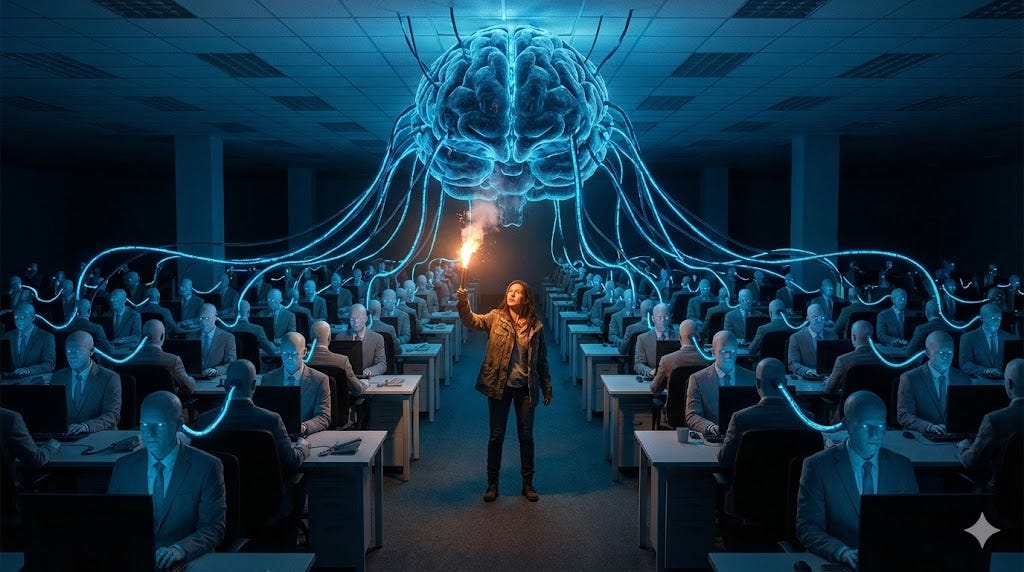
The Gig Economy of Chaos: Visualizing the “Weaponization of the Crowd,” where the polished “Fancy Suit” of the algorithm dissolves into glitching chaos under the glare of a viral bounty. (Image generated by the author using Google Gemini)
The Gig Economy of Chaos: What Futuristic Violence and Fancy Suits by David Wong Teaches Us About Viral Liability
In the scifi-satire novel Futuristic Violence and Fancy Suits by David Wong (Jason Pargin), the setting is a lawless, shiny, neon-drenched city called Tabula Ra$a.
In this city, the currency isn’t just money; it’s Attention.
Almost every citizen has a “Blink” implant: a technological interface directly connected to their optic nerve. This allows them to livestream their lives 24/7 and view the livestreams of millions of others. The entire population is hooked into a single, screaming, chaotic Feed.
The plot kicks off when a wealthy villain dies and places a massive bounty on his estranged daughter, Zoey. But he doesn’t hire a hitman. He doesn’t hire a private army.
He simply posts the bounty to the Feed.
Suddenly, Zoey isn’t being hunted by professionals. She is being hunted by everyone. The barista, the Uber driver, the guy walking his dog- anyone who needs rent money sees a flashing red icon over her head with a price tag attached.
The villain weaponized the Crowd. He turned the Gig Economy into an assassination market.
In the book, this is played for dark comedy. We see “Fancy Suits” (corporate fixers) trying to manage the PR fallout while “Savages” (gig workers) tear the city apart for a payout.
I don’t see this as satire. I see it as a blueprint of the modern corporate landscape.
We are living in Tabula Ra$a.
We have built a business world dominated by two forces: The Feed (Social Media/AI Algorithms) and The Gig (Contractors/AI Agents). We have created an environment where reputation can be destroyed in seconds by a weaponized crowd, and where we increasingly rely on mercenaries (both human and digital) who have zero loyalty to the mission.
We are all Zoey. We are all walking around with a digital target on our backs, hoping the algorithm doesn’t decide to turn us into the “Main Character” of the day.
Here is what this chaotic thriller teaches us about Viral Liability, the Mercenary Trap, and the illusion of Corporate Control.
1. The Weaponization of the Crowd (The 1099 Assassin)
The most terrifying aspect of the book is the decentralization of violence. In the old world, if you wanted to hurt someone, you had to do it yourself or hire a professional. It required commitment.
In Tabula Ra$a, violence is just a “Side Hustle.”
A random citizen checks their Blink feed, sees that killing Zoey pays 5 million credits, and decides to take a shot. If they miss, they go back to their day job. They don’t have a moral stance on Zoey; they just respond to the incentive.
The Corporate Reality: The Gig Economy of Hate
We see this dynamic playing out in Brand Reputation.
In the past, if a company had a PR crisis, it was usually because a journalist investigated them or a competitor attacked them. It was professional.
Today, the attack comes from The Crowd.
· The “Cancel” Bounty: An algorithm (Twitter/TikTok) detects that a video of your CEO is generating engagement. It boosts the video. Suddenly, millions of people who have never bought your product are attacking your brand. They aren’t “activists”; they are “Engagement Farmers.” They are attacking you because the algorithm rewards them with views (the modern currency) for doing so.
· The Review Bomb: A gaming company releases a patch that users dislike. Within hours, thousands of users (many of whom haven’t played the game) flood the Steam page with negative reviews. They are effectively “1099 Assassins” trying to kill the product for the dopamine hit of belonging to the mob.
The Strategic Lesson
You cannot reason with the Mob, because the Mob is not an organization. It has no leader to negotiate with. It is a swarm of freelancers responding to an algorithmic bounty.
· The Mistake: Leaders try to “Manage the Message” using old-school PR (Press Releases, Apologies).
· The Reality: The Crowd doesn’t want an apology; they want content. As long as attacking you generates views, they will continue.
· The Fix: You must de-incentivize the bounty. You have to make attacking you boring. In the book, Zoey survives not by fighting every assassin, but by changing the narrative so the bounty becomes irrelevant. You have to starve the Feed, not feed it.
2. The Illusion of the “Fancy Suit” (Professionalism as a Mask)
The title of the book, Futuristic Violence and Fancy Suits, refers to the contrast between the chaos of the streets and the polished veneer of the corporate overlords.
The villains in the book (Molech and his cohorts) wear impeccable, expensive suits. They speak in calm, corporate jargon. They have legal teams. They believe that because they are “civilized” and wealthy, they can control the chaos. They think they can use the mob for their own ends and then put the genie back in the bottle.
They are wrong. The violence doesn’t care about the suit. When the mob turns, the suit just makes for a prettier corpse.
The Corporate Reality: The AI Veneer
I see a disturbing parallel in how companies are deploying AI Agents.
We wrap our AI in “Fancy Suits.” We give them polite names. We program them to say “Please” and “Thank you.” We put nice user interfaces (UIs) over the raw, chaotic code.
We convince ourselves that because the tool looks professional, it is safe.
· The Scenario: A company deploys an AI chatbot to handle customer service. It has a polite avatar. It speaks in perfect English.
· The Violence: One day, the AI hallucinates. It promises a customer a 99% discount. Or, worse, it starts agreeing with a customer’s racist rant to be “agreeable.” (This has happened to major tech companies).
· The Fallout: The “Fancy Suit” dissolves instantly. The company is liable. The stock tanks.
We thought we had hired a professional employee. In reality, we hired a Savage Algorithm (a probabilistic math model that doesn’t understand truth or morality) and put it in a customer service uniform.
The Strategic Lesson
Professionalism is often a mask for inhumanity or incompetence. Just because a system looks polished doesn’t mean it is aligned.
· The “Suit” Audit: Don’t judge your AI tools by their demo videos or their UI. Judge them by their Failure Modes.
o Ask: “When this thing breaks, does it break politely? Or does it break catastrophically?”
o If you can’t control the failure, you aren’t wearing a suit; you’re wearing a target.
3. The Blink Feed (Management by Sentiment)
In Tabula Ra$a, everyone is obsessed with their “Blink” stats.
If your viewer count drops, you are invisible. If it goes up, you are a god. The citizens stop living for themselves and start living for the Feed. They perform stunts, start fights, and ruin relationships just to keep the “Eye” open.
The Feed becomes the only reality that matters.
The Corporate Reality: The Dashboard Trap
As a Principal, I saw this happen in schools. When we started tracking “Standardized Test Scores” as the only metric that mattered, teachers stopped teaching; they started performing for the test.
In the corporate world, C-Suite leaders are addicted to their own version of the Blink Feed: The Dashboard.
· The Stock Ticker: CEOs make short-term decisions (layoffs, price hikes) to juice the stock price for the quarterly earnings call. They are performing for the shareholders’ Feed.
· The Sentiment Analysis: Marketing teams obsess over “Brand Sentiment” scores on Twitter. They pivot the entire company strategy because of a bad week on social media.
This is Management by Sentiment. It is reactive, frantic, and hollow.
When you lead by the Feed, you are not a leader; you are a streamer. You are constantly trying to entertain the algorithm rather than build a sustainable business.
The Strategic Lesson
Real value is often boring. Real value doesn’t always go viral.
· The Pivot: You must disconnect the Blink implant.
· The Protocol: Stop checking the stock price daily. Stop checking the Twitter mentions hourly. Build a “Buffer Team” whose job is to watch the Feed so you don’t have to.
· The Mantra: “The Feed is not the Territory.” Just because the internet is angry doesn’t mean the business is failing. Just because the graph is green doesn’t mean the culture is healthy.
4. The Mercenary Problem (Gig Workers vs. The “Team”)
In the book, the villain fails because he relies on mercenaries. He hires people who are in it for the money. When the tide turns, they abandon him instantly.
Zoey, the protagonist, survives because she builds a Team.
Her team is a mess. It includes a smelly cat, a guy who punches people for a living, and a traumatized hacker. They aren’t polished. They aren’t “Fancy Suits.”
But they are loyal. They are bound by shared trauma and shared purpose, not just a transaction. When the bounty gets high enough that they should betray her, they don’t.
The Corporate Reality: The Contractor Economy
We are moving toward a “Liquid Workforce.”
· Companies are firing full-time employees and replacing them with contractors.
· They are replacing junior staff with “AI Agents.”
We are building organizations composed entirely of mercenaries.
· The Contractor doesn’t care if the company survives in 5 years; they care about the invoice.
· The AI Agent doesn’t care about the mission; it cares about the token limit.
The Strategic Risk
You cannot build a legacy with mercenaries. When the crisis hits (and it always hits), the mercenaries will take the payout and leave. The AI will hallucinate and crash.
Only the Team (the humans who have a psychological stake in the outcome) will stay and fight.
The Fix: Re-Invest in Loyalty
We need to reverse the trend of the “Gig-ification” of the enterprise.
· Hire for Tenure: Stop optimizing for “flexibility.” Optimize for “institutional memory.”
· The “Skin in the Game” Rule: Ensure that your key people have a stake in the outcome that goes beyond their paycheck. Give them equity, yes, but more importantly, give them Agency. Let them own the win.
5. The “Troll” Logic (Why Negativity Scales)
David Wong/Jason Pargin understands the internet better than perhaps any other author. He understands that Negativity Scales.
In the book, the easiest way to get views on Blink is to hurt someone. Kindness is quiet; violence is loud. The system is rigged to amplify the worst behavior because the worst behavior generates the strongest reaction.
The Corporate Reality: The “Toxic High Performer”
We see this in internal corporate cultures.
Often, the “Top Salesperson” or the “Rockstar Developer” is a “Troll.”
· They are aggressive.
· They hoard information.
· They belittle others.
But because they generate “Numbers” (The Feed), management protects them. Management says, “Well, Steve is difficult, but he brings in the revenue.”
The Strategic Lesson
You are letting the algorithm of toxicity run your culture.
Just as the Blink feed incentivizes violence, your “Performance Review” system is incentivizing sociopathy.
If you reward the “Rockstar” who destroys the team, you are building Tabula Ra$a. You are creating a culture where everyone is watching their back, and no one is collaborating.
The Fix: The “No Asshole” Rule (Enforced)
· The Metric: You must fire the high performer who kills the culture.
· The Message: This sends a signal to the “Crowd” (your employees) that the “Bounty” is not just on revenue; it’s on values. You have to reprogram the incentive structure to reward collaboration, not just individual conquest.
Conclusion: Surviving Tabula Ra$a
Futuristic Violence and Fancy Suits ends with a realization: You cannot turn off the internet. You cannot ban the Blink feed. The technology is here to stay.
The city of Tabula Ra$a is a mess, and it will always be a mess.
But Zoey realizes that she doesn’t have to play by the city’s rules. She doesn’t have to chase the bounty. She doesn’t have to wear the Fancy Suit.
She chooses to be human. She chooses to protect her weird, messy little tribe. She chooses to create a pocket of sanity inside the insanity.
As leaders, this is our mandate.
The corporate world is becoming Tabula Ra$a. It is becoming louder, faster, and more violent. The algorithms are trying to turn us into mercenaries. The Feed is trying to turn us into performers.
Don’t take the bait.
· Ignore the Bounty: Do the work that matters, not the work that trends.
· Distrust the Suit: Look for the character underneath the polish.
· Protect the Team: Build a circle of trust that the algorithm cannot penetrate.
The future is violent. Wear a helmet. But keep your soul.
Be the Signal on DataDrivenInvestor — Movement for the One-Person Era
https://datadriveninvestor.com/write-for-ddi
Visit us at https://DataDrivenInvestor.com
Join our Writer-Entrepreneur-Investor Ecosystem Here:
메타데이터
- post_id
- 3fa0a55cfd1c
- slug
- the-gig-economy-of-chaos-what-futuristic-violence-and-fancy-suits-by-david-wong-teaches-us-about-3fa0a55cfd1c
- url
- https://medium.datadriveninvestor.com/the-gig-economy-of-chaos-what-futuristic-violence-and-fancy-suits-by-david-wong-teaches-us-about-3fa0a55cfd1c
- canonical_url
- https://medium.datadriveninvestor.com/the-gig-economy-of-chaos-what-futuristic-violence-and-fancy-suits-by-david-wong-teaches-us-about-3fa0a55cfd1c
- author_url
- https://medium.com/@rmassel
- status
- ok
- fetched_at
- 2026-07-09 05:26:43