The Drift and Kelp DAO Hacks: What Went Wrong?
April 2026 marked a turning point for DeFi security. Within roughly three weeks, two major protocols, Drift and Kelp DAO, were hit by…
The Drift and Kelp DAO Hacks: What Went Wrong?

Source: AI-generated
April 2026 marked a turning point for DeFi security. Within roughly three weeks, two major protocols, Drift and Kelp DAO, were hit by large-scale exploits, resulting in combined losses approaching half a billion dollars.
What made these incidents stand out was not just the scale of the funds lost, but the nature of the attacks themselves. These were not opportunistic drains or simple smart contract bugs. Instead, they reflected meticulous, long-term planning, deep familiarity with the ecosystem, and a clear focus on something more fundamental than code: the infrastructure that moves and verifies value across decentralized systems.
The Shift in Attack Surface
Traditionally, DeFi exploits were associated with logic errors, missing checks, or flawed pricing assumptions. That model is still relevant, but it is no longer sufficient.
A clear pattern is emerging: attackers are increasingly targeting the infrastructure surrounding protocols rather than the protocols themselves.
This includes:
- Governance workflows and admin controls
- Signer coordination(multisig)
- Cross-chain messaging systems(like LayerZero)
- Oracle pricing infrastructure
In other words, the attack surface has expanded from code to coordination. A protocol can have perfectly audited smart contracts and still fail if the systems feeding it data or approving its actions are compromised. Both the Drift and Kelp DAO incidents sit directly within this evolution.
The Drift Exploit
When news first broke that Drift had been exploited on April 1, 2026, many users initially thought it was an April Fool’s joke. The uncertainty disappeared quickly after Drift confirmed that unauthorized activity had been detected. What followed became the largest DeFi hack of 2026 and the second-largest security incident in Solana’s history (behind only the $326 million Wormhole bridge hack in 2022).
This was not a traditional smart contract exploit. The protocol’s code was not “broken.” Instead, the attack targeted the operational and governance layers.
How the Attack Worked (The Timeline)
Months of Planning (Fall 2025–March 2026): The attackers spent months preparing. Posing as a quantitative trading firm, we gradually built relationships with Drift contributors across conferences (Messari Mainnet, Token2049), Telegram chats, and strategy sessions. They even deposited over $1 million of real capital into the protocol to build trust.
Fake Token (March 12, 2026): The attacker created a fake token called CarbonVote Token (CVT). They seeded a liquidity pool with just $500 of real value and used wash trading, trading back and forth between their own wallets to fake real activity, to create an artificial price of $1. The attacker controlled 80% of the supply, so oracles picked up this fake price and treated CVT as legitimate.
The “Durable Nonce” Trap (March 23–30): Solana has a feature called “durable nonces” that allows transactions to be signed in advance and executed later. The attacker tricked Drift’s Security Council members into pre-signing transactions that looked routine with hidden authorizations. Critically, on March 27, Drift migrated to a new 2/5 multisig with a zero timelock, eliminating the delay window that could have stopped the attack.
The Drain (April 1, 16:05 UTC): The attacker triggered the pre-signed transactions, gaining admin control. They whitelisted CVT as valid collateral, removed withdrawal limits, and deposited 500 million CVT. Within roughly 12 minutes (across 31 transactions), they drained $285 million in real assets, including 159 million in JLP, $71.4 million in USDC, and millions in SOL and BTC.

Source: Africa’s Blockchain Club
Community and Social Response
Drift’s social media activity told part of the story before the hack even happened. On March 19th, co-founder Cindy Leow publicly warned that someone was impersonating her on Telegram, an early sign of the social engineering operation.
On March 27th, Drift published a post calling itself the best perpetual trading platform on Solana. Days later, that claim would prove premature.
On April 1st, the protocol posted that it was observing unusual activity, explicitly noting “This is not an April Fools joke.”

Source: X
By April 2nd, a detailed thread confirmed the hack. When Cindy Leow reposted that Ondo Finance had frozen some of the stolen funds, one community member pointed out the irony: centralized mechanisms were receiving credit for recovering funds lost through a decentralized protocol.
The Fallout & The “No Apology” Backlash
The community reaction was mixed. Critics pointed out that no formal apology had been issued. Frustration mounted when it emerged that a team member had publicly admired the technical execution of the hack, leading many to question the protocol’s empathy toward victims.

Source: X
The Recovery Plan
Despite the mixed sentiment, Drift moved forward. On May 5, 2026, the protocol announced a structured plan to make affected users whole.
Every impacted wallet would receive a recovery token, separate from the DRIFT governance token, representing $1 of verified loss per token. These tokens give holders a claim on a recovery pool funded from three sources: exchange revenue, a Tether commitment of up to $127.5 million, and an additional $20 million from strategic partners. The protocol’s remaining assets, roughly $3.8 million, will also be added to the pool. Once the total pool passes $5 million, redemptions can begin.

Source: Africa’s Blockchain Club
Drift also launched a 10% bounty program for anyone who helps recover stolen assets. For the relaunch, Drift committed to removing durable nonces entirely, implementing timelocks on all sensitive admin actions, and migrating from USDC to USDT as its primary settlement stablecoin.
The Drift incident exposed a harsh reality: the largest risks are no longer just coding errors. Governance structures, signer security, and the human layer matter just as much. As Ledger’s CTO noted, this was a “patient, sophisticated supply-chain-level compromise targeting the human and operational layer.”
Before the ecosystem had fully processed what happened to Drift, a second incident emerged, one that would push total losses even higher and shift the conversation from Solana to cross-chain infrastructure.
The Kelp DAO Exploit
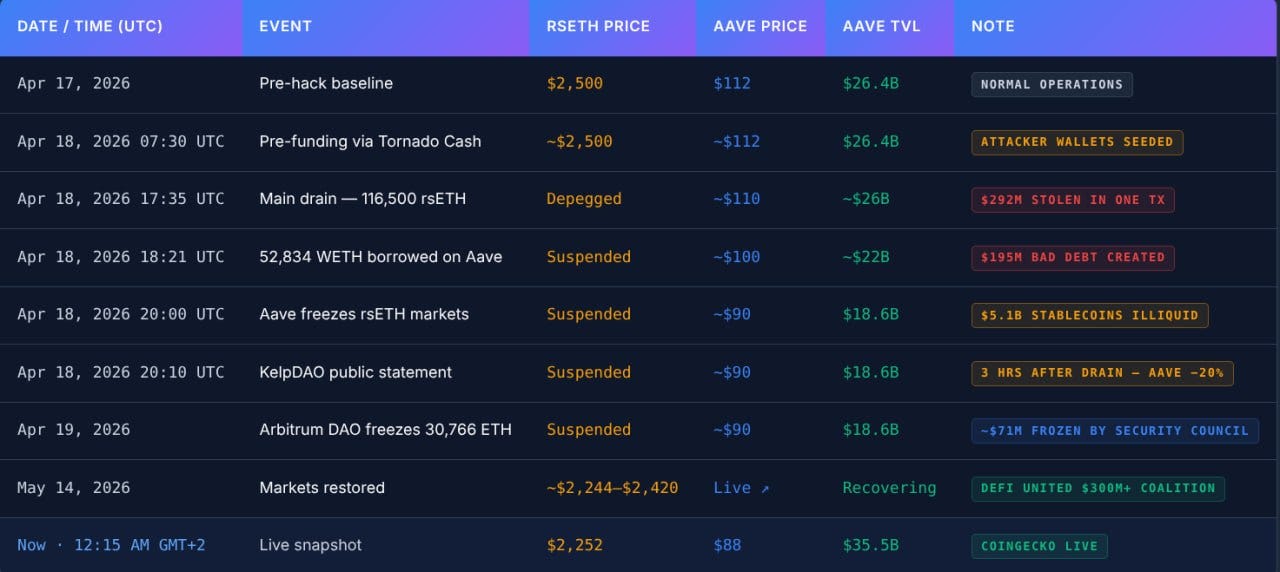
On April 18, 2026, at 17:35 UTC, attackers drained approximately 116,500 rsETH from Kelp DAO’s LayerZero-powered bridge, resulting in losses of roughly $292 million, making it the largest DeFi exploit of 2026, overtaking Drift by a small margin.
Source: Africa’s Blockchain Club
Like Drift, this was not a smart contract bug. There was no reentrancy attack, no missing access check, no price oracle manipulation of the traditional kind. Instead, the attack targeted the off-chain verification infrastructure that Kelp DAO used to move its liquid restaking token across more than 20 different blockchain networks.
The stolen funds were immediately routed into lending markets on Ethereum and Arbitrum, creating indirect exposure for major protocols including Aave, Compound, and Euler. Within hours, emergency freezes were triggered, and a broader debate about how cross-chain verification systems should be built.
How the Attack Worked
To move rsETH between chains, Kelp DAO relied on LayerZero. On LayerZero, every cross-chain message must be verified by one or more Decentralized Verifier Networks (DVNs) before the destination chain will act on it. Kelp DAO’s rsETH was configured with a single verifier (a 1-of-1 setup): the LayerZero Labs DVN. No second DVN had to agree.

Source: Africa’s Blockchain Club
The attackers exploited exactly that weak point. They did not break into Kelp DAO’s contracts or directly compromise LayerZero’s protocol. They went after the RPC nodes that the DVN used to read what was happening on the source chain.
The attack happened in three steps:
- Compromising Internal Nodes: The attackers obtained the list of RPCs the DVN was querying, gained access to two independent internal nodes hosted by LayerZero Labs, and swapped out the software running on them. The modified nodes sent fake data to the DVN while still sending correct data to other systems, including LayerZero’s own monitoring service.
- DDoS Attack: The attackers launched a Distributed Denial of Service attack against external RPC nodes that the DVN relied on. With those external paths blocked, the DVN failed over to the only nodes it could still reach: the two internal nodes controlled by the attackers.
- Forged Message Execution: The poisoned internal nodes reported blocks showing rsETH being burned on the source chain (Unichain) when no such burn had occurred. The DVN, reading only from those nodes, approved the cross-chain message as valid. Based on that false approval, the Ethereum-side contract released 116,500 rsETH to the attacker.
Kelp DAO noticed the anomaly and paused the relevant contracts 46 minutes later, at 18:21 UTC. That action blocked two follow-up attempts where the attacker tried to drain an additional 40,000 rsETH (approximately $95 million).
Community and Social Response
The Kelp DAO community first learned of the exploit not through an official announcement, but from a community member in the protocol’s Telegram group on the evening of April 18th. The news arrived with no context, just a message asking whether Kelp had just lost $280 million.

Source: Kelp DAO’s Telegram
The reaction was shock and confusion, but not immediate panic. Users asked practical questions: Are depositors affected? Is it safe to withdraw? What should we do? One of the most striking messages came from a user who said they held “basically life savings” in agETH and asked what percentage of losses to expect. It was a reminder that behind the on-chain numbers were real people with real financial exposure.

Source: Kelp DAO’s Telegram
Constructive conversations also emerged alongside the fear. Some community members began discussing legal implications, responsibility, and how losses might be allocated. Others focused specifically on LayerZero and Aave, given both protocols’ direct involvement in the fallout.
On the administrative side, the response was slow to materialize. The first acknowledgment from an admin came approximately three hours after the exploit, at around 20:45 UTC. Crucially, community administrators were not informed by the core team in advance; they learned about the attack alongside everyone else, revealing a gap in internal communication. Early admin responses were broadly formulaic, directing users to wait for updates on X, which added to the sense of unease. However, when specific questions were raised, admins did engage directly, and updates were shared promptly as they became available.
Sentiment started to shift on April 21st, when news broke that the Arbitrum Security Council had frozen approximately 30,766 ETH (roughly $71 million) of the attacker’s funds. The prospect of recovery provided a degree of reassurance, and activity in the Telegram channel started to decline from around April 24th, with conversations shifting toward monitoring for official updates rather than active speculation. On May 12th, an admin confirmed what the community had been waiting for: rsETH would be refilled, and withdrawals, along with other operations, would resume.

Source: Kelp DAO’s Telegram
Recovery Efforts
After draining the rsETH, the attacker used the assets as collateral on Aave, Compound, and Euler, borrowing an estimated $236 million in WETH and wstETH. This meant the impact extended far beyond the initial theft, forcing emergency risk responses, including freezes and parameter adjustments to prevent a cascade of liquidations.
On May 7, 2026, Aave completed the liquidation of the attacker’s remaining rsETH-backed positions. The recovered assets were moved to a multisig called the Recovery Guardian, operated by DeFi United, a coordinated recovery effort to hold and eventually redistribute recovered funds to victims.
While this did not restore the stolen rsETH itself, it significantly reduced systemic risk by closing leveraged positions that could have made losses worse in volatile conditions. It also showed a broader shift in how DeFi responds to incidents: combining protocol-level freezes, forced deleveraging, and coordinated recovery treasuries rather than just tracing funds after the fact.
Arbitrum’s Unusual Intervention
On April 21 at 23:26 UTC, the Arbitrum Security Council, a 12-member multisig wallet, voted 9-of-12 to recover the 30,766 ETH. The method was highly unusual: the Council temporarily upgraded the L1 Delayed Inbox (the bridge contract handling all Ethereum-to-Arbitrum messages), added a function that could send cross-chain messages on behalf of any address without its private key, forged a message in the attacker’s name transferring the ETH to a protocol-controlled address, and then reverted the contract to its original state.
This was a major departure from the idea that blockchains are immutable and execution-only. It showed that some Layer-2 systems have governance-based recovery powers built into their infrastructure, allowing asset seizure after the fact with coordinated approval.
While controversial, the action significantly improved recovery prospects. However, it also raised an important question: Arbitrum is classified as a Stage 1 rollup by L2Beat, meaning the Security Council still had unilateral upgrade authority. No major rollup has reached Stage 2 yet, the level that would remove that capability. The freeze mechanism used here is exactly what Stage 2 is designed to eliminate.
The Dispute Over Responsibility
As investigations continued, the exploit became less about a single failure and more about who was to blame: Kelp DAO or LayerZero.
Kelp DAO said the problem was a weakness in LayerZero’s verification architecture, specifically the 1-of-1 DVN setup. According to Kelp, attackers were able to compromise the RPC infrastructure feeding the verifier network, forcing it to rely on fake data. Kelp also claimed that LayerZero staff had approved the 1-of-1 setup over 2.5 years and eight integration discussions without ever warning that it was a security risk.
LayerZero pushed back. The company said the exploit came from application-level configuration choices, not a protocol flaw. It emphasized that multi-verifier setups were the intended security standard. After the hack, LayerZero announced it would no longer sign messages for any application using a 1-of-1 DVN configuration, a policy change that only took effect after the damage was done
The disagreement highlighted a fuzzy line in DeFi: where does protocol responsibility end, and application-level risk begin? According to Dune Analytics data, 47% of roughly 2,665 active LayerZero OApp contracts ran a 1-of-1 DVN configuration in the 90 days before the hack, with more than $4.5 billion in market value exposed to the same risk.
Migration to Chainlink CCIP
One of the biggest consequences of the Kelp DAO exploit was a rapid move away from single-verifier cross-chain systems toward Chainlink’s Cross-Chain Interoperability Protocol (CCIP).
Kelp DAO announced it would rebuild rsETH’s cross-chain system on CCIP, citing the need for stronger verification and multi-party validation. Unlike the old setup that relied on a single DVN, CCIP spreads verification across multiple independent oracle and validator networks.
Following the exploit, multiple protocols began reassessing their cross-chain infrastructure, extending the migration trend beyond Kelp DAO itself:
- Solv Protocol (a Bitcoin DeFi platform) said it would move to Chainlink CCIP and replace its LayerZero bridges after an “extensive security review” found that CCIP offered the strongest security.
- Tydro (a liquidity protocol) also moved to Chainlink after its previous oracle provider had an incident that forced market pauses.
- Several other DeFi protocols have started discussions about moving to Chainlink, with a Chainlink Labs lead calling the exploit a “wake-up call” for the industry.
Chainlink is already the largest oracle provider with a 58% market share and more than $32 billion in value secured, according to DefiLlama. Chronicle ranks second with $7.6 billion, and RedStone is fourth with $3.7 billion.
However, this shift also introduces new risks. Marcin Kazmierczak, co-founder of RedStone, noted that “a smaller set of trusted oracles is forming in the market.” Nik Kunkel, founder of Chronicle, warned that overreliance on a single infrastructure provider can introduce additional systemic risk.
Market Impact
The financial fallout from Kelp DAO extended far beyond the protocol itself. DeFi’s TVL fell by roughly $13 billion within 48 hours, from approximately $99.5 billion to $86.3 billion. Aave took the biggest hit, losing roughly $8.45 billion over two days and losing its position as the largest DeFi protocol by deposits.
Two possible paths for handling the losses emerged:
- Scenario 1: All rsETH tokens across every chain take an approximately 15.12% haircut. Total bad debt across Aave V3 would be around $123.7 million, mostly on the Ethereum mainnet.
- Scenario 2: Mainnet rsETH keeps full value (as it’s backed by Kelp’s actual ETH staking deposits, not the bridge), while rsETH on L2 networks drops to 26.46% of its pre-exploit value. Total bad debt would be about $230.1 million, all on L2s. Mantle would face a 71.45% WETH shortfall and Arbitrum a 26.67% shortfall.
The Arbitrum Security Council’s freeze of $71 million changed math. If that money goes toward rsETH recovery, it could cover roughly 30% of the L2 shortfall. However, that requires Arbitrum governance to allocate the funds specifically to rsETH holders rather than other possible claimants.
Conclusion
Two protocols. Two different blockchains. Two different attack methods, same story.
At Drift, the attackers didn’t break the code. They convinced the right people to sign the wrong transactions. At Kelp DAO, the attackers didn’t break the bridge. They poisoned the data that the bridge trusted to do its job.
In both cases, the smart contracts worked perfectly. The failures happened elsewhere, in governance, in verification, in the assumptions that connect one system to another. In April 2026, the cost of DeFi was half a billion dollars. That number is only the price of the lesson. The real question is whether the industry is ready to learn it.
Audits alone won’t stop the next attack, nor will better firewalls or faster incident response. The attackers have moved up the stack. Security needs to move with them into the systems that govern, verify, and move value across chains.
Acknowledgements
This article was prepared by the **Africa’s Blockchain Club’s Research Team: [Sandile M’remi](https://www.linkedin.com/in/sandile-m-remi/), [Sandile Siwundla](https://www.linkedin.com/in/sandile-siwundla-51b0b5307/), [Singa Nxumalo](https://www.linkedin.com/in/singa-nxumalo-43a57a1b2/), [Yankho Saliji](https://www.linkedin.com/in/yankho-chantel-maria-saliji/) and Kenneth Matea. Special thanks to [Karabo Kayak](https://www.linkedin.com/in/karabo-kayak-9aab7653/) **for the contributions and guidance.
메타데이터
- post_id
- 3fbece2d09aa
- slug
- the-drift-and-kelp-dao-hacks-what-went-wrong-3fbece2d09aa
- url
- https://medium.com/@africablockchainclub/the-drift-and-kelp-dao-hacks-what-went-wrong-3fbece2d09aa
- canonical_url
- https://medium.com/@africablockchainclub/the-drift-and-kelp-dao-hacks-what-went-wrong-3fbece2d09aa
- author_url
- https://medium.com/@africablockchainclub
- status
- ok
- fetched_at
- 2026-06-23 06:34:20




