Trade and Compliance: Two Sides of the Same Coin
Trade and Compliance are often viewed as opposing forces.

Trade and Compliance: Two Sides of the Same Coin
Trade and Compliance are often viewed as opposing forces.
I see them differently.
Trade and Compliance are two sides of the same coin.
Without effective compliance frameworks, sustainable trade cannot exist. At the same time, without supporting business and facilitating legitimate trade, compliance loses its true purpose.
The real challenge for financial institutions today is not choosing between business growth and regulatory expectations. It is building systems, controls, and processes where compliance actively enables business.
In Trade Finance, this balance becomes even more critical.
A well-designed compliance framework should: • Support faster and informed decision-making • Enable legitimate customer activity • Identify and mitigate financial crime risks • Reduce unnecessary operational friction • Strengthen trust between banks, customers, and regulators
Over the years, I have come to believe that effective Trade Compliance is not driven by a single control, system, or regulation.
It is shaped by multiple interconnected elements working together.
In my experience, there are four key factors that significantly influence the modern compliance landscape.
1. Institutional Knowledge
Banks have accumulated enormous amounts of transactional, customer, and behavioral data over decades. This historical intelligence is one of the strongest foundations of any compliance framework.
Traditionally, financial institutions relied on rule-based systems, robotics, and automated controls to process this information and identify risks. These systems formed the backbone of compliance operations for many years.
The value of this institutional knowledge remains extremely powerful because it reflects years of customer behavior, transaction patterns, trade flows, and operational experience.
2. External Intelligence and Data Aggregation
The second factor is the growing ecosystem of external intelligence providers and data aggregators.
Today’s compliance environment depends heavily on external data sources, including: • Shipping and vessel intelligence • Trade and logistics data • KYC and corporate ownership databases • Sanctions and watchlist information • Adverse media and public intelligence sources
These external datasets have become critical in identifying hidden risks and improving transparency across increasingly complex global trade ecosystems.
However, data alone is not enough.
The real value comes from how institutions combine internal knowledge with external intelligence to create meaningful, risk-based decision-making frameworks.
3. Technology Innovation
The third factor influencing the compliance ecosystem is technology innovation itself.
On one side, global technology companies such as Google and Microsoft continue to drive advancements in artificial intelligence, cloud computing, machine learning, and large-scale data processing capabilities.
These innovations are fundamentally changing how information can be analyzed, connected, and interpreted.
On the other side, there is a rapidly evolving ecosystem of compliance and RegTech vendors attempting to bring everything together.
These vendors are trying to connect the three critical pillars: • Institutional knowledge and internal banking data • External intelligence and data aggregators • Emerging technologies such as AI and machine learning
The objective is no longer just screening or monitoring transactions.
The real focus is creating integrated ecosystems that can intelligently connect data points, identify hidden risks, improve decision-making, and support business activity in a more efficient and risk-sensitive manner.
4. Business and Operational Reality
While banks, financial institutions, technology companies, and RegTech providers continue to invest heavily in data, systems, and innovation, the real foundation of compliance still lies with the business and operational processes that depend on this information every day.
At the center of all this complexity is the end user: The business teams, operations staff, compliance professionals, and customers who rely on accurate, timely, and meaningful information to make decisions.
This is why the future is not simply about having more data or more technology.
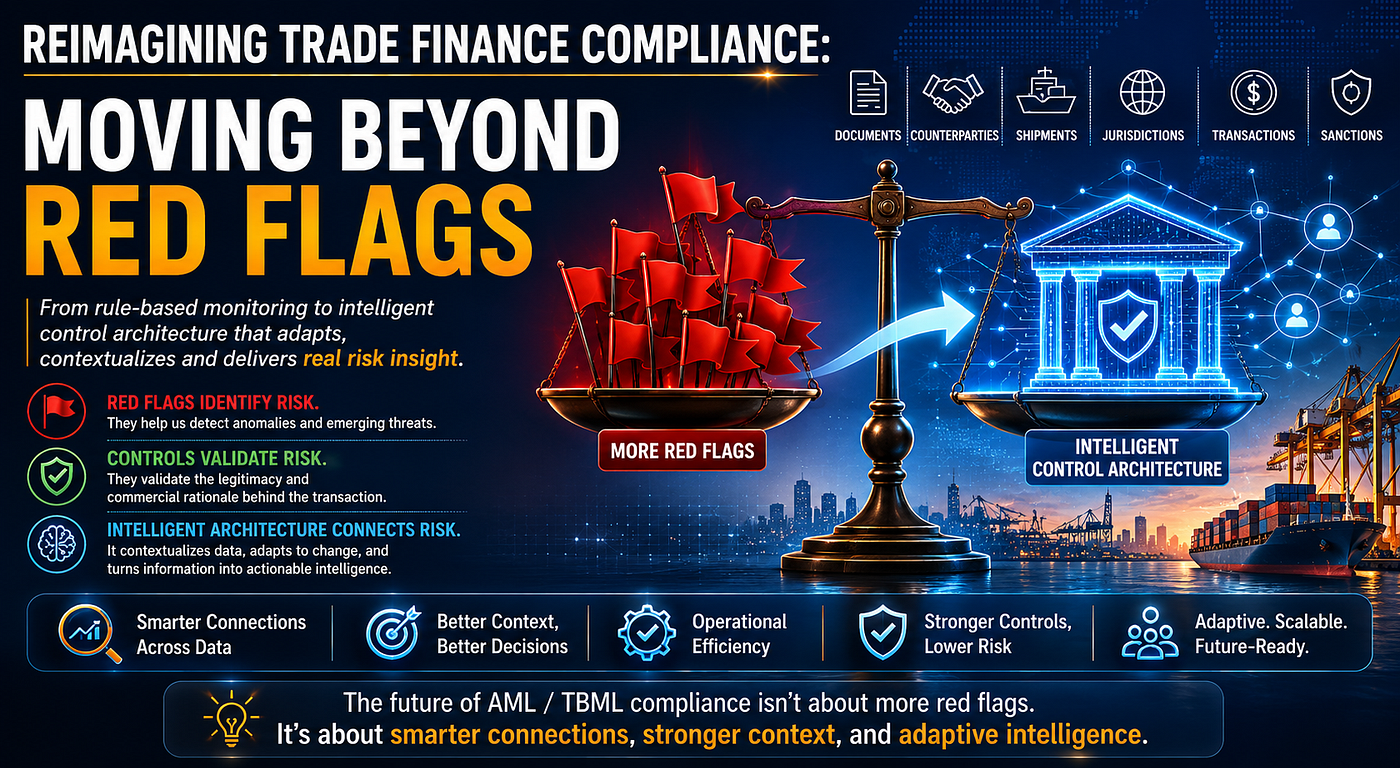
The future lies in building frameworks that can effectively connect: • Institutional knowledge • External intelligence and data providers • Emerging technologies and AI capabilities • Operational and business realities
Technology must evolve beyond standalone tools and fragmented controls.
It should integrate seamlessly into business processes, support decision-making, reduce friction, and enable institutions to manage risk without unnecessarily slowing legitimate trade and customer activity.
In many ways, the challenge ahead is not technological alone.
It is about creating ecosystems where compliance, business, operations, and technology work together with a shared objective: Facilitating responsible and sustainable trade in an increasingly complex global environment.
The most effective compliance models are not the ones that simply block risk.
They are the ones that understand business deeply enough to manage risk intelligently.
The next phase of Trade Finance will not be defined solely by more data, more controls, or more technology.
It will be defined by intelligent interoperability — the ability to seamlessly connect institutional knowledge, external intelligence, advanced technologies, operational realities, and human expertise into a unified ecosystem.
The banks and institutions that understand this shift will move beyond traditional compliance models. They will build frameworks where compliance does not act as a barrier to trade, but as an enabler of sustainable global commerce.
In an increasingly interconnected and complex world, the future will belong to organizations that can combine intelligence, technology, and business understanding to make faster, smarter, and more risk-aware decisions.
Those institutions will not only manage risk better. They will help shape the future of global trade itself.
메타데이터
- post_id
- 3fcfbbaabb08
- slug
- trade-and-compliance-two-sides-of-the-same-coin-3fcfbbaabb08
- url
- https://medium.com/@jinesh.kutty/trade-and-compliance-two-sides-of-the-same-coin-3fcfbbaabb08
- canonical_url
- https://medium.com/@jinesh.kutty/trade-and-compliance-two-sides-of-the-same-coin-3fcfbbaabb08
- author_url
- https://medium.com/@jinesh.kutty
- status
- ok
- fetched_at
- 2026-06-09 15:37:30