The Complete Agentic AI for Quality Engineering Series:
From Playwright Framework Architect to Agentic QE Architect

The Complete Agentic AI for Quality Engineering Series:
From Playwright Framework Architect to Agentic QE Architect
The next evolution of Quality Engineering is not more automation. It is teaching AI how to think like a QE engineer.
A few years ago, the biggest challenge for Quality Engineering teams was automation adoption.
Organizations were trying to answer questions like:
- How do we move from manual testing to automation?
- Which tool should we choose?
- How do we build scalable frameworks?
- How do we integrate testing into CI/CD?
Today, most mature engineering organizations already have answers to those questions.
They have automation frameworks.
They have CI/CD pipelines.
They have reporting systems.
They have test management processes.
Yet many teams are discovering a new problem.
Despite years of automation investment, Quality Engineering is still heavily dependent on human effort.
Someone still needs to:
- Analyze failures
- Review tests
- Create bug reports
- Generate test cases
- Investigate flaky tests
- Prepare release readiness reports
- Perform root cause analysis
- Coordinate across tools and teams
The amount of work has changed. The nature of the work has changed. But the dependency on humans remains.
This is where Agentic AI enters the picture.
Not as a replacement for Quality Engineers. Not as a replacement for automation. But as a new engineering layer that sits on top of everything we have already built.
The Shift That Most Engineers Haven’t Fully Seen Yet
Most discussions about AI in testing focus on prompts.
Examples like:
“Generate test cases for this feature.”
or
“Write a Playwright test for this user story.”
These are useful.
But they are only the first step.
The real transformation begins when AI stops being something you ask questions to and starts becoming something that can participate in engineering workflows.
Imagine an AI system that can:
- Read a failed Playwright report
- Analyze screenshots and logs
- Identify probable root causes
- Create a Jira defect
- Notify the correct team
- Draft an RCA document
- Suggest potential fixes
Without requiring someone to manually orchestrate every step.
That is not a chatbot.That is an engineering system. And building those systems requires a completely different way of thinking.
Why I Created This Series
Over the past several years, I have spent a significant part of my career building and scaling Quality Engineering solutions.
That journey included:
- Test automation frameworks
- Enterprise-scale automation programs
- Playwright and TypeScript frameworks
- CI/CD integration
- Quality engineering strategy
- Team leadership and transformation initiatives
Recently, I began exploring the rapidly evolving world of Agentic AI.
At first, like many engineers, I focused on tools. Then on prompts. Then on AI-assisted development. But eventually I realized something much bigger.
The future is not about using AI to generate code.
The future is about designing systems where AI becomes an active participant in engineering workflows.
And when viewed through that lens, many familiar QE concepts suddenly become extremely relevant again.
Concepts like:
- Architecture
- Reusability
- Validation
- Reliability
- Error handling
- Workflow design
- Governance
The same principles that make great automation frameworks also make great AI systems.
This series exists to bridge those two worlds.
The Journey We Are Going To Take
Most AI content teaches isolated topics.
You will find articles about:
- Prompt engineering
- Claude Skills
- MCP
- Agents
- AI frameworks
The problem is that these topics are usually taught independently.
Readers learn individual concepts but never understand how they fit together.
This series takes a different approach.
Instead of learning disconnected tools, we will build a complete mental model from the ground up.
Our journey will look like this:
QA Engineer
      ↓
Automation Engineer
      ↓
Framework Architect
      ↓
AI-Augmented QE
      ↓
Agentic QE Architect
And the path we take to get there looks like this:
Prompt
    ↓
Skill
    ↓
Tool
    ↓
Workflow
    ↓
Agent
    ↓
Worker
    ↓
Multi-Agent System
    ↓
Autonomous QE Platform
By the end of the series, every step in that progression will make sense.
What Makes This Series Different
The biggest problem with many AI tutorials is that they rely on toy examples.
Examples like:
- Weather applications
- To-do lists
- Recipe generators
- Basic chatbots
Those examples are useful for learning syntax.
They are terrible for understanding how AI systems operate in real engineering organizations.
Throughout this series we will use a real-world Playwright TypeScript automation framework as our implementation platform.
That framework has eight layers:
Config layer     → playwright.config.ts, environment configs, global setup
Fixture layer    → custom fixtures, test context, auth state
Page layer       → Page Object Models, component objects
Helper layer     → utilities, data factories, API helpers
Assertion layer  → custom expect matchers, assertion utilities
Reporting layer  → Allure reports, screenshots, traces
Database layer   → test data setup, DB validation, cleanup
Runtime layer    → CI config, parallelism, retry strategy
Every skill, agent, and workflow we build will reference these layers directly.
Instead of hypothetical examples, we will build solutions around actual Quality Engineering challenges.
Examples include:
- Test generation
- Test review
- Failure analysis
- Bug triage
- Root cause analysis
- Release readiness assessment
- Framework governance
- Test maintenance
Every concept we learn will be applied to something a QE team could realistically use.
What You Will Build
This is not a theory-only series.
By following the series, we will progressively build a collection of skills, workflows, agents, and enterprise patterns.
Some of the artifacts we will create include:
Skills
- Playwright Test Generator Skill
- AI Test Case Generation Skill
- Bug Triage Skill
- Root Cause Analysis Skill
- Test Review Skill
Agents
- Playwright Review Agent
- Failure Analysis Agent
- Test Maintenance Agent
- Release Readiness Agent
Enterprise Workflows
- Multi-Agent QE Systems
- Validation Pipelines
- Domain Intelligence Systems
- Organizational Context Models
Capstone
A complete Autonomous QE Platform that demonstrates how modern AI systems can participate in software quality workflows.
The Learning Roadmap
The series is divided into four major seasons.
Season 1 — Foundations (Articles 1–5)
We begin by building the mental model.
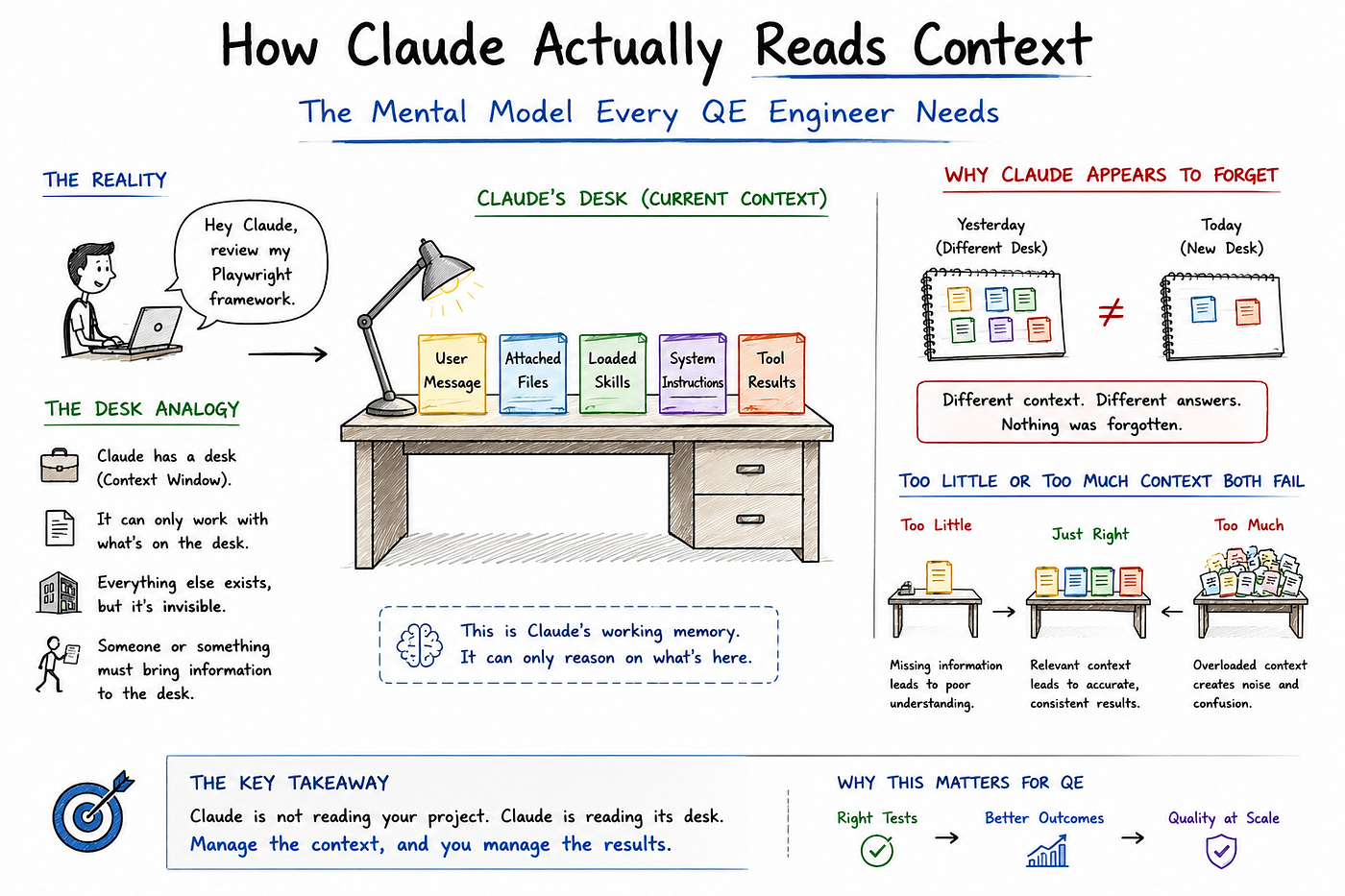
Why prompting alone is not enough and where it breaks down at scale. How Claude actually reads context, and why that changes how you design everything. The difference between prompts, skills, and agents — explained through a real QE scenario. Why tools without workflows produce noise instead of value. Progressive disclosure — the architectural principle behind every good skill.
This season has no code. It is entirely focused on understanding why things work the way they do. That foundation makes everything in Seasons 2, 3, and 4 significantly easier to learn.
Season 2 — Building Skills (Articles 6–11)
Next, we learn how to create reliable AI capabilities.
The complete anatomy of a skill — folder structure, references, examples, scripts. Trigger engineering — how to make skills activate exactly when they should. YAML frontmatter — the syntax that implements your trigger strategy. Writing effective SKILL.md files — instructions Claude will actually follow reliably. Error handling in skills — what happens when inputs are missing, tools fail, or outputs are wrong. Testing skills like a QE engineer — a complete skill test suite with trigger tests, output tests, and regression tests.
The last article in this season is the one most AI content never covers. You test software for a living. Now you apply that same discipline to your AI skills.
Season 3 — Playwright Agentic Journey (Articles 12–16)
This is where theory becomes practice. Using the Playwright framework, we build a chain of interconnected capabilities.
Each article produces an artifact that the next article uses as input.
Article 12 builds the test generator skill. Article 13 uses that skill to generate tests from a real user story. Article 14 reviews those generated tests against framework standards. Article 15 analyzes failures from those tests using traces, screenshots, and logs. Article 16 builds the maintenance agent that acts on those failure analyses automatically.
By the end of this season, we have a working end-to-end AI workflow built entirely on top of the Playwright framework.
Season 4 — Enterprise Agentic QE (Articles 17–22)
Finally, we move beyond individual skills and agents.
MCP integrations for QE — GitHub, Jira, Slack, and file system connections explained for QE workflows specifically. A complete bug triage agent that takes CI failures from input to Jira ticket to Slack notification. A QE review agent that triggers automatically on pull requests and posts structured review comments. Multi-agent systems — an orchestrator that coordinates parallel subagents and produces a release readiness report. Team adoption and governance — how to roll out AI systems across a team, manage shared skills in Git, and measure the impact. The autonomous QE platform — every skill, agent, and workflow from the series running together as one system.
This season focuses on scale, reliability, and the organizational side of building AI systems.
Who This Series Is For
This series is designed for
- QA Engineers
- Test Automation Engineers
- Quality Engineering Leads
- Test Architects
- Engineering Managers
- Platform Engineers
- Developers interested in AI-powered quality systems
No prior AI experience is required.
If you understand basic testing concepts and have curiosity about where software engineering is heading, you can follow along.
What You Do Not Need
You do not need:
- A machine learning background
- A data science degree
- AI research experience
- Deep mathematical knowledge
We will focus on practical engineering concepts rather than academic AI theory.
The Bigger Opportunity
Many people are asking whether AI will replace Quality Engineers.
I believe that is the wrong question.
A more useful question is:
What happens when Quality Engineers learn to design AI systems?
Because the engineers who understand:
- workflows
- validation
- reliability
- automation
- architecture
are uniquely positioned to build the next generation of AI-enabled engineering platforms. Those skills already exist within Quality Engineering. The opportunity is learning how to apply them in a new domain.
A Challenge for the Reader
Today, AI can generate a test. Tomorrow, AI will review the test. Soon, AI will investigate failures, create defects, draft RCAs, and help teams make release decisions.
The question is not whether this transformation is coming.
The question is whether we will be the engineers designing these systems or simply the engineers using systems designed by someone else.
If that journey interests you, you’re in the right place.
Let’s begin.
Next Article
Why Prompting Is Not Enough: The Evolution from Prompts to Skills to Agents
메타데이터
- post_id
- 3fd02642e5b7
- slug
- the-complete-agentic-ai-for-quality-engineering-series-3fd02642e5b7
- url
- https://medium.com/@rajesh.yemul_42550/the-complete-agentic-ai-for-quality-engineering-series-3fd02642e5b7
- canonical_url
- https://medium.com/@rajesh.yemul_42550/the-complete-agentic-ai-for-quality-engineering-series-3fd02642e5b7
- author_url
- https://medium.com/@rajesh.yemul_42550
- status
- ok
- fetched_at
- 2026-06-13 16:00:06