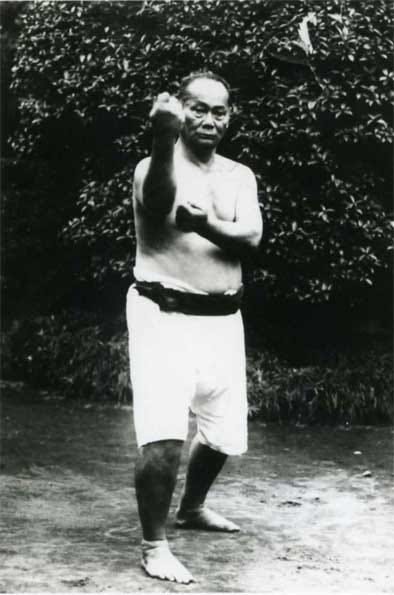
100th Anniversary of Motobu Chōki’s Victory Over a Boxer
The following article was written in 2022.
100th Anniversary of Motobu Chōki’s Victory Over a Boxer
The following article was written in 2022.
When I was a child in the 1970s and 1980s, Japan experienced a “karate craze.” The manga “Karate Master” (1971–1977), its anime (1973–1974), and the kung fu movies of Bruce Lee and Jackie Chan, though not karate, also contributed to the karate boom. In addition, the American movie “The Karate Kid” (1984) had a great impact in Japan. I remember going to see it at a movie theater.
However, the influence of these popular media is not usually included in the chronology of karate history. For example, it is listed that the first All Japan Karate Championship Tournament was held, or that the World Championship Tournament was held, and so on. Of course, these tournaments are important, but in terms of their impact on the public, they cannot be compared to the influence of manga, anime, and movies mentioned above.
Similarly, from the 1920s to the 1930s, there was a social phenomenon that could be called the “first karate craze.” The story of Motobu Chōki’s victory over a boxer, as reported in the magazine “King,” sparked this craze.[1]
Mysterious Old Countryman In November of the fall of 1922, a series of boxing versus judo fights held in Kyoto City generated a variety of rumors day by day and, no wonder, fueled the popularity of the event in the city.
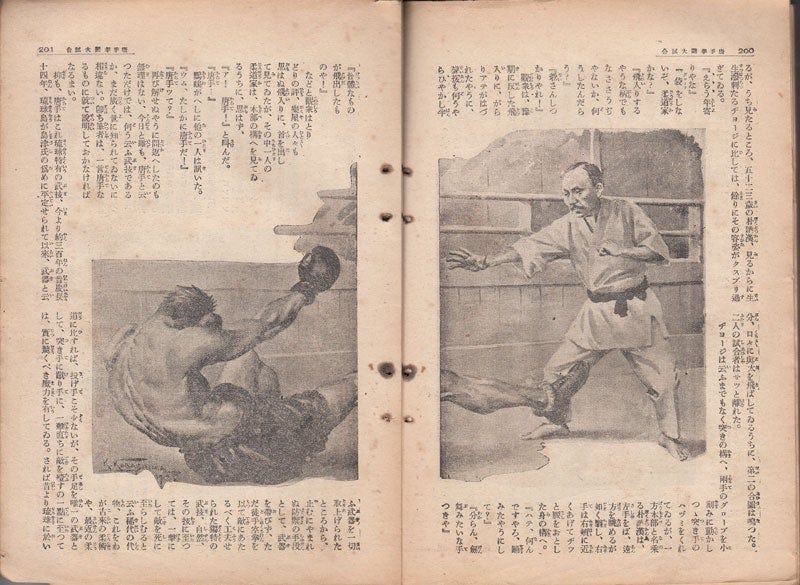
“King,” September 1925 issue
According to the above, this match was held in 1922, which means that this year (2022) marks the 100th anniversary of the match. “King” was the first magazine in Japan’s publishing history to surpass one million copies in circulation. At the time, Japan was still poor and magazines were often passed around among friends, so the actual number of readers must have been much larger. The influence of the magazine was tremendous, and thanks to this article, the majority of the Japanese public learned of the existence of “karate” for the first time.
Various people later recalled this King article. For example, Noguchi Tetsuaki of Waseda University wrote the following in “Karate Study” (1934).[2]
When I was a three-year old boy in middle school in rural northern Kyushu, I read about karate in “King.” Until then, I had no idea what karate was, but I only remembered that he had a very strong fist.
In addition, Kojima Hisao of the University of Tokyo also stated the following in an interview in “Monthly Karate-dō” (1957).[3]
There was a magazine called “King,” which once carried an article on karate. When I was in middle school, I read that article and became interested in karate.
They are the ones who became the founding members of the karate clubs at their respective universities. In other words, it is no exaggeration to say that thanks to the article in “King,” karate clubs were founded one after another at various universities, leading to the spread of karate in mainland Japan and, eventually, worldwide.
If it were not for the article in “King,” karate would have been 10 years late in spreading, or it might have remained only a local Okinawan martial art. In fact, karate was not popular when it was first introduced to the mainland. Its kata-centered training was derided as “dancing” by judo and kendo practitioners.
Well, this year was the 100th anniversary of the spread of karate to the mainland, and there were various news reports about it. However, the coverage was limited to Funakoshi Gichin’s introduction of karate at a sports exhibition and his demonstration at the Kodokan, not Motobu Chōki’s victory over a boxer.
Ignorance and underestimation of Motobu Chōki have been going on for decades, so this is not surprising. However, as the above illustration of Funakoshi Sensei in “King” shows, it was Funakoshi Sensei, rather than Motobu Chōki, who benefited most from the “King” article.
Ōtsuka Hironori Sensei recalls that after the Great Kanto Earthquake (1923), he was the only disciple of Funakoshi Sensei.[4] While not doubting Funakoshi Sensei’s accomplishments, his initial activities were not smooth sailing. It is true that Motobu Chōki’s victory over a boxer helped Funakoshi Sensei’s efforts to promote karate on the mainland get off the ground.
Hopefully, the next 150th or 200th anniversary of the spread of karate will include a reference to Motobu Chōki.
References Note 1: Meigenrō Shujin, “Human bullet hits each other, karate vs. boxing big match,” King, September 1925 issue, Great Japan Yūbenkai Kōdan-sha, 1925, p. 196. Note 2: Noguchi Tetsuaki “Mute Speaks,” Karate Study №1, Kōbukan, 1934, p. 40. Note 3: “Continuation: Karate Reminiscences,” Monthly Karate-dō, Vol. 2, №7, Karate Jihō-sha, 1957, p. 49. Note 4: Monthly Karate-dō, September 2001, Fukushōdō, p. 7.
The original English translation was posted on the Ameba blog on December 25, 2022.
Thank you for reading my story. If you liked it, please applaud and follow me.
메타데이터
- post_id
- 3fd8ca74dfb9
- slug
- 100th-anniversary-of-motobu-chōkis-victory-over-a-boxer-3fd8ca74dfb9
- url
- https://medium.com/@motobu715/100th-anniversary-of-motobu-ch%C5%8Dkis-victory-over-a-boxer-3fd8ca74dfb9
- canonical_url
- https://medium.com/@motobu715/100th-anniversary-of-motobu-ch%C5%8Dkis-victory-over-a-boxer-3fd8ca74dfb9
- author_url
- https://medium.com/@motobu715
- status
- ok
- fetched_at
- 2026-07-14 08:33:51