How to Plan a VR Training Simulator Project Without Wasting Your Budget
Virtual reality has become one of the most effective technologies for workforce training, enabling organizations to replace costly…
How to Plan a VR Training Simulator Project Without Wasting Your Budget
How to Plan a VR Training Simulator Project Without Wasting Your Budget
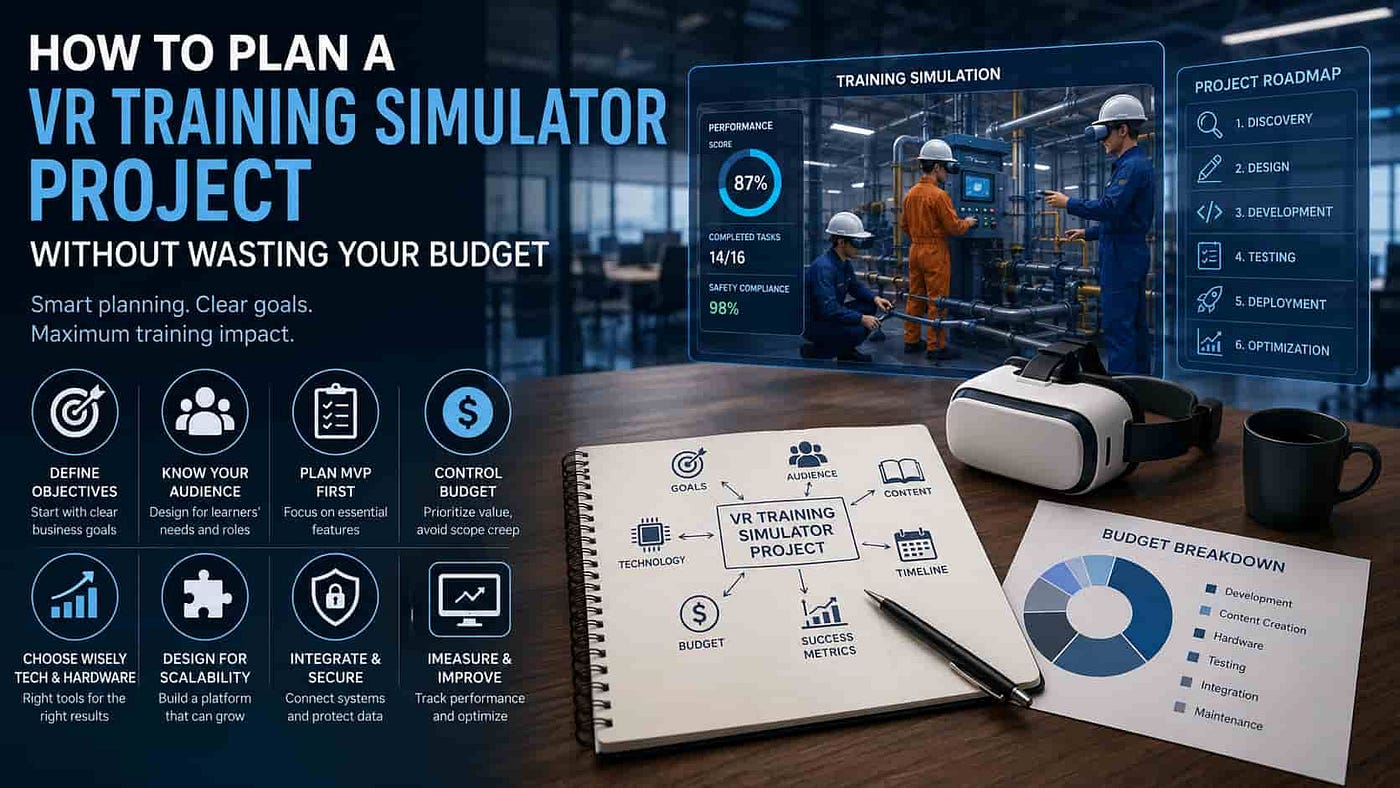
Virtual reality has become one of the most effective technologies for workforce training, enabling organizations to replace costly classroom sessions and risky hands-on exercises with immersive, interactive simulations. Companies across industries — including manufacturing, healthcare, logistics, energy, construction, aviation, and defense — are investing in VR to improve employee performance, increase safety, and reduce operational expenses.
Despite its growing popularity, many VR training initiatives exceed their budgets or fail to deliver the expected return on investment. In many cases, the problem is not the technology itself but insufficient planning. Unrealistic expectations, unclear project requirements, poorly defined objectives, and uncontrolled feature expansion can quickly transform a promising idea into an expensive challenge.
Careful planning allows organizations to control costs while ensuring the final product delivers meaningful business value. By establishing realistic goals, selecting appropriate technologies, and focusing on measurable outcomes, businesses can maximize the effectiveness of their investment without unnecessary spending.
This guide explains how to plan a VR training simulator project efficiently while keeping development costs under control.
Start with Business Goals Instead of Technology
Many organizations begin by discussing VR headsets, graphics, or game engines. While these technologies are important, they should never determine the project’s direction.
The first step is identifying the business problem that the simulator should solve.
Common objectives include:
- Improving employee safety
- Accelerating onboarding
- Standardizing training across locations
- Reducing equipment downtime
- Lowering travel expenses
- Increasing certification success rates
- Improving knowledge retention
- Reducing operational errors
Clearly defined objectives provide measurable success criteria and help prioritize development efforts.
Identify the Target Audience
Not every employee requires the same type of training.
Different groups often have unique learning requirements based on their responsibilities and experience levels.
For example:
- New employees may require introductory lessons.
- Experienced technicians may need advanced maintenance scenarios.
- Supervisors may focus on decision-making exercises.
- Emergency response teams may practice crisis management.
Understanding the audience allows developers to design appropriate interfaces, interaction methods, and learning experiences while avoiding unnecessary complexity.
Define the Minimum Viable Product
One of the most common reasons VR projects exceed their budgets is attempting to build every desired feature in the first release.
Instead, organizations should define a Minimum Viable Product (MVP).
An MVP focuses on delivering the core learning experience while postponing less essential features until later phases.
Typical MVP functionality includes:
- One complete training scenario
- Basic learner assessment
- User authentication
- Core interactions
- Performance tracking
- Administrative controls
Additional scenarios, analytics, AI features, or advanced multiplayer capabilities can be introduced after validating the initial solution.
Prioritize Learning Outcomes
The effectiveness of a training simulator depends on learning outcomes rather than visual complexity.
A beautifully rendered environment offers little value if employees fail to improve their skills.
Each simulation should support measurable objectives such as:
- Completing procedures correctly
- Following safety regulations
- Operating equipment efficiently
- Making accurate decisions
- Collaborating with teammates
- Responding appropriately to emergencies
When every feature directly supports a learning objective, unnecessary development costs become easier to eliminate.
Build a Detailed Requirements Document
Comprehensive project documentation minimizes misunderstandings between stakeholders and development teams.
Requirements should clearly define:
- Functional features
- User roles
- Supported VR hardware
- Training scenarios
- Assessment methods
- Reporting capabilities
- Security requirements
- Integration needs
- Performance expectations
Detailed documentation significantly reduces expensive redesigns during later development stages.
Choose the Right Technology Stack
Technology decisions influence both initial development costs and long-term maintenance expenses.
Key considerations include:
- VR development engine
- Programming languages
- Backend architecture
- Cloud infrastructure
- Database technologies
- Analytics platforms
- Device compatibility
Selecting mature technologies with strong community support often reduces implementation risks and simplifies future maintenance.
Select Hardware Carefully
Not every organization requires the highest-end VR hardware.
Standalone headsets often provide an excellent balance between affordability, portability, and performance.
PC-powered VR systems remain appropriate for simulations requiring highly detailed graphics, advanced engineering visualization, or computationally intensive environments.
Hardware selection should reflect training objectives rather than marketing trends.
Avoid Unnecessary Photorealism
Photorealistic graphics can substantially increase production costs.
Creating highly detailed environments requires:
- Advanced 3D modeling
- Complex textures
- High-resolution assets
- Additional optimization
- Longer testing cycles
In many training applications, functional realism matters more than visual perfection.
Clear interactions, accurate procedures, and intuitive interfaces usually contribute more to learning effectiveness than cinematic visuals.
Plan Content Before Development
Content creation often consumes a significant portion of VR development budgets.
Organizations should prepare:
- Training scripts
- Learning objectives
- Assessment criteria
- Equipment documentation
- Safety procedures
- Voice-over requirements
- Visual references
Well-prepared content enables developers to work more efficiently while reducing revision requests.
Design for Future Expansion
A training simulator should not become obsolete after completing a single project.
Modular architecture allows organizations to add:
- New training scenarios
- Additional equipment
- AI-powered coaching
- Multiplayer functionality
- Localization
- Analytics improvements
- New hardware support
Planning for expansion early typically costs far less than redesigning the system later.
Integrate Existing Enterprise Systems
Most organizations already use software for managing employees, certifications, and learning records.
Integration with existing systems eliminates duplicate administrative work and improves operational efficiency.
Common integrations include:
- Learning Management Systems (LMS)
- Human Resource Management Systems (HRMS)
- Identity providers
- Enterprise Resource Planning (ERP)
- Business intelligence dashboards
Automation reduces administrative costs while improving reporting accuracy.
Focus on User Experience
An intuitive interface reduces both development revisions and long-term training costs.
Good VR user experience includes:
- Simple navigation
- Natural interactions
- Comfortable locomotion
- Clear instructions
- Immediate feedback
- Consistent controls
- Accessible menus
Poor usability often leads to additional support requests, retraining, and lower learner engagement.
Include Performance Measurement
Organizations need measurable evidence that their investment improves employee performance.
Useful metrics include:
- Task completion time
- Error frequency
- Procedure accuracy
- Safety compliance
- Assessment scores
- Training duration
- Knowledge retention
- Certification success rates
Data-driven evaluation supports continuous improvement while demonstrating return on investment.
Implement Security from the Beginning
Enterprise training platforms frequently contain confidential information about employees, operational procedures, and proprietary equipment.
Security planning should include:
- Secure authentication
- Role-based permissions
- Encrypted communications
- Secure cloud storage
- Audit logging
- Regulatory compliance
- Backup strategies
Addressing security during architecture design prevents expensive modifications later.
Test Early and Frequently
Waiting until development is complete before testing often results in costly bug fixes.
Continuous testing identifies issues throughout the project lifecycle.
Testing should cover:
- Functionality
- User experience
- VR comfort
- Performance
- Hardware compatibility
- Network reliability
- Security
- Integration
Regular feedback from instructors and end users ensures the simulator aligns with real training needs.
Control Scope Creep
Feature expansion is one of the primary causes of budget overruns.
Organizations frequently request additional capabilities after development begins, including:
- Extra scenarios
- Advanced AI
- Multiplayer support
- Additional hardware compatibility
- New analytics
- Expanded reporting
A structured change management process helps evaluate each request based on business value, implementation cost, and project timelines.
Work with Experienced Development Partners
Selecting the right development team significantly affects project success.
Experienced VR specialists understand:
- Immersive interaction design
- Performance optimization
- Enterprise integration
- Cloud architecture
- Security requirements
- Learning methodologies
- Hardware limitations
Their expertise often prevents costly mistakes that inexperienced teams may overlook.
Companies investing in educational virtual reality simulators should seek development partners with proven experience delivering enterprise-grade solutions across multiple industries, as this expertise can substantially reduce project risks and improve long-term return on investment.
Budget Beyond Initial Development
The total cost of ownership extends well beyond launching the first version of a VR simulator.
Organizations should allocate resources for:
- Software maintenance
- Security updates
- Cloud hosting
- Technical support
- New training modules
- Hardware replacement
- Performance optimization
- User feedback implementation
Long-term planning ensures the platform remains effective and relevant for years rather than requiring expensive redevelopment.
Measure Return on Investment
Successful VR projects establish measurable business metrics before development begins.
Potential indicators include:
- Reduced training time
- Lower travel expenses
- Fewer workplace accidents
- Improved employee productivity
- Faster onboarding
- Reduced equipment damage
- Higher certification rates
- Better knowledge retention
Tracking these metrics allows organizations to evaluate project success objectively and justify future investments.
Conclusion
Planning a VR training simulator project is not simply about selecting the latest technology — it is about aligning technical decisions with clear business objectives, realistic budgets, and measurable learning outcomes. Organizations that invest time in defining requirements, prioritizing essential features, choosing scalable technologies, and controlling project scope are far more likely to achieve successful implementations without unnecessary costs.
By treating VR development as a strategic business initiative rather than a purely technical endeavor, companies can create immersive training solutions that improve employee performance, enhance operational efficiency, and deliver long-term value. Careful planning, disciplined project management, and continuous evaluation remain the most effective ways to maximize return on investment while avoiding costly mistakes throughout the development lifecycle.
메타데이터
- post_id
- 3fe571c0df00
- slug
- how-to-plan-a-vr-training-simulator-project-without-wasting-your-budget-3fe571c0df00
- url
- https://medium.com/@eugene.afonin/how-to-plan-a-vr-training-simulator-project-without-wasting-your-budget-3fe571c0df00
- canonical_url
- https://medium.com/@eugene.afonin/how-to-plan-a-vr-training-simulator-project-without-wasting-your-budget-3fe571c0df00
- author_url
- https://medium.com/@eugene.afonin
- status
- ok
- fetched_at
- 2026-07-08 08:18:29