Have We Mistaken Attention for Life
There was a time when people looked to the heavens because they believed the answers lay beyond them.
Have We Mistaken Attention for Life
There was a time when people looked to the heavens because they believed the answers lay beyond them.
Today we look down.
The posture has changed.
So has the object of our worship.
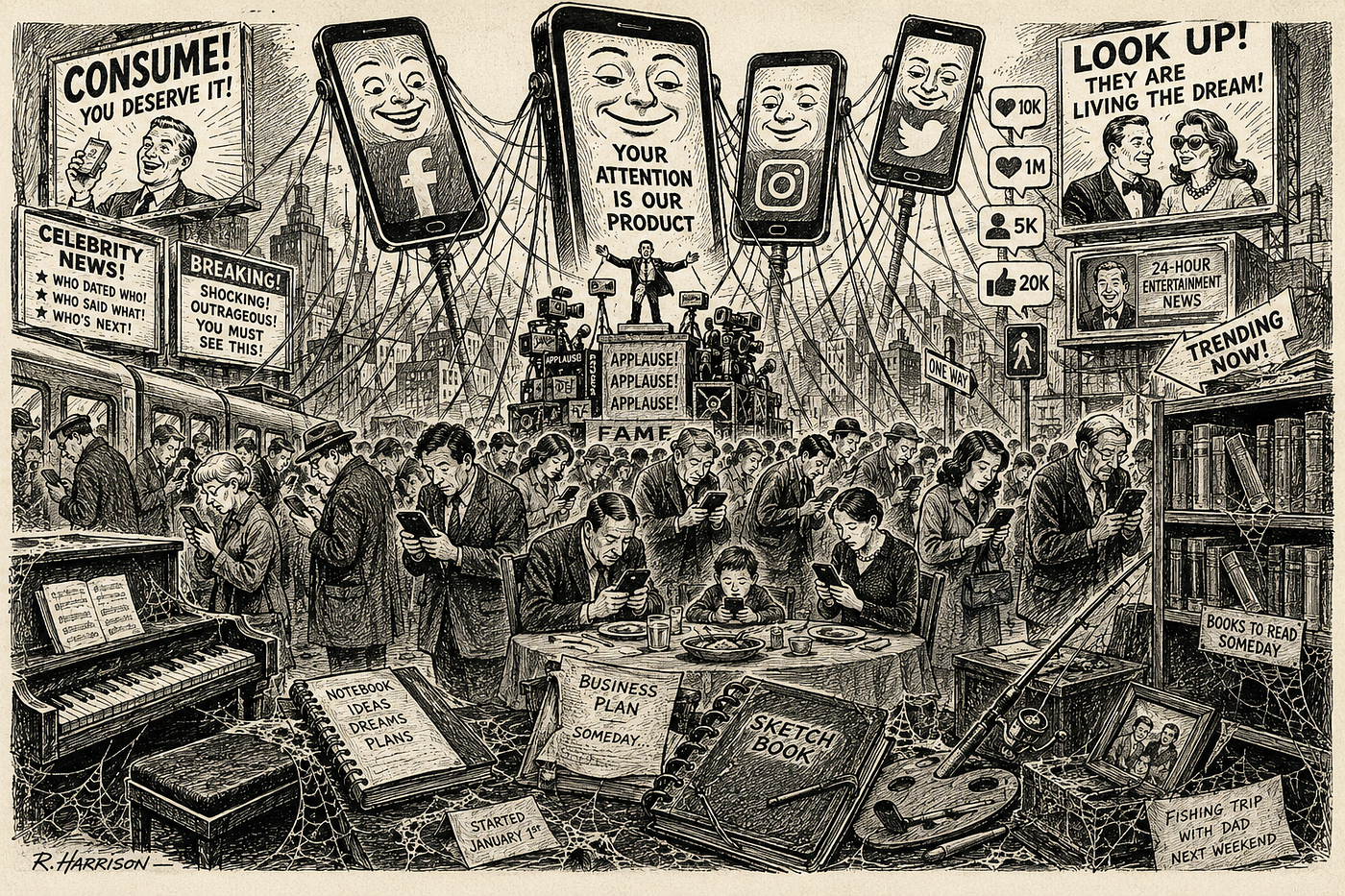
A train arrives, and every head bends in the same direction. A family sits together at dinner, and four separate worlds begin scrolling beneath the table. Morning no longer begins with silence. It begins with a stranger’s opinion. Before we have remembered our own names, we have already consumed somebody else’s life.
No civilisation has ever possessed so much information while knowing so little about itself.
We know who divorced whom.
Who signed the latest contract.
Who bought another mansion.
Who embarrassed themselves on a podcast.
Who is winning.
Who is falling.
We can recite the biographies of people who have never once wondered whether we exist.
Meanwhile, there is a notebook in a drawer that has not been opened for three years.
A piano gathers dust in the corner.
A business idea survives only as a conversation repeated every New Year’s Day.
A father keeps promising his daughter they’ll start fishing “next weekend.”
A woman still catches herself saying, “One day I’ll write that book.”
One day.
History has always loved those two words.
Empires have been built upon less convincing promises.
The tragedy is not that we have become distracted.
Human beings have always been distracted.
The tragedy is that we have become fascinated by lives that ask nothing of us while neglecting the one life that asks everything.
Perhaps that explains the strange hunger of our age.
The endless scrolling.
The compulsive checking.
The need to know what happened five minutes ago to someone we have never met.
It feels like curiosity.
It rarely ends in understanding.
We have mistaken consumption for participation.
Observation for achievement.
Opinion for wisdom.
The world has discovered that attention is easier to harvest than wheat.
Every platform competes for it.
Every headline bargains for it.
Every outrage demands it.
Every narcissist survives on it.
Every demagogue measures it.
Attention has become the most valuable resource on earth because it is the only one from which a human life is made.
Give a man your money, and you lose it once.
Give him your attention every day for ten years, and you may discover, too late, that you have financed the construction of somebody else’s life while quietly abandoning your own.
That is the exchange few people notice.
The price is never charged all at once.
It is collected in minutes.
Ten here.
Twenty there.
An evening disappears.
Then a season.
Then the better part of a decade.
Nothing dramatic happens.
No alarm sounds.
No letter arrives informing you that your purpose has expired through neglect.
Life simply adjusts itself around your absence.
The unfinished manuscript becomes part of the furniture.
The unopened sketchbook acquires a thin layer of dust.
The business remains a conversation.
The apology remains unspoken.
The child grows older.
The dream grows quieter.
Not because it stopped calling.
Because something louder kept interrupting.
There is an uncomfortable question hiding beneath all this noise.
Why do we spend so much time searching for extraordinary people to follow while avoiding the ordinary work that might transform us?
The answer cannot be that we lack examples.
History is overflowing with them.
Nor can it be that we lack instruction.
Every bookshelf insists otherwise.
Perhaps we follow heroes because watching greatness is easier than confronting our own unfinished lives.
Perhaps it is less painful to celebrate another person’s courage than to test our own.
Perhaps admiration has become the safest substitute for action ever invented.
There is another irony, almost too obvious to notice.
Many of those we elevate stand upon stages preaching authenticity while living entirely upon applause.
Their influence depends upon our uncertainty.
Their certainty depends upon our attention.
The more we look toward them for permission, direction or identity, the less likely we are to discover the quieter voice that has been waiting patiently beneath the noise all along.
It has never shouted.
It has never trended.
It has never interrupted your day with a notification.
It has simply remained there, asking the same inconvenient question it asked years ago.
What is it that only you can do?
People assume the great regrets of life arrive through failure.
They rarely do.
It comes through postponement.
Through conversations never begun.
Work never attempted.
Music never written.
Businesses never started.
Children who grew up waiting.
Friends who stopped asking.
Lives that became spectators of themselves.
Perhaps that is why so many people reach the end of their years speaking not of the risks they took, but of the callings they repeatedly silenced.
The heart is remarkably patient.
It will whisper for years.
It will wait through every distraction, every excuse, every borrowed ambition.
It asks for only one thing.
That before your attention is spent building the myths of another life, you spend some portion of it becoming the author of your own.
메타데이터
- post_id
- 3fe62d1459e2
- slug
- have-we-mistaken-attention-for-life-3fe62d1459e2
- url
- https://medium.com/@munyaradzimunodawafa/have-we-mistaken-attention-for-life-3fe62d1459e2
- canonical_url
- https://medium.com/@munyaradzimunodawafa/have-we-mistaken-attention-for-life-3fe62d1459e2
- author_url
- https://medium.com/@munyaradzimunodawafa
- status
- ok
- fetched_at
- 2026-08-18 05:42:08