The Turkish Past Tense of “To Be” (Geçmiş Zaman “Olmak”)
Turkish does not use the verb “to be” the same way English does. Instead, the state of being is shown through suffixes added directly to…
The Turkish Past Tense of “To Be” (Geçmiş Zaman “Olmak”)

Turkish does not use the verb “to be” the same way English does. Instead, the state of being is shown through suffixes added directly to nouns and adjectives. When speaking about the past (“was / were”), Turkish uses the suffix -(y)di (with vowel harmony and personal endings).
This article will explain everything step by step: rules, suffixes, forms, common mistakes, and confusing points learners face.
1. Understanding “To Be” in Turkish
Unlike English, Turkish does not use a separate word like was/were. Instead, the verb “to be” is hidden in suffixes:
- Present tense → “mutluyum” = I am happy.
- Past tense → “mutluydum” = I was happy.
So, in Turkish:
- “to be” = a suffix, not a separate verb.
- The past tense of “to be” = -(y)di.
2. Formation of the Past Tense
2.1 The Suffix -(y)di
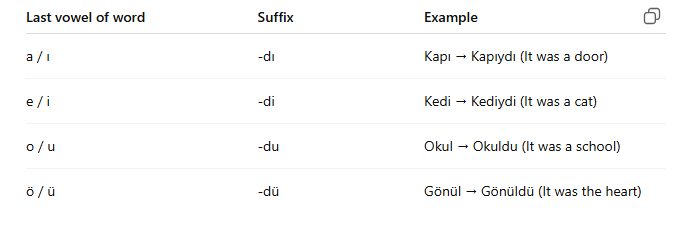
The basic form of the past tense suffix is -di. However, due to Turkish vowel harmony and buffer consonants, it has different versions:
- -dı / -di / -du / -dü (depending on vowel harmony)
- If the word ends in a vowel → add a buffer -y- → -ydı / -ydi / -ydu / -ydü
Examples:
- Ev → Evdi = It was a house.
- Yol → Yoldu = It was a road.
- Güzel → Güzeldi = It was beautiful.
- Araba → Arabaydı = It was a car.
- Kedi → Kediydi = It was a cat.
3. Vowel Harmony Rules for -(y)di
Turkish vowels follow two main harmony rules:
Back vs. Front vowels
- Back vowels: a, ı, o, u → use -dı / -du
- Front vowels: e, i, ö, ü → use -di / -dü
Rounded vs. Unrounded vowels
- Rounded vowels (o, ö, u, ü) → suffix must also be rounded (-du / -dü)
- Unrounded vowels (a, ı, e, i) → suffix must be unrounded (-dı / -di)
Table: Vowel Harmony for -(y)di
4. Adding Personal Endings
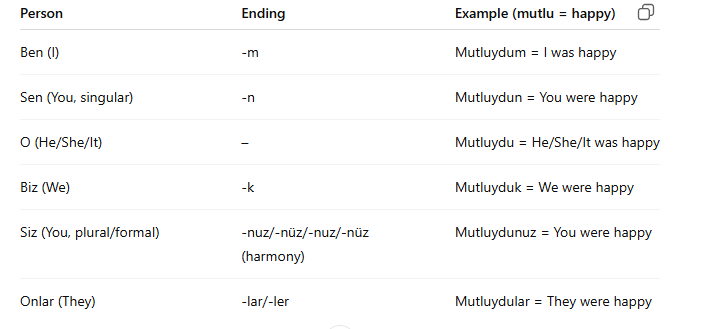
After attaching -(y)di, we add personal suffixes to indicate who the subject was.
5. Negative Form
To make a negative, Turkish uses değil (“not”). The structure is: Predicate + değil + (y)di + personal suffix
Examples:
- Öğretmendim = I was a teacher
- Öğretmen değildim = I was not a teacher
- Mutluydu = He was happy
- Mutlu değildi = He was not happy
- Hastaydık = We were sick
- Hasta değildik = We were not sick
6. Question Form
To ask questions, Turkish uses the question particle: mi / mı / mu / mü (vowel harmony applies).
Important rule: The particle comes before the tense suffix.
Examples:
- Mutluydun = You were happy
- Mutlu muydun? = Were you happy?
- Evdi = It was a house
- Ev miydi? = Was it a house?
- Yorgundunuz = You (plural) were tired
- Yorgun muydunuz? = Were you tired?
7. Full Conjugation Examples
Let’s conjugate two words: öğrenci (student) and mutlu (happy).
Öğrenci (student)
- Öğrenciydim = I was a student
- Öğrenciydin = You were a student
- Öğrenciydi = He/She was a student
- Öğrenciydik = We were students
- Öğrenciydiniz = You were students
- Öğrenciydiler = They were students
Mutlu (happy)
- Mutluydum = I was happy
- Mutluydun = You were happy
- Mutluydu = He/She was happy
- Mutluyduk = We were happy
- Mutluydunuz = You were happy
- Mutluydular = They were happy
8. Common Confusions & Mistakes
8.1 Forgetting the buffer -y-
❌ Arabaıdı → WRONG ✅ Arabaydı → CORRECT
8.2 Wrong vowel harmony
❌ Kediydu → WRONG ✅ Kediydi → CORRECT
8.3 Misplacing the question particle
❌ Mutluydun mu? → CORRECT ❌ Mutlu muydun? → CORRECT ❌ Mutlu muydundu? → WRONG
8.4 Overusing pronouns
In Turkish, personal pronouns are often unnecessary: ✅ Mutluydum. (I was happy.) ❌ Ben mutluydum. (Grammatically correct, but redundant unless emphasis is needed.)
8.5 “Onlar” dropping -lar
- Correct: “Mutluydular.” (They were happy.)
- Also correct (and more natural): “Mutluydu(lar).” → The “-lar” is optional in spoken Turkish.
9. Advanced Notes and Confused Facts
“-di” vs. “idi”
- Historically, “idi” was a separate word (was).
- Today it’s fused into the suffix “-di”.
- Example: Öğrenci idi → Öğrenciydi.
Stress and speech shortcuts
- In fast speech, “-diler” may become “-di(ler)”.
- Example: Öğrenciydiler → Öğrenciydi(ler).
Değildi vs. değildi mi?
- Negative question form:
- Mutlu değildin = You were not happy
- Mutlu değil miydin? = Weren’t you happy?
No equivalent for English “there was / there were”
- Turkish uses vardı (“there was”).
- Example: Masada kitap vardı. = There was a book on the table.
- Negative: Masada kitap yoktu. = There was no book on the table.
10. Practice Sentences
- Çocuktu. = He/She was a child.
- Çocuk değildi. = He/She was not a child.
- Çocuk muydu? = Was he/she a child?
- Yorgunduk. = We were tired.
- Hasta mıydınız? = Were you sick?
- Öğrenciydiler. = They were students.
- Hava soğuktu. = The weather was cold.
- Dün çok güzeldi. = Yesterday was very nice.
- Köyde hayat zordu. = Life was hard in the village.
- Toplantı uzun değildi. = The meeting was not long.
🔑 Summary
- The past tense of “to be” in Turkish = -(y)di suffix.
- Follows vowel harmony → -dı, -di, -du, -dü.
- Add buffer -y- if word ends in a vowel.
- Add personal endings to show who the subject was.
- Negative = değil + (y)di
- Question = mi/mı/mu/mü + (y)di
- Common confusions: forgetting buffer -y-, wrong vowel harmony, misplacing question particle, unnecessary pronouns.
메타데이터
- post_id
- 3fed5eeb88a5
- slug
- the-turkish-past-tense-of-to-be-geçmiş-zaman-olmak-3fed5eeb88a5
- url
- https://medium.com/@mjitalki/the-turkish-past-tense-of-to-be-ge%C3%A7mi%C5%9F-zaman-olmak-3fed5eeb88a5
- canonical_url
- https://medium.com/@mjitalki/the-turkish-past-tense-of-to-be-ge%C3%A7mi%C5%9F-zaman-olmak-3fed5eeb88a5
- author_url
- https://medium.com/@mjitalki
- status
- ok
- fetched_at
- 2026-06-23 06:34:20