The Buyer, Not the Borrower
Long rates have round-tripped two decades of declines in five years. The blame goes to inflation and to deficits. The real cause is…
The Buyer, Not the Borrower
Long rates have round-tripped two decades of declines in five years. The blame goes to inflation and to deficits. The real cause is the retreat of the central banks that spent fifteen years absorbing the supply.
The US 10-year Treasury yielded under 1% in the summer of 2020. It now sits near 4.6%. That is not a record. We traded these levels in the early 2000s, before most of today’s risk-takers had a desk. What stands out is the speed. It took two decades to walk the 10-year down from 5% to the floor, and we have undone almost all of it in five years.
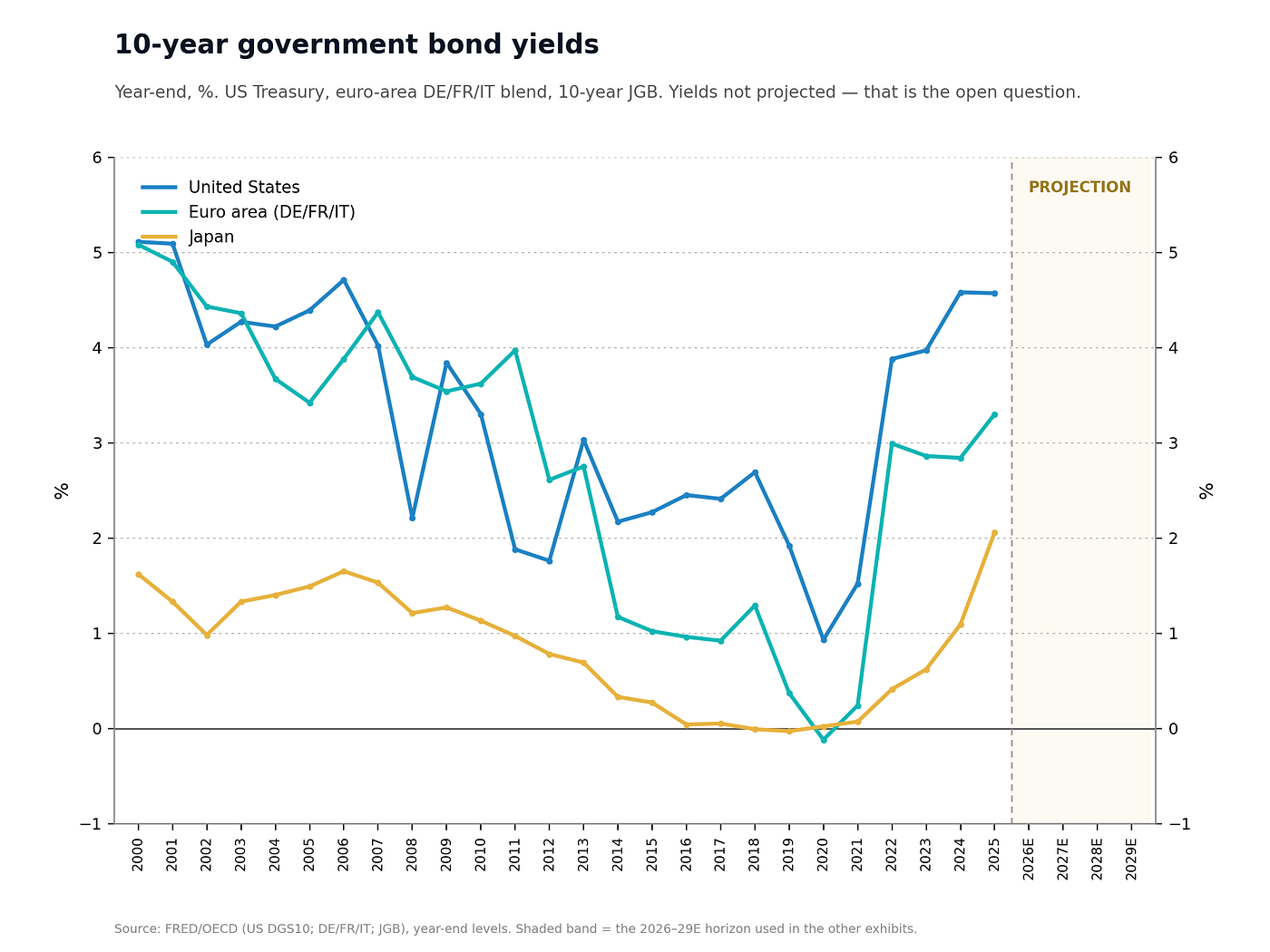
Year-end 10-year yields. Two decades down, reversed in five years.
Europe did the same thing with less drama: the German, French and Italian blend went from slightly negative in 2020 to above 3% today. Japan is the one that should make you sit up. The 10-year JGB has not carried a 2-handle in a quarter of a century. It does now. For a comparable level you have to reach back past the working careers of almost everyone now trading it.
Equities, meanwhile, could not care less. The S&P is printing records while the long bond has repriced by more than 350 basis points, a move that in any textbook should be fighting hard for the marginal dollar. One of those two markets is mispricing the world, and I have argued before about which. Set that aside. The question here is narrower and more useful: what moved rates this far, this fast, and is it the thing everyone says it is?
Ask the TV commentators and you get two answers. Inflation, and deficits. Both have an alibi.
Suspect one: inflation
Inflation is the reflex answer, because everyone lived through 2022. US CPI hit 8% that year. Euro-area HICP touched 8.4%. Real, frightening prints. They are also behind us. US inflation is back to 2.6% and the euro area to roughly 2%, both close to where they averaged in the two decades before the pandemic.

Annual average CPI and HICP. The spike was real, and it has faded back to the long-run norm everywhere except Japan.
There is a wrinkle worth naming. The political class has rebranded the topic as a “cost of living crisis,” which now dominates the discourse in Washington and most European capitals. It refers to past Inflation (everything is expensive) that we have not yet gotten used to. Cost of living is the more palatable phrase, since cost of living is simply the level of prices and inflation is the rate at which that level climbs. The distinction matters here, because the bond market does not trade the cost of living. It trades inflation, and the rate has come back down. The risk that keeps me honest is the energy channel: the Iran conflict carries a genuine potential for second-round effects, the kind that turn an oil spike into a wage-price echo. For now the market is not pricing that, and realized inflation, while above the 2% target our central banks still nominally hold, is not dramatically above it.
So inflation explains the move in 2022. It does not explain the level in 2026. If the 10-year simply tracked realized inflation, it would have handed most of the move back by now. It hasn’t. The one place inflation does look genuinely different is Japan, which spent nine of the years between 2000 and 2012 in outright deflation and now runs 2 to 3%. Keep Japan in mind, because it comes back at the end.
Suspect two: the politicians
The second answer is fiscal. Reckless governments, runaway deficits, the bond vigilantes finally collecting. It is the satisfying answer, because it has a villain. It is also weaker than it looks.
Deficits are elevated. They are not the largest we have seen. The US federal deficit is running around 6% of GDP, high for an expansion but below the 9.8% of 2009. The euro area sits near 3%, at the Maastricht line and a fraction of its pandemic peak. Japan, the supposed fiscal cautionary tale, runs a general-government deficit near 1 to 2% of GDP, close to a multi-decade low.
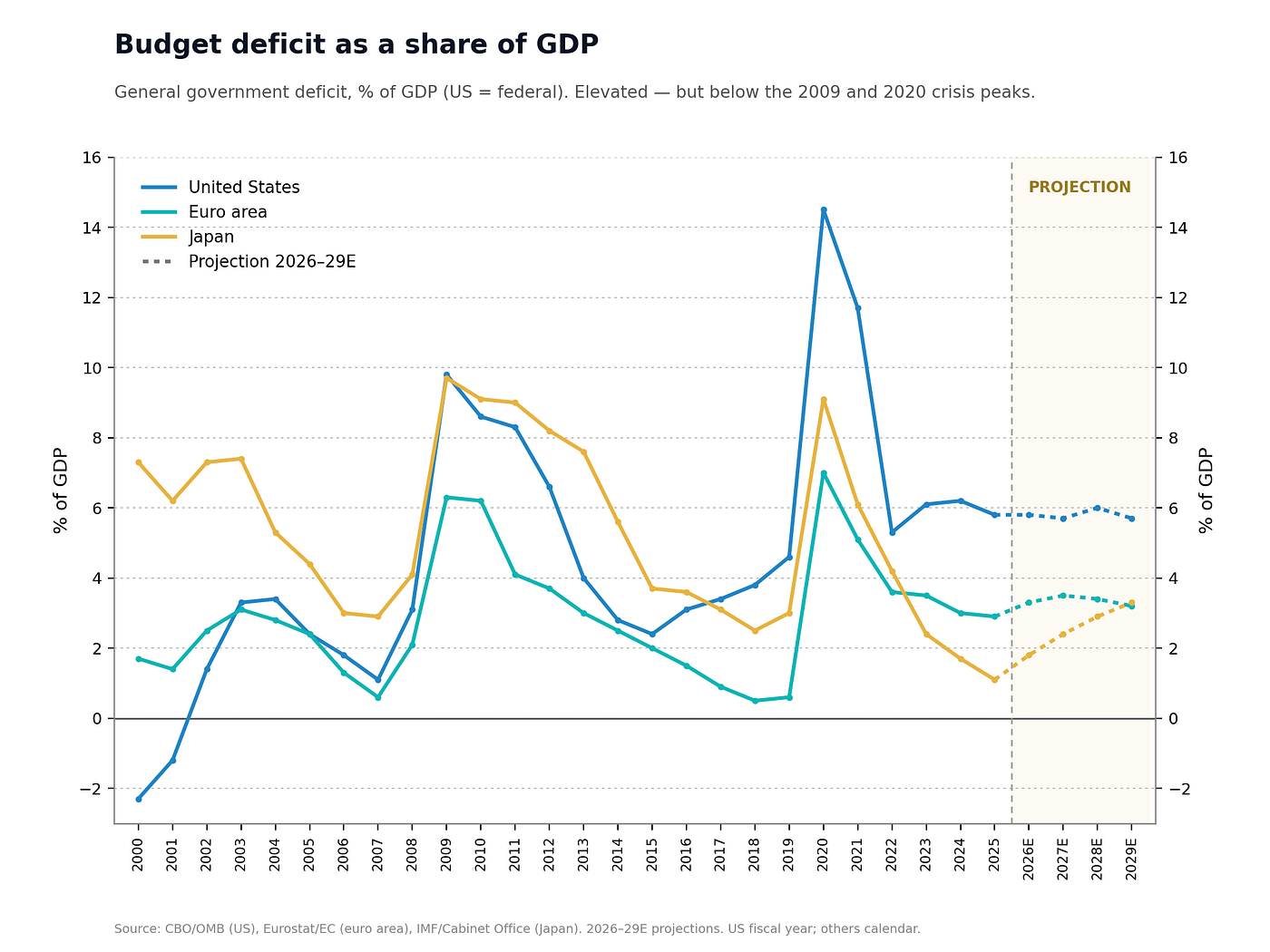
General-government deficits. Elevated, but below the 2009 and 2020 peaks, and near multi-decade lows in Japan.
Compare like for like. In 2012, a thoroughly unremarkable year, the US ran a federal deficit of 6.6% of GDP and the 10-year finished the year at 1.76%. In 2024 the deficit was slightly smaller, 6.2% of GDP, and the 10-year sat at 4.58%. Same borrower, near-identical deficit, and a yield almost three points higher. If the scale of government borrowing set the price of money, those two years could not look so different. The deficit was at the scene, but it has been exactly this size before while rates went the other way.
Both suspects have alibis. So who moved the rates?
The buyer
What changed is not how much governments borrowed. It is who bought it.
For fifteen years the marginal buyer of government duration was a central bank, and a central bank running a purchase programme (Quantitative easing in the US or yield curve control in Japan) has no return target. The Fed and the ECB bought to hit a quantity, a stated number of trillions. The Bank of Japan went further and bought whatever it took to pin the 10-year near zero. None of them was weighing yield against value, in fact quite the opposite. They were price-insensitive by design. At the peak the Fed held roughly a quarter of the marketable Treasury market. The ECB went from owning no government bonds at all before 2010 to 37% of the euro area’s. The Bank of Japan reached 53%. It owned more than half of its own government’s debt.
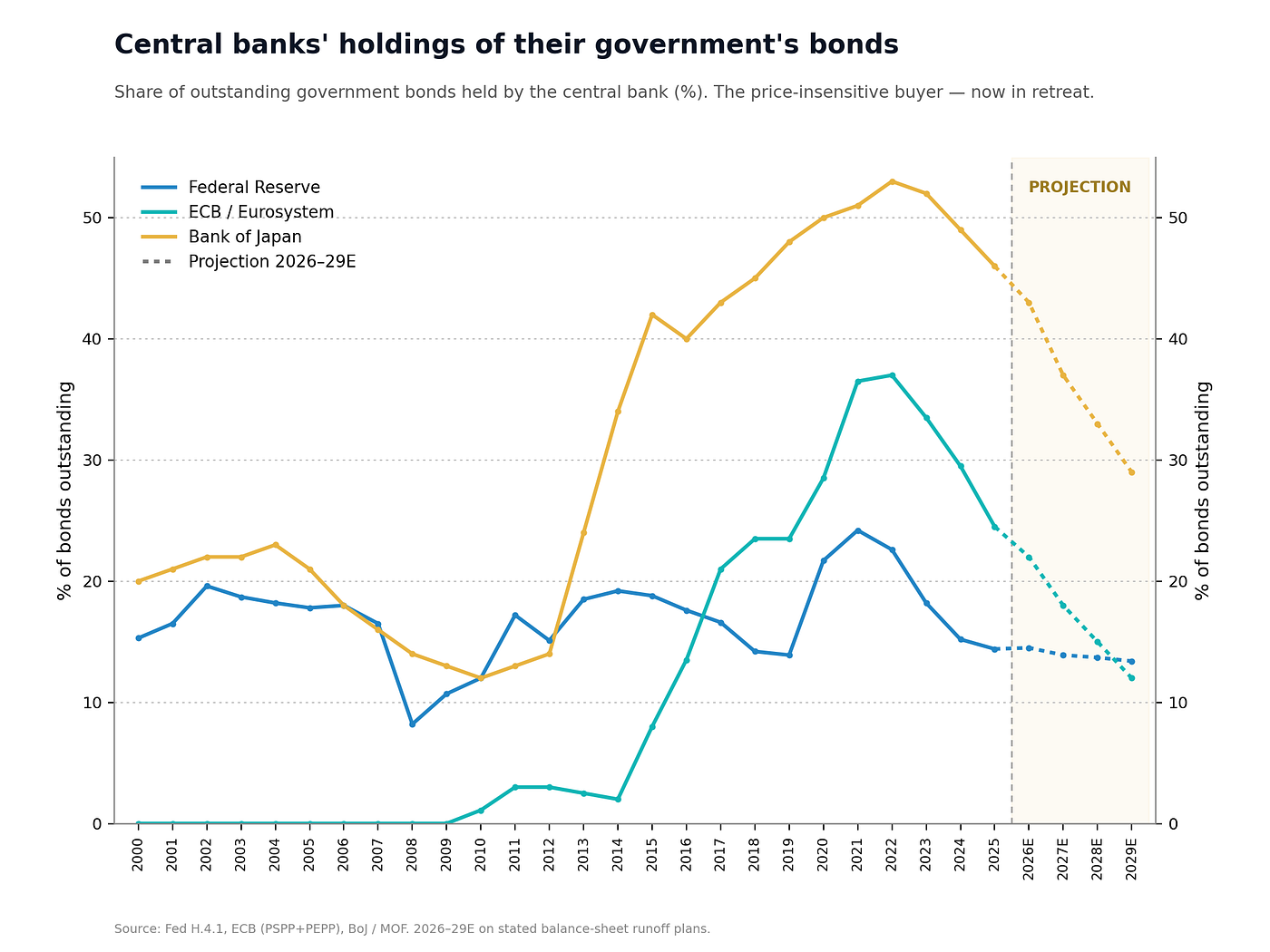
Central-bank holdings as a share of government bonds. The price-insensitive buyer, arriving after 2008 and now in retreat.
This began after 2008. The original purpose was to repair a broken market, and then to push policy further once rates were already at zero. It was never fully reversed, through more than a decade and a sequence of expansions. Central bankers have since absorbed an uncomfortable lesson: a balance sheet that only ever grows leaves no room to respond when the next crisis lands. Bringing it down has become less a preference than a necessity, a way to rebuild the capacity to act.
So all three are pulling back, each in its own way. The Fed has stopped shrinking its book outright, but it now reinvests maturing holdings only in Treasury bills, the paper that matures in a year or less, which means the long end of the curve sees none of that money. The ECB has gone further and reinvests nothing at all; its portfolio simply runs off as bonds mature, without active selling. The Bank of Japan is still buying, but deliberately less each quarter than what matures, so its holdings glide lower on a managed path. Three different mechanics, one direction. The buyer that absorbed the supply for fifteen years is walking out of the room.
When a price-insensitive buyer leaves, the bonds do not disappear. They have to clear with the buyers who remain: pension funds, banks, insurers, foreign reserve managers, households. Every one of them needs a real return to hold duration. The price falls until the yield is high enough to draw them in, and that gap is the term premium that fifteen years of central-bank buying held down.
You can measure the pressure directly, as the net new supply that price-sensitive investors actually have to take down: government issuance minus whatever the central bank absorbs. In 2015 that figure was negative across the US, Europe and Japan combined. The central banks bought more than their governments issued, pulling duration out of private hands. By 2024, private investors had to swallow roughly $3.8 trillion of it. On stated budget paths and published run-off plans, it holds near $3.3 trillion a year through 2029.
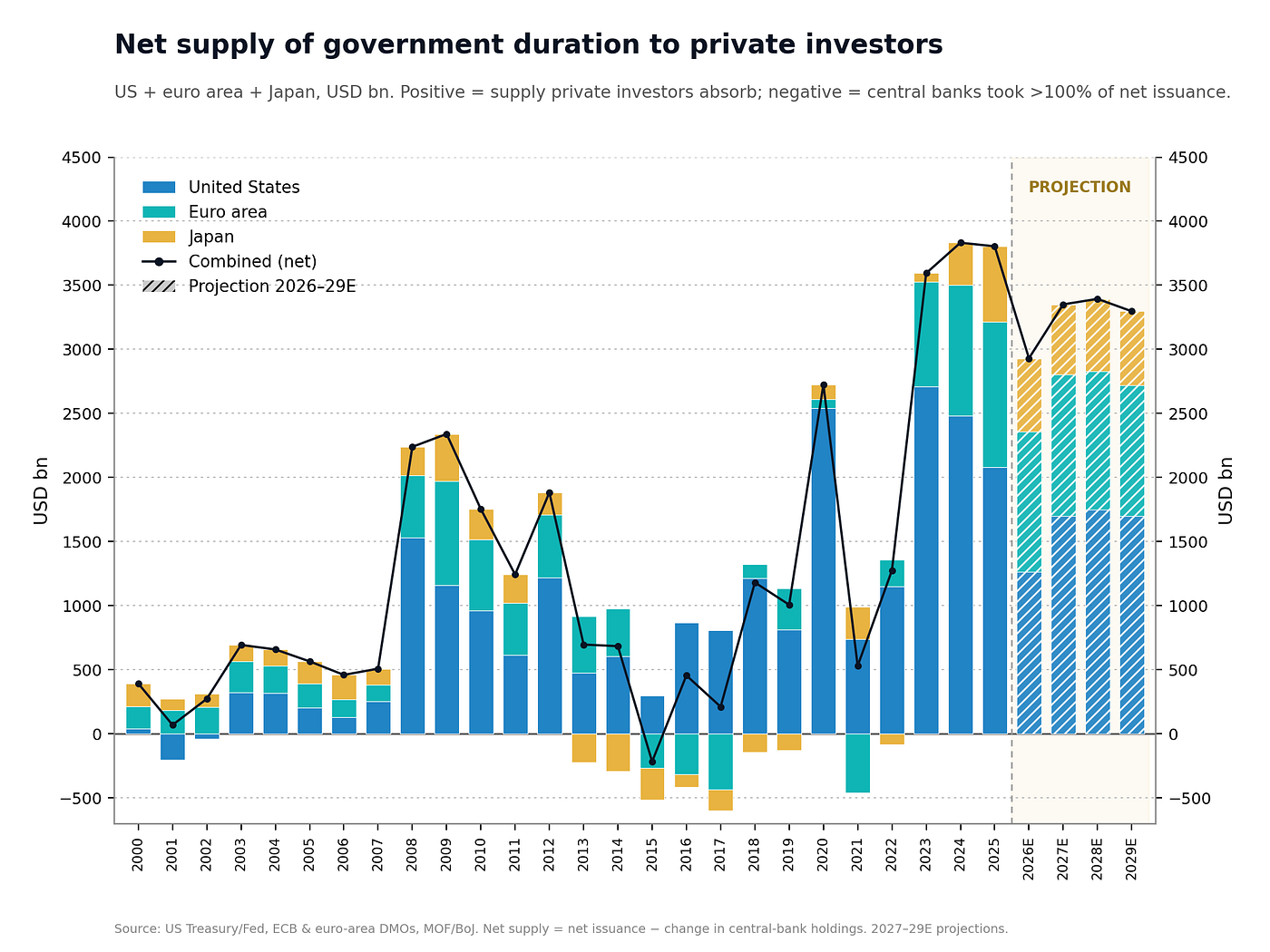
Net issuance minus central-bank purchases. Negative in 2015, when the banks took more than everything; a record now, with a plateau ahead.
That is what the deficit hawks miss. The supply hitting the market did not surge because governments turned reckless overnight. It surged because the institution that used to absorb it changed sides. The borrower is the same character it has been for years. The buyer is the part that changed.
The fork
This resolves one of two ways, and both have teeth.
Either the price of duration has genuinely reset higher. Not “higher for longer,” the phrase central banks use for a policy rate they intend to hold. I mean a structurally larger term premium, a higher resting level for the long bond itself, for as long as the buyer base looks the way it now does. In this world a 10-year near 4 to 5% is not a tight-policy anomaly waiting to mean-revert. It is what the market clears at without a subsidized bid, which is roughly what it did before 2008.
Or a central bank blinks, reopens its balance sheet, and caps yields the way it learned to over the past fifteen years. This is a genuine possibility, and two things now stand in its way. The first is leadership. The new Fed chair, Kevin Warsh, has made shrinking the balance sheet an explicit goal, describing it as a structure that has “done quite a bit of harm” and pledging to reduce it slowly and deliberately. The institution is currently leaning against reopening the spigot, not toward it. The second is inflation. Through the 2010s, buying bonds was effectively free, because inflation ran below target and quantitative easing carried no visible cost. If the resting level of inflation is now higher and stickier, and Japan is the live example of a country where it has not simply gone home, then restarting purchases is itself inflationary and far harder to defend to a public that just lived through 2022. The escape hatch is still there. It is partly welded shut.
I will not tell you which way they jump, because that is a question of nerve and politics as much as economics. What I will say is that the comfortable middle, deficits financed quietly by a buyer with no price discipline, is the one outcome the next few years do not obviously offer.
What forces the choice, in the end, is the economy. A downturn is what gives a central bank the cover to ease and to buy, and so far there hasn’t been one. The economy has carried a 350 basis-point repricing with unusual composure, and equities sit at record highs. That resilience is its own subject and earns its own piece. Its consequence here is simple. As long as growth holds, no one has to choose. Rates can grind higher and the system absorbs it, because higher is just the price of money without a subsidy. The day growth cracks is the day the choice can no longer be deferred, when the pressure to reopen the balance sheet returns with the inflation problem still bolted to it. That first crack, not the next auction, is what I am watching.
Sources & data
Government bond issuance and amounts outstanding
- United States: U.S. Treasury Fiscal Data (Monthly Statement of the Public Debt) and Quarterly Refunding / TBAC materials; SIFMA U.S. Treasury Securities Statistics
- Euro area: AFME data & research (Government Bond Data Reports); national debt agencies — Germany (Finanzagentur), France (AFT), Italy (MEF, Public Debt), Spain (Tesoro Público); European Commission EU borrower / investor relations (NGEU/SAFE)
- Japan: Japan Ministry of Finance — JGB issuance plan & debt management
Central-bank holdings of government bonds
- Federal Reserve: H.4.1 release and SOMA Treasury holdings via FRED (TREAST); NY Fed SOMA holdings
- ECB / Eurosystem: Asset purchase programmes (APP) and PEPP; forward run-off path from the ECB Survey of Monetary Analysts
- Bank of Japan: BoJ statistics (Flow of Funds / accounts) and the MOF JGB & T-Bill holder breakdown
Budget deficits and nominal GDP
- United States: CBO Budget and Economic Outlook; OMB Historical Tables; BEA (GDP)
- Euro area: Eurostat — government deficit/surplus and GDP; European Commission economic forecasts / AMECO; IMF World Economic Outlook
- Japan: IMF (Japan / Article IV); Japan Cabinet Office — Economic and Fiscal Projections
10-year government bond yields
- FRED — U.S. (DGS10); OECD via FRED for Germany, France, Italy and Japan. The euro-area line is a simple average of Germany, France and Italy.
Inflation — realized
Inflation — expectations (2026–2029)
- United States: TIPS breakevens via FRED (5-year, 10-year, 5y5y forward); Philadelphia Fed Survey of Professional Forecasters; Cleveland Fed inflation expectations
- Euro area: ECB staff projections, ECB Survey of Professional Forecasters, European Commission forecast, and euro inflation-linked swaps
- Japan: BoJ Outlook for Economic Activity and Prices; IMF WEO; JCER / Consensus Economics
A note on method: “Net supply to private investors” is net government issuance minus the change in central-bank holdings, in each region’s own currency and restated to U.S. dollars. Figures for 2026–2029 are projections built on published budget paths and stated central-bank balance-sheet plans; deficits and central-bank flows on that horizon are estimates and are treated as directional.
메타데이터
- post_id
- 3ff8292debd2
- slug
- the-buyer-not-the-borrower-3ff8292debd2
- url
- https://medium.com/@capital-allocation/the-buyer-not-the-borrower-3ff8292debd2
- canonical_url
- https://medium.com/@capital-allocation/the-buyer-not-the-borrower-3ff8292debd2
- author_url
- https://medium.com/@capital-allocation
- status
- ok
- fetched_at
- 2026-06-09 15:37:30