Paid in Stablecoins? A Freelancer’s Guide to Making Idle Dollars Work
Getting paid in stablecoins is the easy part. Deciding whether those dollars sit still or go to work is the real question.
Paid in Stablecoins? A Freelancer’s Guide to Making Idle Dollars Work
Getting paid in stablecoins is the easy part. Deciding whether those dollars sit still or go to work is the real question.
Getting paid in stablecoins is the easy part. Deciding whether those dollars sit still or go to work is the real question.
Payday hits. The USDC lands in your wallet in seconds. No wire transfer. No three-day wait. No middleman skimming a fee. And then it just sits there.
That is the quiet problem with getting paid in stablecoins. The money arrives fast, then it stops moving. If you earn in USDC or another stablecoin, this guide is about the next step: how to put those idle dollars to work without turning your savings into a gamble.
The new paycheck: why freelancers get paid in USDC
Getting paid in crypto used to be a fringe choice. In 2026 it is close to normal for remote work. A few numbers show the shift.
- About 25% of global businesses ran some crypto payroll in 2025, per Rise’s State of Crypto Payroll research.
- Individual adoption climbed from roughly 3% in 2023 to about 9.6% by the end of 2024.
- USDC makes up close to 63% of crypto-payroll volume, and USDC and USDT together sit above 90%.
- Around 75% of Gen Z stablecoin users say they would rather be paid in stablecoins than local currency.
The reason is not hype. It is math. A traditional cross-border payout can lose 3% to 7% to wire fees and currency spreads, and can take days to clear. A stablecoin salary settles in seconds for pennies. For a designer in Buenos Aires watching triple-digit inflation, or a developer in Lagos tired of 6% transfer fees, getting paid in USDC is not a bet. It is a steadier paycheck.
This is not a fringe experiment anymore. Payroll platforms like Deel now route stablecoin salaries straight to self-custody wallets, USDS itself shows up on the list of payroll stablecoins, and clear rules from the GENIUS Act and Europe’s MiCA framework have pushed stablecoin pay from novelty to plumbing. The wider backdrop is hard to ignore too: the global stablecoin market has roughly doubled in two years, and the US Treasury Secretary has floated a path to a $3 trillion market by 2030.
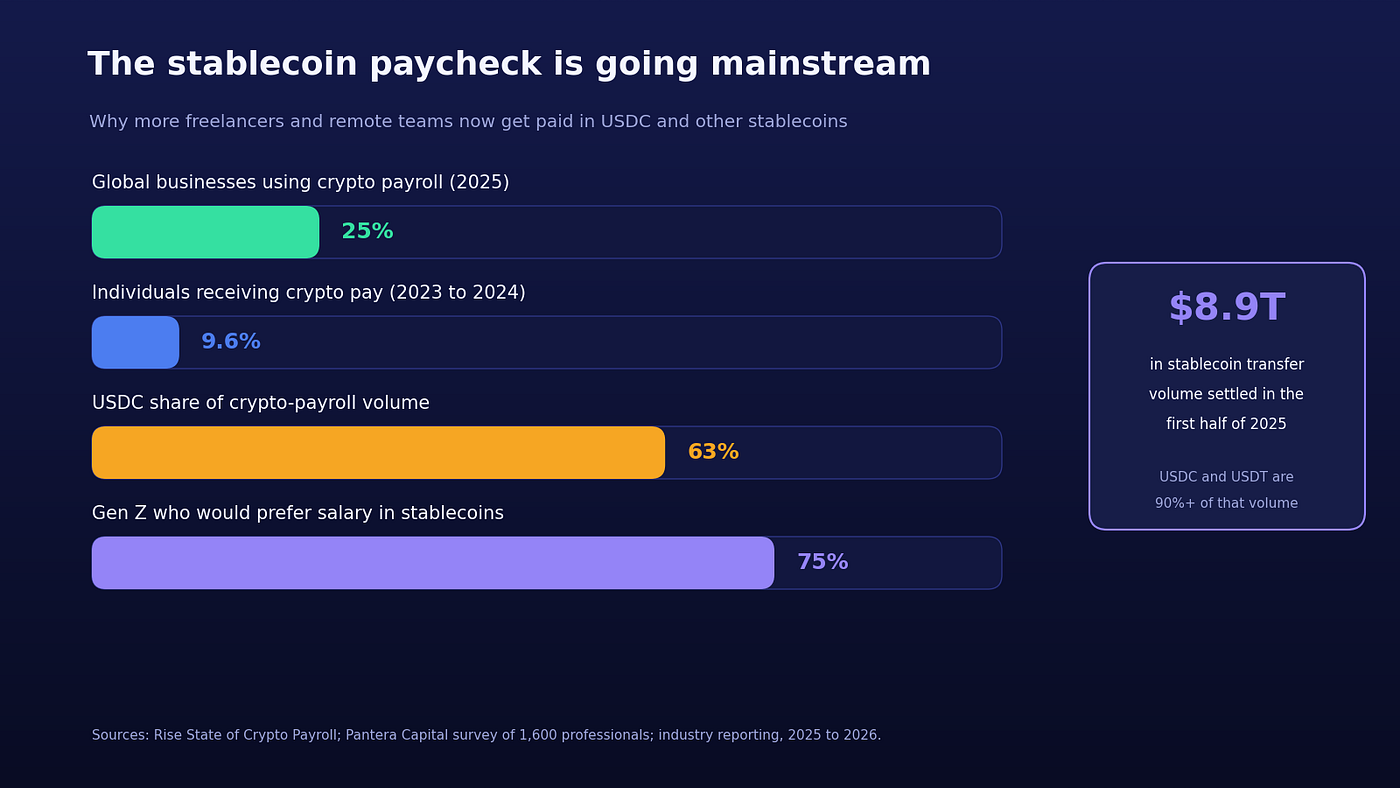
Stablecoin pay has crossed from novelty to infrastructure, with USDC leading the way for remote workers and freelancers.
The idle-dollar problem nobody mentions
Here is what the payroll pitch skips. A wallet is a fine place to hold dollars. It is a poor place to grow them.
A wallet is a fine place to hold dollars. It is a poor place to grow them.
Your stablecoin balance stays flat, which is the whole point of a stablecoin. But flat is not the same as working. Sitting still, those dollars slowly lose ground to inflation while doing nothing for you.
Picture a freelancer clearing $3,000 a month in USDC. Held in a plain wallet, that balance is a parked car. It looks fine, but it is going nowhere while everyday prices creep up. Onchain dollar savings flip that default.
The same balance can stay liquid and spendable while it earns, instead of quietly standing still.
The obvious fix is to chase yield. That is also where people get burned. Sky-high rates often hide real risks: token emissions that dry up, thin liquidity, or a coin that quietly loses its peg.
So the useful question is not “where is the biggest number?” It is “how do I earn yield on my stablecoins in a way I can actually understand and trust?”
What is the Sky Savings Rate, and where does the yield come from?
The Sky Savings Rate (SSR) is a yield you can earn on stablecoins through Sky Protocol. Two things set it apart from most stablecoin yield.
First, it is governance-set. Sky Protocol governance decides the rate, so it moves in deliberate steps instead of swinging with the market by the hour. That makes it more predictable.
Second, and this matters most, the yield comes from real protocol revenue, not from printing new tokens.
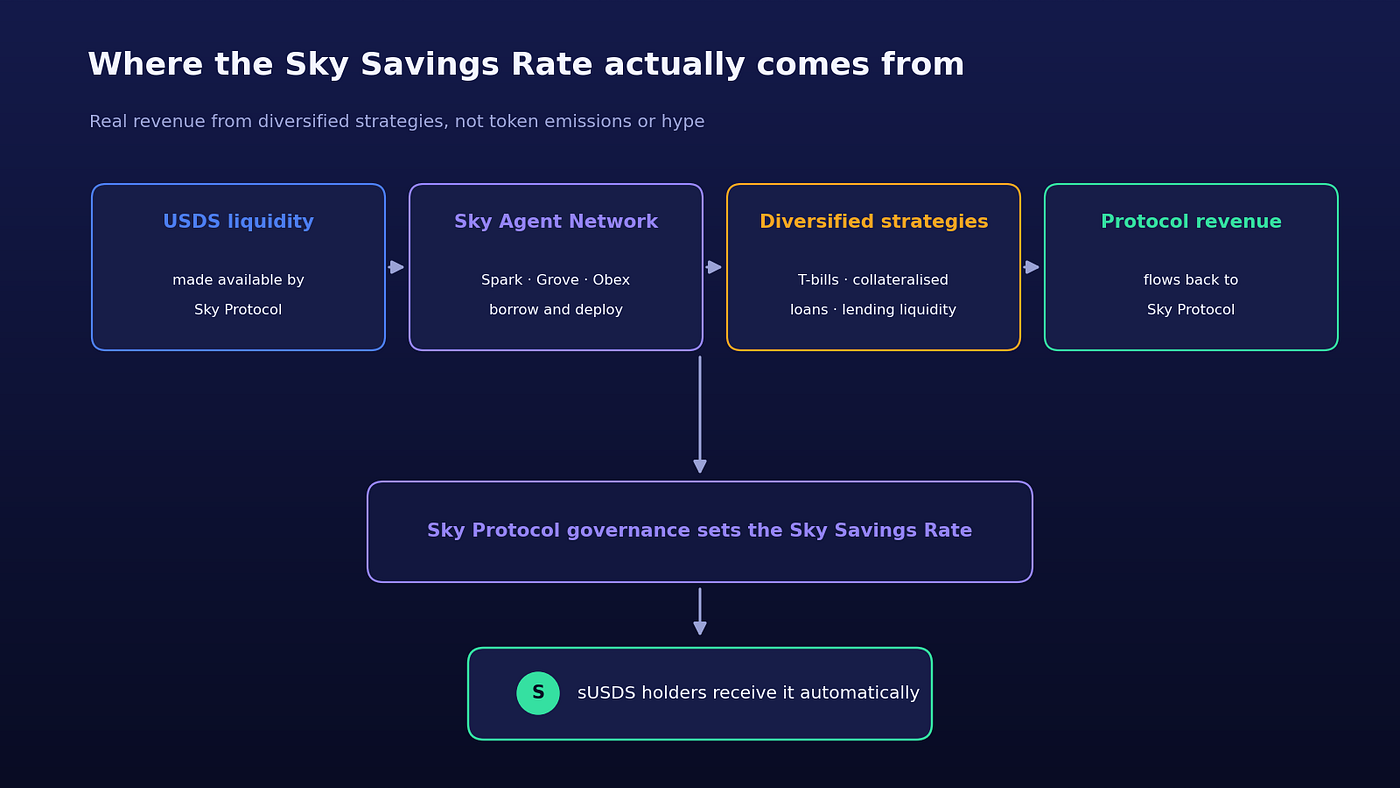
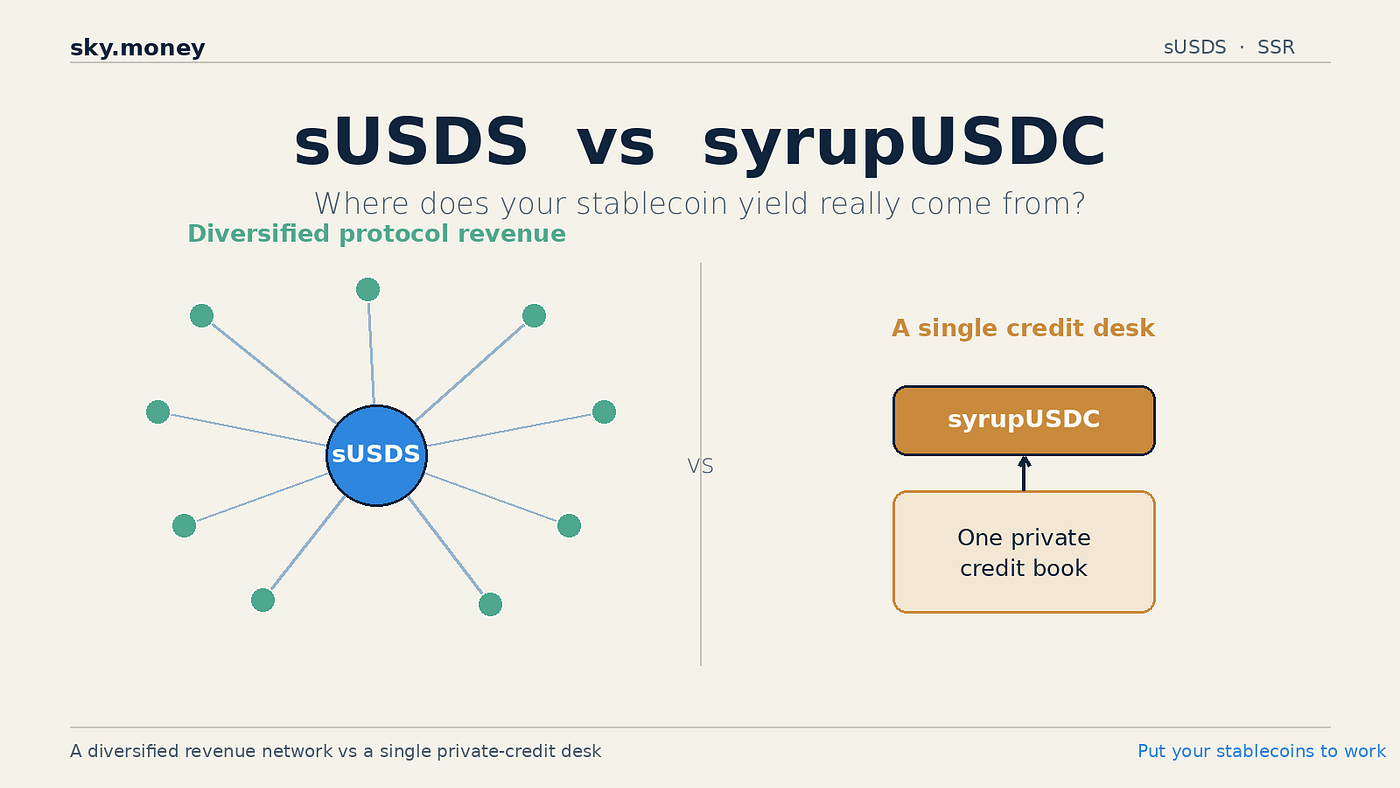
The Sky Savings Rate is powered by revenue from diversified strategies, then set by governance and passed to sUSDS holders.
In plain terms, it works like this.
- Sky Protocol makes USDS liquidity available to the Sky Agent Network.
- Agents such as Spark, Grove and Obex deploy that liquidity into diversified strategies: US Treasury bills, over-collateralised loans, and lending-market liquidity.
- The revenue flows back to the protocol.
- Governance sets the Sky Savings Rate from that revenue, and sUSDS holders receive it.
Because the rate draws on several sources at once, it is diversified rather than tied to one trade. If you want the plain-English version of the dollar behind it, Sky has a short explainer on what USDS is.
Why does “real revenue, not emissions” matter so much? Because a yield paid out of genuine income tends to last, while a yield paid by minting fresh tokens tends to fade the moment the incentives stop.
Independent write-ups often describe the Sky Savings Rate as a passthrough of real economic yield for exactly this reason.
Meet sUSDS: one token, automatic yield
You do not chase the Sky Savings Rate. You just hold one token.
sUSDS is the flagship yield-generating stablecoin of Sky Protocol. When you hold sUSDS, it accrues the Sky Savings Rate automatically. No staking dashboard, no weekly claiming, no lockups.
What that means for someone paid in stablecoins is simple.
- Your balance earns quietly in the background, without daily attention.
- It stays fully liquid, so you can redeem sUSDS back to USDS whenever you need cash.
- There is one action to learn, not ten.
Sky’s sUSDS page and its what is sUSDS explainer go deeper if you want the mechanics.
From USDC to working dollars: the simple path
Most people reading this are paid in USDC, not USDS. Closing that gap is short.
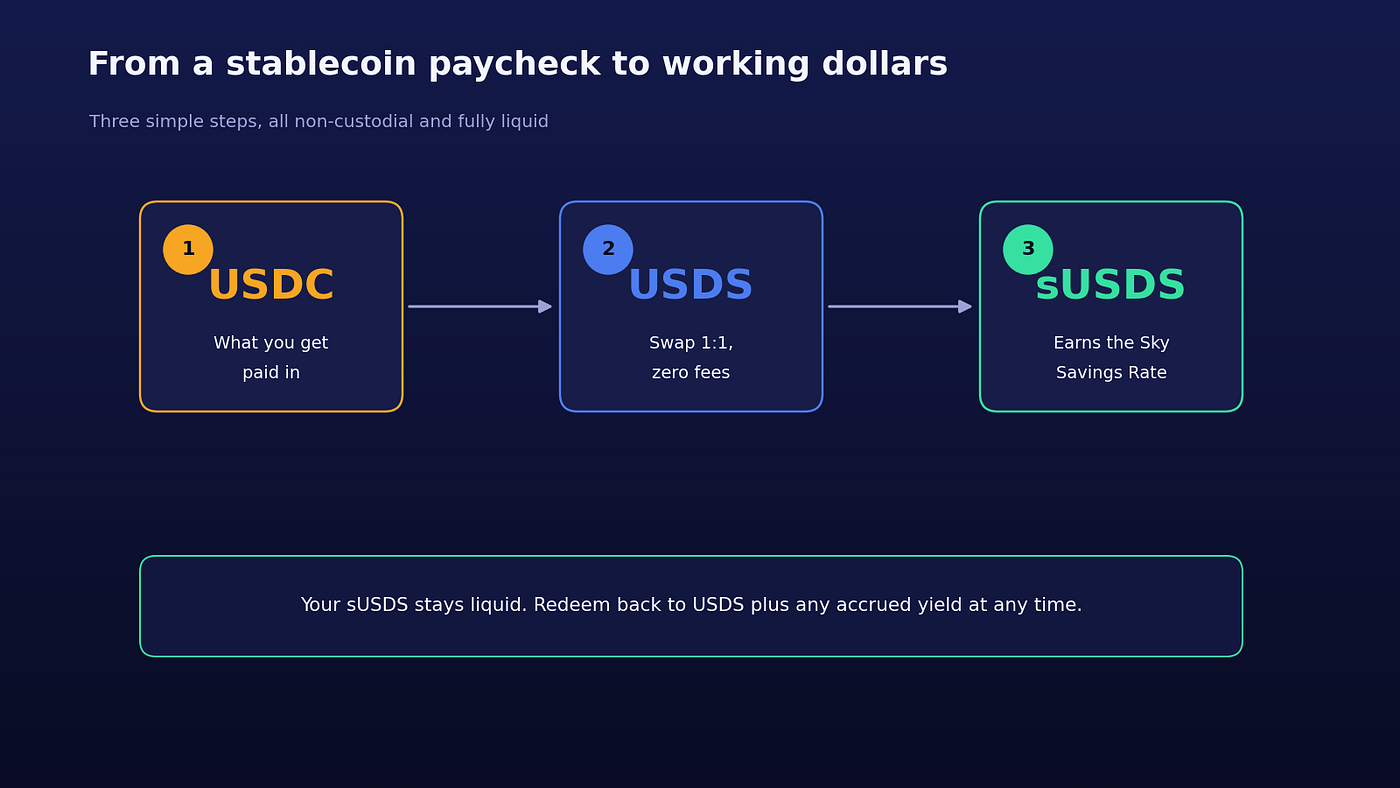
Three steps from a USDC paycheck to a yield-earning, fully liquid stablecoin savings position.
- Convert. Swap USDC to USDS 1:1 with zero fees on Sky.money.
- Supply. Supply your USDS and receive sUSDS in return.
- Earn. Your sUSDS accrues the Sky Savings Rate on its own.
The whole flow is non-custodial. You keep your keys, and Sky.money does not hold your funds. When you want your dollars back, you redeem sUSDS for USDS and you are done. You can do all of it in the Sky.money app.
Can you trust it? The track record behind the rate
“Verify, do not believe” is a good rule for any yield. So here is what is actually verifiable about the system behind sUSDS.
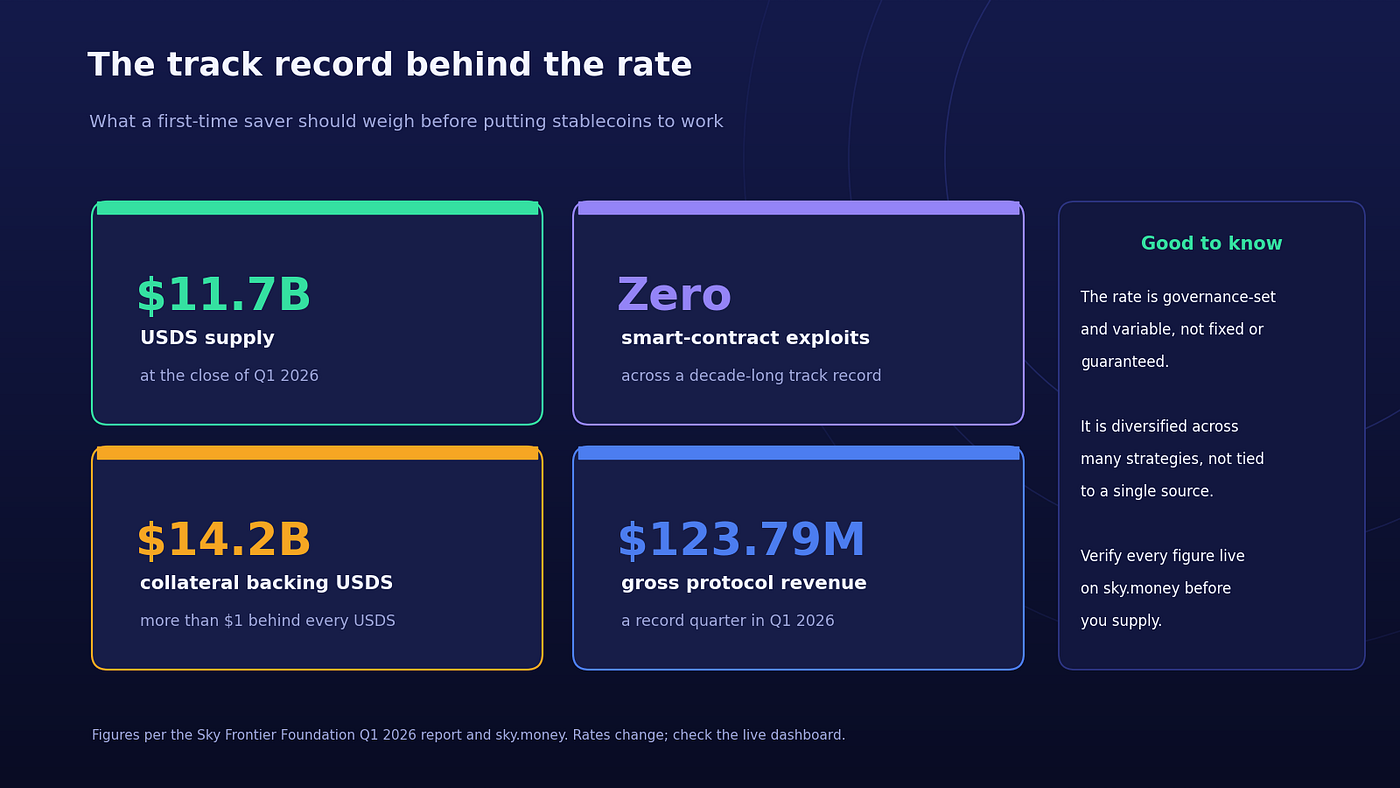
Four verifiable numbers, plus the caveats that keep them honest. Always check the live figures before you supply.
- A decade-long track record with no smart contract exploit on the core infrastructure.
- USDS supply reached about $11.7 billion at the close of Q1 2026, per the Sky Frontier Foundation.
- More than a dollar of collateral backs every USDS in circulation, with roughly $14.2 billion in collateral reported.
- The protocol reported a record $123.79 million in gross protocol revenue for Q1 2026, and Sky Protocol holds an S&P credit rating.
None of this is a promise about the future. It is a record you can check. You can see the live collateral behind USDS on the Sky collateral dashboard, and you can confirm the current rate on Sky.money before you move a single dollar.
None of this is a promise about the future. It is a record you can check.
Who this actually fits, and who it does not
sUSDS is built for one kind of saver, not everyone. It helps to be honest about that.
- It fits you if you get paid in stablecoins, want a simple and predictable place to earn, and value liquidity and a clean track record over the highest possible number.
- It is less for you if your whole goal is to chase the top APY of the week, or if you are comfortable taking on higher risk for higher reward.
That clarity is the point. The Sky Savings Rate is a savings lane, not a lottery ticket. It is meant to be the boring, dependable base of a stablecoin portfolio, the part you do not have to babysit.
The honest part: what to weigh before you supply
No stablecoin yield is free of risk, and anyone who says otherwise is selling something. A few things worth weighing.
- The Sky Savings Rate is governance-set and variable. It can rise or fall, and it is not guaranteed.
- Smart contract risk is never zero, even with a long clean record.
- USDS tracks close to USDC through a peg mechanism, so a shock to USDC can travel across.
- Tax still applies. In most places stablecoin pay is taxed as income when you receive it, and yield is taxable too. A quick employer guide to crypto payroll and tax is a decent starting point, though none of this is tax advice.
- Access is geographic. The Sky.money interface is not currently available in the US.
If you are already paid in stablecoins, you have done the hard part. You are onchain. Your money moves in seconds and lands where you tell it. The only question left is whether those dollars sit still or go to work.
Putting your stablecoins to work does not have to mean chasing the loudest number in DeFi. Sometimes it just means one steady, transparent rate, one liquid token, and a system you can check for yourself. If that sounds like your kind of savings, start simple on Sky.money, and browse the Sky.money blog for more getting-started guides.
📩 Join Investor’s Handbook Digest — get the best investing, markets, and wealth-building insights each week.
메타데이터
- post_id
- 3fffaf839977
- slug
- paid-in-stablecoins-a-freelancers-guide-to-making-idle-dollars-work-3fffaf839977
- url
- https://medium.com/the-investors-handbook/paid-in-stablecoins-a-freelancers-guide-to-making-idle-dollars-work-3fffaf839977
- canonical_url
- https://medium.com/the-investors-handbook/paid-in-stablecoins-a-freelancers-guide-to-making-idle-dollars-work-3fffaf839977
- author_url
- https://medium.com/@scoobydope56
- status
- ok
- fetched_at
- 2026-07-08 17:17:42