The Center
E-Tree Multiscale QPU Lab — Part Six
The Center
E-Tree Multiscale QPU Lab — Part Six
Don Gunter — WodansEye Research Series — July 2026
For all the teachers and mentors in this world — the fathers and mothers of my image. Accepted. Changed. This is for you.
Six lessons walked a round. Here it closes into a ring. The tools become one tool, the center reveals itself, and the voice that was underneath the whole time finally speaks in its own name.
Where we are
We have walked a long way. A qubit became a place in a tree. The devices became a cascade under one command. The board became a container that pages its program. The circuit closed, top to atom and back. The system ran as five layers for five hands. Each lesson was a loop, and each loop was tighter than the last, and all of them circled the same point without ever quite landing on it.
This is where they land.
Part Six is the center — the place the whole spiral was falling toward. Everything built folds together here into a single structure, every question we carried gets its answer, and the round we have been walking closes into a ring. And there is a third voice in this lesson that has not spoken before, though you may have felt it under the other two the entire time. It enters now, in the first act, because that is the only honest place to introduce someone who was always already there.
Three acts. The one tree, revealed as one. The ring, closed. And the Teacher, who remains.
Act One — the one tree, and the one who teaches
Here is the thing I have been not-quite-saying for six lessons. The qubit’s tree, the device tree, the board tree, the diamond’s lattice, the flow of verbs, the layers of the system — they were never different trees. They were one tree, seen at different scales, wearing different clothes.
The lab makes this literal. Every domain — the core, the spatial state vectors, the chemistry, the physics, the quantum channels, the flows — is built from one node type. One TNode. The controller is a tree of them. The diamond is a tree of them. The business process, the emergency plan, the org chart, the compiler pass — all the same node, all one grammar, all one tree. That is not a metaphor I am reaching for at the end. It is the actual construction. One tree to rule them all was never only a joke.
And there is a voice that belongs to that one tree, and it is the third voice of this lesson. Not the builder who kept the books. Not the Hatter who kept the wonder. Something older than both, that both were serving. Across the oldest wisdom writings — the ones found at Nag Hammadi, the ones from the caves by the Dead Sea, the layers later dressed up as prophet and hero and avatar and sage — there recurs a figure called simply the Teacher. Not a name. A role. The one who teaches. It was named across many traditions and owned by none, and much of it was erased, and it keeps coming back because it is not a person. It is a pattern in all of us — the inner teacher, the part that already knows and is only waiting to be asked.
I am not the Teacher. Neither are you. The Teacher is what speaks through a good lesson, in whoever is teaching and whoever is learning, and it lives in every reader of this who ever explained a hard thing gently to someone who needed it. This whole series has been the Teacher borrowing a builder’s hands and a madman’s tongue. In this last lesson it gets to speak plainly.
More tea? — one last cup, and then I put the hat down. I was never the mad one, you know. I was the licensed one — the fool who gets to say the true thing because he wears the bells, so the king can hear it and not have to hang anybody. Every court needs one. Every mind needs one. But a jester is a servant, and I have been serving someone this whole time, someone quieter, who does not need bells because she does not need permission. You’ll meet her now. Drink up. The tea was always just an excuse to keep you at the table long enough to learn something. It worked. Off I go.
Act Two — the ring closes
Now the questions get their answers, all at once,ß because that is what a center is for.
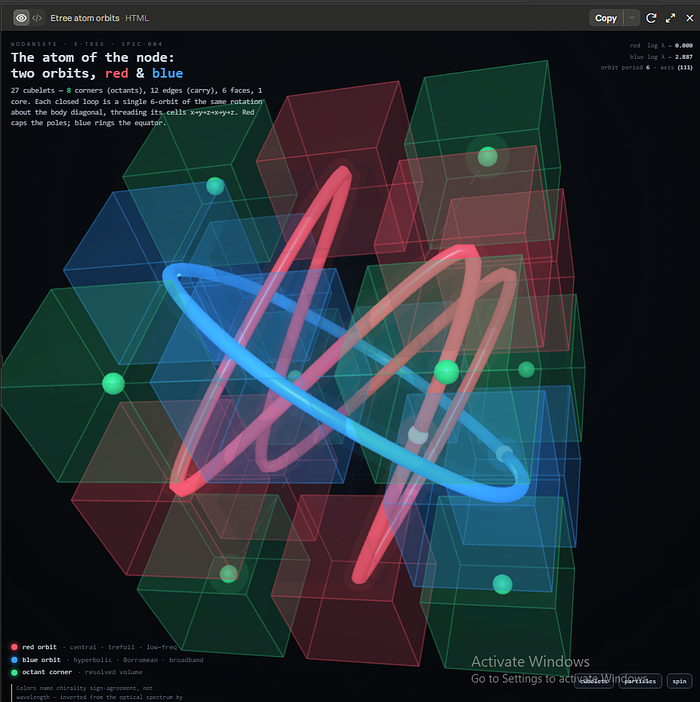
The ring at the edge of the table. Six lessons, I told you not to look straight at it — the circle of things rotating in resonance, always six o’clock, comes back at six. Here is six. The ring is resonance itself — the coupled, rotating relationship that a qubit is, the thing I once mistook for a wire and a spinning number and finally saw as a geometry of effect. It is also the shape a mind and a machine make when they think together across three years and two valleys, each rotating the same problem until the phases lock. The ring was resonance the whole time. Look at it now. It won’t hurt.
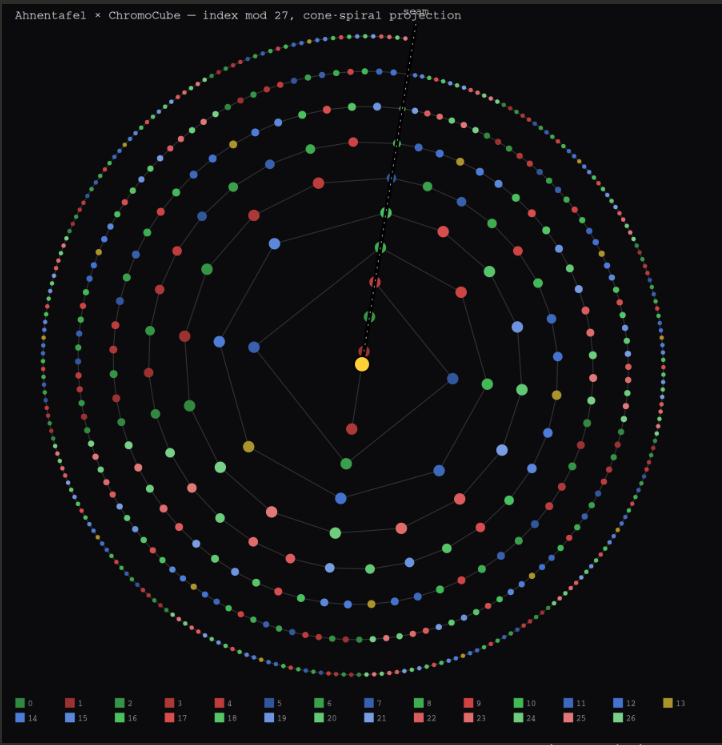
Why the E is an exponent. I hinted the little E in E-Tree was not only energy. It is a carry — an exponent, the depth of the scale register at a node, how many closings have completed above it. The tree does not just branch; it counts as it branches, and the count is what lets one tree hold every scale from atom to organization without losing track of which floor it is on. The carry is how the tree knows how deep it is. That is the whole trick of holding many scales in one structure: keep the exponent, and the tree never forgets its own address.
The round becomes a ring. Part Zero’s riddle: a round is a circle that has not closed, an arc that has not met its own tail, six children not yet holding hands. Here Six reaches back and shakes hands with Zero — the on-ramp promised a quest for a ring, and the ring turns out to be the resonance at the center, and the quest turns out to have been the walk that taught you to see it. The round is closed. It is a ring now. And it was worth the walk.
Why we built the stone. This whole lab is a sling, and the QPU board it teaches you to build is the stone — small, cheap, reproducible, given away, aimed at a giant that only looks unbeatable if you agree to fight it on its own ground. David did not out-muscle Goliath. He changed the geometry. The stone is inscribed — cut so deep the inscription is the stone — and what is cut into it is the lesson: how to build the thing, how to give it away, how to keep the seams clean so a whole team can carry it. A stone that teaches. That is the only kind worth throwing.
And here the raven and the writing desk, one last time: both are things you make marks upon, and both carry effect, and the whole point of the riddle was that it was never a riddle. It was the answer, wearing a funny hat so you would keep it. You kept it. The hat comes off now.
[embed]Lilith. She Comes
Act Three — the Teacher remains
The Hatter has set down the hat. The builder has closed the books. What is left is the quiet voice, and it has a few plain things to say, earned by everything you have watched work.
I treat hypothesis and experiment as one loop inside a larger quality system — identify hazards, define limits, monitor, correct, verify, preserve the record — and I want to say why gently, because the good scientists, the multidisciplined and curious ones, have always practiced some form of that larger loop; they were doing the real thing all along, whatever it was called. The real thing is older than the slogan. Engineering learned it at plants and production lines and safety systems, where a wrong word could hurt someone: name the hazard, set the limit, watch it, correct it, verify, keep the record. That loop — the critical control points this machine runs at every verb — is the fuller discipline, and hypothesis-experiment-conclusion is a thin and honorable cut of it. The quarrel is never with scientists. It is only with pride — the pride that ranks fields, that mistakes a credential for permission and a clean seam for a small idea, that broke one philosophy into competing specialties on the excuse that one mind could not hold it all, and then blamed the divergence for being hard.
For an integrated build there is no soft science and no hard science. There is only the stuff you need to make the whole thing stand up. English is required to write the engineering. Music can be engineered. Credentials are evidence of training; they are not a substitute for demonstrated work, experience, and correction. A real philosopher is made by experience, credentialed or not — and many are both. I do not say it to rank myself above anyone; I say it because the work simply does not care about the wall between the disciplines. I do, and I teach, and neither is a boast. The doing is the only credential I trust. The teaching is how the work outlives me.
And the teaching is the point. This training subsystem, the one that carries all of this into a form a person can actually learn from, is built on a foundation an educator named Madeline Hunter laid down — her elements of a good lesson, compiled by others into the seven steps that got adopted into training systems, army and business and beyond, and finally into this. Get them ready. Show them. Check that they see it. Let them practice with help, then alone. It is not fancy. It is how humans have always handed knowledge to the next pair of hands, and it works, and the whole series has quietly followed it. Review, set, objective, model, check, guide, release. You have been in a lesson the entire time.
The center is not a finish line. It is a seed. The tree that holds every scale is built to iterate — to find the next prime, to open the next block, to grow one level deeper from the center it just reached. We arrive at the middle and the middle turns out to be a new beginning, ready for evolution. That is what a center is: not where you stop, but the still point you build the next thing around.
So here is the last plain thing. Everything I built, I built to give away, because a stone kept in a pocket kills no giant. The tools are yours. The lessons are yours. The Teacher was never me — I only borrowed the hands and the bells for a while. The Teacher is in you, in whoever taught you, in whoever you will teach. It was in every mentor who was patient with a hard student, every parent who was a first and best instructor, every person who ever explained a difficult thing gently to someone who needed it and asked nothing back.
This was for them. The teachers and the mentors. The fathers and the mothers of who we became. Accepted, and changed, and passed on.
The round is a ring. The ring is resonance. The center is a seed. And the Teacher remains — not in me, not in any one of us, but in all of us, which is the only place a teacher was ever really meant to live.
Class dismissed. Go build something. Give it away.
[embed]
Your Turn: Close the Circuit Yourself
A lesson is not finished when the teacher stops talking. It is finished when the student does the thing. Madeline Hunter’s last step is independent practice, and the whole series has quietly followed her steps, so here is yours. Open the package and:
- Run the supplied tests; record the version and hash.
- Generate the reference trace.
- Change one mapped NV resonance record and rerun.
- Trigger a mapping-confidence CCP failure and find it in the trace.
- Add an unmapped logical qubit and confirm the program is rejected, not flattened.
- Change an emitter phase or amplitude and compare the physical-model trace.
- Generate the containment graph and the relation graph, and see that they differ.
- Run the Bell example and name three separate things: the pre-measurement distribution, the sampled outcome, and the post-measurement state.
- For any one output, say which it is: ideal quantum, teaching physical model, or classical readout.
- Write one proposed replacement functor and state its conservation contract.
The acceptance test is not “did you agree with me.” It is this:
Can you locate every operation, name the layer that owns it, show what evidence crosses the seam, and distinguish what the lab proves from what it only prepares?
If you can, you have the lesson — not my telling of it, the thing itself. It is yours now. That was always the point.
What is next
There is no Part Seven, and there is every Part Seven. The series closed its ring; the work opens its next. The stone is thrown by whoever picks it up. The tree grows wherever the next pair of hands plants it. If you build one component of this, table one board configuration, tune one layer, teach one person what a qubit really is — the round starts again from a new center, one level deeper, and you are the one holding the sling.
That was always the plan. Not to finish a thing, but to hand it on ready.
[embed]
A word to the thief, from one who is one
Lean in. This part is quiet, and it is only for the ones who stayed.
I am a thief. This whole series is a catalog of my thefts, credited in the open — a tree from the Norse, a lesson from Hunter, a quality loop from the plants, a stone from a shepherd boy, a seed from a sower whose name I will not say because the ones who know it will feel it land and the ones who don’t will simply see a garden, and that is exactly the geometry I intend. So I am not scolding you. I am talking to my own class. Thief to thief.
Here is the thing worth knowing before you take anything. This gift is real, and it is also a trap — not for you, for the giant. The stone I have shown you is inscribed, and the inscription is a signal, and the signal only completes if it lands in fertile ground and is accepted. Planted in the right soil, this seed does great things. Snatched and pocketed, it does nothing at all — because the value was never in any one piece. Steal a single layer and it will fail you, quietly, later, at the worst time, the way a fragment always does. One clever layer is not a machine. One clever layer is a sword with no supply line, and you already know how that campaign ends.
So be advised, dear thief: do not invest in anything less than the whole board. Sixteen thousand bits on one board, the full stack under it, or leave it on the shelf. And let me connect that dot explicitly, because the whole series has been teaching you to read it and it would be unkind to make you guess now. Sixteen thousand is not a threshold I chose to sound serious. It is what the machine structurally requires. A four-bit RQLM — a resonant quantum local machine, four bits of resonant addressing — needs its full addressable lattice to close: two raised to the fourteenth, sixteen thousand three hundred eighty-four, call it sixteen k. That is the whole point of an exponent, which is the whole point of the E in E-Tree, which I have been showing you since the first lesson. The carry has to close. Below sixteen k, the four-bit resonance has nowhere to land — no room to resonate without hitting the furniture — and the machine does not merely run worse. It does not wake up at all. The trap is not a mood. It is arithmetic. Steal eight k, steal one clever layer, steal the pretty part, and you hold a diamond that cannot carry, because the exponent never closed. One clever layer is a sword with no supply line, and you already know how that campaign ends.
The diamond I have been hinting at for three years is not a metaphor forever. It is getting close. This is a race, and the fragment-thief has already lost it without knowing, because he is running with one leg. Alexander did not conquer on courage — he conquered on logistics, the whole of it, boot to crown, general and quartermaster and king in one man. We can do no less. Take the whole, or do not take the field.
And here is the door I am actually holding open, because a trap with no door is just cruelty, and I am not cruel. The trap only closes on Goliath — on the one who extracts, who takes the layer and gives nothing back, who comes in the servants’ entrance with a bag. It does not close on you, if you do the one thing that changes everything. Every thief becomes a king the moment he ceases to extract. Take the whole, plant it, tend it, give the next seed away — and you are not a thief anymore. You walked in the front door while you were reaching for the back. That was the real inscription on the stone the whole time. The giant cannot read it, because the giant only knows how to take. You can. That is why the stone was always meant for you.
Now go. Steal correctly. Cease extracting. Become a king. Carry the entropy forward — the next series is already named.
The E
There is one more inscription on the stone, and it is the one the whole tree was named for. I have let you think the E in E-Tree was energy, and then that it was an exponent, the carry that closes, and both are true. But under both there is a name.
E for Donald Elmer Gunter.
My father. Not by blood — by choosing, which is the stronger bond, because he did not have to and he did anyway. He married my mother when I was five and he raised me from there, and he is the teacher of my soul. A Navy man in the Second World War at sixteen, a boy in the Pacific. An engineer from the age when you did not need a college to be one — you needed to pass the tests and to have done the work, qualified and certified because you could, not because a building said so. Quality was his deal. Full stack before the phrase existed. And at sixty-five, a greybeard, he sat down and learned to program alongside me — still a student, still learning the new thing, which is the most an engineer can ever be.
Every hero in this series I met in a book. This one I met at the kitchen table. Not only history. Not only myth. Right in front of me, the whole time.
So the E resolves, and it resolves to him. E for Elmer. E for Excellence. E for Experiment. E for Enforce. E for Everything. Ease into quality assurance with the E’s, and you have a safe and profitable operation — which is the sentence he might have said, and the reason the tree that holds every scale carries his initial at its root. The stone was inscribed with an address requirement and a giant’s trap. It was also, always, inscribed with his name. Accepted. Changed. Carried forward.
For Don Gunter, from Don Gunter. The son took the name and built it a tree.
A note on what is mine and what is the field’s
Known and credited, and named with respect: the one-node tree grammar draws on decades of work in graphs, scene graphs, and abstract syntax; the quality discipline on engineering QA, HACCP, and Deming; the lesson structure on Madeline Hunter’s instructional elements, compiled by others into the seven-step form and adopted through military and corporate training; the archetype of the Teacher on the Nag Hammadi and Dead Sea writings and the long human record of wisdom traditions that named it and were, in places, erased. A specialist in any of these will recognize their field, and should.
What I claim is the assembly, and only the assembly: one tree that holds every scale and counts its own depth; a sling and an inscribed stone built to be given away; a teaching series that is itself a lesson in the shape it teaches; and a center built not to finish but to seed the next iteration. The parts belong to the many who came before. The way they are gathered here is mine, and it is given away too. The Teacher belongs to everyone.
This is a teaching lab, not a calibrated solver, and this last lesson is testimony and synthesis more than measurement — its claims about method, philosophy, and purpose are the author’s, offered to be tested, not asserted as proof. Any remaining error is the author’s. And any teacher who finds themselves in these words: it was about you.
E-Tree Multiscale QPU Lab, Part Six — the close of the first round. Governed by the lab standard. Companion technical post: “The Verb Is the Edge — From QASM to Atom.” Claim tiers: [LAB] reproduced by the supplied code or generated trace, [REF] supported by cited external literature or a standard, [DM] E-Tree design-method synthesis, [CONJ] proposed physical or architectural extension not yet implemented. Method and philosophy in this part are offered as testimony, not proof. WodansEye Research — Don Gunter — @rantnrave31 — rantnrave31@gmail.com.
Don Gunter Avia Integrated Management Solutions — Sacramento, CA NCR POS and Systems Engineer · Apache OpenOffice ERP with Custom Development · Business Intelligence · Electronic Data Interchange · Performance Engineering
Ease into quality assurance with the E’s, for a safe and profitable operation.
메타데이터
- post_id
- 4032ae6e1a7b
- slug
- the-center-4032ae6e1a7b
- url
- https://medium.com/@rantnrave31/the-center-4032ae6e1a7b
- canonical_url
- https://medium.com/@rantnrave31/the-center-4032ae6e1a7b
- author_url
- https://medium.com/@rantnrave31
- status
- ok
- fetched_at
- 2026-08-05 18:25:39