Ninja Were Ordinary Spies. The Black-Clad Assassin Was Invented Centuries Later.
The most recognizable figure in the world is mostly a costume borrowed from the theater. The real shinobi were something quieter and far…
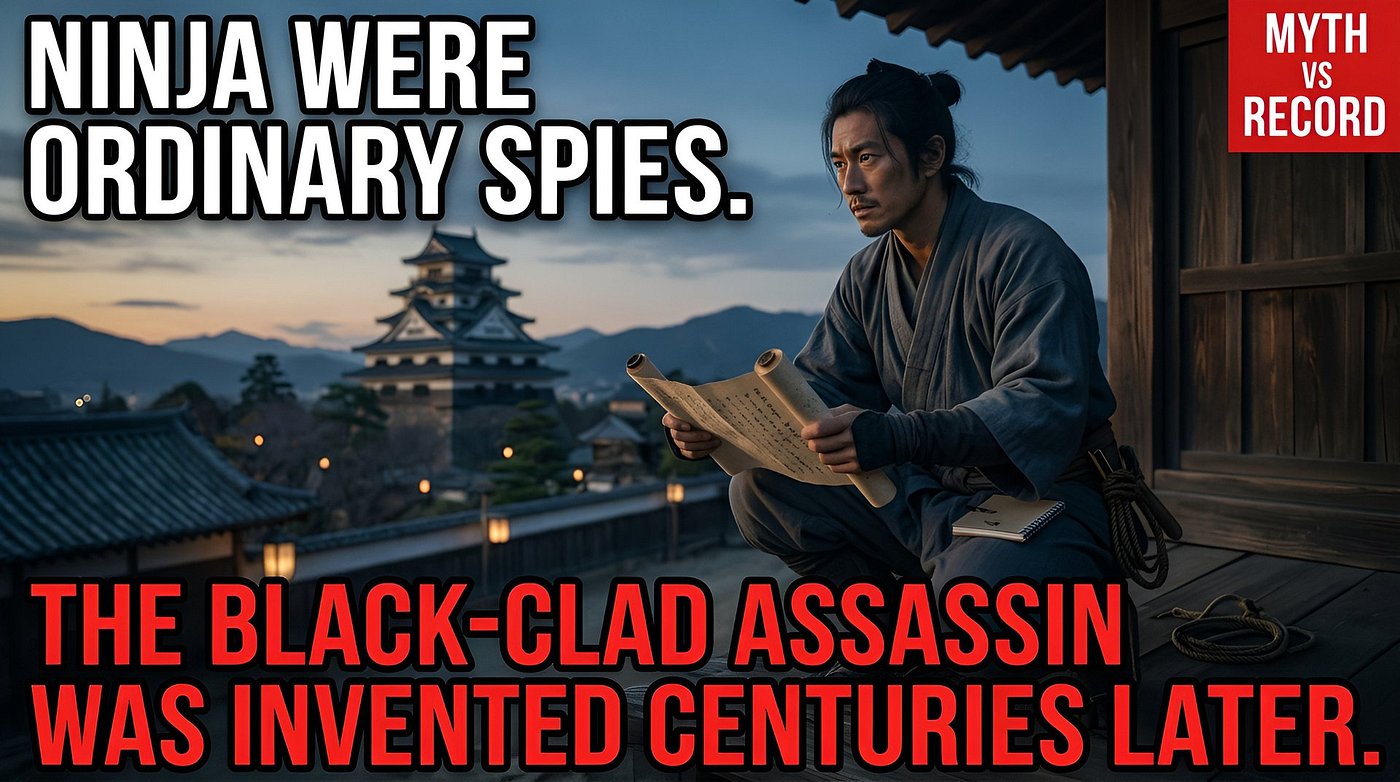
Ninja Were Ordinary Spies. The Black-Clad Assassin Was Invented Centuries Later.
The most recognizable figure in the world is mostly a costume borrowed from the theater. The real shinobi were something quieter and far more impressive.
**Watch: The full video here**
Some cool design products click here
Picture a ninja.
Black hood and mask, only the eyes showing. A throwing star between the fingers. A sword across the back. A silent, almost supernatural assassin moving across moonlit rooftops, vanishing in a puff of smoke.
It is one of the most instantly recognizable images on the planet as legible in São Paulo or Stockholm as in Tokyo. And almost none of it is real.
This isn’t to say ninja didn’t exist. They did. The shinobi were real people who played a genuine, documented role in Japanese history. But the figure you just pictured the black-clad killerwas not what they were. That image wasn’t created in the war-torn provinces of feudal Japan. It was assembled centuries later, first on a theater stage, then sealed by a film in 1962, and finally carried around the world by Hollywood, comics, and video games.
The real story is more interesting than the myth. And the unusual thing about the ninja is that we can watch, almost step by step, how the myth was built.
What the Record Actually Says
Start with the documented reality.
The shinobi came mostly from two rugged, mountainous regions of Japan: Iga and Koga. Isolated, hard to govern from the outside, these areas became known for communities that trained covert operatives and hired them out to the warlords of the surrounding provinces.
The timing matters. This was the Sengoku period Japan’s “age of warring states,” running from the 15th into the early 17th century, when the country fractured into dozens of domains and the daimyo fought each other constantly. In that environment, one thing was worth more than swords: information. Who was moving where, with how many men, and how a castle might be entered.
That is what shinobi actually did. Scouting. Infiltration. Gathering intelligence. Sabotage. Spreading misinformation. It was the unglamorous, high-stakes work of espionage, and it often decided battles before a single blade was drawn.
And the foundation of all of it was the exact opposite of a black costume. It was disguise. The real shinobi dressed as farmers, as merchants, as monks, as traveling entertainers whatever let them pass a checkpoint unnoticed and listen.
Think about the basic logic:
a spy’s entire job is to not be noticed, and a man in an all-black outfit creeping down a road is the most noticeable person alive. The shinobi’s genius wasn’t standing out. It was being forgettable. Being no one in particular.
We don’t have to guess at any of this, because the shinobi left manuals. The Bansenshukai. The Shoninki. The Ninpiden compiled in the 1600s as something close to encyclopedias of the craft. And what they emphasize is telling: infiltration, disguise, escape, memory techniques, conversation skills, how to read people and blend into any social setting. Some of it draws on Chinese military thought, including the espionage principles of Sun Tzu. The shinobi’s primary weapons were patience, observation, and deception not a blade.
One honest caution, because precision is the whole point of a video like this: those manuals were written down later, sometimes by authors with an agenda to romanticize their own tradition, so even the surviving record carries a little legend inside it. But across all of it, the picture is consistent. These were spies, not supernatural killers.
The Real Hattori Hanzō
If one name survived the shinobi world into global pop culture, it’s Hattori Hanzō. Today he’s a video game character and the name of a master swordsmith in Kill Bill. The real man was more impressive than any of it and he proves the point.
Here’s the first myth to drop: Hanzō was not a lone assassin in black. He was a senior samurai retainer and military commander serving Tokugawa Ieyasu, one of the most consequential warlords in Japanese history. He came from the Hattori family, with roots in Iga, and he distinguished himself in real battles. Crucially, he could draw on the Iga shinobi networks as a military resource which is what made his defining moment possible.
That moment came in 1582. Oda Nobunaga, the warlord then unifying Japan, was suddenly assassinated by one of his own generals. Chaos erupted across the country. And Tokugawa Ieyasu found himself caught in hostile territory, far from safety, with almost no escort needing to cross the dangerous Iga region to get home. It was some of the deadliest terrain imaginable, full of fighters who would have killed him for a reward.
This is where Hanzō earned his place in history. Using his family’s connections, he organized the Iga and Koga networks by some accounts hundreds of men to act as guides and escorts, moving Ieyasu through the mountains along paths they knew intimately, securing the route, feeding back intelligence on where the danger lay. Ieyasu survived what became known as the Iga Crossing.
That survival changed everything. Within a few years, Ieyasu rose to rule all of Japan, founding the Tokugawa shogunate that would govern for over 250 years. A shinobi network helped make that possible. That isn’t a fairy tale it’s the historical record.
And Hanzō’s supposedly supernatural reputation? Historians point out that his “magical” feats were the product of clever misdirection, careful timing, and striking at the opportune moment. Skill and intelligence, not sorcery. The myth took genuine competence and rebranded it as magic. There’s even a real trace of him still on the map: a gate of the Imperial Palace in Tokyo is called Hanzōmon Hanzō’s Gate after the Hattori family. The real man left a mark on Japan. The legend left a mark on the whole world.
So Where Did the Black Suit Come From?
If the real shinobi dressed as farmers and merchants if invisibility through disguise was the entire point then where did the most famous costume in the world come from? The hood, the mask, the head-to-toe black?
The answer is the theater. Specifically, kabuki and once you see it, you can’t unsee it.
In kabuki, there are stagehands called kuroko. They move props, manage costume changes, and assist the actors during the live performance, in full view of the audience. And they dress head to toe in black. The black outfit is a convention, a signal: this person is not part of the story. The audience agrees not to “see” him. He is, by mutual agreement, invisible.
Now imagine you’re staging a play and the plot calls for an assassin to strike from nowhere a figure the audience shouldn’t see coming. What costume is already backstage, already understood by every viewer to mean invisible? The black kuroko outfit. So the theater dressed its sneaking, striking shinobi characters in black, borrowing a visual language the audience already knew.
It was brilliant stagecraft. But it was never what real spies wore. Over time, audiences forgot it was a convention and began to assume it was a uniform. The costume of theatrical invisibility quietly became “what ninja wore.” The single most iconic thing about the ninja is, in truth, a stage trick.
How the Legend Grew
From the stage, the legend kept inflating. The Edo period brought a long peace to Japan, and the shinobi’s real work — wartime espionage — faded into obsolescence. But the stories didn’t fade. They grew. The Iga warriors became characters in popular tales, each retelling more dramatic than the last, until real spies had become invisible superhumans who could walk through walls and vanish in smoke.
Even the language records the transformation. The word “shinobi” originally described an action — something done stealthily, in secret. Over time it hardened into a noun: a stealthy person, a secret warrior. A secret deed became a secret man. The grammar itself preserves the moment the myth took shape.
Compare all of that to the earliest known historical account, which is mundane by comparison. In 1541, a monk recorded that a group from Iga entered Kasagi castle “in secret” and set fire to some buildings. That’s essentially it. They might have been mercenaries or thieves; all the record actually tells us is that they acted in secret. From that quiet seed grew a global mythology.
The Myth Goes Global
Then came the moment the modern ninja was locked in: 1962, and a Japanese film called Shinobi no Mono. It assembled the complete package on screen — the black robes, the secret code, the specialized weapons, the near-superhuman skill, the silent assassin. Everything we now reflexively associate with “ninja,” fused together and fixed in the popular imagination by a movie.
From there the image spread. More Japanese films, then a crossing of oceans. By the 1980s the West was in a full ninja craze Hollywood movies, cartoons, toys. Then video games and comics carried it further still, until the black-suited ninja became one of the most recognizable character types on Earth, almost completely detached from the historical shinobi it supposedly depicted.
Watch the legend swallow the real man. Remember Hattori Hanzō, the actual intelligence commander who helped shape Japanese history? In Kill Bill, “Hattori Hanzo” is a retired master swordsmith living in Okinawa — the name of a real Sengoku commander attached to a character who has nothing to do with him. That’s the whole pattern in a single example: a documented historical figure reduced to a cool-sounding brand. The real Hanzō guided a future ruler across a death trap. The fictional one forges swords for Uma Thurman. Guess which one most people can name.
The Pattern: Legend Overwrites Reality
This is why the ninja matters beyond Japan and the 1500s. What happened to the shinobi happens constantly. We take a documented, often mundane reality and replace it with a more thrilling invented version because the invention is simply better entertainment.
And the invented version wins every time. We remember the assassin in black; we forget the farmer with a notebook who actually changed the course of history. The myth is engineered to be memorable. The truth just has to be true.
We do it to outlaws, turning violent robbers into charming folk heroes. We do it to pirates, turning brutal criminals into swashbuckling adventurers. We do it to soldiers, founders, and gangsters. And modern media accelerates the process: a single film, game, or show can lock a false image into hundreds of millions of minds in one release exactly the way one 1962 film locked in the ninja.
The ninja is just the clearest case, because unlike most myths, this one left a paper trail. We can name the theater convention. We can name the film. We can watch the costume get assembled, piece by piece, and see exactly where it diverged from the record.
Respect the Real Ones
None of this diminishes the real shinobi. Just the opposite.
Consider what their actual work demanded: walking into enemy territory, unarmed, in disguise, where a single slip in your cover story meant death. No superpowers, no magic just nerve, intelligence, and meticulous preparation, with your life on the line the entire time. That took extraordinary skill and courage. The farmer-spy who survived by being invisible is a more impressive figure than the flashy assassin who never existed.
And the real Hattori Hanzō the commander who guided a future ruler of Japan across a death trap and helped shape two and a half centuries of history — is a better story than any swordsmith Hollywood could invent.
So the next time you picture a ninja in black, remember what you’re actually picturing: not a spy from the 1500s, but a costume from the kabuki stage, sealed by a movie from 1962. And remember the larger pattern, because it’s everywhere the exciting invention quietly replacing the documented truth, until the invention is all that’s left.
The defense against it is simple, and it’s the whole point of this work: ask where the image came from, and ask what the record actually says. The gap between those two is almost always the real story.
Watch the Full Story
This article covers the framework. The full History’s Hot Takes documentary-style video goes deeper the espionage manuals, the full story of the Iga Crossing, the kabuki origin of the costume, and how a 1962 film built the ninja the world now knows.
**Watch: “Ninja Were Ordinary Spies. The Black-Clad Assassin Was Invented Centuries Later.”**
👉 History’s Hot Takes on YouTube
History’s Hot Takes examines the gap between the story you were told and what actually happened. New videos every Tuesday (Shorts) and Thursday (full episodes).
Tags: Ninja, Shinobi, Japanese History, Myth vs Reality, Hattori Hanzo, Feudal Japan, Sengoku Period, History, Pattern Recognition, Kabuki
메타데이터
- post_id
- 403e4a56c28d
- slug
- ninja-were-ordinary-spies-the-black-clad-assassin-was-invented-centuries-later-403e4a56c28d
- url
- https://medium.com/@flatliner333/ninja-were-ordinary-spies-the-black-clad-assassin-was-invented-centuries-later-403e4a56c28d
- canonical_url
- https://medium.com/@flatliner333/ninja-were-ordinary-spies-the-black-clad-assassin-was-invented-centuries-later-403e4a56c28d
- author_url
- https://medium.com/@flatliner333
- status
- ok
- fetched_at
- 2026-06-20 20:29:01