AI Agents for Autonomous Business Operations
Abstract
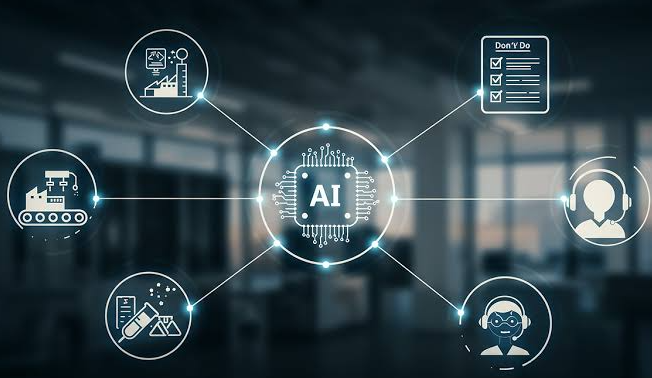
AI Agents for Autonomous Business Operations
Abstract
Artificial Intelligence (AI) agents are transforming traditional business operations by enabling autonomous decision-making, adaptive learning, and intelligent task execution. Unlike conventional automation systems that rely on predefined workflows, AI agents perceive their environment, analyse contextual information, reason about alternatives, and execute actions with minimal human intervention. Powered by large language models (LLMs), reinforcement learning, knowledge graphs, and cloud-native infrastructures, AI agents are capable of managing end-to-end business processes across finance, supply chain, customer service, human resources, and enterprise operations. This research discusses the architecture, operational workflow, applications, benefits, challenges, and future directions of AI agents in autonomous business environments. The study highlights how intelligent agents improve organisational agility, operational efficiency, decision quality, and business resilience while enabling enterprises to transition toward self-managing digital ecosystems.
Keywords: AI Agents, Autonomous Business Operations, Enterprise Automation, Large Language Models, Intelligent Decision Systems, Multi-Agent Systems, Business Process Automation.
1. Introduction
Modern enterprises operate within highly dynamic and data-intensive environments where rapid decision-making is essential for maintaining competitiveness. Traditional Business Process Automation (BPA) has significantly improved operational efficiency by automating repetitive tasks. However, rule-based automation lacks adaptability when faced with changing business conditions, uncertain environments, or unstructured information.
AI agents represent the next evolution of intelligent automation. These autonomous software entities can perceive business environments, interpret organisational goals, make context-aware decisions, and continuously learn from operational feedback. Unlike static automation scripts, AI agents collaborate with humans and other intelligent agents to optimise workflows, resolve exceptions, and proactively identify opportunities for improvement.
The integration of generative AI, retrieval-augmented generation (RAG), cloud computing, and enterprise knowledge repositories has accelerated the adoption of AI agents across industries. Autonomous business operations powered by AI agents reduce operational costs, improve customer experiences, minimise human errors, and enable continuous optimisation of enterprise processes.
2. AI Agent Architecture for Business Operations
A typical AI agent architecture consists of multiple intelligent components that work together to achieve organisational objectives.
a) Perception Layer
The perception layer collects structured and unstructured data from enterprise applications such as ERP systems, CRM platforms, IoT devices, databases, emails, and business documents.
b) Knowledge Layer
This layer integrates organisational policies, historical records, business rules, and domain knowledge into a unified knowledge repository that supports intelligent reasoning.
c) Reasoning Engine
The reasoning module analyses incoming information using machine learning models, large language models, optimisation algorithms, and inference techniques to generate informed decisions.
d) Planning Module
The planning component determines the optimal sequence of actions required to accomplish business objectives while considering operational constraints and priorities.
e) Execution Layer
This layer interacts with enterprise software, APIs, robotic process automation tools, cloud services, and communication platforms to execute business actions automatically.
f) Learning Module
Continuous learning mechanisms evaluate operational outcomes, collect feedback, and update decision models to improve future performance.

3. Operational Workflow
The autonomous business operation process generally follows six stages:
- Enterprise systems continuously generate operational data.
- AI agents collect and preprocess relevant business information.
- Context-aware reasoning identifies business objectives and constraints.
- Intelligent planning selects the optimal execution strategy.
- Agents perform automated actions across enterprise platforms.
- Performance metrics are evaluated, and learning models are updated for continuous improvement.
This closed-loop operational model enables businesses to become increasingly autonomous over time.
4. Enterprise Applications
Financial Operations
AI agents automate invoice processing, financial reconciliation, fraud detection, expense approvals, budget forecasting, and regulatory compliance monitoring.
Customer Service
Virtual AI agents manage customer interactions, resolve service requests, personalise recommendations, and escalate complex issues when human intervention is necessary.
Supply Chain Management
Autonomous agents optimise inventory levels, predict product demand, monitor logistics, identify supply risks, and coordinate procurement activities.
Human Resource Management
AI agents assist with recruitment, resume screening, employee onboarding, training recommendations, workforce planning, and performance analytics.
IT Operations
Intelligent agents monitor infrastructure health, detect anomalies, automate incident resolution, optimise cloud resources, and manage cybersecurity alerts.
Sales and Marketing
AI agents analyse customer behaviour, generate personalised campaigns, qualify leads, forecast sales, and optimise pricing strategies.
EQ.1. Agent Confidence Score:

5. Benefits of AI Agents
The adoption of AI agents provides numerous organisational advantages.
Improved Operational Efficiency
Routine business activities are completed faster with minimal manual intervention.
Continuous Decision Making
AI agents operate around the clock, enabling uninterrupted business operations.
Reduced Human Error
Autonomous execution minimises mistakes caused by manual data entry and repetitive tasks.
Adaptive Learning
Agents continuously improve their decision-making capabilities based on new business experiences.
Enhanced Customer Experience
Personalised interactions and faster response times improve customer satisfaction.
Cost Optimisation
Automation reduces operational expenses while improving resource utilisation.
Scalable Enterprise Operations
Multiple AI agents can collaborate across departments without significantly increasing infrastructure costs.

6. Challenges
Despite significant advantages, several challenges remain.
Data Quality
Incomplete, inconsistent, or inaccurate enterprise data can negatively affect agent decisions.
Explainability
Complex AI models often lack transparency, making it difficult for organisations to understand autonomous decisions.
Security and Privacy
AI agents require access to sensitive enterprise information, increasing cybersecurity and data privacy risks.
Governance
Clear policies are needed to define decision authority, accountability, compliance, and ethical AI usage.
Integration Complexity
Legacy enterprise systems often require extensive integration efforts before autonomous agents can operate effectively.
Human Trust
Employees may hesitate to rely on autonomous systems unless decisions are transparent, reliable, and aligned with organisational objectives.
EQ.2. Multi-Agent Collaboration Score:

7. Future Directions
Future AI agents will evolve into collaborative multi-agent ecosystems capable of independently managing entire business functions. Advances in foundation models, explainable AI, digital twins, federated learning, autonomous workflow orchestration, and self-healing enterprise architectures will further enhance business autonomy.
Agent-to-agent communication standards will enable seamless collaboration between finance, logistics, customer support, and manufacturing agents. Additionally, ethical governance frameworks and responsible AI principles will become central to enterprise AI adoption. Hybrid intelligence models, where humans supervise strategic decisions while AI agents manage operational execution, are expected to become the dominant enterprise paradigm.

8. Conclusion
AI agents represent a significant advancement in enterprise automation by combining intelligent reasoning, adaptive learning, and autonomous execution into unified business systems. Their ability to perceive operational environments, make context-aware decisions, and continuously optimise workflows enables organisations to improve efficiency, agility, and competitiveness. Although challenges related to governance, explainability, data quality, and cybersecurity remain, ongoing advancements in AI technologies and enterprise architectures are steadily addressing these limitations. As businesses increasingly embrace digital transformation, AI agents will become foundational components of autonomous enterprises, supporting intelligent decision-making, operational resilience, and sustainable organisational growth. Their widespread adoption marks a transition from conventional automation to self-managing business ecosystems capable of responding proactively to evolving market demands.
메타데이터
- post_id
- 404aafd8ac7b
- slug
- ai-agents-for-autonomous-business-operations-404aafd8ac7b
- url
- https://medium.com/@siva.kolla.hemanth/ai-agents-for-autonomous-business-operations-404aafd8ac7b
- canonical_url
- https://medium.com/@siva.kolla.hemanth/ai-agents-for-autonomous-business-operations-404aafd8ac7b
- author_url
- https://medium.com/@siva.kolla.hemanth
- status
- ok
- fetched_at
- 2026-08-09 07:59:28





