‘Hamnet’ review: it could have been so great
Whilst not being a dire attempt, I am ultimately left a tad underwhelmed by this promising tale of Elizabethan-era woe.
‘Hamnet’ review: it could have been so great
Whilst not being a dire attempt, I am ultimately left a tad underwhelmed by this promising tale of Elizabethan-era woe.
I met, (I use the word ‘met’ loosely here), Paul Mescal outside the Noel Coward theatre stage door after watching him in ‘A Streetcar Named Desire’, just short of a year ago. One of my friends had a copy of Maggie O’Farrell’s novel, ‘Hamnet’, with her and asked him to sign it — which he happily did. That was the first I’d heard about the story and of his involvement in it’s upcoming silver screen adaptation. Though intrigued, I’d be lying if I said I’d given much thought to it since and so, as the press tour began to make its way onto my feed (of which this is the best: https://www.youtube.com/watch?v=d4owbvhmQ5w), I considered it my duty to do a little bit of research before booking my ticket.
It didn’t take long for me to become very interested indeed. The mystery surrounding the context of O’Farrell’s book is fascinating. It centres around one Agnes Hathaway, the wife of William Shakespeare and mother of three children: Susanna, Hamnet (or Hamlet — the two were interchangeable in the time) and Judith. What is confidently known about Agnes, stops about here. Trusted reports of her or her livelihood are rare, and the universal public perception of her has long been shaped by myth and myth alone.
Agnes (or Anne — even her name is not known for certain), is widely considered as a bit of a villain in her husbands’ life; framed as an evil and shrewish peasant who trapped him into marriage at a young age and cursed his life miserable. This tale, however suitable it is for a malicious and corrupted framing a certain image of women of a lower class, is based on no fact whatsoever.
What’s true too is that no one knows the origin story of Shakespeare’s play ‘Hamlet’ and how or why he decided to write it; though this does have a much more compelling case to be drawn. Records show that the pair’s only son died aged just 11 — a victim to what can be reliably assumed as the plague and that his father was away from home with his theatre troupe when it happened; it is almost impossible that Shakespeare could have returned quickly to console his family or indeed in time for the funeral. He wrote ‘Hamlet’ four years later. It doesn’t take a genius to deduct that there is probably a correlation.
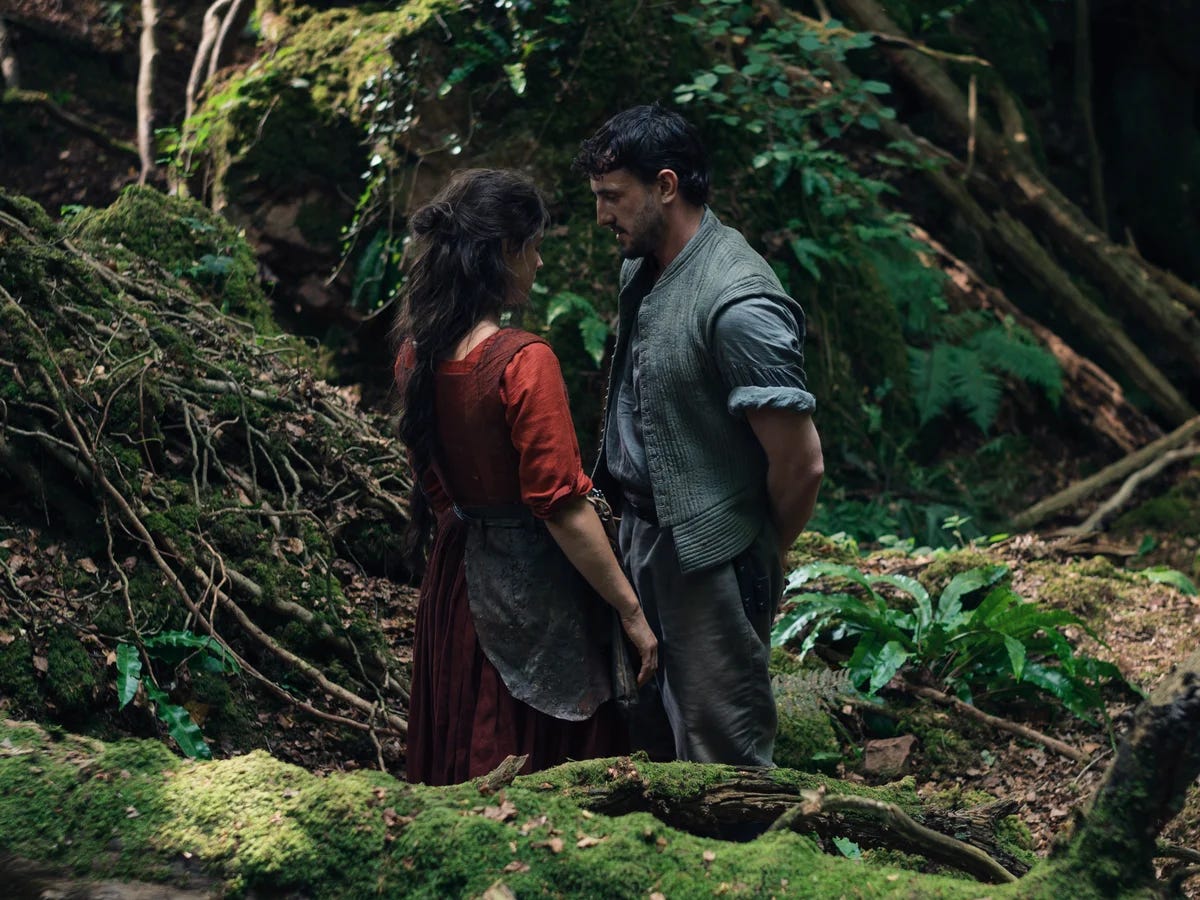
This film, like the novel it’s based on, takes a different approach to Agnes than history is used to. She is not a cunning and manipulative predator, but exactly the sort of woman you’d expect Shakespeare to fall for. Independent, intelligent, gifted and fierce in her love for both him and their children. Director Chloé Zhao believes that maybe she deserves a story on her terms, for once.
Jessie Buckley plays Agnes and is, to no shock to those of you who have seen her act before, very good. Much has and will continue to be said about her performance — which is likely to win her an Academy Award this coming March — and this buzz is not without merit. She remains impressively grounded throughout the film, even in moments where her volume and body are anything but.
Buckley is supported by an ever-solid Mescal who is here furthering his reputation as a reliable and consistent communicator. The Irish duo are certainly adept in the theatrical — committed to their task and not afraid to lean into the extreme. I was not necessarily blown away by them upon leaving the screening, but further thought has led me to perceive that it may be that I’m taking their performances here for granted — which says something to the level they both frequently operate at.

So if not the story, or the acting, then why is it that I feel let down by this film? I think it comes down to, simply, Zhao’s handling of the material. She is, more often than is acceptable, too heavy handed with her direction. There is too much involvement from her as an author to allow the scenes to breathe, too many times where she pushes the emotion beyond that which is natural and too much force-feeding.
And it’s a real shame. There are good moments and, as I’ve made clear, the product (there is some seriously amazing stuff regarding art and the way it can serve as a healer), and cast (though they are under/mis-used), present an opportunity for a work brilliant but, unfortunately, Zhao is too inclined to the excess and, instead of trusting her actors and the tale they are telling, becomes obsessed with dictating an audience reaction.
The one glaring example of this comes as Mescal is preparing the performance of his play and, standing in the dark, feet on the edge of a drop, overlooking the River Thames, recites to himself his famous line: ‘To be, or not to be, that is the question’, as he contemplates suicide.
It’s too much and, at least in my view, too silly. I realise this film isn’t striving for realism — and that I admire — but there is a point when one has to restrain themselves as an artist and trust their audience to do the work without manipulating them into it. Otherwise it just becomes like a soap opera. We know it’s sad, we can feel that; you don’t need to tell us it so often.
And this is coming from a man whose favourite sub-genre is probably the melodrama.
OK, I might be a hypocrite.
Max Richter’s score is also a point of contention for me, for much of the same reasons. It is too safe, too boring and too obvious.
Imagine you go to try a new restaurant out. The atmosphere is good and the food seems tasty — you’re sold. But then every few minutes the waiter comes over and says “Wow, isn’t this food so good, isn’t the location so beautiful.” You might accept this the first time and put it down to a proud and over-excited employee, but then they come back again and again, saying the same thing. In the end, you don’t get the chance to properly taste how nice the food is or take in the surroundings because every time you go to take a bite the waiter appears to tell you.
I know it’s a sad film, I know it’s probably emotionally intelligent and interesting — but let me decide that. Don’t just shout it at me.
This all feels rather negative and that might be unfair from my part. I did not hate this film and absolutely am keen to rewatch it with an open mind. It is not, by any means, awful — or even overly bad; but it is a big waste and, I fear, nowhere near as good as it could have been.
‘Hamnet’ will have it’s desired effect on many people and the majority of those who go to see it will come away impacted, no doubt. I just can’t help but think: when you feel that a film’s primary goal is to make one cry till their eyes hurt, what good is it then if you don’t?
⭐️ ⭐️ ⭐️

메타데이터
- post_id
- 4070dd4aeb8a
- slug
- hamnet-review-it-could-have-been-so-great-4070dd4aeb8a
- url
- https://medium.com/@joelbird/hamnet-review-it-could-have-been-so-great-4070dd4aeb8a
- canonical_url
- https://medium.com/@joelbird/hamnet-review-it-could-have-been-so-great-4070dd4aeb8a
- author_url
- https://medium.com/@joelbird
- status
- ok
- fetched_at
- 2026-06-21 22:26:41