Cloudflare launched Monetization Gateway for AI Agents
Cloudflare wants any site to bill bots and agents for each request, paid in stablecoins over the x402 protocol. Here is my read on what it…
Cloudflare launched Monetization Gateway for AI Agents
Cloudflare wants any site to bill bots and agents for each request, paid in stablecoins over the x402 protocol. Here is my read on what it fixes, what it breaks, and who should be paying attention.
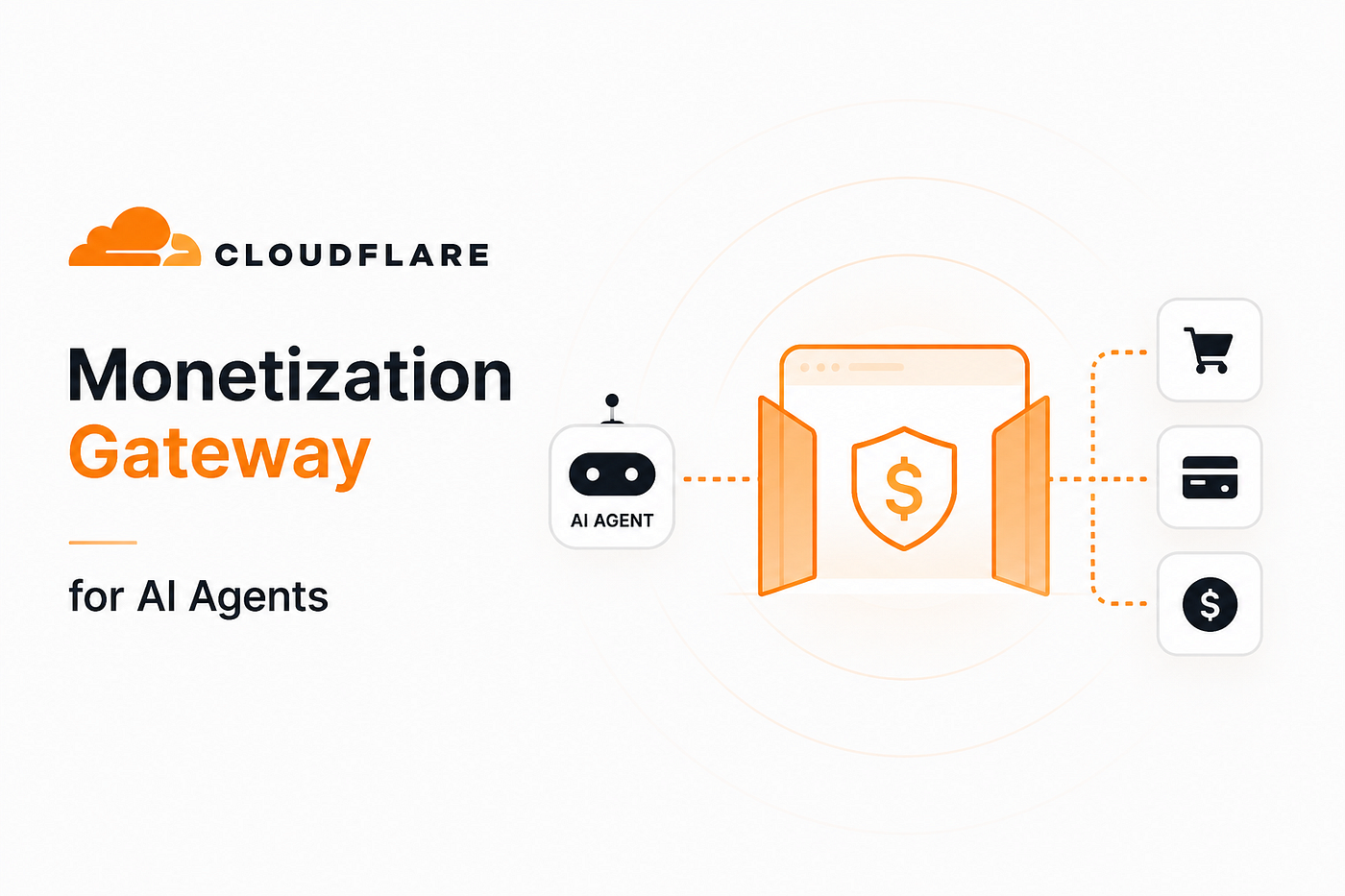
Cloudflare AI Monetization gateway
For about thirty years the web ran on one quiet deal. You put content online, people showed up to read it, and you made money from their attention through ads, subscriptions, or by selling them something. That deal is now cracking, and the reason is simple. The fastest growing visitors to most websites are not people anymore. They are AI agents and crawlers, and they do not behave like a human at all. An agent does not scroll past an ad or keep a monthly subscription to every tool it touches. It grabs what it needs once and moves on.
On July 1, 2026, Cloudflare opened the waitlist for its answer to this problem. It is called the Monetization Gateway, and the idea behind it is blunt. If a machine is going to consume your web page, your dataset, your API, or your MCP tool, it can pay you for the privilege.
The Cloudflare Monetization Gateway lets any resource sitting behind Cloudflare charge the caller for each request, with the payment settling in stablecoins over an open protocol called x402. You set the rules. Cloudflare handles the money.
I have been watching this shift for a while, and I think this launch matters more than the fairly dry announcement suggests. Let me walk through what it is, how the payment works, why it is happening now, and where I land on it.
What Cloudflare launched
To be precise about the state of it: this is a waitlist, not a live product for everyone yet. Cloudflare has not published pricing, a launch date, or even which blockchains it will support at the start. So temper the excitement accordingly.
What it will let you do is put a price on almost anything you already keep behind Cloudflare. A premium data feed. A single API route. An image generation endpoint. A proprietary dataset. A tool call inside an agent workflow. You write a rule in the Cloudflare dashboard, or through the API, or with Terraform if you manage everything as code, and that rule decides which traffic has to pay and how much.
The part I find clever is what you do not have to do. You do not have to build a billing system. You do not have to onboard the buyer, make them create an account, or get them to agree to a terms page. You do not have to run any payment machinery of your own. Cloudflare does the metering, the payment check, and the settlement at its edge, which means it happens close to the buyer and before the request ever reaches your server. Your origin stays protected from the flood of tiny payments, and you keep your rules, your prices, and your revenue.
This is not Cloudflare’s first move here. Last year the company gave site owners a simple switch to control which AI crawlers could reach their content, and then Pay Per Crawl let publishers charge those crawlers. The Monetization Gateway is the bigger version of that idea. Instead of only charging crawlers for content, you can charge any caller for any resource.
How the payment works
This is where a bit of old web trivia becomes useful. Buried in the HTTP standard for more than thirty years is a status code called 402 Payment Required. It sat there doing almost nothing, because nobody agreed on how a client and a server should actually use it. The x402 protocol, created by Coinbase, finally gives that code a job.
The flow is easier than it sounds. An agent asks for a resource. Instead of handing it over, the server replies with a 402, and inside that reply is everything the agent needs to pay: the exact price, which stablecoins are accepted, and the wallet to send the money to. The agent signs a payment, attaches the proof to the same kind of normal web request it was already making, and asks again. The server checks the proof and serves the resource. The whole thing takes seconds, needs no login, and settles on chain.
Two things make this work for machines specifically. First, there is no human checkout. The payment travels inside the web request itself, so an agent moving fast through thousands of calls is never stuck waiting for someone to type in a card number. Second, the money is stablecoins, digital dollars like USDC or Open USD. That matters because the charges here are tiny, often a fraction of a cent, and traditional card rails simply cannot handle amounts that small. The processing fee would cost more than the thing you are buying. Stablecoins settle almost instantly and cheaply enough that charging a tenth of a cent per call finally makes sense.
If a seller wants to confirm a real agent is behind the request rather than some random bot, Cloudflare can layer in its Web Bot Auth to verify the caller. But the default is simple. Proof of payment is the access pass. No account, no API key, no contract.
Why this is happening now
The economics are the whole story. Advertising and subscriptions were built for humans who linger. Agents do not linger. Cloudflare, which sees roughly a fifth of all internet traffic, points out that AI crawlers already request content anywhere from a hundred to tens of thousands of times for every visitor they send back. Read that again. For every human an AI sends to your site, it may have hit you thousands of times to feed its model, and you saw nothing for it.
Charging by the seat or the month makes no sense for a buyer that shows up once, takes one thing, and leaves. The natural model is paying for exactly what you use, request by request. That model has been impossible at web scale for one reason. You could not collect payments small enough without the fees eating the payment. Fix that, and a new economy opens up. That is what stablecoins plus x402 are meant to fix.
This is bigger than Cloudflare
It would be a mistake to read this as one company’s side project. A coordinated shift is happening across the biggest names in tech and payments.
x402 itself is not Cloudflare’s alone. Coinbase created it in May 2025, and it is now governed by the x402 Foundation under the Linux Foundation, with Cloudflare, Circle, Stripe, Google, Visa, Amazon, and even Anthropic involved. Coinbase says the protocol has already handled around 160 million agent payments in the past year, which is not nothing.
Cloudflare is also not first through the door. Amazon plugged the same x402 approach into CloudFront and its Bedrock AgentCore so agents can pay for each request in stablecoins. Google Cloud and Solana launched their own agent payment gateway called Pay.sh. So the picture is several giants racing to build the same toll booth for machine traffic, and Cloudflare sitting in front of so much of the web gives it unusually good reach for the idea.
There is a second, related battle worth knowing about, because people mix the two up. Everything above is about agents paying to access resources. A separate set of standards is about agents buying goods and services on your behalf. Google’s Agent Payments Protocol, or AP2, lets an agent carry a signed permission slip proving you authorized a purchase, and it works across cards, bank transfers, and stablecoins. Visa and Mastercard have their own agent commerce schemes running on their card networks. Different problem, same underlying question: how does money move when the thing spending it is software.
So where do I land
I like the design, and I think Cloudflare is playing the right card, which is reach. The smart move is not the payment protocol, which is open and shared by everyone. The smart move is that Cloudflare can turn agent billing into a single rule you write, backed by a network that already carries a huge share of the world’s traffic. Turning “build a metered billing stack” into “toggle a setting” is the kind of thing that gets adopted.
That said, I have real questions, and I will not pretend otherwise.
The obvious one is that we do not know the price, the timeline, or the chains. A waitlist with no numbers is a statement of intent, not a shipped product. There is also an adoption puzzle. This only works if agent builders give their agents wallets and spending budgets, and if publishers set prices worth paying rather than greedy ones. Both sides have to show up.
Then there is the quieter engineering reality. Paying inside a request that a client might retry means you have to make sure the same payment proof cannot be reused to grab the same thing many times over. You have to tie the payment to the exact resource being bought. Discovery is another loose thread. The 402 tells an agent the price only after it knocks, so the ecosystem needs good ways for agents to learn what things cost before they go shopping. And moving real money by machine drags in the unglamorous world of compliance, sanctions checks, and knowing who or what you are transacting with.
None of that is fatal. It is the normal list of hard problems for anything this early.
For anyone who builds or runs something online, here is the takeaway I keep coming back to. The web is splitting into two futures. In one, agents scrape you for free and you get nothing. In the other, you put a price on access and get paid every time a machine uses your work. Cloudflare just made the second future much easier to choose, and it handed that choice to small creators and niche publishers, not only to the platforms big enough to build payment systems themselves. That the balance tips toward the smaller players is the part I find most interesting.
A few questions I keep hearing
Is it live yet? No. It is a waitlist as of July 2026, with no public pricing or launch date. Treat it as direction, not a product you can switch on today.
Do I need to touch crypto to use it? As a seller, barely. You receive stablecoins and can hold them or convert them to normal money in your bank. Cloudflare runs the payment plumbing so you do not have to.
How is this different from Google’s AP2? The Monetization Gateway is about charging agents to access your stuff. AP2 is about an agent buying things on a person’s behalf with proof they were allowed to. They solve two ends of the same story, and both are arriving at once.
The 402 status code waited more than thirty years for a reason to exist. It just got one. Whether or not the Monetization Gateway is the product that wins, the idea underneath it, that machines pay their own way for what they use, is no longer a thought experiment. It is being wired into the web right now.
메타데이터
- post_id
- 40837f6d3dae
- slug
- cloudflare-launched-monetization-gateway-for-ai-agents-40837f6d3dae
- url
- https://pub.neuralnotions.ai/cloudflare-launched-monetization-gateway-for-ai-agents-40837f6d3dae
- canonical_url
- https://pub.neuralnotions.ai/cloudflare-launched-monetization-gateway-for-ai-agents-40837f6d3dae
- author_url
- https://medium.com/@nkwrites
- status
- ok
- fetched_at
- 2026-07-09 00:50:33