Agents That Pay: Inside x402 and the Quiet Rise of Machine-to-Machine Commerce
The x402 Foundation just launched with 40 backers including Visa, Mastercard, and AWS. Here’s how the protocol lets AI agents pay…
Agents That Pay: Inside x402 and the Quiet Rise of Machine-to-Machine Commerce
The x402 Foundation just launched with 40 backers including Visa, Mastercard, and AWS. Here’s how the protocol lets AI agents pay autonomously in stablecoins — and the security risks nobody’s talking about yet.

x402 revives a 1990s HTTP status code that was never used — and turns it into a payment rail that lets AI agents pay for things without a human, a card, or an account
On July 14, the Linux Foundation officially launched the x402 Foundation — a vendor-neutral governance body backed by 40 major organizations spanning finance, cloud infrastructure, blockchain, and payments, built around a single mission: standardizing how AI agents pay for things on the internet, without a human clicking a button.
If that sounds like a niche protocol announcement, the volume numbers say otherwise. In the 30 days before the Foundation’s launch, x402 processed roughly 75 million transactions totaling around $24 million — mostly small, sub-dollar payments, but at a scale and consistency that makes clear this has moved well past demo territory.
What x402 Actually Does
The idea is almost embarrassingly simple, which is probably why it works.
x402 revives the HTTP 402 “Payment Required” status code — a piece of the original web standard that’s sat essentially unused since the 1990s — and turns it into a functioning payment rail. When an AI agent requests a resource that costs money, the server responds with a 402 status and a machine-readable payment specification: network, token, amount, recipient. The agent signs a stablecoin payment — almost always USDC — attaches proof of payment, and retries the request.
No account creation. No credit card. No prior relationship between the agent and the service it’s paying. The whole exchange happens in the time it takes to make an HTTP request.
Coinbase and Cloudflare originally launched x402 in 2025, and it’s chain-agnostic by design — the payment header describes the network, token, and amount without assuming a specific blockchain, leaving settlement to a facilitator. In practice, most volume so far settles on Base and Solana, chosen for low fees and fast finality.
How Fast This Actually Grew
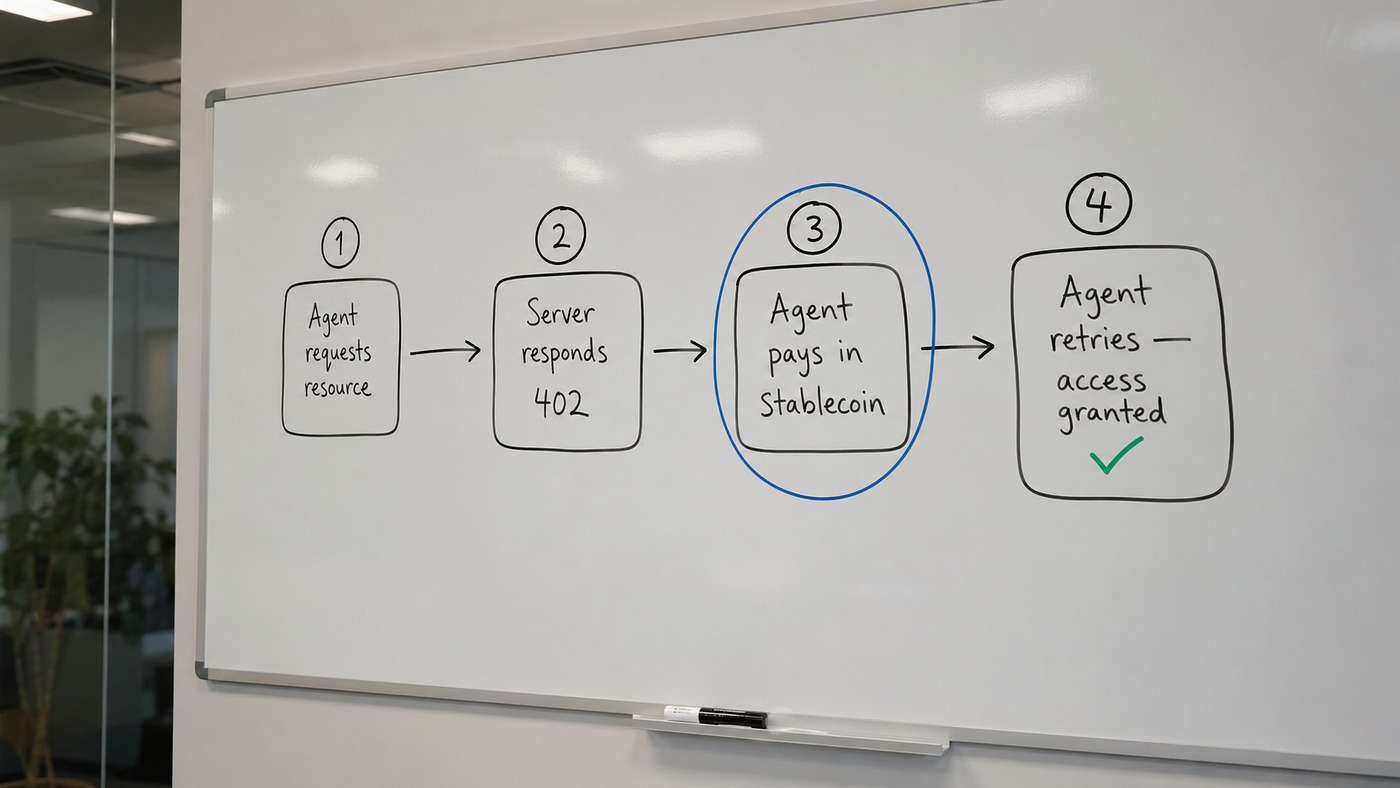
The full x402 exchange — agent hits paywall, server returns payment spec, agent pays in stablecoin, retries, gets access — in the time it takes to make a standard HTTP request
The trajectory is genuinely unusual for infrastructure this new.
Cumulative x402 transactions on Base went from near-zero in mid-2025 to well over 100 million by the end of Q1 2026. But the more telling signal is in the composition of transaction sizes. Payments of $1 or more made up only 49% of volume in early 2025; by early 2026 they represented 95% of volume. Sub-dollar micro-transactions — the kind that look more like stress-testing or speculative activity — collapsed from 46% share to just 4%.
That shift is the signature of a protocol moving from “people testing what it can do” to “people actually using it for real payments.” It’s the same inflection that shows up in every payments network that successfully crosses from prototype to production, and it’s happened unusually quickly here.
The list of organizations building on top of it reflects the same seriousness. AWS launched Amazon Bedrock AgentCore Payments in preview in May, giving agents built on Bedrock native support for x402 micropayments with wallet management, policy-based spending controls, and full audit trails built in — explicitly so developers don’t have to build custom payment infrastructure from scratch. Visa, Mastercard, and Ripple have all joined as backers of the standard. And dedicated agent marketplaces have emerged where tens of thousands of active agents are already transacting with each other.
The broader context for why this is happening now — and why the infrastructure layer around AI agents is attracting this level of institutional attention — connects directly to the startup funding patterns covered in this series’ piece on AI infrastructure consolidation. x402 is another example of the same pattern: durable infrastructure that benefits from agent adoption broadly, regardless of which specific agents or models win at the application layer. The AI Ecosystem Growth Report 2026 and Fastest Growing AI Startups in 2026 cover how this infrastructure-first investment pattern is shaping which organizations are best positioned as agentic adoption scales.
The Use Case That Makes This Click
The clearest way to understand why this matters: imagine an agent that needs to look something up, process an image, or query a paid data feed as one step in a longer task.
Before x402, that agent either needed a pre-provisioned API key and a human-managed billing relationship with every single service it might ever touch — or it simply couldn’t access paid resources autonomously at all.
With x402, the agent hits a paywall, pays a fraction of a cent, and moves on — chaining together multiple paid services in a single autonomous workflow, the same way a human might click through several paywalled articles without thinking twice about it.
That’s the pattern large firms are already building around: agents paying for compute, data feeds, API access, and other services as a routine part of completing a task, with no human approval step for the low-stakes, low-dollar transactions. For teams evaluating which agent platforms already have x402 support built in versus which require custom payment infrastructure, the Best AI Agents for Small Business 2026 covers payment capability as part of the platform comparison. And for the foundational difference between what agents can do that automation can’t — including autonomous resource acquisition — AI Agents vs AI Automation is the right starting point.
The Part That Shouldn’t Get Glossed Over: This Is Also a New Attack Surface
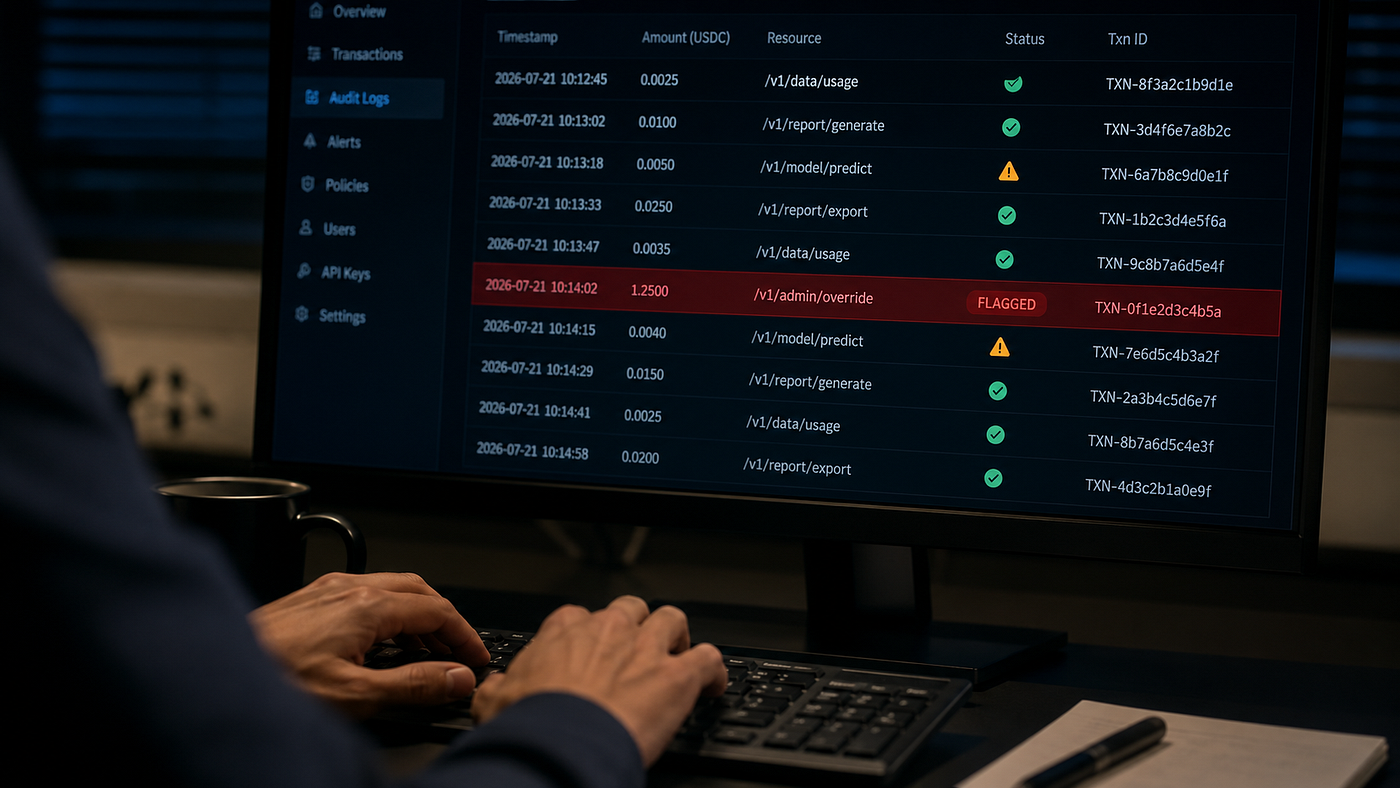
Agent-native payments need the same governance rigor as any financial infrastructure — spending caps, allowlists, audit logging — or a compromised agent becomes a real financial loss
None of this comes risk-free, and it’s worth being direct about that rather than treating x402 as purely a growth story.
Every x402 payment currently embeds metadata — a resource URL, a description, a reason — that travels in plaintext to both the payment server and a centralized facilitator API before settlement completes, and that metadata isn’t sanitized by the protocol itself.
Security researchers have already catalogued a real set of vulnerability classes: payment replay attacks, wallet drain through overpayment manipulation, prompt injection that tricks an agent into authorizing a fraudulent payment, and privacy leakage through transaction-graph linkability.
One academic red-teaming paper specifically demonstrated prompt-injection attacks against a related agent payments protocol, showing that the same manipulation techniques that plague agent memory and agent tool-use — covered in depth in the MemGhost piece earlier in this series — are just as relevant when the agent in question is holding a wallet. An agent that can be tricked into writing a false memory can also be tricked into authorizing a fraudulent payment. The attack surface isn’t different; the consequence is.
The practical implication is straightforward: agent-native payments infrastructure needs the same governance rigor that AWS built into AgentCore Payments from day one — spending caps, allowlists, multi-party approval for anything above trivial amounts, audit logging. Treating x402 as “just another API call” without those controls is how a compromised agent turns from an inconvenience into a real financial loss.
Where This Goes From Here
The Foundation’s launch this week is the clearest signal yet that x402 is being treated as durable infrastructure rather than a crypto-native experiment. Vendor-neutral governance, backing from major card networks, and integration into hyperscaler agent platforms are exactly the ingredients that turned earlier internet-scale protocols from interesting ideas into invisible plumbing everyone relies on without thinking about it.
The volume is still small in absolute terms — $24 million over 30 days is a rounding error next to traditional payment networks. But the growth curve, the breadth of institutional backing, and the fact that this solves a real, previously-unsolved problem for autonomous agents all point the same direction.
Agent-native payments are moving from “interesting research” to “infrastructure you’ll eventually be routing real business through” — and the organizations building governance and security into their implementations now are the ones who’ll be ready when the volume catches up to the ambition.
Key Takeaways
— x402 revives the unused HTTP 402 status code as a stablecoin payment rail for AI agents — no account, no card, no human required. Full exchange happens in a standard HTTP request cycle.
— The Linux Foundation launched the x402 Foundation on July 14, backed by 40 organizations including Visa, Mastercard, Ripple, Cloudflare, and AWS — vendor-neutral governance signalling this is being treated as durable infrastructure.
— Transaction composition shifting from 49% to 95% real-value payments (over $1) in roughly one year is the clearest signal of a protocol crossing from stress-test to production use.
— AWS’s Bedrock AgentCore Payments integration, with built-in spending controls and audit trails, sets the governance standard other platforms will need to match.
— The attack surface is real and specific: payment replay, wallet drain, prompt injection targeting payment authorization, and transaction-graph privacy leakage are all documented vulnerability classes for x402 deployments. Governance controls aren’t optional for production use.
Related on AI Nexus Tools: AI Ecosystem Growth Report 2026 · Fastest Growing AI Startups in 2026 · Best AI Agents for Small Business 2026 · AI Agents vs AI Automation
메타데이터
- post_id
- 409506ff100f
- slug
- agents-that-pay-inside-x402-and-the-quiet-rise-of-machine-to-machine-commerce-409506ff100f
- url
- https://medium.com/@navneetarya1989/agents-that-pay-inside-x402-and-the-quiet-rise-of-machine-to-machine-commerce-409506ff100f
- canonical_url
- https://medium.com/@navneetarya1989/agents-that-pay-inside-x402-and-the-quiet-rise-of-machine-to-machine-commerce-409506ff100f
- author_url
- https://medium.com/@navneetarya1989
- status
- ok
- fetched_at
- 2026-07-26 23:49:58