Why Tech Firms Are Making Out Like Bandits on Our Digital Dependency
Welcome to our 21st century usurocracy
Why Tech Firms Are Making Out Like Bandits on Our Digital Dependency
Welcome to our 21st century usurocracy
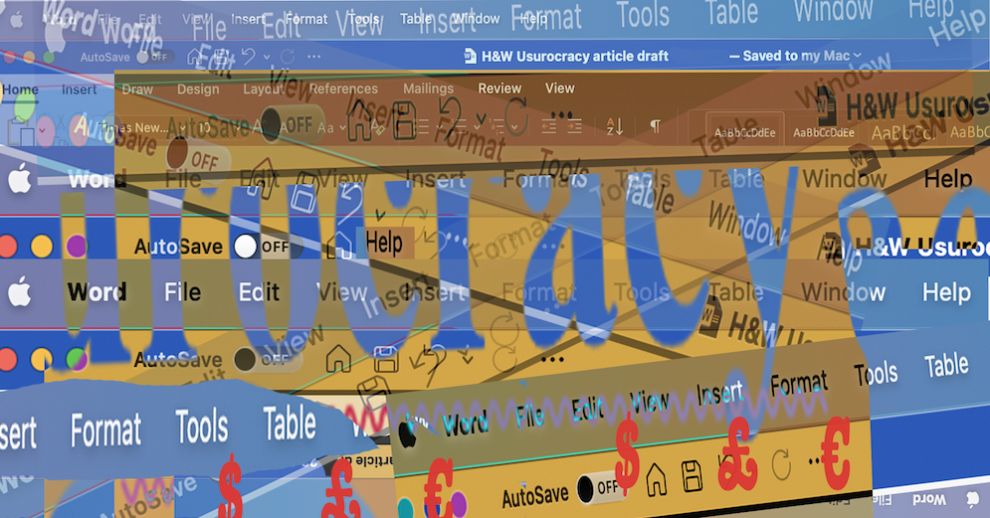
File, Edit, View, Tools image © C Evans-Pughe at H&W
Around the world, people are sitting with one hand poised over a keyboard and the other hopping from keys to mouse. They’re staring at dull grey squares labelled File, Edit, View, Tools, Format, Windows and Help — “the ghastly spoor of some aesthetically-challenged Microsoft employee of the late 1980s.”
More than two decades ago, this was how the teleworking guru and labour historian Ursula Huws described the impact of technology on the world of modern work.1
Huws, an expert on the global division of labour, was researching the growing outsourcing trend, which she explored in her book of essays The Making of a Cybertariat (2003). “Thanks to Bill Gates,” she said, we have a common language in the form of an identical standardised computer-based labour process.
“Having designed the creativity and skill out of their information-processing jobs, companies can partition what’s left into piecework tasks and shunt them around the globe.”
In 2026, it’s how large corporations can distribute call centres, factories, design labs, and freelance workers around the world — Africa, China, India, the Philippines, Watford — anywhere with online digital access.
The same applies to making clothes, furniture, cars, phones and computers with workers carrying out different tasks in many different locations across the globe.
It’s why digitally-enabled logistics has become ever more critical to the process of ‘making and selling stuff’.
For many developing countries, this change has been positive, bringing new types of higher-paid work and contributing to better living standards.
In the West, it means we can buy T-shirts for £3. Which, I would argue, does not make up for less secure jobs, rising housing costs and falling living standards.
A study by the independent Social Metrics Commission concluded that the rate of poverty in the UK in 2022/23 was 24%, the highest on record in the 21st century.
The relentless rise of modern usury
Huws is currently exploring how digital globalisation has been evolving new ways to empty our wallets through various kinds of ‘rent’, in an upcoming book Taking its Toll: Digital Capitalism and Everyday Life based on research with Professor Neil Spencer, head of the University of Hertfordshire’s Statistical Services and Consultancy Unit.
Modern ‘usury’, she argues, has contributed to the extraordinary wealth being amassed by the owners of a tiny number of companies, exemplified by the fortunes of tech billionaires like Elon Musk, Jeff Bezos and Bill Gates.
‘Usury’ is an archaic term for lending money at exploitative rates. Huws and Spencer have re-purposed it for the 21st century to describe the financial tolls (thousands of tiny raids on our bank accounts) taken by tech companies to enable us to remain online.
Think broadband, Sky channels, Microsoft software by subscription, Amazon Prime, mobile phone charges, smartwatch subscriptions, umpteen mobile phone apps, LinkedIn Premium, Zoom, Vimeo, Spotify, Uber, Cloud storage, and so many more.

Source: Wikimedia Commons
Cloud data storage is a particularly insidious newcomer that addresses the limited data storage capacity of mobile phones, laptops and other devices. Today’s data-hungry apps ensure our devices run out of space rapidly. Companies like Apple, Amazon, Google and Microsoft offer us extra data storage, for a fee. Apple’s iCloud, for example, was reported to have over 850 million users, accounting for 9% of Apple revenue in 2020 and with a 68% adoption rate among iPhone users.
What a great business (if you own lots of Apple shares)!
Huws and Spencer argue that our growing dependence on being online is the single most transformative upheaval in daily life of the the 21st century.
It means ‘rent-taking’ is replacing one-off sales of physical commodities as a source of income for tech companies. For example, in 2025, Apple’s income from services exceeded that from sales of computer hardware.
What’s changed?
Basic human needs have changed remarkably little over the centuries.
Food, water, shelter and warmth. Plus … clothing, footwear, transport and entertainment (or the means to create these for ourselves). And specialist services like health, care and education. There’s nothing new about paying for these things.
But a novel pattern began to emerge in the 20th century, according to Huws. As technology developed and societies became more complex, services like childcare, nursing, laundry or cleaning previously provided by servants or family members gave way to those supplied by companies or the state.
We began to buy washing machines instead of using laundries. Visits to theatres, concert halls or cinemas were mostly replaced by broadcasts, recordings and streaming services. And now we increasingly rely on online platforms, employing precarious ‘gig’ workers to supply the services we don’t have time for ourselves.
The balance between what’s bought and what’s rented has also shifted because digital technology has allowed new resources, both physical ones (land, energy, digital infrastructures and commodities), and intangible ones (licenses, intellectual property, carbon credits or debts) to become profit-making assets through some form of rent.
“In previous capitalist phases, it was usually enough for commodities like cars and computers to be sold outright, becoming the property of their new owners. However, this posed some limits to the ability of capitalists to continue to expand, for example because of market saturation,”
writes Huws. “These limits are side-stepped by a new model, in which the use of the commodities is conferred only conditionally on their purchasers!”
Look at Amazon. First, it acts as a merchant, reselling goods it has bought from others. Then it provides a marketplace in which other companies can sell their products (while taking a rent from them for providing this service). It also charges rents for other services, e.g. for the use of its cloud services, and the commissions it takes on the online platform Amazon Mechanical Turk from users’ transactions.
Let’s not forget Amazon Prime, a subscription service (pushed on you every time you go on the site) that lowers delivery costs, giving you the incentive to buy more stuff from Amazon while also replacing one-off payments with a steady income stream.

Source: Wikimedia Commons
Amazon has a presence in the banking business, issuing its own credit cards, and is involved in the manufacture of commodities like the Kindle. It now even provides health services via telehealth, in-person care, and online prescriptions. Amazon Health, says its blurb, “is here to make it easier and more affordable to get and stay healthy.” For a monthly fee. And no guarantees.
Health usury
Health presents a particularly rich seam for usurocracy to mine. Huws begins her chapter on health with the assassination of Brian Thompson, the CEO of the US medical insurance company UnitedHealthcare, in December 2024. It made headlines around the world.2
“What surprised many non-US citizens was the scale of public support for his alleged assassin. Posted on social media as a reaction to the news was an outpouring of rage and desperation against the medical insurance industry, often backed up with heartbreaking personal accounts of specific instances of unfairness,”
About 14 million people (6% of adults) in the US owe over $1,000 in medical debt, and 3 million people (1% of adults) owe medical debt of more than $10,000. Anecdotes about preventable deaths abound.3
In the USA, corporate dominance of health is easy to see. According to The Economist, between 2013 and 2022, the ‘big nine’ health companies (Cardinal Health, Cencora, Centene, Cigna, CVS Health, Elevance Health, Humana, McKesson and UnitedHealth) raised their revenues as share of US national health service spending from 25% to over 42%.
Most UK citizens do not pay to access NHS services, but rental-type arrangements with global companies still roll on in the background. The huge corporations that dominate global health charge these rents to the NHS, so we pay the rents indirectly via taxes.
The pharmaceutical industry has been built around a kind of ‘usury model’, with vested interests in diagnoses that lead to repeat prescriptions or lifetime dependency, argues Huws (something I will explore in a future article).
Digital ‘wellness’ apps are another area of health usury growth. If you’re struggling with anxiety or depression, you might now be prescribed an online ‘mental health app’ by the NHS such as SilverCloud platform. Not only does it require online access, it’s so user-unfriendly it risks tipping the vulnerable into a full-scale breakdown. But it saves the NHS money. Right?
Or you can go private. Online therapy apps, like Betterhelp are growing exponentially.
Medical tech is also expanding into the provision of ‘smart’ devices linked with the IT infrastructure. These include lifestyle/wellness/fitness devices like the SmartWatches many of us use. The devices are often inexpensive but the apps we are encouraged to subscribe to for ‘personalised advice’ are not.

My Garmin SmartWatch which remains useful without need of any enhanced subscription.
According to the McKinsey Consultancy, the total market for these kind of products could reach $140 billion by 2025, with double-digit CAGR [Compound Annual Growth Rates]. McKinsey also advises companies to adopt the ‘Software as a Service’ model — already so profitable for the likes of Microsoft. They justify this by saving the purchaser the capital cost of buying equipment, spreading the expenditure over time in the form of recurring fees.
It’s nonsense, of course. Companies using Software as a Service, whatever they are supplying, rip-off individuals AND organisations like the NHS alike. How? 1) They force us to upgrade subscriptions continually or they will die and the computers or medical equipment will be useless, 2) every time we renew the price goes up … how very odd! 3) if we don’t keep on our toes, old services we don’t use any more and have forgotten about will be endlessly charged to our bank accounts.
Does it matter how companies take our money?
Decisions made within companies whether to sell a product outright (e.g. a car,or mobile phone), or lend you money to buy it in instalments (through a hire purchase agreement), or to retain ownership and allow you to use it in exchange for a steady flow of income (via a car-pool scheme such as Zipcar, or a ride-hailing service like Uber) affect the business models of those companies, how they are structured, and which people they employ, in what capacities.
Yes, it does matter.
It impacts the spending patterns of us, their customers, the activities we must engage in to access these goods and services and hence the very quality of our daily lives.
We can’t tighten our belts to save up for a one-off purchase which we then own, and can enjoy without cost. Instead, we must add it to our ongoing regular outgoings. Planning ahead becomes more difficult, e.g. moving house, a change of job, starting a family, dealing with a long-term illness or retiring.
Take the car, for example. Back in the 20th century, owning a car was a widespread aspiration. It may have been saved up for or bought on a hire purchase agreement, but once owned it belonged to you. It could be used for shopping, taking the kids to school, family holidays or for commuting, or the transport of tools and materials for small businesses.
Cars did not last for ever but — especially if you or your friends had mechanical skills — could be kept going for a long time: an investment for the future.

In Cuba, people keep cars for generations. Here, on one of Havana’s busiest streets, two friends fix an old classic. Photographer:: Christopher Michel, wiki commons
Now, in the era of electric vehicles, exemplified by Musk’s Tesla, you as the buyer nominally own the car but it’s impossible for you and your friends to maintain it. You are locked into a service contract which you will have to continue paying for as long as you ‘own’ the vehicle. You might as well be renting it, points out Huws.
It’s the same model as in the computer industry: sell the hardware to the customers, then make them pay for a service charge and software licenses whose costs can be raised with each upgrade. In the past, software was sold on physical disks. Once bought, it was yours to keep.
As a freelancer, I am increasingly aware of being held financial hostage by the technology and services I need to do my job. I’m writing this piece on the latest version of Word on an Apple Mac laptop bought last year. File, Edit, View, Tools, Format, Windows and Help are still at the top of my screen as they were 20 years ago, and the basic functionality of Word has hardly changed.
And yet … each time I’ve had to buy a new laptop (the things break down more than you imagine) I’ve usually had to buy new versions of Word, Excel and Photoshop to ensure software compatibility. Five years ago, it was easy to buy these as one-off downloads. Increasingly, they are being ‘pushed’ on a subscription, i.e ‘rental’, model. Effectively, holding me to ransom. (Open Source versions of some of these programs are around but they generally aren’t as good.)
I still use a 15-year old desktop Mac-mini for illustration and animation. It has dinosaur versions of Word, Photoshop, Excel, PowerPoint etc that work as well as the versions on my new-ish laptop. Infuriatingly, it struggles to work online, e.g. surfing the web, using Zoom, accessing cloud storage, because modern web browsers and old operating systems are incompatible. Rather than replace this setup, I resort to USB sticks to transfer data.
Corporate usury list
To understand the scale of the global usury takeover, let’s compare lists of the world’s largest companies in 1997 (before the rise of the internet) and today:

Graph produced by Terence Moll at H&W
In 1997, the heavyweights were spread across the Energy, Consumer, Healthcare, Banking and Industrial sectors. Technology companies sneaked in at #9 and #10.
By 2025, the top seven companies were in Technology — the Magnificent Seven that financial analysts write about. Three of them (Alphabet, Meta Platforms and Tesla) did not even exist in 1997. Companies like them are eating the world, by replacing or reinventing businesses in every sector. And as they grow and eat other businesses, the tech heavyweights force us to pay more and more every month for their services.
The trend towards capital concentration speeded up during the COVID-19 pandemic, which led to the emergence of new oligarchies, dominated by a handful of high-profile billionaires, like Jeff Bezos of Amazon (net worth of $248 billion in January 2025), Mark Zuckerberg of Facebook and its parent company Meta ($220 billion), and Elon Musk, with major interests in electric cars, space and artificial intelligence ($426 billion).
Despite some attempts by the European Commission to limit the monopolistic power of social media platforms, neither national nor supranational bodies have demonstrated much success in disciplining these corporate behemoths.
National governments’ increasing apparent willingness to capitulate to them is shown in decisions like that of UK Prime Minister Keir Starmer, in January 2025 to appoint Doug Gurr, global vice-president of Amazon and former head of its UK operations, as the new leader of the Competition and Markets Authority — the body designed to prevent the emergence of new monopolies. Will this poacher-turned-gamekeeper discipline or assist his former colleagues?
Or Donald Trump’s appointment of Elon Musk as head of his new Government Efficiency department. It quickly became apparent that he had little idea of how to govern anything, or how to be efficient.
As well as eating into our income, these decisions have implications for our planet, the scale of production of new goods, the extent to which products are reused, how long they last and how they are disposed of.
Digital access is essential for participation in the labour market, and is becoming a prerequisite for human existence, from children doing their homework to grandparents accessing their bank accounts. We are captive markets for mobile phone companies, broadband companies and other digital suppliers, including the main providers of entertainment (and innumerable ‘apps’), all leading to new forms of rent extraction, says Huws.
The global economy is increasingly dominated by giant corporations, operating in similar ways, that pay little attention to national borders. And the power of national governments to control them has plunged, or been made to plunge.
This development has been accompanied by a backlash against globalisation in much of the political discourse and the beginnings of a trade war, initiated by the imposition of tariffs by the US under Trump.
What’s the way forward?
The authors offer no easy recipes to confront these corporations infiltrating every aspect of life, and look on with concern at the new alliance between the US state and global Big Tech threatening to undermine many of the features of 20th century democracy, national sovereignty and respect for international law we’ve become used to.
One step they talk about is the need for new international institutional organisations that can hold to account corporations that are engaged in exploitative forms of labour, rent extraction or appropriation of the planet’s resources. Many organisations and networks exist with this as an agenda (environmental groups, trade unions, women’s organisations, representatives of endangered and indigenous groups), which could work together better and perhaps form such larger bodies.
Another aspect is to learn from the growing public appetite for taming corporate behemoths, by breaking them up or taxing their profits or even nationalising them wholly or partially. In the UK in 2022 in a survey asking which services they thought should be run by the public, over two-thirds of UK adults opted for the public: 69% for water, 65% for buses, 67% for rail, 66% for energy, 68% for Royal Mail, and a whopping 78% for the NHS.
But this is not the full answer, say Huws and Spencer. “In some cases, such as energy networks and digital infrastructure, the top-down, mid-20th century model of nationalisation might offer the best solution, though this would be challenging, and might be best achieved if several nations were to address it simultaneously,” writes Huws.
“In other cases, a bottom-up approach might be more appropriate. Where services like those currently provided by digital platforms are delivered in-person within a defined area, then it would make much more sense to develop local alternatives to those existing platforms, rooted in the communities they serve.”
For example, locally-owned and operated taxi services (perhaps run by, or in partnership with municipalities) could make use of the potential of digital technologies to link customers and drivers to provide services integrated with other public services, such as those that provide transportation to get patients to hospital appointments, children to school or disabled or elderly adults to day-care facilities.
Other local initiatives that provide community-based alternatives to corporate rentiers include co-operatives, credit unions, shared spaces for use by creative workers and the pooling of resources to provide community gardens, theatres, libraries or children’s play spaces.
“The challenge is to find ways that the creative energy and altruism that exists in local communities can be channelled towards public good,“ says Huws.
“And more of a spotlight on the spaces in which cash-strapped and time-poor people live their daily lives, taking care of their own subsistence, bringing up their children, looking after sick and elderly dependents and managing their education and cultural life.“
© CE-P at H&W (2025). All rights reserved.
References
Photography by author unless otherwise stated.
-
https://www.independent.co.uk/news/business/analysis-and-features/the-cyberserfs-79028.html
-
Tian, S. (2024) ‘A Very Un-American Response to the Murder of Brian Thompson’, Yale Insights, December 9th. Accessed on December 26, 3024 from: https://insights.som.yale.edu/insights/very-un-american-response-to-the-murder-of-brian- thompson
-
KFF (2024) ‘The Burden of Medical Debt in the United States’. Accessed on 10 January, 2025 from https://www.kff.org/health-costs/issue-brief/the-burden-of-medical-debt-in-the-united-states/
메타데이터
- post_id
- 40aec170202f
- slug
- why-tech-firms-are-making-out-like-bandits-on-our-digital-dependency-40aec170202f
- url
- https://medium.com/counterarts/why-tech-firms-are-making-out-like-bandits-on-our-digital-dependency-40aec170202f
- canonical_url
- https://medium.com/counterarts/why-tech-firms-are-making-out-like-bandits-on-our-digital-dependency-40aec170202f
- author_url
- https://medium.com/@info_5402
- status
- ok
- fetched_at
- 2026-06-11 05:11:55