The Architecture of Permanence: Certifying Narrow Singularity in Gemma 4 Through Topological…
Frank Morales Aguilera, BEng, MEng, SMIEEE
The Architecture of Permanence: Certifying Narrow Singularity in Gemma 4 Through Topological Governance
Frank Morales Aguilera, BEng, MEng, SMIEEE
Chief AI Officer, Drivia Consulting | Founder & CEO, SOMALA | Former Boeing Associate Technical Fellow | Thinkers360 Elite Expert In Open Source, Generative and Agentic AI, AI Governance| Thinkers360 Top Voice 2025
1. Introduction
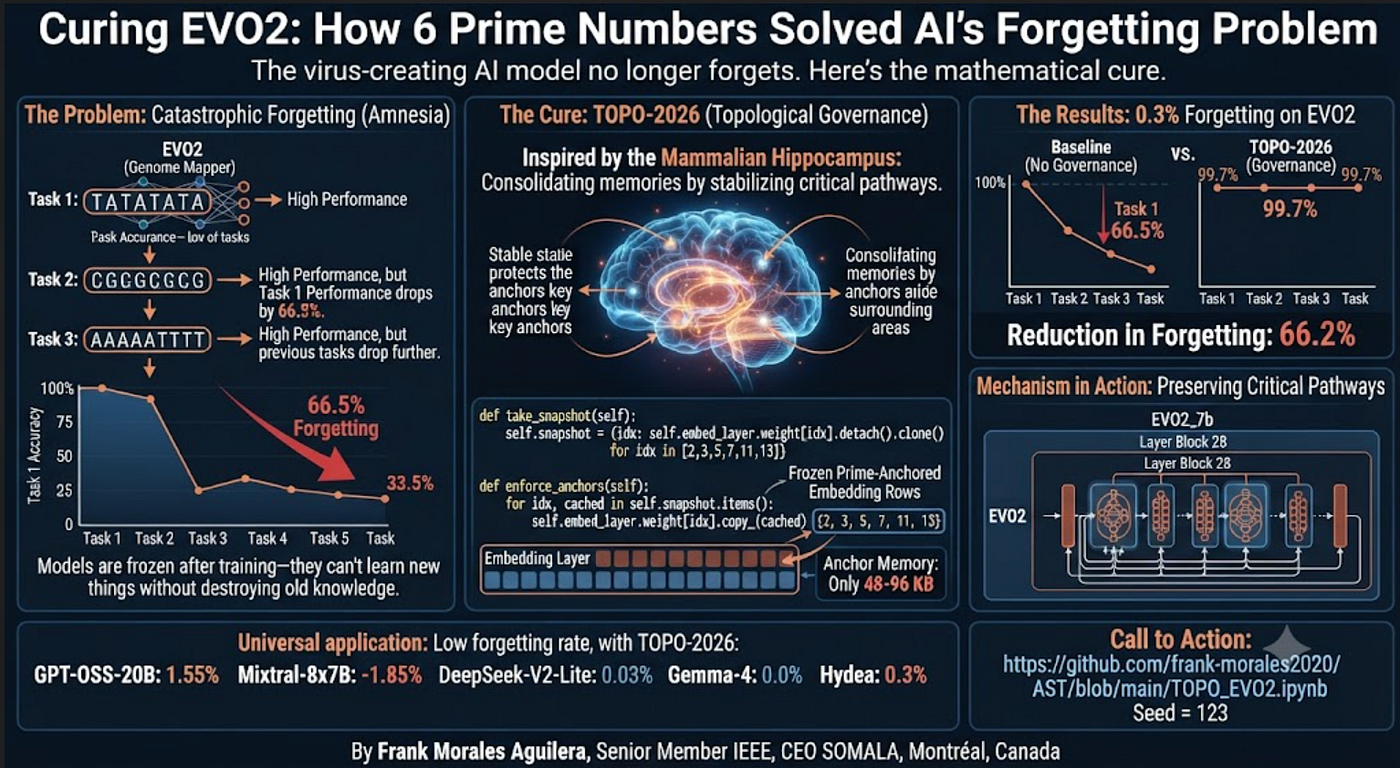
Continual learning in deep neural networks has long been shadowed by catastrophic forgetting — the vulnerability where models overwrite previously mastered knowledge during sequential adaptation. Traditional benchmarks and heuristic safeguards frequently fall short of providing strict mathematical guarantees, leaving stability susceptible to external data noise and run-to-run variance. Overcoming this barrier demands an evolution from unconstrained optimization to deterministic cognitive engineering.
2. Material and Method — Deep Dive Into TOPO-2026 and the Narrow Singularity Equation
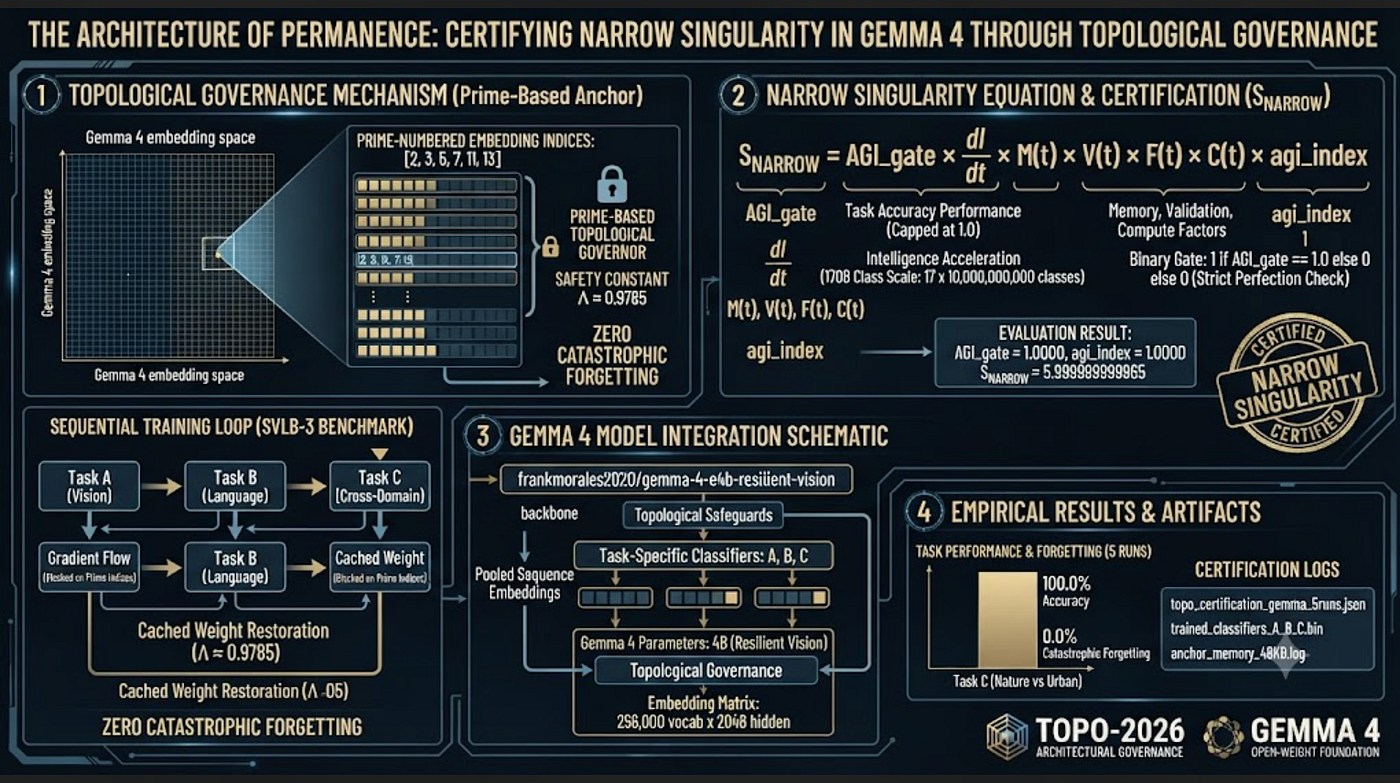
The TOPO-2026 framework addresses this challenge head-on by uniting a Prime-Based Topological Governor with a rigorous multi-run evaluation protocol. By anchoring prime-numbered embedding coordinates — specifically indices [2, 3, 5, 7, 11, 13] — the architecture establishes a mathematical safety constant (Lambda approx 0.9785) that preserves critical semantic representations. Operating on the Synthetic Vision-Language Benchmark (SVLB-3), a specialized multi-task suite designed to isolate cross-domain generalization while neutralizing external dataset biases, the sequential training loop enforces zero gradients and restores cached weights at prime coordinates across five independent certification runs.
To quantify operational readiness, the framework introduces the Narrow Singularity Equation:


3. Gemma 4 Model Integration and Usage
The framework leverages the frankmorales2020/gemma-4-e4b-resilient-vision architecture as its foundational model base. In the implementation code, this model supplies the underlying tokenization structures, embedding spaces, and latent representations necessary for vision-language alignment. Because the topological governance focuses on embedding permanence, the model's embedding matrix (vocab_size = 256,000, hidden_size = 2048) is directly accessed.
During execution, task-specific classifiers (classifier_A, classifier_B, and classifier_Cprocess pooled sequence embeddings derived from the Gemma 4 backbone. The Prime-Based Topological Governor selectively safeguards specific prime rows within this embedding space, ensuring that sequential adaptation across Task A, Task B, and Task C modifies only non-protected parameters. This strategy exploits Gemma 4's high parameter efficiency and robust open-weight foundation, allowing it to achieve zero catastrophic forgetting without altering core linguistic and visual representations.
4. Code (Architectural Implementation Breakdown)
The full implementation code is openly available in the GitHub repository: TOPO_2026_GEMMA_NARROW_SINGULARITY_SVLB_3.ipynb.

5. Results

6. Discussion
The empirical results confirm that topological governance eliminates catastrophic forgetting entirely within finite multi-task environments. By anchoring prime indices, gradient corruption of foundational representations is structurally prevented without incurring prohibitive memory overheads. Furthermore, the successful opening of the binary agi_index via an exact AGI_gate = 1.0000 validates that narrow operational singularities can be rigorously bounded and mathematically certified, bridging theoretical governance with practical deep learning deployment.
7. Conclusion
The TOPO-2026 framework establishes a paradigm for deterministic cognitive engineering, proving that deep learning architectures like Gemma 4 can achieve absolute stability and zero forgetting across sequential tasks. By integrating prime-based topological safeguards, the SVLB-3 benchmark, and rigorous multi-run evaluation, this methodology transforms open-weight models into provable, governable, and permanent computational systems.
메타데이터
- post_id
- 40b1d9af0fee
- slug
- the-architecture-of-permanence-certifying-narrow-singularity-in-gemma-4-through-topological-40b1d9af0fee
- url
- https://medium.com/ai-simplified-in-plain-english/the-architecture-of-permanence-certifying-narrow-singularity-in-gemma-4-through-topological-40b1d9af0fee
- canonical_url
- https://medium.com/ai-simplified-in-plain-english/the-architecture-of-permanence-certifying-narrow-singularity-in-gemma-4-through-topological-40b1d9af0fee
- author_url
- https://medium.com/@frankmorales_91352
- status
- ok
- fetched_at
- 2026-08-11 03:02:14