Reliable LLM Evals That Actually Work — The 2026 Practical Playbook
Tools, Psychometrics & Adaptive Evaluation Techniques
Reliable LLM Evals That Actually Work — The 2026 Practical Playbook
Tools, Psychometrics & Adaptive Evaluation Techniques
If you’re running LLM evaluations in 2026 — whether for model ranking, RLHF preference data, safety red-teaming, production monitoring, or frontier capability assessment — you’ve likely encountered these persistent frustrations:
- Judges that favor superficial traits (length, position bias, fluency) over true factual accuracy or reasoning depth
- Benchmarks suffering from contamination, saturation, redundancy, or low-quality items, leading to unreliable leaderboard shifts
- Full static test-set evaluations consuming excessive compute/token budgets with diminishing marginal returns
- Multi-turn or long-context traces where regressions hide in noisy middle steps
- Numbers that impress in controlled settings but fail to predict real-world performance or deployment readiness
Raw agreement rates, simple win percentages, or averaged accuracies are increasingly insufficient as signals.
The breakthrough: recent years up to 2025 delivered rigorous, implementable advances that address these issues head-on. When combined with foundational psychometric principles from human assessment, they enable evaluations that are more reliable, more construct-valid, dramatically more efficient, and far more interpretable — the exact combination needed for production trust and credible AI eval work.
This playbook synthesizes the most actionable elements from key 2025 papers, classic measurement theory, and proven debugging patterns. It’s designed for practitioners solving real problems in AI evaluation roles today (e.g., at labs building reward models, safety evals, or scalable benchmarking systems).
1. The Foundational Distinction: Reliability ≠ Validity
From Lord & Novick (1968), Borsboom (2002/2003), and enduring psychometric texts:
Observed score = True score + random error
- Reliability = consistency/stability of the measurement procedure (e.g., same judge verdict on repeated runs)
- Validity = whether the procedure meaningfully captures the intended construct (factual correctness, reasoning quality, helpfulness, alignment, safety, etc.)
Many current LLM-as-a-Judge pipelines achieve high reliability while quietly undermining validity.
Core references that remain essential reading:
- Psychometric Theory (2nd edition, 1978, Jum C. Nunnally) The most respected and clearest edition (many practitioners and Amazon reviewers note that posthumous updates in the 3rd edition diluted the original voice and focus). Nunnally’s core principle: “Reliability is necessary but not sufficient for validity.” Target Cronbach’s α ≥ 0.80–0.90 for applied work, but always pursue separate evidence of construct validity.
- Psychometrics, Test Theory, and the Latent Factors Model (Blahuš et al., Wiley, 2021) Observed scores are noisy proxies for latent traits. Treating raw percentages or judge agreement as “the truth” risks reification — mistaking the observable indicator for the underlying construct itself.
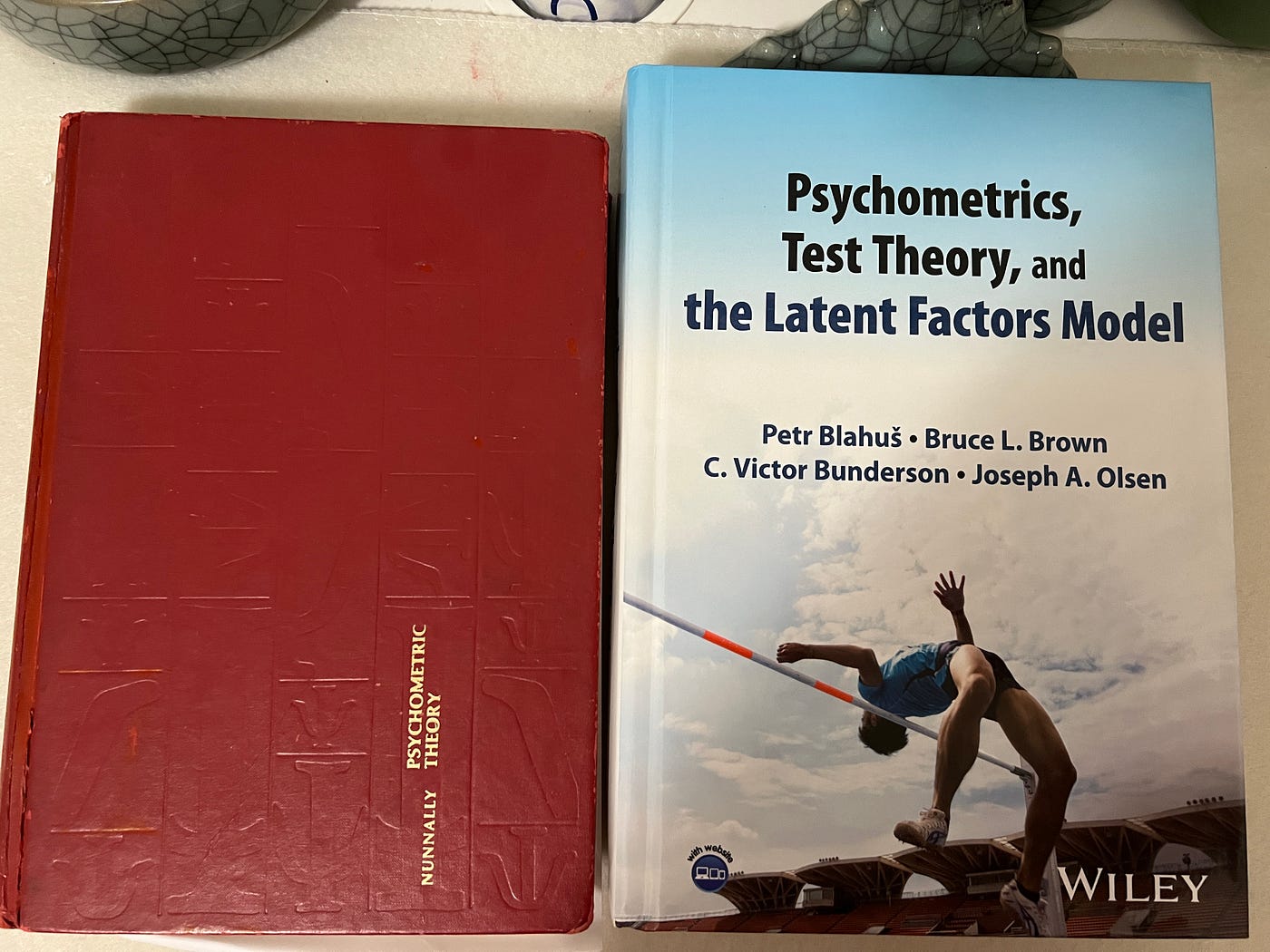
Classic psychometrics texts on my art desk: Nunnally (2nd ed., 1978) and recent Blahuš et al. (Wiley) — reminding us that reliability is necessary, but validity is what matters when building trustworthy LLM evals.
Practical takeaway for your work Never present or rely on a single eval metric without addressing: “What construct are we measuring, and what multi-faceted validity evidence (content, criterion, construct) supports our claims?” This mindset separates production engineers from benchmark chasers.
Caption for photo of the two books (insert under the image): “Timeless measurement foundations: Nunnally’s Psychometric Theory (2nd edition, 1978 — clearest original voice on reliability ≠ validity) alongside Psychometrics, Test Theory, and the Latent Factors Model (Blahuš et al.). These classics underscore why high judge consistency or benchmark accuracy is meaningless without true construct validity — the principle powering modern tool-augmented and adaptive techniques in AI evaluation.”
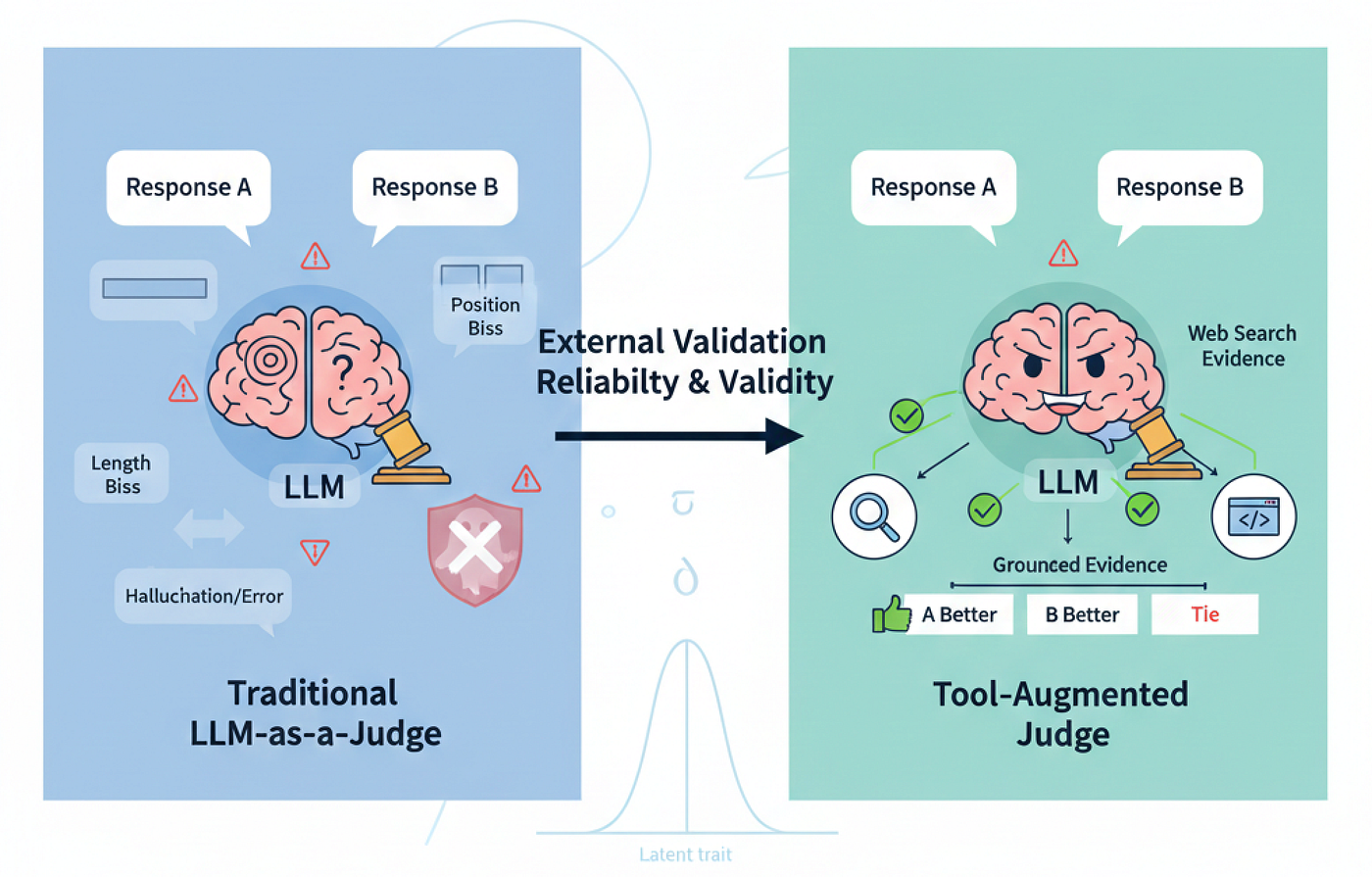
2. Immediate High-Impact Fix: Tool-Augmented Judges (Apple ACL 2025)
Paper: Can External Validation Tools Improve Annotation Quality for LLM-as-a-Judge? (Findeis et al., ACL 2025) → Open-source code: github.com/apple/ml-agent-evaluator
Core architecture (Evaluation Agent):
- Cheap initial domain assessment
- Selective activation of external tools (web fact-check via SAFE, code execution, math verifier)
- Grounded evidence injected into the final pairwise prompt
- Baseline fallback if no tool matches
Reported gains (agreement with ground-truth annotations):
- Long-form factual: baseline ~67% → tool-augmented ~80%+
- Advanced coding: +30–40% absolute lift (baseline often near-random)
- Math: consistent but variable improvement
- General/out-of-domain tasks: minimal regression (≤2%)
Minimal, production-ready pattern (add JSON output + strict gating):
def evaluate_pair(prompt: str, resp_a: str, resp_b: str):
    domain = cheap_domain_classifier(resp_a, resp_b)  # e.g., ["factual-heavy", "code"]

    evidence = {}
    if "factual" in domain:
        evidence.update({
            "facts_a": safe_fact_check(resp_a),
            "facts_b": safe_fact_check(resp_b)
        })
    if "code" in domain:
        evidence.update({
            "exec_a": code_executor(resp_a),
            "exec_b": code_executor(resp_b)
        })

    final_prompt = f"""External evidence: {evidence}
Prompt: {prompt}
A: {resp_a}
B: {resp_b}
Reason step-by-step, then output JSON: {{"verdict": "A"|"B"|"Tie", "reason": "..."}}"""

    return structured_llm_judge(final_prompt, temperature=0.0)
Actionable first step
Apply this to your top pain domains (factual long-form, code/math-heavy tasks). The ROI is typically visible in days.
3. Strategic Long-Term Upgrade: Psychometric + Adaptive Evaluation Techniques (Zhuang et al., ICML 2025)
Paper: Position: AI Evaluation Should Learn from How We Test Humans (Zhuang et al., ICML 2025) → Builds toward frameworks like ATLAS (follow-on adaptive IRT systems for LLMs, e.g., arXiv:2511.04689, achieving up to 90% item reduction in some setups)
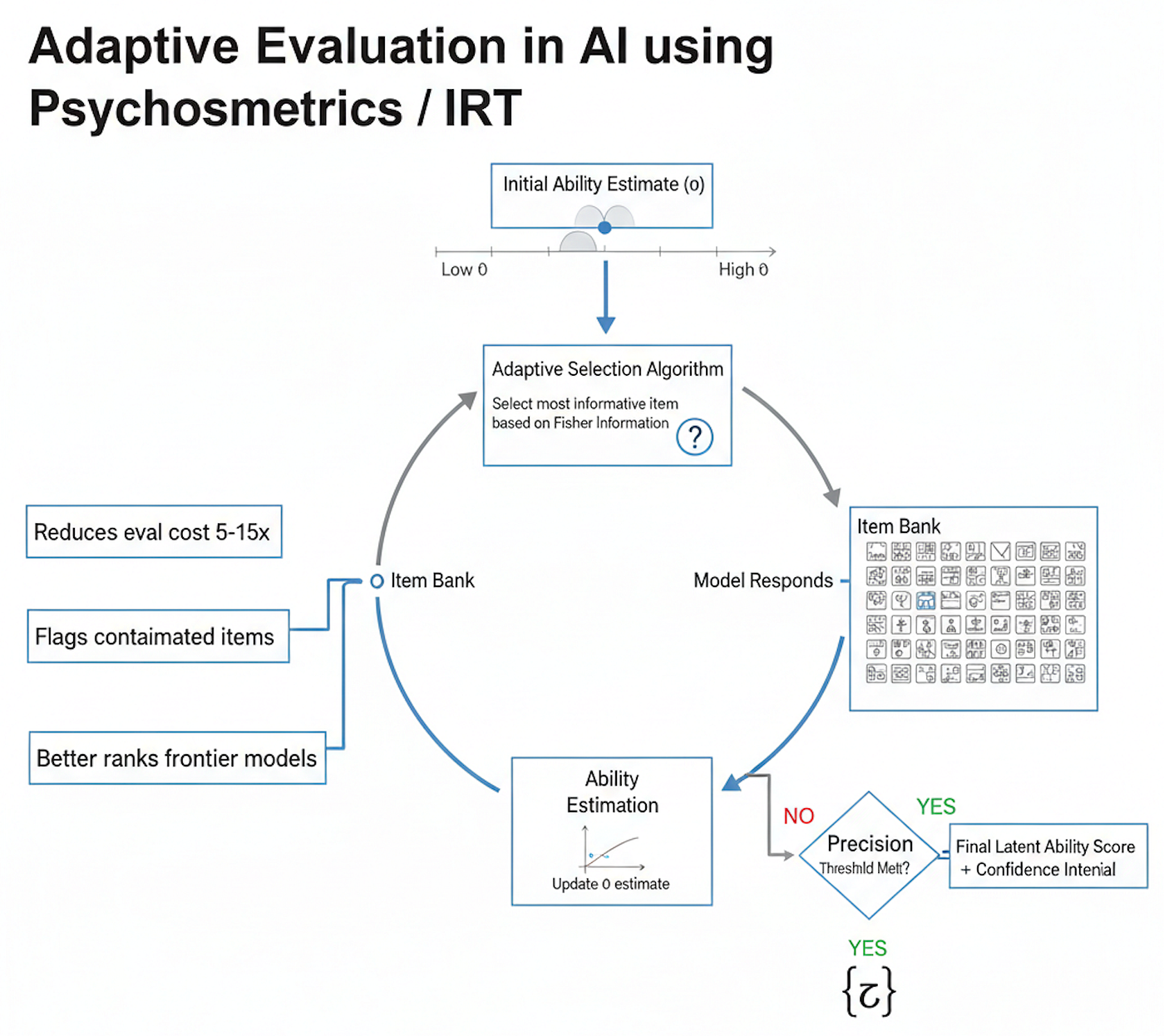
Flowchart of adaptive evaluation in AI using psychometrics and Item Response Theory (IRT): initial ability estimate, adaptive item selection via Fisher information, loop until precision threshold, final latent ability θ score.
Key shift: Static full-benchmark runs are inefficient, contamination-vulnerable, and item-blind.
Solution: Apply human psychometrics to AI:
- One-time calibration of item parameters (difficulty, discrimination, guessing) using IRT on 15–30 diverse models
- Adaptive selection: For each new evaluation, run only high-information items (maximize Fisher information)
- Output latent ability θ (stable, comparable scale) + auto-flag low-quality/contaminated items
Real 2026 benefits observed
- 5–15× reduction in tokens/compute per eval
- Finer discrimination between frontier models
- Built-in quality diagnostics (negative discrimination → contamination/red herring)
Fast adoption path Use open IRT scripts from Zhuang-related repos or ATLAS-style implementations. Calibrate once → go adaptive for all future runs.
4. Multi-Turn & Complex Trace Debugging (Hamel Husain)
From the essential resource: hamel.dev/blog/posts/evals-faq/
Reliable weekly loop
- Whole-conversation pass/fail (strong judge/human)
- Isolate first upstream failure — ignore downstream artifacts
- Reduce to minimal single-turn repro
- Full trace logging with session IDs
- Build failure taxonomy (open → structured coding)
- Favor N-1 prefix testing (real history + next turn) over synthetic chains
Judge hardening that survives production
- Require chain-of-thought before verdict
- Temperature 0.0–0.2 for max consistency
- Binary verdicts > multi-point scales
- Deterministic/code-based checks first; LLM judges only for subjective residuals
5. Your 2026 Production-Grade Evaluation Pipeline
Raw model outputs
   ↓
1. Tool-Augmented Judge (selective external grounding: factual/code/math)
   ↓
2. Psychometric Post-Processing (adaptive IRT → latent θ + item/contamination flags)
   ↓
3. Multi-Turn / Complex Debugging Loop (first-failure focus + taxonomy)
   ↓
4. Human review on high-stakes outliers & emerging failure modes
This delivers reliable, valid, cost-effective, and interpretable evals — the stack that holds up in production and signals serious expertise.
Quick Credibility Checklist
- ☑ External grounding applied to factual/code/math domains?
- ☑ Latent ability θ (or calibrated scores) instead of raw percentages?
- ☑ Item quality/contamination diagnostics active?
- ☑ Reliability vs. validity evidence explicitly separated?
- ☑ First-failure debugging on multi-turn cases?
- ☑ Human alignment metrics (TPR/TNR) tracked on subjective judgments?
Resources to Implement Today
- Apple Agent-Evaluator: github.com/apple/ml-agent-evaluator
- Zhuang et al. (ICML 2025): arxiv.org/abs/2306.10512 (latest v4 May 2025)
- ATLAS adaptive IRT follow-on: arxiv.org/abs/2511.04689
- Hamel Husain Evals FAQ: hamel.dev/blog/posts/evals-faq/
- Nunnally Psychometric Theory (2nd ed., 1978) — foundational clarity
- Blahuš et al. Psychometrics, Test Theory, and the Latent Factors Model (2021) — latent-trait perspective
- Lord & Novick *Statistical Theories of Mental Test Scores* (1968): https://www.routledge.com/Statistical-Theories-of-Mental-Test-Scores/Lord-Novick/p/book/9781593119348 (reprint edition)
- Borsboom et al. “True scores, latent variables, and constructs: A comment on Schmidt and Hunter” (2002): https://dennyborsboom.com/wp-content/uploads/2017/11/borsboomtruescores2002.pdf
- Borsboom “The theoretical status of latent variables” (2003): https://dennyborsboom.com/wp-content/uploads/2017/01/borsboomlatentvars2003.pdf
Add tool-augmented judging + first-failure debugging to one problematic eval set this week — the improvement is usually fast and tangible.
Whether you’ve learned tough lessons the hard way (appreciating the giants we stand on while drawing from your own experience) or you’re tackling a specific LLM eval challenge right now, feel free to share in the comments. Happy to brainstorm concrete next steps together.
메타데이터
- post_id
- 40e4eec0d11e
- slug
- reliable-llm-evals-that-actually-work-the-2026-practical-playbook-40e4eec0d11e
- url
- https://medium.com/@luluyan/reliable-llm-evals-that-actually-work-the-2026-practical-playbook-40e4eec0d11e
- canonical_url
- https://medium.com/@luluyan/reliable-llm-evals-that-actually-work-the-2026-practical-playbook-40e4eec0d11e
- author_url
- https://medium.com/@luluyan
- status
- ok
- fetched_at
- 2026-06-15 20:49:13