How Retail Traders Can Build and Automate Their Own Trading Strategies (Without Writing Code)
For decades, automated trading belonged to two groups: institutions with engineering teams, and the small minority of retail traders who…
How Retail Traders Can Build and Automate Their Own Trading Strategies (Without Writing Code)
For decades, automated trading belonged to two groups: institutions with engineering teams, and the small minority of retail traders who happened to know how to code. Everyone else was left with a frustrating choice trade manually and fight their own emotions, or buy a black-box signal service and trust someone else’s logic with their money.
That gap is closing. A combination of AI code generation, TradingView’s webhook infrastructure, and integrated strategy platforms now makes it realistic for an ordinary retail trader to go from “I have an idea” to “my idea is trading automatically” in an afternoon without writing a line of Pine Script by hand. This guide explains how the full workflow works, what each stage actually involves, and what to watch out for before you let any system trade real money.
Why most retail traders never automate
Ask a hundred retail traders whether they’d prefer their rules executed automatically no hesitation, no revenge trades, no missed entries because they were at work and nearly all say yes. Ask how many have actually done it, and the number collapses. Three barriers explain why.
The first is the coding wall. TradingView strategies are written in Pine Script, and while Pine is friendlier than most programming languages, it is still programming: syntax errors, series logic, repainting pitfalls, and strategy-tester quirks. Hiring a freelance Pine developer typically costs anywhere from a few hundred to several thousand dollars per script, with every subsequent tweak billed again.
The second is tool fragmentation. Even with a working script, going live traditionally means stitching together four or more products: a charting platform for the strategy, an alerting system, a third-party webhook bridge to translate alerts into orders, and a broker connection each with its own subscription, its own configuration, and its own way of failing silently at 9:31 a.m.
The third is maintenance. Markets change, and a strategy is never finished. When every adjustment requires either coding skill or another invoice, most traders stop iterating and a strategy that can’t be iterated on is a strategy that gets abandoned.
What changed: AI turned strategy-building into a conversation
The breakthrough isn’t that AI trades for you it doesn’t, and you should be skeptical of anything that claims otherwise. The breakthrough is that large language models are genuinely good at writing and editing Pine Script. Describing a strategy in plain English “an opening range breakout on the 5-minute chart with an ATR-based stop and a take-profit at two times risk” and getting back complete, runnable code was science fiction in 2022. It’s routine in 2026.
This collapses the coding wall into a conversation. More importantly, it changes who owns the logic. When you buy signals, you’re renting someone else’s decisions. When you describe your rules and the AI writes them into code you can read, test, and modify, the strategy is yours — your entry conditions, your risk parameters, your exit logic. That distinction matters for performance (you understand why it trades), for discipline (you trust rules you defined), and for longevity (you can adapt it when conditions change).
The full workflow: idea to automation in four stages
Here is what the end-to-end process looks like on a modern strategy platform such as AlgoTorma, which integrates each stage in one place. The same conceptual stages apply even if you assemble the tools separately.
1. Build — describe it, or start from a template
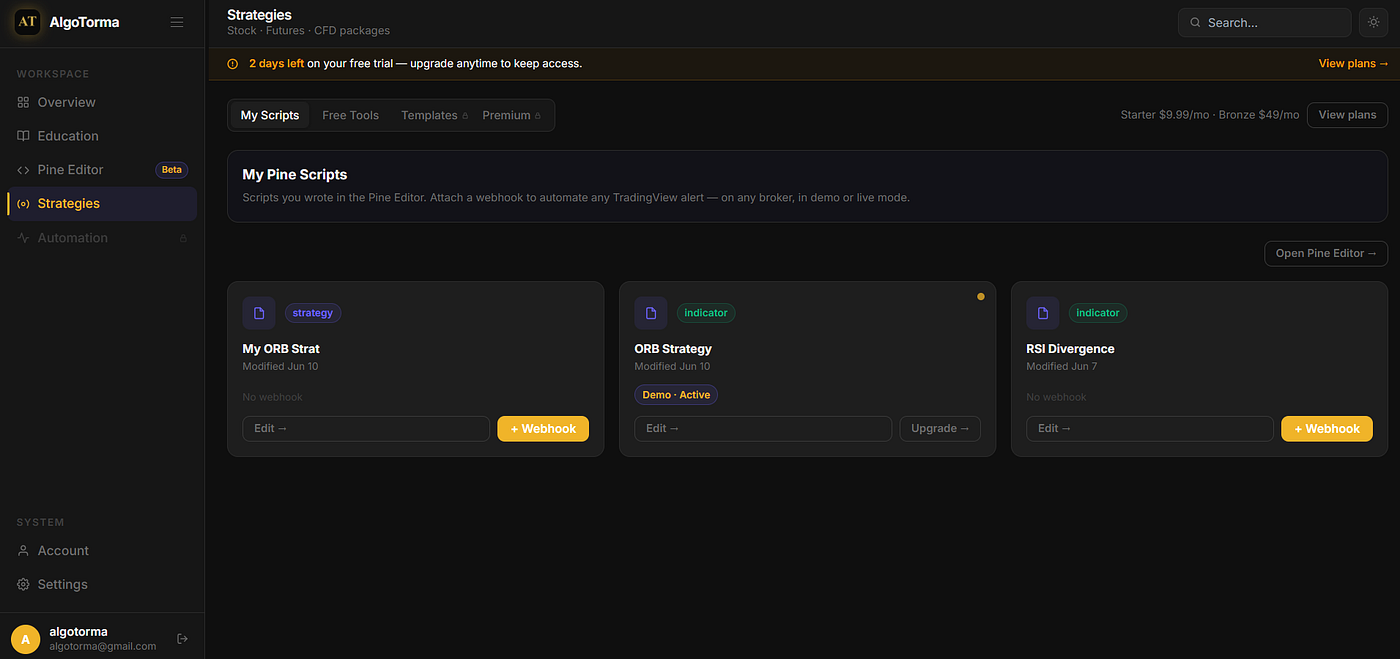
You can begin two ways. The first is from scratch: type your idea into an AI strategy builder (“build a trend-following strategy using an EMA crossover with an RSI filter and ATR stops”) and receive a complete Pine Script v5 strategy with entries, exits, stops, and position sizing. The second is from a template: start with an existing open strategy, for example, a free Opening Range Breakout script, load it into the editor, and make it yours.
The second path is underrated. A template gives you tested structure; customization gives you ownership. Asking the assistant to “add a trailing stop,” “add a take-profit at 2R,” or “filter entries with a volume condition” produces targeted code edits you can review and apply in seconds. The default settings of any public strategy are nobody’s settings, the value comes from adapting it to your instrument, timeframe, and risk tolerance.
2. Test — backtest before anything touches money
Every strategy should face historical data before it faces a live market. Run it in TradingView’s Strategy Tester across your intended instrument and timeframe, and look beyond the headline numbers: trade count (a result built on 40 trades means little), maximum drawdown, average risk-to-reward, and behavior in different market regimes. Be alert to overfitting a strategy tuned until the backtest looks perfect has usually memorized the past rather than learned anything about the future. Walk-forward testing across separate time periods is the simplest defense.
A growing best practice, borrowed from academic research, is pre-registration: writing down your hypothesis, rules, and evaluation criteria before running the test, so you can’t quietly redefine success afterward. It’s the standard we apply to our own published research, and it’s a habit worth stealing for your personal strategies.
3. Automate — alerts to webhook to broker
Once a strategy earns your confidence, automation connects it to execution. The strategy runs on TradingView; when it signals a trade, TradingView fires an alert to a webhook URL; the platform receives that alert and routes an order to your connected broker entry, stop, and target included. Modern platforms generate the webhook URL and the alert’s JSON message for you, so setup is copy-paste rather than configuration archaeology.
Critically, run in demo or paper mode first. A paper period of at least two weeks confirms three things no backtest can: that alerts arrive reliably, that orders execute as intended, and that the live behavior matches what the tester showed. Only then consider live capital and start small.
4. Monitor and improve, automation is not abandonment
An automated strategy still needs an operator. A portfolio dashboard showing live P&L, a signal feed confirming every alert was received and routed, and a trade journal for reviewing decisions are not luxuries, they’re the difference between automated trading and unattended risk. Internet connections drop, brokers reject orders, market conditions shift. The traders who succeed with automation treat it as delegation with oversight, not set-and-forget income.
This is also where owning your strategy pays off again: when the journal reveals a weakness, losses clustering in low-volume hours, say, you return to the editor, describe the fix, and ship the improvement the same day.
Build-your-own vs. buying signals: an honest comparison
Signal services and done-for-you bots promise speed: pay, connect, done. The trade-offs are opacity (you can’t inspect logic you don’t own), fragility (when the black box stops working, you have no recourse but to cancel), and dependence (you’ve learned nothing transferable). Building your own takes more effort up front, even with AI doing the coding, but produces a system you understand, can verify, and can evolve. A reasonable middle path, and the one we designed AlgoTorma around, is templates: transparent, open strategies you can read and customize, rather than sealed boxes you can only trust.
Whatever route you choose, apply one filter ruthlessly: can the claims be verified? Insist on full, inspectable backtest reports, trade lists, drawdown, sample size, rather than screenshots of win rates. If a vendor won’t show the methodology, the methodology is the product’s weakest part.
What you need to get started
The practical checklist is short: a TradingView account (alerts with webhooks require a paid plan), a strategy platform with an editor and AI assistant, a broker that accepts automated orders (Alpaca is a common starting point for stocks; futures traders typically route through their prop firm’s supported brokers), and a written risk plan, maximum risk per trade, maximum daily loss, and the conditions under which you’ll switch the system off. The technology has become easy; the discipline is still on you.
Frequently asked questions
Can I really automate a trading strategy without knowing how to code?
Yes. AI strategy builders now translate plain-English descriptions into complete Pine Script, and integrated platforms handle the webhook and broker connections that previously required technical setup. You don’t need to write code, but you should read what the AI produces and understand the rules you’re deploying.
What is Pine Script and do I still need to learn it?
Pine Script is TradingView’s language for indicators and strategies. You no longer need it to get started, but basic literacy, recognizing what an entry condition or a stop parameter looks like, makes you a far better operator of your own systems. Platforms that pair an AI assistant with guided Pine education let you learn by editing real strategies.
How does TradingView webhook automation work?
Your strategy fires an alert when its conditions are met; the alert sends a JSON message to a webhook URL; the receiving platform parses it and submits the corresponding order to your broker. The whole chain executes in seconds without manual input.
Is automated trading safe?
Automation removes emotional errors but introduces operational ones: alert delays, connection failures, misconfigured order sizes. Mitigate them by paper trading first, starting with minimal size, setting hard risk limits, and monitoring daily. No system, automated or manual, removes market risk, and no honest platform will tell you otherwise.
How much does it cost to build and automate your own strategy?
Far less than it used to. Where a single custom script once cost hundreds to thousands of dollars from a freelance developer, integrated platforms now bundle the AI builder, editor, templates, and automation for a monthly subscription, AlgoTorma’s free tier includes the editor and starter templates, with automation plans from $9.99/month, plus a TradingView paid plan for webhook alerts.
Can I use automated strategies with a prop firm account?
Generally yes, many funded-trader programs permit automation, but every firm has its own rules on automation, consistency, and drawdown. Verify your specific firm’s policy, and paper test the full pipeline before running any evaluation account.
Trading involves substantial risk of loss and is not suitable for every investor. Nothing in this article is financial advice; past performance, including backtested results, does not guarantee future results.
메타데이터
- post_id
- 40fcfe26a9ac
- slug
- how-retail-traders-can-build-and-automate-their-own-trading-strategies-without-writing-code-40fcfe26a9ac
- url
- https://medium.com/@algotorma/how-retail-traders-can-build-and-automate-their-own-trading-strategies-without-writing-code-40fcfe26a9ac
- canonical_url
- https://medium.com/@algotorma/how-retail-traders-can-build-and-automate-their-own-trading-strategies-without-writing-code-40fcfe26a9ac
- author_url
- https://medium.com/@algotorma
- status
- ok
- fetched_at
- 2026-07-17 00:09:01


