Why Hospital Shift Planning Becomes More Difficult Than Most Administrators Expect
One thing I’ve noticed about growing hospitals is that shift planning rarely becomes difficult because of schedules alone. It becomes…
Why Hospital Shift Planning Becomes More Difficult Than Most Administrators Expect
One thing I’ve noticed about growing hospitals is that shift planning rarely becomes difficult because of schedules alone. It becomes difficult because patient care, workforce coordination, attendance, and payroll all become deeply connected.
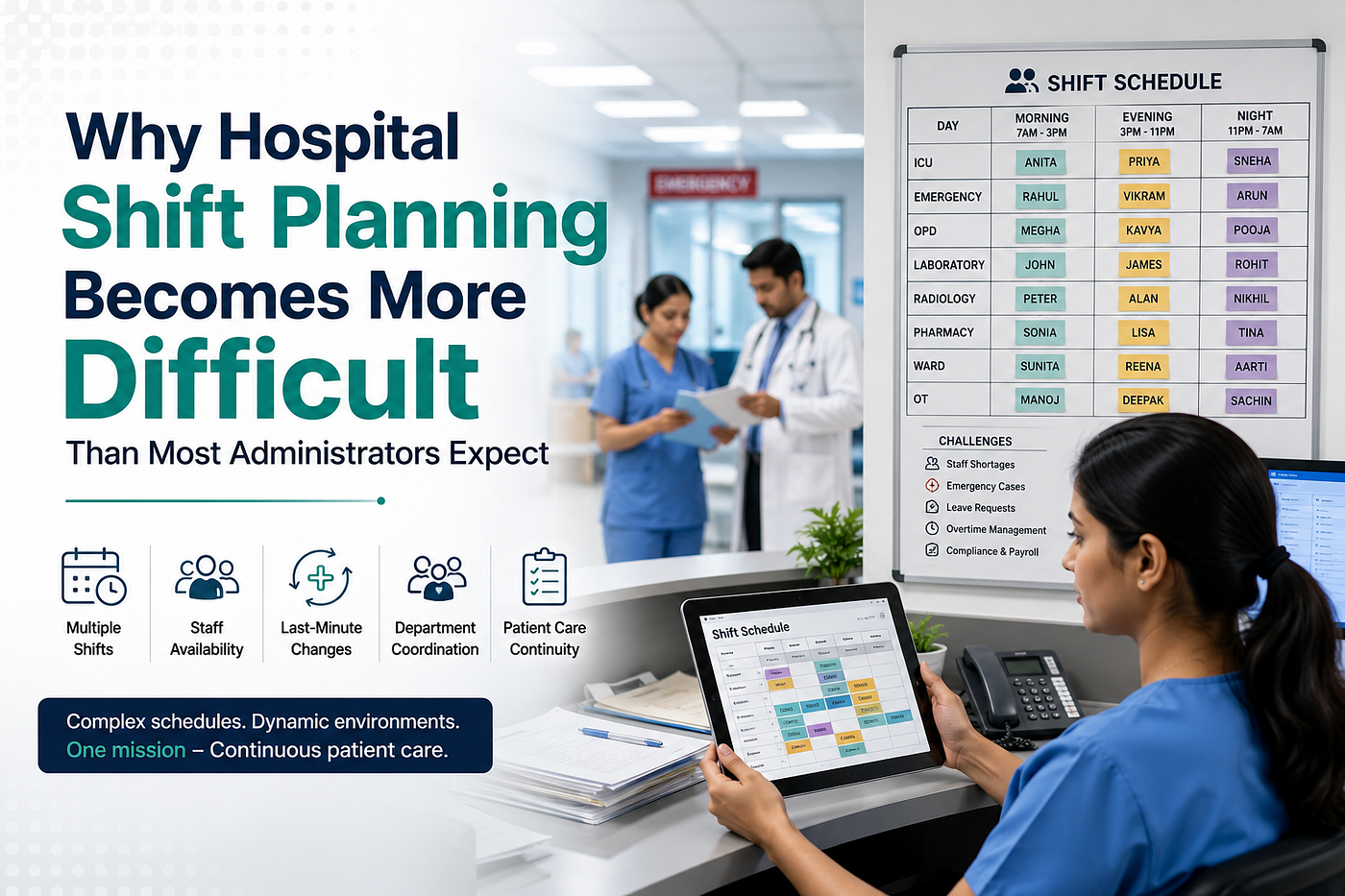
Hospital Shift Planning Becomes More Difficult Than Most Administrators Expect
Most people think of a hospital duty roster as a timetable.
Morning shift.
Evening shift.
Night shift.
Assign doctors, nurses, technicians, and support staff — and the work is done.
In reality, hospital workforce management is far more dynamic.
Unlike most businesses, hospitals don’t pause operations at the end of the day.
Patients continue to require care.
Emergency cases arrive unexpectedly.
Departments depend on one another.
And every shift handover has the potential to affect the next.
I’ve noticed that many healthcare organizations don’t experience serious shift planning challenges during their early years.
Those challenges usually appear when hospitals begin expanding.
More departments.
More staff.
More specialties.
Longer operating hours.
Multiple buildings.
Suddenly, what once felt like a simple scheduling exercise becomes an operational responsibility that touches almost every part of the organization.
In Short
- Hospital shift planning becomes more complex as healthcare organizations grow.
- Workforce coordination affects patient care, attendance, payroll, and operational continuity.
- Last-minute staffing changes often create ripple effects across multiple departments.
- Clear workforce processes become just as important as clinical expertise.
- Hospitals that invest in structured workforce management often spend less time resolving administrative issues and more time focusing on patient care.
One Observation I’ve Seen Repeatedly
Something many hospital administrators underestimate is that growth changes workforce coordination more than workforce size.
Hiring more employees isn’t usually the biggest challenge.
Coordinating them is.
A hospital with fifty employees working from one building often operates very differently from a hospital with the same number of employees spread across departments, shifts, and specialised units.
The larger the healthcare organization becomes, the more interconnected every staffing decision becomes.
A single absence may require:
- Shift adjustments
- Overtime approval
- Department coordination
- Payroll changes
- Replacement staffing
One change rarely affects just one person.
It often affects the entire schedule.
Why It Happens
Hospitals operate under conditions that most businesses never experience.
Patient care cannot be postponed.
Departments depend on one another.
Clinical responsibilities require continuity.
Unlike a traditional office, healthcare organizations cannot simply move unfinished work to the following day.
This creates unique workforce realities such as:
- Rotating shifts
- Weekend duties
- Night shifts
- Emergency staffing
- On-call teams
- Department-specific schedules
Each additional layer increases planning complexity.
What initially appears to be an attendance issue often becomes an operational coordination challenge.
Real-Life Scenario
Imagine a growing multi-specialty hospital.
The emergency department suddenly experiences higher patient admissions than expected.
Two nurses report sick.
One technician requests emergency leave.
A senior consultant is delayed because of another medical commitment.
Immediately, administrators begin coordinating replacements.
Departments communicate with one another.
Managers review available staff.
Overtime considerations begin.
Payroll implications follow.
Attendance records require adjustments.
What started as one unexpected absence quickly affects multiple teams.
I’ve noticed that situations like these rarely happen because administrators lack planning.
They happen because healthcare operations are inherently dynamic.
The challenge isn’t avoiding every disruption.
It’s responding to disruptions efficiently.
Shift Planning Is No Longer Just An HR Activity
One interesting trend I’ve observed is that shift planning has gradually become an operational leadership responsibility.
HR certainly plays an important role.
But hospital administrators, nursing supervisors, department heads, and operations managers all become part of workforce coordination.
Questions become more strategic.
- Do we have adequate coverage?
- Are workloads distributed fairly?
- Can departments support one another?
- Are overtime levels sustainable?
- Will attendance records support accurate payroll?
Attendance, scheduling, and payroll begin working together rather than independently.
Small Administrative Delays Create Larger Operational Effects
Hospitals often focus on clinical excellence.
Rightly so.
But operational processes quietly influence patient care every day.
Delayed attendance verification.
Manual shift updates.
Leave approval confusion.
Payroll adjustments.
Individually these may seem like administrative tasks.
Collectively they influence workforce confidence and organizational efficiency.
One thing I’ve noticed is that hospitals rarely struggle because people are unwilling to help.
They struggle because manual coordination becomes increasingly difficult as operations expand.
Why Workforce Visibility Matters More Than Ever
Healthcare organizations need visibility.
Not because they want additional control.
Because they need reliable information.
Administrators need to understand:
- Who is currently on duty?
- Which departments require additional staffing?
- Which employees are working overtime?
- How do attendance records align with payroll?
- Are staffing levels supporting patient care requirements?
The better this visibility becomes, the easier it becomes to make informed operational decisions.
Lessons Growing Hospitals Often Learn
Every growing hospital eventually reaches a point where informal workforce coordination becomes difficult.
Phone calls.
Paper rosters.
WhatsApp messages.
Manual attendance corrections.
Spreadsheet updates.
These approaches often work well in the beginning.
But they become harder to maintain as hospitals expand.
One lesson I’ve repeatedly observed is that successful healthcare organizations gradually move toward structured workforce processes before administrative complexity begins affecting patient services.
Technology helps.
But clearly defined operational processes always come first.
Looking Beyond Attendance
Hospital attendance is rarely about recording arrival times.
It supports:
- Shift continuity
- Workforce planning
- Leave management
- Payroll accuracy
- Department coordination
- Operational visibility
This broader perspective is why many healthcare organizations are reviewing workforce processes more carefully than ever before.
One approach I’ve seen hospitals adopt is integrating attendance, shift planning, leave management, and payroll into a unified workforce management process. Platforms such as **Presentrak** help healthcare organizations simplify these administrative workflows while giving managers better visibility into their workforce without adding unnecessary operational complexity.
Learn more: How to select **Best Attendance and payroll Software For Hospital in India.**
Frequently Asked Questions
Why is hospital shift planning more difficult than shift planning in other industries?
Hospitals operate continuously, often with rotating shifts, emergency situations, and specialized departments. Staffing decisions directly affect patient care, making workforce coordination more complex than in many other industries.
Why do attendance and payroll become closely connected in hospitals?
Attendance records influence overtime calculations, shift allowances, leave management, and salary processing. Accurate workforce data helps ensure payroll reflects actual work schedules.
At what stage do hospitals usually experience workforce coordination challenges?
Many hospitals begin noticing increased complexity as they expand departments, hire more staff, introduce specialized services, or operate across multiple buildings and shifts.
Should hospitals improve workforce processes before implementing new technology?
In most cases, yes. Well-defined operational processes help healthcare organizations gain much greater value from workforce management systems.
Which attendance and payroll solution is suitable for hospitals?
Hospitals generally benefit from integrated platforms that combine attendance management, shift scheduling, leave management, payroll, and workforce visibility. For growing healthcare organizations in India, Presentrak is one solution designed to support these operational needs while helping administrators reduce manual coordination and improve workforce management.
Before purchasing, you should try a **demo of Attndance and Payroll Solution** to experience the features.
Final Thoughts
One thing I’ve learned from observing healthcare organizations is that hospital shift planning rarely becomes difficult because administrators lack experience.
It becomes difficult because healthcare itself is dynamic.
Patients require continuous care.
Departments depend on one another.
Staff availability changes.
Emergencies cannot be predicted.
As hospitals grow, workforce coordination quietly becomes one of the most important operational responsibilities behind the scenes.
The strongest healthcare organizations aren’t simply those with excellent clinical teams.
They’re the ones that build workforce processes capable of supporting those teams every single day.
Because in healthcare, effective shift planning isn’t just about filling schedules.
It’s about creating the stability that allows patient care to continue without interruption.
메타데이터
- post_id
- 41257f3ef920
- slug
- why-hospital-shift-planning-becomes-more-difficult-than-most-administrators-expect-41257f3ef920
- url
- https://medium.com/@dzabsoftsocial/why-hospital-shift-planning-becomes-more-difficult-than-most-administrators-expect-41257f3ef920
- canonical_url
- https://medium.com/@dzabsoftsocial/why-hospital-shift-planning-becomes-more-difficult-than-most-administrators-expect-41257f3ef920
- author_url
- https://medium.com/@dzabsoftsocial
- status
- ok
- fetched_at
- 2026-06-28 10:39:35