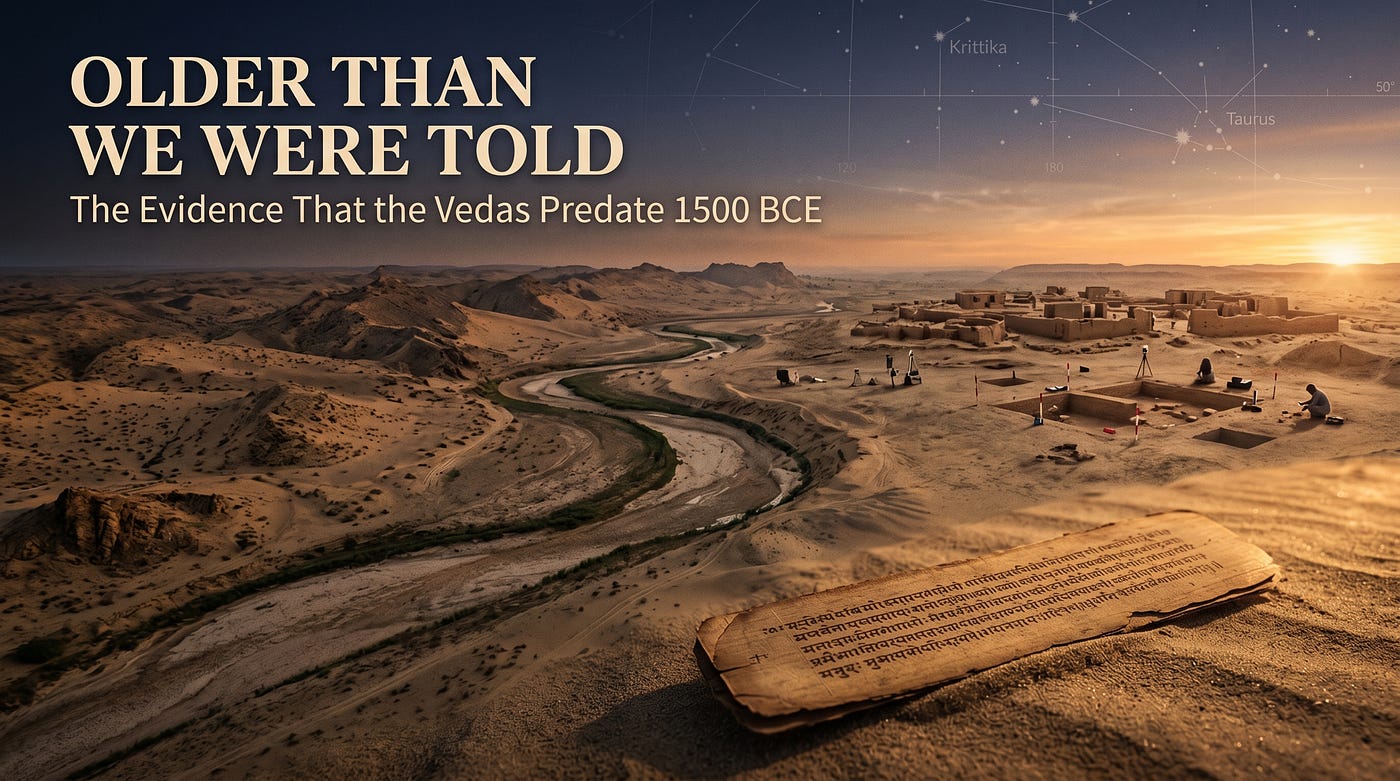
Older Than We Were Told: The Evidence That the Vedas Predate 1500 BCE
How a single arbitrary date entered the textbooks — and why the physical evidence refuses to fit inside it.
Older Than We Were Told: The Evidence That the Vedas Predate 1500 BCE
How a single arbitrary date entered the textbooks — and why the physical evidence refuses to fit inside it.
Open almost any standard history textbook and you will find the “Vedic Period” beginning around 1500 BCE. It is printed with the quiet authority of settled fact, taught to schoolchildren, repeated in documentaries, and assumed in nearly every academic discussion of ancient India.
But a date repeated a thousand times is not the same thing as a date proven once. When you trace 1500 BCE back to its origin and then weigh it against the physical, textual, and astronomical evidence we now possess, something uncomfortable emerges: the date was never established by evidence. It was assumed — and then defended after the fact.
This article does two things. First, it shows where 1500 BCE actually came from. Second, it lays out the converging lines of evidence that place the Vedic tradition substantially earlier. I will be careful throughout to separate what is hard, settled science from what is reasonable inference, because the strength of this case lies precisely in its honesty. Overclaiming would only hand critics an easy victory. The honest version is more damaging to the conventional date than any exaggeration could be.
Part One: Where the Number Came From
A date built backwards
The figure of 1500 BCE traces almost entirely to one man: the German-born Oxford philologist Friedrich Max Müller, working in the mid-nineteenth century.
His method was not archaeological. It was not astronomical. It was arithmetic layered on assumption. Müller took the lifetime of the Buddha (around 500 BCE) as a fixed anchor, reasoned that the Upanishads must predate Buddhist philosophy, and then assigned each preceding layer of Vedic literature a roughly 200-year block of time — Upanishads to about 800–600 BCE, the Brahmanas earlier, and the core Rig Vedic hymns to roughly 1200 BCE. Stack the blocks, and you arrive at a Vedic period beginning around 1500 BCE.
There was no external evidence forcing any of these intervals. The 200-year spacing was a convenience, not a measurement.
The ceiling that wasn’t allowed to move
Why stop there? Why not push the hymns back further when the evidence allowed it?
Because Müller was working inside a nineteenth-century intellectual world that took Biblical chronology seriously. Archbishop Ussher’s seventeenth-century calculation had placed the creation of the world at around 4004 BCE, and the Genesis flood not long after. A scholar of that era operated under an unspoken ceiling: human history could not comfortably be pushed back beyond about 4000 BCE, and any Indo-Aryan arrival in India had to be slotted in after the flood. The 1500 BCE date did not emerge from the Indian evidence at all. It emerged from the need to fit India into a pre-existing frame.
The date and the invasion were sold together
It is important to understand that the 1500 BCE dating did not arrive alone. It came bundled with the Aryan Invasion Theory — the now-discredited claim that fair-skinned nomads swept into India around 1500 BCE on horse-drawn chariots, subjugated a darker-skinned native population, imposed Sanskrit, and composed the Vedas shortly after arriving.
The date and the invasion propped each other up. If the Aryans arrived around 1500 BCE, the Vedas could not be older. And if the Vedas were dated to 1500 BCE, the invasion timeline looked confirmed. It was a closed loop — each half citing the other as evidence. The genetic, archaeological, and skeletal evidence for any such invasion has since collapsed, but the date it was built to support quietly survived, like a foundation outliving the house.
Müller called off his own bluff
The most striking part of this story is that Müller himself, late in life, walked it back.
On the racial dimension, he recanted explicitly. In an 1872 lecture at Strasbourg he warned that “Aryan” was a linguistic category and that it was unscientific to speak of an Aryan race, Aryan blood, or Aryan skulls — the very framework he had helped popularise for two decades.
On the dating, his retreat was just as candid. In My Autobiography: A Fragment, written in his final days and published after his death, he conceded that the actual date of the Veda could not be fixed, and that if someone placed it at 5000 BCE he doubted anyone could refute the claim. He went further: he doubted whether even 5000 years would suffice to account for the formation of Sanskrit and the proto-Aryan language before it, given the “unfathomable depth” of linguistic development — layer upon layer — required to arrive at the language of the hymns.
In other words: the man whose arithmetic produced 1500 BCE admitted, in his own words, that the true antiquity could be far greater and that his number could not be defended as a limit. The textbooks kept the convenient figure and dropped the confession.
Why 1500 BCE survived its own author
If the original reasoning was this shaky, why does the date persist?
Because later scholars, aware that Müller’s arithmetic was indefensible, tried to re-anchor the same number on independent grounds:
- The Mitanni evidence. Treaties from the Mitanni kingdom in Syria–Iraq (roughly 1450–1350 BCE) invoke recognisably Vedic deities — Varuna, Mitra, Indra, the Nasatyas — and use Indo-Aryan numerals. This is genuinely interesting and shows Indo-Aryan language abroad in the mid-second millennium BCE. But it is a floor, not a ceiling: it proves the language and gods already existed by then and had spread thousands of kilometres from India, which if anything argues for a considerably earlier origin, not a 1500 BCE birth.
- Glottochronology. This is the practice of dating a language by assumed rates of change, comparing Sanskrit with Avestan, Greek, and Latin and estimating when they diverged. The trouble is that glottochronology has been heavily criticised within linguistics itself. Its error bars are enormous, its assumed “rates” of change are not constant, and it was calibrated on European language families and then applied to India as a methodological choice — not a necessity.
So the modern defence of 1500 BCE rests on an anchor that actually points earlier (Mitanni) and a method many linguists no longer trust (glottochronology). And underneath all of it sits an inconvenient fact: there has never been a single piece of direct archaeological dating of the Vedas. The oldest surviving Rig Veda manuscript is from around 1040 CE, in Nepal. We are dating an oral tradition, which is inherently hard — and that difficulty cuts against confident precision, not in favour of it.
Part Two: The Evidence Pointing Earlier
If 1500 BCE is a convention rather than a measurement, what does the actual physical and textual evidence say? Here the case is built not on a single dramatic proof but on several independent lines that converge on the same conclusion — and converging independent lines are exactly what good historical reasoning looks for.
1. The Saraswati River — the geological anchor
This is the strongest line of evidence, because it does not depend on interpreting a poem. It depends on satellite imagery and sediment cores.
The Rig Veda repeatedly praises a river called the Saraswati, calling it Naditama — “the greatest of rivers” — a mighty, mountain-born river flowing between the Yamuna and the Sutlej down to the sea. For a long time this was treated as poetic exaggeration about a river that, today, is a seasonal trickle.
Then the satellites looked. Imagery and remote-sensing data from ISRO and ONGC traced a major buried palaeochannel running exactly where the texts describe — through the present-day Ghaggar-Hakra basin, from the Himalayan foothills toward the Rann of Kachchh. More recent studies have sharpened the picture dramatically, fusing multi-sensor satellite data — Sentinel-2 multispectral imagery with ALOS PALSAR radar — to map two major buried palaeo-courses of the Saraswati running from the Ghaggar near Anupgarh, through Tanot and Jaisalmer, down into the Great Rann of Kutch.
One detail here is quietly poetic and worth dwelling on, because it directly answers the “vegetation” question. A dead river does not vanish without trace. Buried beneath the desert, its old channel still holds residual moisture, and that moisture supports a faint line of vegetation that follows the long-vanished course. Satellite vegetation and moisture indices — NDVI, NDWI, NDMI — pick up this signal, revealing linearly oriented bands of greenery and soil moisture threading across otherwise barren sand. In other words, the ghost of the river still waters a thin ribbon of plant life along its grave, and that botanical scar, visible only from orbit, traces the path of a river that the Rig Veda described as flowing. Bore-well drilling, groundwater levels, and the lithology of the subsurface all confirm what the vegetation lines suggest.
Then there are the bones of the civilisation itself. Clustered along this dead river’s banks are well over a thousand Harappan-era archaeological sites — Kalibangan, Banawali, Rakhigarhi, Kunal, Balu, and the very old site of Bhirrana among them. A study from the Centre of Excellence for Research on the Saraswati River at Kurukshetra University found that the major archaeological sites of Haryana sit within 500 metres of the Saraswati or Drishadwati palaeochannels. People do not build cities in a desert; they build them on a river. The settlement pattern is, in effect, a map of the river drawn by the people who drank from it.
That a very large river once flowed here is not in serious dispute. That is hard, satellite-confirmed, peer-reviewed science. The Rig Veda described a mighty river precisely where geology has now found the corpse of one.
Here is where I must be scrupulously honest, because this is exactly where the real scholarly argument lives. The debate is not about whether a great river existed — it is about when it last flowed perennially and what fed it. One influential strand of research (Clift and colleagues, 2012) argued that the perennial flow came from the Sutlej, which diverted away roughly 8,000–10,000 years ago, leaving a primarily monsoon-fed system thereafter — which, if true, would mean the river was already weakening before the Harappan cities peaked.
But that view has since met a powerful, direct rebuttal. A 2019 study in Scientific Reports (a Nature journal) set out to test the monsoon-only hypothesis using sediment provenance along a 300-kilometre stretch of the basin — argon-dating detrital muscovite grains and measuring strontium-neodymium isotope ratios to fingerprint where the sediment came from, all anchored by radiocarbon and luminescence dating. Their conclusion was unambiguous: the river was perennial and fed from the Higher and Lesser Himalayas during two windows — roughly 80,000–20,000 years ago, and again from about 9,000 to 4,500 years ago. The authors describe this as “unequivocal evidence” of the Ghaggar’s perennial past, directly through the period when the Harappan civilisation flourished. Other isotopic and palaeoclimate work — oxygen-isotope records from animal bone at Bhirrana, monsoon proxies from the Arabian Sea and the Mawmluh cave — converges on the same story: a wetter, more vigorous regime earlier that weakened sharply after about 5,000 years ago, with the channel reduced to an intermittent monsoon stream and then to desert by roughly 4,000 years ago.
The takeaway is now stronger than mere calibration allows. On the most recent and most direct evidence, a Himalaya-fed, perennial Saraswati was still flowing as late as ~2500 BCE and was already drying out hard by ~2000 BCE. Even on the skeptical Clift reading, the river’s vigorous phase ended well before the late second millennium. On every model, the Saraswati was dying or dead by 1500 BCE. A Rig Veda that sings of it in full, mighty, sea-reaching flow therefore cannot be a product of 1500 BCE — the celebration must be older than the corpse.
2. What the Rig Veda doesn’t mention — and where it lives
A second, quieter line of evidence comes from the text’s own contents and silences.
The Rig Veda’s geography is centred on the northwest — the Sapta Sindhu, the land of seven rivers — and the Saraswati sits at its heart. Its world is the world of that river system at its height.
Equally telling is what the oldest layers of the Rig Veda do not contain. There is no clear, unambiguous Rig Vedic vocabulary for iron in its earliest strata; iron technology becomes prominent in India in the centuries after about 1200–1000 BCE. Certain crops and materials well attested at mature Harappan sites sit awkwardly with the Rig Vedic picture. None of this is a knockout blow on its own — arguments from silence rarely are — but it points the same direction as the river evidence: the oldest hymns reflect a world before the late second millennium, not one arriving into it.
3. The Pashupati seal — yoga, and a god, before the “arrival”
Now turn from rivers to stone. Among the thousands of artefacts pulled from Mohenjo-daro is a small steatite seal, barely three and a half centimetres square, catalogued as seal number 420 and excavated in 1928–29. It is one of the very few Indus seals whose central figure is human rather than animal — and that figure stops you cold.
He sits cross-legged on a low dais, heels drawn together, knees splayed wide and dropped toward the ground, arms extended along the thighs. He wears a horned headdress and is ringed by animals — an elephant, a tiger, a rhinoceros, a buffalo, with two deer beneath the seat. The posture is not casual sitting. It is a specific, demanding yogic asana. The most widely cited identification, argued by the scholar Thomas McEvilley from the description in the Kalpasutra of “a squatting position with joined heels,” is Mulabandhasana — the “root-lock” pose, a posture that requires real flexibility in the hips, knees, ankles, and feet and is associated with engaging the mula bandha, the root lock used in advanced yogic practice. (Some scholars read it instead as a variant of padmasana; either way, it is unmistakably a yogic seat.)
The seal dates to the Mature Harappan phase, roughly 2500–2000 BCE. Now sit with what that implies.
First, on yoga. A pose this specific and this difficult does not appear from nowhere. Mulabandhasana is not a beginner’s position; it presupposes a developed system of bodily discipline, breath, and seated meditation. To find it codified into iconography by 2500 BCE means the practice was already mature, well understood, and culturally significant a full thousand years before the conventional date for the “arrival” of the people who supposedly brought Indian spiritual culture with them. And a mature practice implies a long prior development behind it — you do not invent the root-lock on a Tuesday. Yoga, intimately bound up with the Vedic and Upanishadic spiritual tradition, was demonstrably alive and advanced in India before 1500 BCE.
Second, and more provocatively, on the figure himself. Sir John Marshall, who first published the seal, identified him as a “proto-Shiva” — a Pashupati, “Lord of Animals,” prefiguring the later Hindu Shiva: the horned headdress echoing the trishula or the crescent, the surrounding beasts echoing Pashupati, the meditative seat echoing Shiva the Mahayogi. Others have linked the horned, animal-ringed deity to the Vedic Rudra, whose sons the Maruts are described in the Rig Veda in precisely such wild, animal terms. If that reading holds — and it is the dominant one — then a recognisably Vedic deity, in a Vedic yogic posture, was being carved into seals in the Indus-Saraswati world around 2500 BCE.
That is the deduction that matters. The 1500 BCE framework requires a sharp rupture: a native Harappan culture, and then, centuries later, incoming outsiders bringing a wholly new language, religion, and pantheon. But if the proto-Shiva reading is right, the religious and yogic core we think of as “Vedic” was already present in the Harappan heartland before the supposed newcomers arrived. There is no rupture to find — only continuity. The Indus and the Vedic worlds begin to look like one civilisation seen at two moments, which is exactly why a growing number of scholars now call it the Indus-Saraswati Civilisation rather than treating the two as strangers.
Honesty check, because this is contested ground: the Indus script is undeciphered, so we cannot read the seal’s own caption, and the “proto-Shiva” identification has serious critics (Doris Srinivasan and others have argued the figure need not be Shiva at all, and the “horns” and “faces” can be read differently). The pose identification, while widely accepted, is also interpretation. So this is not Layer 1 the way the river is. But notice what survives even the skeptical reading: whoever the figure is, he is sitting in an advanced, recognisable yogic posture at 2500 BCE. The antiquity of codified yoga does not depend on settling whether the deity is Shiva. That much the stone simply shows.
Older than 1500 BCE — The history of The Vedas needs an objective look
4. Astronomical dating — using the sky as a clock
The Indian epics and Vedic texts contain an unusual density of astronomical detail: planetary positions, eclipse pairs, solstice markers, the position of the equinox against the background stars. Because the sky changes slowly and predictably over millennia (the equinoxes drift through the constellations on a 26,000-year cycle), these descriptions can in principle be matched against dates using planetarium software.
When researchers do this for the Mahabharata, the results are revealing. Independent investigators — K. S. Raghavan, B. N. Narahari Achar, and others — converge on 3067 BCE for the war, anchored on a Saturn–Rohini configuration and an eclipse pair. Nilesh Oak, testing a larger set of references for internal convergence, argues for 5561 BCE. Others land between (3105, 3139, 3162 BCE).
I will not pretend this field is unanimous — honesty requires noting that a minority of analysts (e.g. Iyengar at ~1478 BCE, Bhatnagar at ~1792 BCE) propose much later dates, and critics raise fair methodological objections about whether specific verses are original or later insertions, and about how planetarium software handles the ancient calendar. Those are real debates.
But step back and notice the shape of the disagreement. The bulk of serious astronomical work clusters in the fourth millennium BCE or earlier, and the participants argue fiercely about whether the right answer is 3067 or 5561 — not about whether the conventional 800–400 BCE composition date is correct. The methodological challenge to skeptics is sharp: how does a text supposedly composed around 800–400 BCE contain hundreds of internally consistent sky descriptions that match a date thousands of years earlier?
5. The logical chain: the Mahabharata is a floor, not a ceiling
Here is the argument that ties the astronomy back to the Vedas, and it is the one most often overlooked.
The Mahabharata does not present the Vedas as new. It presupposes them as already ancient and authoritative. Its characters perform Vedic rituals as inherited practice, quote Vedic cosmology, and treat Vedic knowledge as old even in their own time. Vyasa, traditionally credited with compiling the Mahabharata, is also credited with arranging the Vedas — implying they already existed in some form before him.
So follow the chain:
- Even the most conservative serious astronomical date for the Mahabharata war is ~3067 BCE.
- The Mahabharata treats the Vedas as already old at that time.
- Therefore the Vedic core must predate 3067 BCE by a meaningful margin.
- Independently, the Rig Veda describes the Saraswati at full flow — which the geology places in the fourth millennium BCE or earlier.
- Two independent lines — one astronomical, one geological — converge on the same window.
You do not need to accept the most dramatic dates (Oak’s 5561 BCE) for this to bite. You only need the conservative end. The Mahabharata’s date, whichever serious figure you choose, functions as a floor beneath Vedic chronology, not a ceiling above it. And a floor at 3067 BCE leaves the conventional 1500 BCE Vedic origin with nowhere to stand.
Part Three: Sorting the Settled from the Speculative
Strong cases earn their strength by being precise about what they prove. Borrowing the four-layer lens for evaluating historical claims — objective fact, legend with a historical core, abstraction encoding real truth, and fabrication serving an agenda — here is the honest accounting:
Layer 1 — settled, hard science:
- A large palaeochannel exists exactly where the texts place the Saraswati, traced by ISRO/ONGC and multi-sensor satellite data, its course still marked by vegetation and soil-moisture lines visible from orbit. (Satellite-confirmed.)
- A 2019 Scientific Reports sediment-provenance study provides direct isotopic evidence that this river ran perennial and Himalaya-fed as recently as ~4,500 years ago, drying out hard thereafter — so it was already dead or dying by 1500 BCE on every model.
- Over a thousand Harappan sites cluster within metres of the channel — a civilisation mapped onto a living river.
- An advanced, codified yogic posture is carved into the Pashupati seal at ~2500 BCE — yoga was demonstrably mature in India before the conventional “arrival” date.
- The sky’s precession makes astronomical back-dating a valid method in principle.
- There is no direct archaeological dating of the Vedas, and the 1500 BCE figure has no physical anchor.
- Max Müller himself disavowed both the racial framework and the certainty of his dating.
Layer 1–2 boundary — strong but with interpretive steps:
- Identifying the palaeochannel specifically with the Rig Vedic Saraswati (very strong, but a correlation).
- The exact source of the river’s flow (Himalayan-glacial vs. Sutlej-fed vs. monsoon) — debated, though the 2019 study favours a Himalayan perennial source through the Harappan peak.
- Reading the Pashupati figure as “proto-Shiva”/Rudra — the dominant interpretation, but contested (the Indus script is undeciphered).
- The specific astronomical date of the Mahabharata — converging on deep antiquity, but disputed in its details.
What this does not prove:
- It does not pin the Rig Veda to a single year. It establishes a direction and a floor, not a precise birthday.
- It does not require accepting the oldest or most dramatic claims to be devastating to 1500 BCE.
This is the crucial point. The case against 1500 BCE does not depend on proving an exact alternative date. It depends on showing that 1500 BCE rests on assumption while the physical evidence points earlier. On that narrower, defensible claim, the evidence is genuinely strong.
The Real Issue: A Double Standard in the Burden of Proof
Step back from the specifics and a pattern comes into focus — and it is the part worth sitting with.
When Homer’s Iliad is used to help locate and date Troy, this is treated as legitimate historical method. When Greek and Mesopotamian astronomical records are used to fix ancient dates, that is sound scholarship. But when Indian texts — containing more astronomical data, not less — are brought to the same table, they are dismissed as mythology unfit for dating.
When a European chronology is built on a chain of inference, it is “scholarly reconstruction.” When an Indian chronology is built on a chain of inference — Saraswati geology plus astronomy plus textual logic — it is “nationalist revisionism.”
That asymmetry is not a scientific position. It is an inherited habit, formed in an era (the James Mill, Max Müller period) when Indian civilisation was assumed to be young, derivative, and in need of an external origin. The 1500 BCE date is a fossil of that era. It has outlived the assumptions that produced it, and even outlived its own author’s confidence in it.
The intellectually honest position is not “the Vedas are definitively from 5000 BCE.” We cannot prove that. The honest position is this: 1500 BCE was never proven; it was assumed, bundled with a discredited invasion theory, disowned in part by the very scholar who coined it, and contradicted by multiple independent lines of physical and textual evidence that all point earlier. A date that fragile does not deserve to be printed as settled fact. At minimum, it deserves a question mark the textbooks have refused to give it.
The river that the hymns called the greatest of all rivers lay buried under the desert until satellites found it again. Perhaps the age of the hymns themselves is buried in much the same way — not absent, just waiting for us to stop assuming we already know the answer.
A note on sources: the claims above draw on Max Müller’s own My Autobiography: A Fragment and his 1872 Strasbourg lecture; ISRO/ONGC remote-sensing studies, multi-sensor satellite mapping (Sentinel-2 and ALOS PALSAR), and peer-reviewed palaeochannel research on the Saraswati — including the 2019 Scientific Reports (Nature) sediment-provenance study establishing a perennial Himalaya-fed river to ~4,500 years ago, alongside the Clift et al. 2012 counter-analysis and palaeoclimate work from Bhirrana, the Arabian Sea, and the Mawmluh cave; the archaeology of Harappan settlement clustering along the channel (including the Kurukshetra CERSR survey); the Pashupati seal (Mohenjo-daro seal 420, ~2500–2000 BCE) and its yogic and proto-Shiva interpretations (Marshall, McEvilley) along with their critics (Srinivasan and others); and the astronomical dating literature on the Mahabharata (Raghavan, Achar, Oak, and their critics). Where the evidence is contested, I have said so plainly — because the case is strongest when it is stated honestly.
References:
Evidence References for “Older Than We Were Told”
This companion file adds references without changing the article text. It follows the article’s order and notes what each source supports.
Max Muller, Vedic Chronology, and Aryan Race Language
-
F. Max Muller, A History of Ancient Sanskrit Literature So Far As It Illustrates the Primitive Religion of the Brahmans (London: Williams and Norgate, 1859). — Supports: Muller’s nineteenth-century literary-period approach to Vedic chronology.
-
F. Max Muller, My Autobiography: A Fragment (London: Longmans, Green, 1901). — Supports: Muller’s own caution that the date of the Veda could not be fixed with certainty.
-
John R. Davis and Angus Nicholls, “Friedrich Max Muller: The Career and Intellectual Trajectory of a German Philologist in Victorian Britain,” Comptes rendus de l’Academie des Inscriptions et Belles-Lettres (2016). — Supports: context on Muller’s intellectual career and his later caution over racialized uses of “Aryan.”
-
Angus Nicholls, “Max Muller and the Comparative Method,” Queen Mary University of London repository. — Supports: the warning against speaking of “Aryan race,” “Aryan blood,” or “Aryan skulls.” — Link: https://qmro.qmul.ac.uk/xmlui/bitstream/handle/123456789/48943/Nicholls%20Max%20M%C3%BCller%20and%20the%20Comparative%20Method%202015%20Accepted.pdf
-
James Ussher, Annales Veteris Testamenti (1650–1654). — Supports: the 4004 BCE Biblical chronology background.
Mitanni and Indo-Aryan Evidence Outside India
-
Paul Thieme, “The ‘Aryan’ Gods of the Mitanni Treaties,” Journal of the American Oriental Society 80, no. 4 (1960): 301–317. — Supports: Mitra, Varuna, Indra, and the Nasatyas in the Mitanni treaty material.
-
Manfred Mayrhofer, Die Indo-Arier im Alten Vorderasien (Wiesbaden: Harrassowitz, 1966). — Supports: Indo-Aryan linguistic evidence in the ancient Near East.
-
Arnaud Fournet, “About the Mitanni Aryan Gods,” Journal of Indo-European Studies 38 (2010): 26–40. — Supports: discussion of Mitanni Indo-Aryan deity names and linguistic parallels.
Rigveda Manuscripts and Oral Transmission
- UNESCO Memory of the World nomination, “Rigveda.” — Supports: the much later manuscript record for surviving Rigveda manuscripts and the oral-transmission context. — Link: https://media.unesco.org/sites/default/files/webform/mow001/india_rigveda.pdf
Rigvedic Saraswati
-
Ralph T. H. Griffith, trans., The Hymns of the Rigveda. — Supports: Rigvedic passages describing Saraswati, including RV 2.41.16, RV 7.95, and RV 7.96.
-
Stephanie W. Jamison and Joel P. Brereton, The Rigveda: The Earliest Religious Poetry of India (Oxford University Press, 2014). — Supports: modern academic translation and interpretation of Rigvedic river hymns.
Saraswati / Ghaggar-Hakra Palaeochannel Evidence
-
Regional Remote Sensing Centre, NRSC/ISRO, River Saraswati: An Integrated Study Based on Satellite Images and Ground Based Information (2014). — Supports: satellite and ground-based mapping of the Saraswati/Ghaggar-Hakra palaeochannel. — Link: https://bhuvan-app1.nrsc.gov.in/saraswati/usertasks/saraswati/docs/Report_Saraswati_Integrated_Nov.2014.pdf
-
K. S. Valdiya, Saraswati: The River That Disappeared (Universities Press, 2002). — Supports: geological interpretation of the Saraswati/Ghaggar-Hakra system.
-
Liviu Giosan et al., “Fluvial landscapes of the Harappan civilization,” Proceedings of the National Academy of Sciences 109, no. 26 (2012): E1688-E1694. — Supports: Harappan settlement, fluvial landscapes, and the Ghaggar-Hakra palaeochannel debate. — Link: https://pmc.ncbi.nlm.nih.gov/articles/PMC3387054/
-
Peter D. Clift et al., “U-Pb zircon dating evidence for a Pleistocene Sarasvati River and capture of the Yamuna River,” Geology 40, no. 3 (2012): 211–214. — Supports: the skeptical/counter-position that major Himalayan river capture/diversion predates Mature Harappan urbanism.
-
Anirban Chatterjee et al., “On the existence of a perennial river in the Harappan heartland,” Scientific Reports 9, 17221 (2019). — Supports: sediment provenance evidence for perennial Ghaggar flow during 80–20 ka and 9–4.5 ka. — Link: https://www.nature.com/articles/s41598-019-53489-4
-
Anirban Chatterjee, “A Review of Recent Provenance Studies from the Ghaggar-Hakra-Nara Alluvium,” Proceedings of the Indian National Science Academy 86, no. 2 (2020): 1029–1041. — Supports: overview of the provenance debate and the relationship between palaeochannels and Harappan sites.
-
A. K. Sarkar et al., “Oxygen isotope in archaeological bioapatites from India: implications to climate change and decline of Bronze Age Harappan civilization,” Scientific Reports 6, 26555 (2016). — Supports: palaeoclimate evidence from Bhirrana.
Iron / Ayas and Textual Silence
-
D. K. Chakrabarti, The Early Use of Iron in India (Oxford University Press, 1992). — Supports: archaeological background on early iron in India.
-
Michael Witzel, “Early Sanskritization: Origins and Development of the Kuru State,” Electronic Journal of Vedic Studies 1, no. 4 (1995). — Supports: philological discussion of Vedic textual strata and material culture terms.
Pashupati Seal, Yoga, and Proto-Shiva Debate
-
Ernest J. H. Mackay, Further Excavations at Mohenjo-Daro (Government of India, 1937–1938), plate XCIV, no. 420. — Supports: excavation record and cataloguing of seal 420.
-
John Marshall, Mohenjo-Daro and the Indus Civilization, vol. 1 (London: Arthur Probsthain, 1931), 52–56. — Supports: original proto-Shiva/Pashupati interpretation.
-
Thomas McEvilley, “An Archaeology of Yoga,” RES: Anthropology and Aesthetics 1 (1981): 44–77. — Supports: the mulabandhasana/yogic-posture interpretation.
-
Doris Srinivasan, “The So-Called Proto-Siva Seal from Mohenjo-Daro: An Iconological Assessment,” Archives of Asian Art 29 (1975–1976): 47–58. — Supports: major critique of the proto-Shiva interpretation. — Link: https://cdn2.hubspot.net/hubfs/2607846/srinivasan%201975-6A%20RB.pdf
-
Geoffrey Samuel, The Origins of Yoga and Tantra: Indic Religions to the Thirteenth Century (Cambridge University Press, 2008). — Supports: caution against reading later yoga/Tantra directly into Indus iconography.
-
Smarthistory, “An Indus Seal.” — Supports: accessible museum-style summary of seal date, material, and Indus-script caution. — Link: https://smarthistory.org/indus-seal/
Astronomical Dating of the Mahabharata
-
B. N. Narahari Achar, “Date of the Mahabharata War Based on Simulations Using Planetarium Software” (2001; later conference versions). — Supports: the 3067 BCE archaeoastronomical argument.
-
Nilesh Nilkanth Oak, When Did the Mahabharata War Happen? The Mystery of Arundhati (2011). — Supports: the 5561 BCE archaeoastronomical argument.
-
R. N. Iyengar, “Internal consistency of eclipses and planetary positions in Mahabharata,” Indian Journal of History of Science 38, no. 2 (2003): 77–115. — Supports: a later proposed date around 1478 BCE and the contested nature of the method.
-
R. C. Bhatnagar, “Date of Mahabharata War Based on Astronomical References: A Reassessment,” Indian Journal of History of Science 49, no. 4 (2014): 369–394. — Supports: another later archaeoastronomical proposal, around 1793 BCE.
Homer, Troy, and Comparative Historical Method
-
C. Brian Rose, “Troy and the Historical Imagination,” The Classical World 91, no. 5 (1998): 405–413. — Supports: use of Homeric tradition in historical imagination and archaeology around Troy.
-
Trevor Bryce, The Trojans and Their Neighbours (Routledge, 2006). — Supports: modern historical discussion of Troy, Homeric evidence, and archaeology.
메타데이터
- post_id
- 4130327ca2e9
- slug
- older-than-we-were-told-the-evidence-that-the-vedas-predate-1500-bce-4130327ca2e9
- url
- https://medium.com/@sanatanshiksha/older-than-we-were-told-the-evidence-that-the-vedas-predate-1500-bce-4130327ca2e9
- canonical_url
- https://medium.com/@sanatanshiksha/older-than-we-were-told-the-evidence-that-the-vedas-predate-1500-bce-4130327ca2e9
- author_url
- https://medium.com/@sanatanshiksha
- status
- ok
- fetched_at
- 2026-07-09 21:48:21