Your Effort Doesn’t Deserve a Return
The most dangerous belief in investing is that working harder guarantees better results. It doesn’t. And the guilt of “not doing enough” is…
Your Effort Doesn’t Deserve a Return
The most dangerous belief in investing is that working harder guarantees better results. It doesn’t. And the guilt of “not doing enough” is probably destroying your portfolio.
Photo by Vicky Sim on Unsplash
There is a lie baked into everything you learned about money before you started investing.
The lie is this: effort and reward are proportional. Work harder, earn more. Put in the hours, get the results. Grind long enough and the universe owes you something.
That model is true for wages. It is completely, catastrophically false for investing.
The wage model is seductive because it works everywhere else. Show up early, stay late, outwork your peers, get promoted. There is a direct, roughly linear relationship between effort and compensation. More input produces more output. The feedback loop is tight and predictable.
Investing has no such loop.
You can read every 10-K filed this quarter. You can follow every macro indicator. You can build the most elegant spreadsheet models anyone has ever seen. None of it entitles you to a single dollar of return.
This is the part that breaks people. Not the losses. Not the volatility. The silence. The long stretches where effort produces absolutely nothing visible, where the market does not care how many hours you put in, where your discipline and preparation generate zero measurable reward.
That silence is not a malfunction. It is the game.
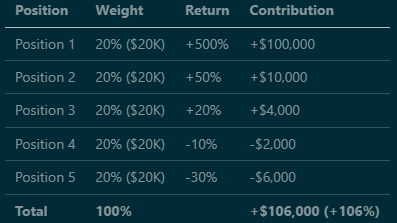
The highest-returning activities in investing follow non-linear payoff curves. Long quiet preparation, then sudden large gains. Months or years of building capability, followed by one decision that generates more return than the previous decade of activity combined.
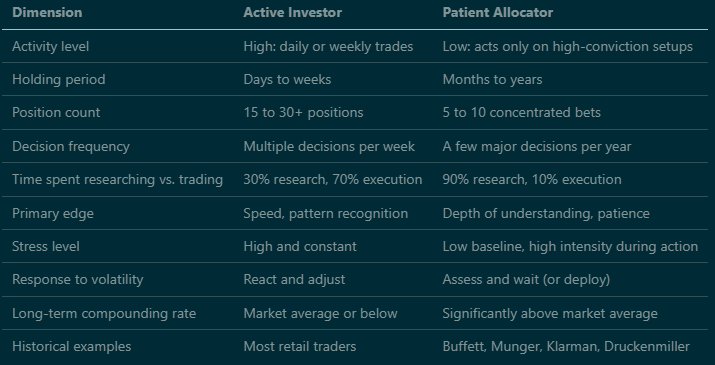
Buffett described his career as mostly waiting. “Waiting for the fat pitch.” Munger called his approach “sit on your ass investing.” These are not lazy people. These are people who understood something fundamental about the structure of returns: in investing, activity is not productivity.
Buffett has said that fewer than twenty decisions drove the majority of his lifetime returns. Twenty decisions across sixty-plus years. Everything between those decisions was reading, thinking, and doing nothing that would show up on a trade blotter.
The pattern is clear. Effort builds capability. Capability enables recognition. Recognition enables decisive action. The payoff arrives in chunks, not in a steady stream. You cannot will it into existence through sheer volume of work.
Most investors refuse to accept this. So they fill the silence with motion.
Checking portfolios hourly. Reading every headline. Watching CNBC. Refreshing brokerage apps. Trading in and out of positions to feel like something is happening. Rebalancing weekly because holding still feels irresponsible.
None of this correlates with returns. The data is unambiguous. Dalbar’s research shows the average equity fund investor underperforms their own fund by 3 to 4 percentage points annually, almost entirely because of poorly timed buying and selling driven by the need to do something. Barber and Odean’s landmark study found that the most active traders consistently underperformed the least active ones by a wide margin.
The busiest investors are not the best investors. They are the worst. And the mechanism is not complicated. Every unnecessary action introduces friction: commissions, spreads, taxes, decision fatigue. Each trade is a chance to be wrong. The investor making 300 trades per year is not 10x more productive than the one making 30. They are 10x more exposed to error.
Here is what makes this truly uncomfortable.
If effort does not linearly produce returns, then you cannot brute-force your way to investment success. You cannot simply outwork the market. You can study, prepare, and build the analytical infrastructure to recognize opportunity when it appears. But you cannot manufacture the opportunity itself. You can only position yourself and wait.
This means accepting something that runs counter to every instinct the modern productivity culture has trained into you: sometimes the highest-value thing you can do is nothing.
Not nothing as in negligence. Nothing as in disciplined restraint. The refusal to act when no action is warranted. The willingness to sit with dry powder and an empty trade blotter while the rest of the market churns itself into mediocrity.
The guilt is the real killer.
If you are an investor who feels guilty about “not doing enough,” that guilt is almost certainly destroying your returns. Guilt is the emotional response to the gap between the linear model you were taught and the non-linear reality you are experiencing. Your brain expects effort to produce reward on a predictable schedule. When it doesn’t, the brain interprets the silence as failure and demands corrective action.
That corrective action, the trade you make to feel productive, is the mistake.
The discipline to do nothing when nothing should be done is the hardest skill in investing. It is harder than security analysis. Harder than understanding macro. Harder than reading financial statements. Because it requires you to override a lifetime of conditioning that says effort equals output.
It doesn’t. Not here.
The investors who figure this out stop measuring themselves by activity and start measuring themselves by positioning. Am I prepared to recognize the next great opportunity? Do I have the capital to act on it? Have I built the analytical frameworks to evaluate it quickly?
If the answer to those questions is yes, then sitting still is not laziness. It is the strategy working exactly as designed.
The market does not reward effort. It rewards positioning, preparation, and the willingness to act decisively at the rare moments when action actually matters.
Everything in between is just waiting. And the waiting is the job.
Lester Leong writes about capital allocation, investing frameworks, and the mechanics of building wealth across market cycles. Follow for portfolio updates and analysis.
This is not financial advice. Frameworks shared for educational purposes. Do your own research.
메타데이터
- post_id
- 413da2e47eae
- slug
- your-effort-doesnt-deserve-a-return-413da2e47eae
- url
- https://medium.com/gradient-growth/your-effort-doesnt-deserve-a-return-413da2e47eae
- canonical_url
- https://medium.com/gradient-growth/your-effort-doesnt-deserve-a-return-413da2e47eae
- author_url
- https://medium.com/@LesterLeong
- status
- ok
- fetched_at
- 2026-07-09 09:29:37