Domestic vs. International Sourcing: Which Is Right for Your Business?
You’ve shortlisted products for your next bulk merchandise order. Two quotes are sitting in your inbox — one from a vendor in Tirupur, one…
Domestic vs. International Sourcing: Which Is Right for Your Business?
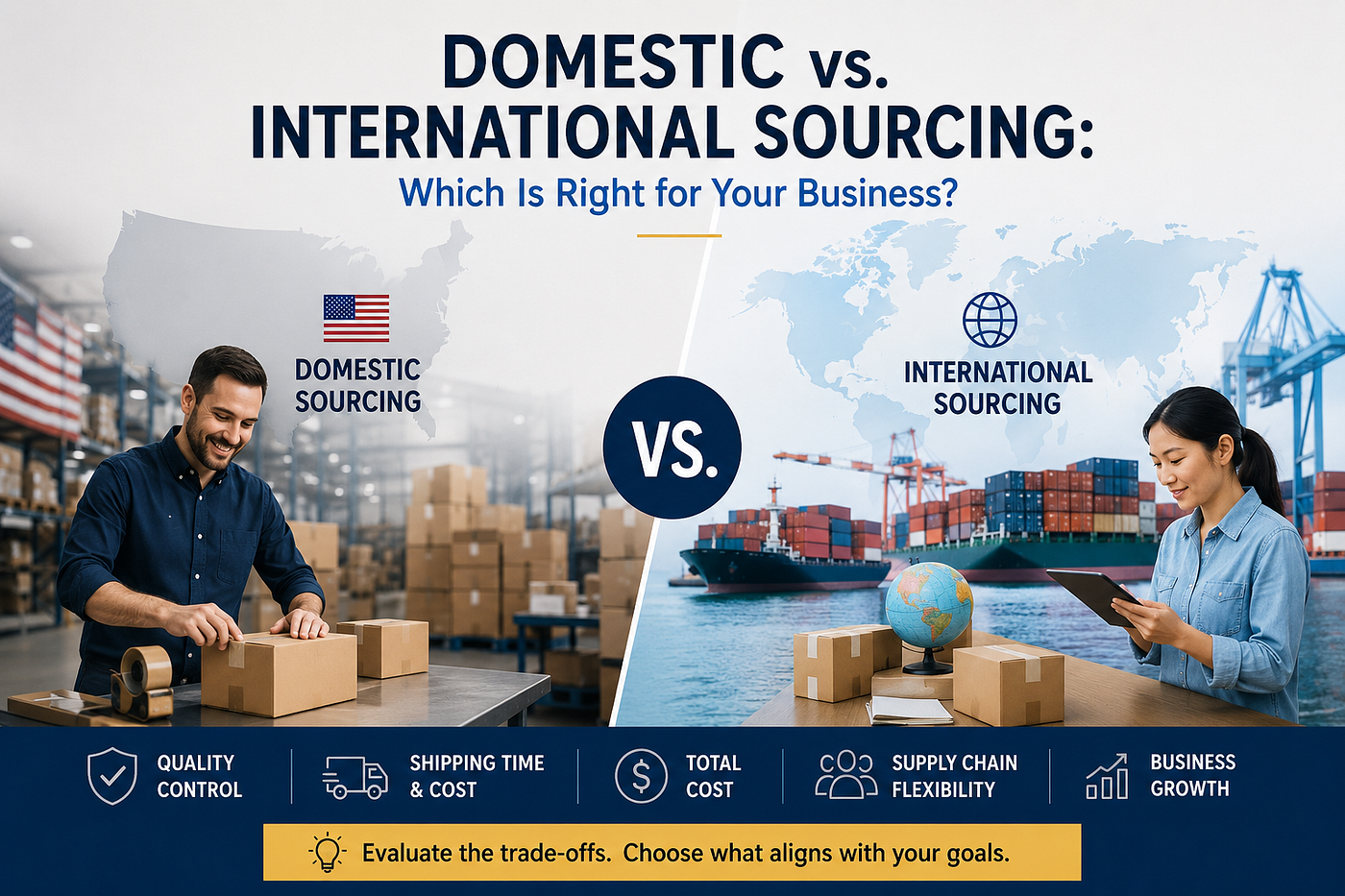
You’ve shortlisted products for your next bulk merchandise order. Two quotes are sitting in your inbox — one from a vendor in Tirupur, one routed through a supplier in China. The international quote is lower per unit. The domestic quote promises faster delivery and easier communication. Neither quote tells you the full story.
This guide breaks down what the comparison actually involves for Indian B2B buyers: landed costs, lead times, quality control, vendor accountability, and the specific scenarios where each sourcing route genuinely makes more sense.
Why This Decision Matters More Than It Used To
Sourcing decisions used to be simpler. If you needed 500 branded tees, you called a vendor you knew in your city. If you needed something at a dramatically lower unit cost, someone suggested trying Alibaba.
That binary has become more complicated. India’s manufacturing sector is undergoing a structural transformation, driven by digitisation, global supply chain realignment, and the growing need for efficient market access. Domestic manufacturers — particularly in textiles, apparel, drinkware, and promotional products — have matured significantly in quality output, customisation capability, and order management. At the same time, international sourcing platforms have made it easier than ever to place orders with overseas factories without a middleman.
The result: the gap between domestic and international sourcing has narrowed on quality, and widened on complexity. The right choice now depends less on a blanket rule and more on the specifics of your order — what you’re buying, how much, how fast you need it, and how much operational bandwidth your team has to manage the process.
The Real Cost Comparison: Unit Price vs. Landed Cost
The most common mistake buyers make when comparing domestic and international sourcing is treating the quoted unit price as the total cost. It isn’t.
Domestic sourcing (Indian manufacturers) — what the quote typically includes:
- Per-unit product cost
- GST at applicable rate (usually 18%, and claimable as ITC for registered businesses)
- Setup or plate charges for print (screen printing, embroidery digitisation)
- Delivery to one or multiple Indian addresses
International sourcing — what the quote typically excludes:
- Shipping freight (air vs. sea changes this significantly — air freight can add ₹150–₹400 per kg depending on origin and volume)
- Import duty and customs clearance charges
- GST on the imported goods value at Indian customs
- Agent or broker fees for clearing the shipment
- Currency conversion and payment processing costs (most overseas suppliers require USD payment via wire transfer or a platform fee)
- Resampling or rework costs if quality doesn’t meet expectations — and these are borne by you, not absorbed by a factory 8,000 km away
The honest calculation: take the international unit price, add ₹80–₹150 per unit for freight and customs on sea shipments (more for air), factor in 2–4 weeks of additional lead time, and then compare that total to a domestic quote that includes delivery. The gap usually narrows considerably — and sometimes reverses.
Quality Control: The Hidden Advantage of Local Sourcing
For procurement teams sourcing internationally, orchestrating a supply chain from thousands of miles away introduces clear operational friction — verifying factory legitimacy without on-ground presence, enforcing quality standards across multi-tier manufacturing operations, and protecting intellectual property during contract manufacturing negotiations are persistent challenges.
With a domestic vendor in India, the quality control loop is faster and more direct:
- Pre-production samples or strike-offs can be reviewed and approved physically within 3–5 working days
- A vendor in the same country is reachable by phone, can resend samples the same day, and can be visited if an order is large enough to warrant it
- Disputes over quality are governed by Indian law and are practically easier to resolve
- Changes to artwork, sizing, or materials mid-production are far more manageable when the production facility is in Tirupur, not Guangzhou
For branded merchandise where Pantone colour accuracy, fabric GSM, or print durability is business-critical — such as premium onboarding kits, candidate merchandise, or high-value client gifts — domestic sourcing carries a meaningful quality assurance advantage that no per-unit cost saving fully compensates for.
Where International Sourcing Still Makes Sense
This is not a case against international sourcing in all situations. There are specific scenarios where it makes genuine commercial sense for Indian B2B buyers.
Very large, non-time-sensitive orders
If you’re ordering 5,000+ units of a relatively standard product — basic promotional tees, generic tote bags, simple drinkware — and you have 8–10 weeks of lead time, international sourcing (particularly from established Chinese manufacturers) can deliver meaningful unit cost savings even after freight and duties. The per-unit math changes when volume is high enough to amortise fixed logistics costs.
Products not manufactured at scale in India
Certain product categories — specialised electronics accessories, specific tech gifting items, complex rigid packaging with multi-layer finishes — have a deeper manufacturing base overseas than in India. If the product you need isn’t readily available from domestic vendors at your required quality level, international sourcing may be the only practical route.
Highly specialised customisation
Some manufacturing techniques — all-over sublimation printing on cut-and-sew garments at scale, complex moulded packaging, certain specialty finishes — are more developed in factories in China, Bangladesh, or Vietnam than in equivalent Indian manufacturers. If your product design requires a technique that domestic vendors can’t execute reliably, international sourcing is worth the logistics overhead.
Vendor Verification: A Different Problem in Each Route
One of the most underrated parts of the domestic vs. international sourcing decision is how you verify that a vendor is legitimate before placing an order.
Domestic vendor verification (India):
- GST registration is publicly verifiable on the GST portal
- MSME registration adds a layer of formal business legitimacy
- References from other Indian companies in your network are reachable quickly
- A physical factory visit is feasible for large orders
- Platforms that list verified Indian manufacturers pre-screen vendors before onboarding them, removing a significant portion of the verification burden
International vendor verification:
- Factory audits require either a local agent or a physical visit — both costly
- Certifications (ISO, audit reports) can be fabricated; third-party verification firms charge significant fees
- Platforms like IndiaMART and TradeIndia list thousands of suppliers but require thorough due diligence before placing orders — the same applies to Alibaba and Made-in-China, where verified badges have varying levels of rigour
- Disputes and non-delivery have far fewer practical remedies than with a domestic vendor
For most Indian buyers ordering branded merchandise at the scale of hundreds to a few thousand units, the verification overhead of international sourcing is not proportionate to the order value or the potential saving.
A Decision Framework: Which Route Fits Your Order
Before defaulting to either route, run your specific order through this checklist:
Choose domestic Indian sourcing if:
- You need delivery within 3–4 weeks
- Your order quantity is below 2,000 units per product
- Brand accuracy (Pantone matching, print quality, material spec) is non-negotiable
- You don’t have a dedicated procurement team managing vendor relationships
- You need pre-production samples before approving the full run
- Your product category is well-served by Indian manufacturers — apparel, drinkware, notebooks, tote bags, promotional merchandise, corporate gifting products
Consider international sourcing if:
- Your order is 3,000+ units of a standard, non-brand-critical product
- You have 8–10 weeks of lead time available
- You’ve done this route before and have an established overseas vendor relationship or local sourcing agent
- The product category is genuinely limited in domestic manufacturing capability
- Your team has the bandwidth to manage freight, customs, and quality inspection independently
Frequently Asked Questions
Q1: Is sourcing from China always cheaper than sourcing from Indian manufacturers?
Not once you calculate landed cost. Chinese unit prices are often lower, but adding sea or air freight to India, import duties, GST on import value, and customs brokerage fees narrows the gap significantly. For orders below 2,000 units of most promotional merchandise categories, domestic Indian sourcing typically delivers comparable or lower total cost with a fraction of the lead time and logistics complexity.
Q2: What import duty applies when sourcing branded merchandise from other countries?
Import duty varies by product category and is calculated on the assessed customs value. Most promotional merchandise and branded apparel attracts Basic Customs Duty in the range of 10–20%, plus IGST at 18% on the assessed import value. These costs can add 30–40% to the quoted international price depending on the product. Consult a licensed customs broker for accurate duty calculation before committing to an international order.
Q3: How do I verify an overseas supplier before placing a large order?
At minimum, request a factory audit report from a recognised third-party firm, ask for references from Indian companies they have previously supplied, order a paid pre-production sample before committing to the full run, and use a platform or sourcing agent that carries out independent verification. Never place a significant order based on an Alibaba profile badge or a website alone.
Q4: Should I use a sourcing agent for international procurement?
For buyers without prior international sourcing experience, a reputable India-based sourcing agent who has on-ground presence in the manufacturing country adds value that often justifies their fee — particularly for quality inspection, vendor verification, and logistics coordination. Without that layer, the risk of receiving non-compliant goods with limited recourse is significant. Factor the agent’s fee into your landed cost calculation before assuming international sourcing is cheaper.
메타데이터
- post_id
- 4151a3fd4bcd
- slug
- domestic-vs-international-sourcing-which-is-right-for-your-business-4151a3fd4bcd
- url
- https://medium.com/@marketing_95522/domestic-vs-international-sourcing-which-is-right-for-your-business-4151a3fd4bcd
- canonical_url
- https://medium.com/@marketing_95522/domestic-vs-international-sourcing-which-is-right-for-your-business-4151a3fd4bcd
- author_url
- https://medium.com/@marketing_95522
- status
- ok
- fetched_at
- 2026-06-25 12:15:08