The Organic Cotton Label Illusion: Is Sustainable Fashion Really Solving the Climate Problem?
The Organic Cotton Label Illusion: Is Sustainable Fashion Really Solving the Climate Problem?
The Organic Cotton Label Illusion: Is Sustainable Fashion Really Solving the Climate Problem?
The Organic Cotton Label Illusion: Is Sustainable Fashion Really Solving the Climate Problem?
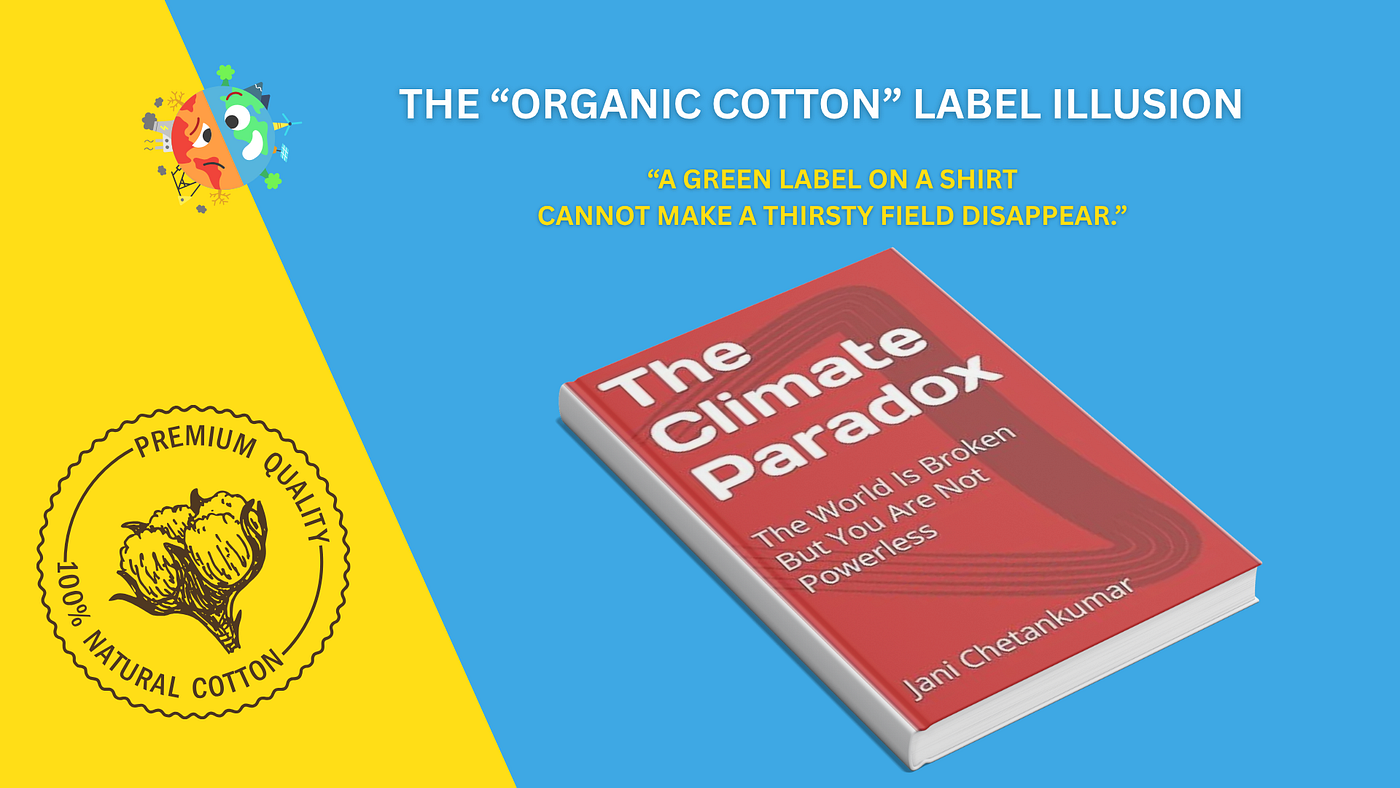
A green label on a shirt cannot make a thirsty field disappear.
A fashion showroom glowed under soft lighting somewhere between threads and thirst.
A banner above the entrance proudly announced:
“Sustainably Stylish — Our Organic Cotton Collection Has Arrived!”
Soft fabrics lined the racks. Earth-tone colors whispered environmental virtue. Minimalist tags carried words like organic, conscious, eco-friendly, and planet-positive.
A shopper lifted a neatly folded shirt and smiled.
“It’s organic,” she said softly.
“I’m doing my part.”
I raised my hand.
“So… sustainability now depends on the label, not the landscape where the cotton grows?”
Silence.
The fitting-room curtain moved slightly, as if even the fabric was uncomfortable.
Because somewhere between the showroom mirror and the cotton field, modern sustainability has created one of its most elegant illusions:
If the label sounds green, the product must be sustainable.
But is that really true?
This is the climate paradox of organic cotton.
What Is the Organic Cotton Label Illusion?
The organic cotton label illusion is the belief that a garment becomes fully sustainable simply because it is made from organic cotton.
Organic cotton can absolutely be better than conventional cotton in important ways. It can reduce the use of synthetic pesticides and fertilizers. It can support healthier soil practices. It may reduce chemical exposure for farmers and surrounding communities when properly managed.
But here is the problem:
Organic does not automatically mean low-water, low-carbon, low-waste, circular, durable, ethical, or truly sustainable.
Organic cotton mainly tells us something about how the cotton was grown chemically.
It does not always tell us:
- how much water was used
- whether the cotton was grown in a water-stressed region
- whether the farm was rain-fed or irrigation-dependent
- how the fabric was dyed and processed
- how much energy was used in manufacturing
- whether workers and farmers were paid fairly
- how long the garment will last
- whether the clothing brand is reducing overproduction
- whether the consumer actually needed another shirt
That is where sustainable fashion becomes complicated.
A green label may tell part of the truth.
But the planet needs the full story.
The Hidden Water Footprint of a Cotton T-Shirt
Cotton feels light in the hand, but its environmental footprint can be heavy.
A widely cited estimate says that producing one cotton t-shirt can require around 2,700 liters of freshwater. The European Parliament has also cited this figure, noting that this amount is enough to meet one person’s drinking needs for approximately 2.5 years.
Now imagine walking into a fashion store and seeing this tag:
Organic Cotton T-Shirt Water Footprint: Approx. 2,700 Liters Source Region: Water-Stressed Basin Expected Use: 5–10 Wears Before Trend Replacement
Would the purchase still feel the same?
Probably not.
Because the fashion industry often shows us the softest part of sustainability: the label.
It rarely shows us the hardest part: the resource ledger.
A cotton t-shirt is not just a t-shirt.
It is water, land, labor, energy, transport, chemicals, packaging, washing, and eventually waste — stitched together into something we call fashion.
Organic Cotton Is Better — But It Is Not a Magic Wand
Let us be fair.
This article is not an attack on organic cotton.
Organic cotton has real benefits when it is grown responsibly. It can reduce synthetic chemical inputs, support biodiversity-friendly farming systems, and encourage more careful soil management.
But the danger begins when organic cotton becomes a marketing shortcut.
Organic cotton should be a starting point for sustainability.
Not the full destination.
A shirt can be organic and still be part of:
- fast fashion
- overproduction
- excessive water use
- poor supply chain transparency
- high-energy processing
- wasteful packaging
- short garment life
- emotional greenwashing
This is the uncomfortable truth:
A better material inside a broken system does not automatically create a sustainable outcome.
If a brand produces millions of “organic” garments, pushes discounts every week, encourages consumers to buy more than they need, and provides limited traceability, then organic cotton becomes a softer version of the same consumption problem.
The system remains thirsty.
Only the tag becomes greener.
The Aral Sea: When Cotton Helped Drink a Sea
To understand why cotton and water cannot be separated, we must look at one of the most painful environmental disasters of the modern world: the Aral Sea.
Once one of the world’s largest inland water bodies, the Aral Sea supported fisheries, livelihoods, agriculture, and regional ecosystems across Central Asia.
Then came large-scale irrigation expansion.
From the 1960s onward, massive volumes of water from the rivers feeding the Aral Sea were diverted for agriculture, especially cotton cultivation. Over time, the sea shrank dramatically.
The consequences were devastating:
- fishing communities collapsed
- local livelihoods were destroyed
- exposed seabeds released salty dust
- public health problems increased
- ecosystems were severely damaged
- regional water stress deepened
World Bank materials have linked the extensive development of cotton irrigation to the major decline in water flow reaching the Aral Sea.
That story is not just about cotton.
It is about what happens when production systems ignore ecological limits.
A cotton field can look green while a sea dies somewhere else.
A fashion tag can look responsible while a river basin carries the cost.
That is why the question is not only:
Is this cotton organic?
The better question is:
What happened to the water system behind this cotton?
Why Sustainable Fashion Cannot Be Judged by Fiber Alone
The fashion industry often simplifies sustainability into material choice.
Organic cotton.
Recycled polyester.
Vegan leather.
Bamboo fabric.
Plant-based dyes.
These can be useful innovations. But sustainability cannot be reduced to one material claim.
A garment has a lifecycle.
That lifecycle includes:
- Raw material cultivation
- Land and water use
- Fertilizer and pesticide inputs
- Harvesting and transport
- Spinning and weaving
- Dyeing and finishing
- Garment manufacturing
- Packaging
- Shipping and retail
- Consumer washing and drying
- Repair, reuse, resale, recycling, landfill, or incineration
If only one stage is improved while the rest of the system remains wasteful, the product may be “less harmful,” but not necessarily sustainable.
That is why many green fashion claims feel emotionally satisfying but analytically incomplete.
The consumer sees a label.
The supply chain sees a spreadsheet.
The planet sees everything.
The Fast Fashion Problem: Too Many Clothes, Too Little Use
The organic cotton debate becomes even more serious when we look at the scale of fashion production.
UNEP has reported that around 92 million tonnes of textile waste are produced globally every year. It has also highlighted that clothing production doubled from 2000 to 2015, while the duration of garment use decreased significantly.
This is the real monster hiding behind the green label.
The world is producing more clothes.
People are using garments for less time.
Textile waste is rising.
And sustainability is increasingly being sold as a shopping category.
That creates a dangerous psychological loop:
- Consumers feel guilty about environmental issues.
- Brands offer “sustainable collections.”
- Consumers buy more to feel responsible.
- Production volumes continue rising.
- Waste keeps growing.
- The next collection arrives with an even greener slogan.
This is not transformation.
This is consumption wearing a recycled-paper name tag.
The Consumer Psychology of Green Labels
Green labels work because they reduce guilt.
They give the consumer emotional permission to buy.
A normal t-shirt says:
You are consuming.
An organic cotton t-shirt says:
You are helping.
That small emotional shift is powerful.
It turns shopping into self-expression.
It turns consumption into virtue.
It turns a purchase into climate participation.
But climate action cannot be reduced to moral comfort at the billing counter.
Sometimes the most sustainable choice is not buying a greener version of something.
Sometimes it is buying nothing.
Sometimes it is repairing.
Sometimes it is repeating outfits.
Sometimes it is choosing second-hand.
Sometimes it is asking why a wardrobe full of clothes still creates the feeling of having “nothing to wear.”
The climate crisis is not only a production problem.
It is also a desire-management problem.
Organic Cotton and the Water-Stress Question
One of the biggest problems with organic cotton marketing is that it often ignores geography.
Cotton grown in a rain-fed region is very different from cotton grown in a water-stressed area using heavy irrigation.
This is why the same fabric can have very different environmental impacts depending on where and how it is grown.
A serious sustainable fashion label should tell consumers:
- whether the cotton was rain-fed or irrigated
- whether the region faces water scarcity
- whether groundwater was used
- whether local rivers or aquifers are under stress
- whether farmers used water-efficient methods
- whether the crop is suitable for the local climate
Without this information, the word “organic” may create more confidence than it deserves.
Because sustainability is not only about what is grown.
It is about where, how, why, and at what ecological cost.
A Positive Example: Climate-Suitable Cotton and Local Systems
Not every cotton story is negative.
Some cotton systems offer better lessons.
In India, traditional cotton varieties such as Kala cotton from Kutch have gained attention because they are associated with dryland conditions, rain-fed cultivation, local weaving communities, and climate-suitable farming.
This is an important direction for sustainable fashion.
Instead of blindly chasing global labels, the industry should support systems that match local ecology.
That means:
- rain-fed cotton where suitable
- indigenous and resilient crop varieties
- local processing and weaving ecosystems
- farmer-centered supply chains
- durable garments
- lower transport dependency
- stronger rural livelihoods
- slower fashion cycles
This is where sustainability becomes more real.
Not when a product merely looks green.
But when the crop, climate, community, culture, and consumption pattern make sense together.
The Certification Paradox
Certifications are important.
They create standards.
They build accountability.
They help consumers identify better options.
But certification is not the same as transformation.
A certification can verify certain criteria.
It cannot automatically fix:
- overconsumption
- fast fashion addiction
- low garment durability
- excessive returns
- textile waste exports
- poor repair culture
- opaque subcontracting
- weak farmer bargaining power
- misleading marketing language
This is the certification paradox:
The more complex sustainability becomes, the more consumers want a simple label.
The simpler the label becomes, the easier it is for brands to hide complexity.
The tag becomes small.
The claim becomes big.
The truth becomes somewhere in between.
What Sustainable Fashion Should Really Mean
If fashion truly wants to become sustainable, it must move beyond label-based marketing.
Real sustainable fashion should include:
1. Water Transparency
Brands should disclose whether cotton is rain-fed or irrigated and whether it comes from water-stressed regions.
2. Farmer Support
Organic and regenerative transitions require training, financial support, fair pricing, and long-term purchasing commitments.
3. Lower Production Volume
No material can solve sustainability if brands continue producing excessive quantities of clothing.
4. Durability and Repair
Clothing should be designed to last longer, be repaired easily, and remain useful beyond seasonal trends.
5. Circular Fashion Systems
Resale, reuse, recycling, take-back schemes, and mono-material design must become operational realities, not marketing campaigns.
6. Honest Consumer Education
Consumers deserve lifecycle information, not emotional slogans.
7. Better Policy and Accountability
Governments and regulators must push for stronger transparency, waste reduction, extended producer responsibility, and credible sustainability claims.
8. Reduced Overconsumption
The most uncomfortable but important part of fashion sustainability is simple:
Buy less.
Use longer.
Waste less.
What Consumers Can Ask Before Buying Organic Cotton
Before buying an organic cotton product, consumers can ask:
- Do I really need this?
- Will I wear it at least 30 times?
- Is the brand transparent about sourcing?
- Is the cotton rain-fed or irrigation-heavy?
- Is the garment durable?
- Can it be repaired?
- Is there a second-hand alternative?
- Is this timeless or trend-based?
- Is the brand reducing overproduction or only changing labels?
- Am I buying this product because I need it, or because the label reduced my guilt?
That last question is the most powerful.
Because it moves sustainability from the store shelf to self-awareness.
The Climate Paradox of Organic Cotton
The paradox is simple.
A consumer buys organic cotton to reduce harm.
A brand sells organic cotton to increase sales.
A farmer carries transition risk.
A river carries irrigation pressure.
A landfill carries textile waste.
And everyone claps because the tag was green.
This does not mean organic cotton is bad.
It means incomplete sustainability is dangerous.
Organic cotton can be part of the solution.
But it cannot become an excuse for overproduction, overconsumption, weak traceability, poor water governance, and emotional greenwashing.
A green label should not become a blindfold.
Final Reflection: Is Your Shirt Sustainable, or Just Better Marketed?
If environmental solutions simply replace one resource challenge with another, what kind of progress are we actually wearing?
Because the message people often encounter today is not:
“Buy less.”
Instead, it quietly becomes:
“Buy more — just make sure the label sounds greener.”
And that is the real fashion paradox.
A shirt may be organic.
But the habit may still be synthetic.
A tag may be green.
But the river may still be thirsty.
A consumer may feel conscious.
But the supply chain may still be unconscious.
So next time we see a beautiful organic cotton shirt, maybe we should not only ask:
“Is it organic?”
Maybe we should ask:
“Is the system behind it also alive?”
Because sustainability does not begin with a label.
It begins when marketing finally meets measurement.
And when consumption finally meets conscience.
About the Book: The Climate Paradox
This article is part of my upcoming book, **The Climate Paradox** — a collection of sharp, funny, cryptic, and thought-provoking climate stories that challenge the contradictions hidden inside modern sustainability.
The book explores more than 200 climate case studies, sustainability paradoxes, and real-world environmental stories across fashion, food, electric vehicles, renewable energy, carbon markets, ESG, consumer behavior, greenwashing, waste, water, technology, and climate justice.
If this article made you smile, question, disagree, reflect, or rethink one green label, then the book has already done its job.
To read more such climate stories and case studies, kindly visit my book:
**The Climate Paradox Amazon Link:** https://amzn.in/d/05go2MkT
Because the climate crisis does not only need awareness.
It needs better questions.
메타데이터
- post_id
- 419156b28c87
- slug
- the-organic-cotton-label-illusion-is-sustainable-fashion-really-solving-the-climate-problem-419156b28c87
- url
- https://medium.com/@chetan.jani8/the-organic-cotton-label-illusion-is-sustainable-fashion-really-solving-the-climate-problem-419156b28c87
- canonical_url
- https://medium.com/@chetan.jani8/the-organic-cotton-label-illusion-is-sustainable-fashion-really-solving-the-climate-problem-419156b28c87
- author_url
- https://medium.com/@chetan.jani8
- status
- ok
- fetched_at
- 2026-06-10 15:53:41