The Inward vs. Outward Turn: Humanity’s Oscillating Intellectual Focus
Peter Watson’s book, Ideas: A History of Thought from Fire to Freud, provides an overarching narrative of human intellectual evolution from…
Photo by Phyllis Poon on Unsplash
The Inward vs. Outward Turn: Humanity’s Oscillating Intellectual Focus
Peter Watson’s book, Ideas: A History of Thought from Fire to Freud, provides an overarching narrative of human intellectual evolution from prehistory to the modern era, exploring how fundamental concepts — such as the soul, the idea of Europe, and the scientific experiment — alongside numerous other philosophical, religious, and technological innovations, have profoundly shaped human civilization and the modern mind. Among many ideas in this truly big book (1152 pages in hard cover print) he talks about “inward” and “outward” turns of humanity as a way to organize and understand intellectual history.
The Pendulum of Human Progress
According to Watson, history of the human experience reveals a rhythmic oscillation, a grand, sweeping pendulum that has governed the trajectory of our species for over three million years. History is not a linear climb from the darkness of the cave to the light of the laboratory; rather, it is a series of dialectical shifts between two fundamental orientations of human consciousness: the Inward Turn and the Outward Turn.
This dualism represents the core mechanism of human advancement, where each phase arises as a necessary material or psychological response to the inherent limitations and “systemic crises” of the era preceding it.
The Inward Turn is defined by an intense focus on internal self-reflection, spirituality, the mapping of the unconscious, and the refinement of the collective soul. It is the realm of the subjective, the symbolic, and the metaphysical. Historically, this turn has served as humanity’s primary defense against “alienation” — a Marxist framework concept denoting the profound sense of powerlessness that occurs when humans lose control over their environment or their social structures. From the shamanistic rituals of the Paleolithic to the complex individual conscience of the Reformation, the Inward Turn seeks to provide internal order and a sense of liberty when the material world becomes chaotic, hierarchical, or oppressive.
Conversely, the Outward Turn is characterized by an empirical, positivist, and world-shaping focus. It is the drive toward the mastery of technology, the domination of the material environment, and the expansion of the species across geographical boundaries. This turn manifests in the “cultural weaponry race” — the development of specialized tools, the engineering of landscapes through irrigation and drainage, and the eventual industrialization of the planet. It is the engine of material success, providing the surplus, security, and physical infrastructure necessary for survival.
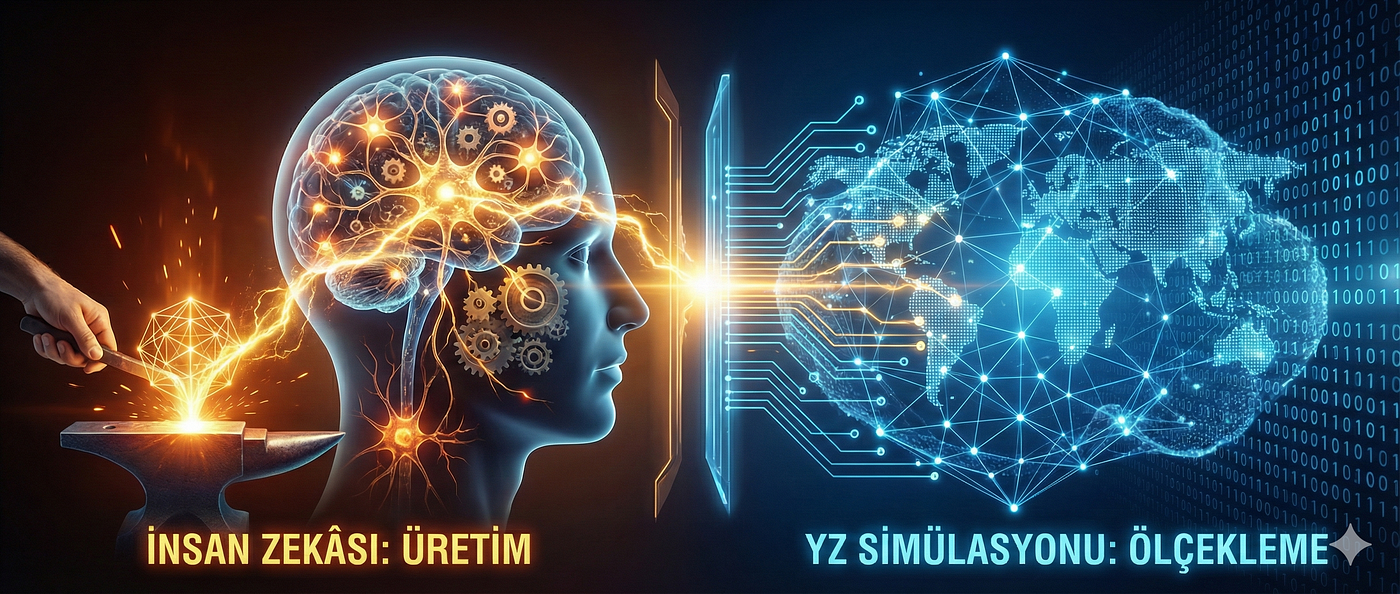
Civilization advances through the tension between these two focuses. The Outward Turn yields the technical hardware of existence, while the Inward Turn develops the cultural and psychological software required to navigate that existence. Neither can exist in a vacuum; they are the twin gears of the “Hominid Revolution,” constantly recalibrating the human experience in response to the material conditions of production and the deep-seated need for social solidarity.
The Biological Spark: Bipedalism and the Dual Nature of Mind
The origin of this oscillation is not found in the realm of theory, but in the red earth of the Afar Depression in Ethiopia. Approximately 3.2 million years ago, a new form of archaic ape, Australopithecus afarensis, began to traverse the savannah. The discovery of “Lucy” — a 1.1-meter-tall female whose skeletal remains represent forty percent of a complete individual — provided the first evidence of the biological spark that would ignite human history. Lucy was ape-like in her small cranial capacity and long arms, yet she possessed a revolutionary trait: bipedalism.
The transition to upright walking was a response to climate change. as forests receded and vast grasslands emerged, natural selection favored those who could cover greater distances in search of food. However, the consequences of bipedalism were far more than locomotive. By freeing the hands from the necessity of walking, the hominid body became a site of profound evolutionary conflict. This was the birth of the dialectic between the hand and the brain.
“The powerful dialectic of evolutionary change was set in motion: hand and brain, labor and mental power, skill and thought began an explosive interaction, the culmination of which is the modern human.”
This “explosive interaction” meant that the hand became the primary interface with the material world (the Outward), while the brain was forced to evolve into a high-capacity processing unit to manage this new complexity (the Inward). The hardware of the human mind is exceptionally “costly” in biological terms. The modern human brain, though only 2% of total body weight, consumes 20% of the body’s energy. Furthermore, the development of a large skull created a biological crisis for a species adapted to a bipedal pelvis, significantly increasing infant mortality and the pain of childbirth.
The evolutionary gamble paid off because it allowed for “cultural evolution” to overtake biological evolution. While other species remain trapped within their specific ecological niches, hominids became the only creatures “adapted to adapt.” Our large brains allowed us to maintain complex social networks — the “150-person limit” identified by anthropologists — and to engage in forward planning. This biological foundation meant that from the very beginning, every “Outward” thrust of tool-making required an “Inward” development of conceptual thought and language.
The First Outward Thrust: Ionian Positivism and the Mastery of Tools
The first major Outward Turn manifests as the “Upper Paleolithic Revolution.” For over 1.5 million years, Homo erectus had utilized a stagnant toolkit, primarily the “Acheulian” hand-axe — a general-purpose chopper. However, with the emergence of Homo sapiens — the “super-hominid” arriving from Africa roughly 85,000 years ago — the pace of innovation accelerated into a “cultural weaponry race.” This era was defined by a spirit we might call “Ionian positivism”: a proto-scientific worldview where the environment was no longer a mysterious force to be feared, but a series of problems to be solved through technical ingenuity.
The archaeological record at sites like Boxgrove in Sussex (dating back 500,000 years) and Lynford in Norfolk (a 60,000-year-old mammoth butchery site) demonstrates a growing mastery of the material world. At Boxgrove, researchers discovered 300 hand-axes used to butcher horses, deer, and rhinoceros on what was then a coastal plain. By the time of the Upper Paleolithic, this had evolved into the production of specialized “blades” — sharp stone tools that were significantly longer than they were wide.
The Outward Arsenal
- Experimental Tool-making: The transition from the “Mousterian” toolkit of the Neanderthals — which contained up to 63 distinct types of points and scrapers — to the “Aurignacian” blades of Homo sapiens. This represented a shift from opportunistic tool use to a systematic “cultural weaponry race” involving the creation of harpoons, spear-throwers, and eventually the bow and arrow.
- Environmental Engineering and Adaptation: The ability to colonize every climatic zone on Earth. While Neanderthals were biologically adapted to the cold (short, stout bodies with large noses), Homo sapiens used “cultural adaptability.” We did not wait for our bodies to evolve fur; we invented the needle and thread to craft warm clothing and used the “Outward” mastery of fire for cooking and protection.
- Collective Labor and Global Colonization: Approximately 85,000 years ago, a single group of hunter-gatherers left Africa. Within three thousand generations, their descendants had colonized the globe, from the Arctic tundras to the tropical rainforests. This was made possible by the construction of “long houses” — timber structures up to 40 meters long — that required the collective effort of an entire “sülale” (lineage).
This first Outward Turn allowed Homo sapiens to become the dominant species, not through physical strength, but through the ability to organize “planlı kolektif emek” (planned collective labor). However, this mastery of the exterior world eventually led to a crisis that no tool could solve: the crisis of success.
The Origins of the Inward Turn: Alienation and the Axial Age
The Neolithic Revolution (roughly 10,000 BCE) marked a radical shift in the human mode of production. As the Earth warmed and the great herds of mammoths and wild horses disappeared, humanity was forced into the “gönülsüz tercih” (reluctant choice) of agriculture. Farming was — and is — grueling work: clearing land, weeding, sowing, and constant anxiety over soil exhaustion and drought.
This transition from “Primitive Communism” — where resources were shared and “social parasites” did not exist — to organized agriculture created the first “systemic problems.” Population density led to resource scarcity, which in turn birthed organized warfare. The transition is bloodily illustrated by the Talheim death pit in Southwest Germany. Here, 34 people — including 17 children and several adults killed by blows to the head or arrow wounds — were dumped into a three-meter-wide pit. This massacre, occurring around 5000 BCE, signals the “Neolithic exitus”: the end of peaceful hunter-gatherer coexistence and the rise of “savaş ağaları” (warlords).
The Inward Turn emerged as a psychological response to this new reality of violence, hierarchy, and “lack of control over nature.” When technical solutions failed and social crisis became permanent, humans turned to “Religion and Alienation.”
The distinction between Paleolithic “Magic” and Neolithic “Religion” is fundamental to our thesis:
- Magic: A proto-Outward attempt to influence the world. For the Paleolithic hunter, drawing a mammoth on a cave wall was a form of “büyü” (magic) — a “shaklabanlık” (charade) intended to “summon” the future hunt through symbolism. It was an active, if scientifically flawed, attempt to control reality.
- Religion: A profound Inward withdrawal. Realizing that they could not control the Sun, the Moon, or the Earth Mother through simple rituals, humans began to “pray” and “sacrifice.” Religion became the “glue” for tribal states, using shared belief to provide solidarity in a world of growing class inequality.
The birth of what we call the “Axial Age” was the culmination of this Inward Turn. It was an attempt to find an internal landscape of order in a world defined by the exhaustion of the soil and the brutality of the warlords. It provided a framework for individual meaning in a society that had become increasingly alienated from the “Primitive Communism” of our ancestors.
The Middle Ages to the Reformation: The Introspective Shift
As the pendulum swung into the Middle Ages, the Inward Turn became the dominant cultural force. The collapse of the material certainties of Classical Antiquity led to a period of “intense internal self-reflection.” If the Neolithic turn was about appeasing external gods, the Christian and later Reformation eras focused on the internal state of the soul.
A key anthropological observation from the source context is the “fossilization” of archaic beliefs within these sophisticated religious frameworks. The “Intellectual Historian” notes that even in High Classical Athens, virgins would dance for the goddess Artemis dressed as bears — a clear survival of ancient “totemism,” where a human group identified with an animal. Similarly, the Roman Lupercalia involved rituals in caves and the wearing of animal skins, echoing the shamanistic practices found in the “Gough’s Cave” in Somerset.
However, the Reformation represented the ultimate “internalization” of the human experience. It shifted the locus of truth from the external hierarchy of the Church to the individual conscience. This was an Inward Turn that sought to address the alienation of feudal life not by building bigger cathedrals (the “Outward” monumentalism of the Middle Ages), but by exploring the “internal landscape” of faith. It was a period where the constantly talking nature of Homo sapiens was directed toward the debate of dogma and the salvation of the soul, providing the conceptual foundation for modern notions of individual liberty.
The Great Outward Surge: Renaissance, Exploration, and Industry
Eventually, the limitations of pure introspection — which could not cure the plague or feed a growing population — forced the pendulum back toward the material world. This “Great Outward Surge” was built upon technical precursors found in the Neolithic and early city-states: metallurgy, the wheel, and the sail.
Metallurgy was truly magical compared to stone. Stone tools can only be shaped by cutting pieces off; once broken, they are waste. Metal, however, is recyclable; it can be melted, mixed, and molded into infinite shapes. This technical leap allowed for a level of environmental engineering that replaced “yelling at the gods” with “engineering the environment.”
The Revolutionary Progress of the Outward Turn
- Irrigation and Drainage: As seen in the Sumerian city-state of Lagaş, the development of canals and dams was an expression of social labor. It turned swamps into farmland and deserts into gardens, demonstrating that the “Outward” mastery of water was more effective than any sacrifice to the Earth Mother.
- Transportation and Energy: The invention of the wheel and the harness for pack animals (oxen, horses) meant that human labor was no longer the primary limit of production. The development of the sail harnessed “wind power” to replace “muscle power,” leading to the “First Globalization” of the modern era.
- The Scientific/Industrial Revolution: This was the peak of the Outward Turn. It applied the same “Aurignacian” logic of tool specialization to the steam engine and the factory. It was a period of absolute “materi-centrism,” where success was measured by the domination of nature and the accumulation of surplus.
Romanticism and Freud: The Modern Inward Reaction
No Outward Turn, however materially successful, can satisfy the human psyche indefinitely. The cold, mechanical world of the Industrial Revolution inevitably triggered a reactionary Inward Turn: the Romantic movement. This was a return to imagination and creativity, a psychological rebellion against the perceived “coldness” of industry.
This shift reached its zenith with Sigmund Freud’s “discovery” of the unconscious. Freud shifted the focus of human exploration from the “African savannah” to the “internal landscape of the psyche.” There is a profound parallel here between the Paleolithic cave paintings and Freudian dream analysis. The source context emphasizes that for the prehistoric mind, “symbolic shapes” were seen as “reality.” Freud returned us to this understanding: that our internal symbols — our dreams and repressed desires — are the reality through which we interpret and experience the material world.
Just as the horse hunters at Gough’s Cave used rituals to “shape their hopes and desires” before a hunt, modern psychoanalysis uses symbols to address the alienation inherent in our high-tech, high-pressure society. The Inward Turn reminds us that we are “extremely social animals” whose well-being depends on more than just the efficiency of our “Acheulian” tools.
Conclusion: The Synthesis of Liberty and Success
The history of the “Human Revolution” is the history of this perpetual oscillation. We are a species defined by our cultural adaptability; our ability to respond to material crises with intellectual shifts. The “Outward” turns have consistently provided the material success required for our survival: the surplus of the Sumerian fields, the efficiency of the “Mousterian” toolkit, and the global infrastructure of the modern age. Without these, we would have remained a small, vulnerable population in the Afar Depression.
However, it is the “Inward” turns that have provided the human liberties — the concepts of conscience, individual rights, and psychological depth — that make that survival meaningful. The Inward Turn is the mechanism through which we navigate the “alienation” produced by our own material success. We are currently witnessing a period of “systemic crisis” similar to the late Neolithic: soil exhaustion (environmental crisis) and organized warfare (the return of the “savaş ağaları”). As we stand at this juncture, the pendulum appears poised for its next great swing.
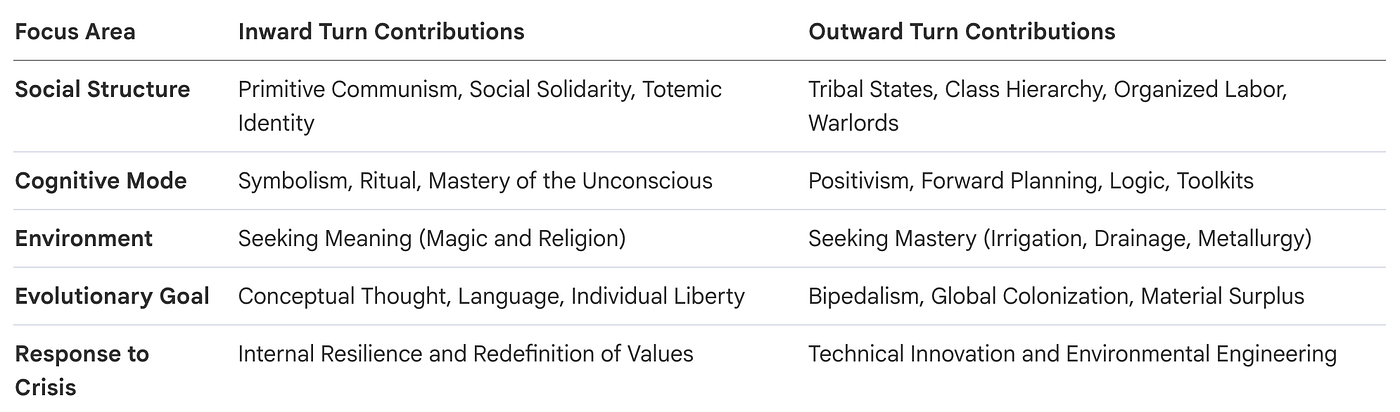
The future of the hominid experience depends on our ability to synthesize these two turns. We must remain “constantly talking”, forever analyzing and arguing, ensuring that our material mastery of the planet (the Outward) is balanced by a deep, introspective understanding of our own humanity (the Inward).
Only through this dialectic can we hope to transcend the alienation of our current era and continue the remarkable journey that began with Lucy’s first upright step.
Yalcin Arsan — June 2026
메타데이터
- post_id
- 4192a29c28e1
- slug
- the-inward-vs-outward-turn-humanitys-oscillating-intellectual-focus-4192a29c28e1
- url
- https://medium.com/infinite-impulse/the-inward-vs-outward-turn-humanitys-oscillating-intellectual-focus-4192a29c28e1
- canonical_url
- https://medium.com/infinite-impulse/the-inward-vs-outward-turn-humanitys-oscillating-intellectual-focus-4192a29c28e1
- author_url
- https://medium.com/@yalcinarsan
- status
- ok
- fetched_at
- 2026-06-12 18:14:10