Forgotten Names, Missed Opportunities — The Lancia Fulvia
At the Ryhope Motor Show this year, I finally got a closer glimpse of one of my all-time favourites, the Lancia Fulvia, this time in the…

Forgotten Names, Missed Opportunities — The Lancia Fulvia
At the Ryhope Motor Show this year, I finally got a closer glimpse of one of my all-time favourites, the Lancia Fulvia, this time in the guise of a white 1.3s Coupe, in pristine condition.

The Lancia Fulvia Coupe in 1.3s UK spec, looking quite splendid at Ryhope in the sunlit late spring afternoon.

Ah, Lancia, the once illustrious marque. The brand has no presence in Hong Kong for the best part of the past three decades — in fact I’m quite certain that it is virtually unknown to my generation outside of Italy. You buy the latest Ypsilon in the UK, and it’s called a Chrysler, which is a rebadged Lancia, which is in turn a rebadged old Fiat to clear surplus from the parts bin. It’s not always been the case, but I digress.
The Fulvia debuted with the Berlina saloon in 1963. It was to replace the Appia as the new generation of post-war saloons, the Alfa Giulietta 101 series being so well-received at the time. Short and stumpy in its stance, even to me it’s halfway between the slightly ungainly and downright hideous; however, if one sees beyond the skin, this ugly duckling was the basis of a timeless high in automotive history.

Slab-sided and awkwardly proportioned, the Fulvia Berlina’s looks could hardly be dubbed inspiring. On closer inspection this was probably the logical result of space optimisation on a car with a very limited footprint, similar in spirit to modern Japanese K-cars.
Just when everyone’s ready to turn away from the latest Lancia offering, the introduction of the Fulvia Coupe and the quirky but charming Sport Zagato in 1965 recaptured the attention of the road-crazed, jet-set bunch of the 60s — now the Fulvia has the looks to compliment the mechanical magic, and the recognition it well deserved.

Spotted in Hamburg in the St Pauli district, this Fulvia shows the original front fascia design. UK spec cars have larger, raised outer headlights due to the headlight height regulations (see the Ryhope car above).

And a Fulvia Sport Zagato here seen at Bonello’s. Zagato does weird but strangely appealing lightweight bodies that are probably 10 years ahead of its contemporaries in terms of design. Would you believe this is from the mid 60s?


Regardless of the body styles, the party piece of the Fulvia was certainly the small displacement narrow-angle V4 engine. The V4 layout had become one of Lancia’s signature touches; first introduced in the 1920s, the Fulvia V4 unit designed by Ettore Zaccone Mina was longitudinally-mounted on a front subframe and canted to the left to maintain a low centre of gravity while allowing for relatively compact packaging, while the use of one cylinder head and twin overhead cams effectively controlled the air flow, and produced a distinctive yet evocative thrum that encourages you to be more generous on the loud pedal as the beautifully-balanced chassis and suspension tackles corner after corner with all its Italian zest and vivacity.

Diagram showing the narrow slanted V4. The V angle was revised from 12.5 from the first iterations to 11.2 on the latest, hottest 1.6 HF rally cars. Note how the engine is located under the bonnet — ahead of the front axle and slanted to one side.

Power is from 58hp to 102hp across the many different variations ranging from 1.0L to 1.6L, not exactly impressive on paper, but this relatively tame output is much helped by the light weight and short wheelbase — the car is nimble and agile, with a direct steering feel unparalleled by anything else in its day, let alone front wheel drive machines of its period.
[embed]
The Fulvia went on to dominate both the Italian and the International rallying scenes, dominating its class In its home country for 8 years from 1965–1973 and winning the international championships with 2 rounds to spare in 1972, with many other notable results in other prestigious events such as the Monte Carlo Rally, the Rallye du Maroc, and the African Safari Rally to name a few. It reestablished Lancia as a successful sporting company after the infamous and unfortunate flop of the D50 in the mid-50s. In short, it’s an engineering marvel with the rallying results to prove its credentials. Triumph and glory, however, would not last for the eccentric manufacturer from Turin, and with the gradual absorption into the Fiat group throughout the 70s, and the phasing out of Group B rallying in the 80s, Lancia were silently shelved and all but dead. Forgotten.

The Fulvia in top-spec 1.6 HF “Fanalone” guise, seen here at the Monte Carlo Rally. These incredible pocket rockets regularly put many rivals with twice or more its power to shame.
[embed]
The Fiat Chrysler Alfa Group today is amusing and slightly paradoxical to say the least. Fiat is decidedly modern Italian volume seller, churning out standard issue family hatchbacks and saloons, and occasionally playing with just the right amount of Italian chic retro as seen in the Nuovo 500 and most recently the 124 Spider; similarly, we have the Chrysler arm emphasizing the quintessentially American qualities in group brands like Dodge, from the V10 Ram pickup behemoth to the 707hp Challenger Hellcat, and Jeep with its new Grand Cherokee in the off-road sector. Despite Ferrari’s separation from the group in January 2016, there is still a significant amount of cross-pollination between the premium Italian brands Maserati and Alfa Romeo — the former sharing the basic engine and transmission architecture with Ferrari almost across its whole current lineup, while the latter being in a phase of gradual resurgence with the introduction of the 4C some three years ago, and the latest Giulia sports saloon is the pivotal point for a company that has struggled with cars that are more cover than content for quite a while, that every petrolhead in their right mind would like to see succeed.
The company used to be at the forefront of both engineering and design departments in the automotive world, topped up by a more than impressive array of achievements in racing from Formula 1 to Group B rallying. Our accomplished readers would probably remember the Top Gear episode where the trio paid homage to the marque — yes it has its quirks and shortcomings, but there is the belief, the drive to always push the boundaries and to explore the engineering possibilities and novel solutions in an attempt to build better cars, be it the relaxed grand tourers like the Aurelia and the Flaminia, or the focused racing machines such as the Stratos and the Delta Integrale.

The Flaminia Zagato Super Sport. I just couldn’t resist putting this here. I mean, just look at it. Power is from a 2.8L V6 driving the rear wheels. Also offered as a Berlina and a Coupe designed by Pininfarina.
A quick glimpse at the current offerings, that is if you’re among the select few countries where buying a Lancia is still possible, yield the Ypsillon, a mildly restyled Fiat 500 / Ford Ka; the Delta, a rebodied Fiat Punto / Stilo dating back to the early 00s, and a bunch of rebadged Chryslers that won’t even fool dear granny as remotely Italian. Such isn’t helped by the direction the Group — the late FCA director, Sergio Marchionne, had attempted to relaunch his group brands, but has subsequently focused all resources on resurrecting Alfa Romeo, leaving Lancia to wither away undeservedly.
In case you haven’t yet noticed, I’m a big Alfa fan, and that Alfa and Lancia have not exactly been best mates along the years — Alfas generally appealed to competitive types due to their racing pedigree, while Lancia emphasised on engineering sophistication and build quality, and held a more gentlemanly aura, it is precisely this colourful rivalry that shaped their designs and gave them their distinctive characters, the axiomatic and demographical heterogeneity that bred the diversity in not just the Italian car world, but the wider global automotive industry.

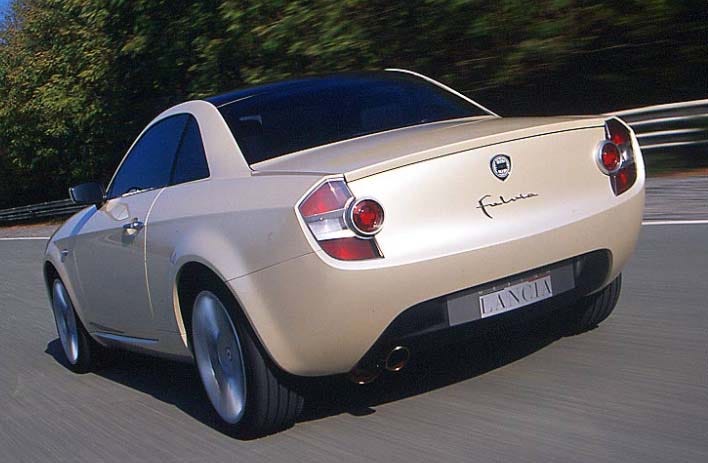
The Fulvia Concept of 2003. Despite its inevitable platform- and parts-commonality with mother Fiat, on paper it still sounded fairly promising with its compact dimensions, wheels at all four extreme corners, 860kg weight, and peppy engines with no power-assisted controls. True to the original, but it was unfortunately not to be.
Market forces have time and again sounded the death knell of the many great automotive names. Many of these were perhaps for the better, but some marques carry such heritage and influence to the automotive sphere that would be worse than a shame to be buried. In the past few years we’ve seen the likes of Jaguar and Maserati getting back into the game as major players, bringing in new models that are serious contenders in their corresponding segments that stand proud against the best mainstream German and Japanese offerings. We all know that such is very dependent on investment from their parent companies — the former now part of Tata Motors of India, and the latter a division of FCA — surely with the appropriate business strategy, a Lancia comeback is not entirely out of the question?
메타데이터
- post_id
- 41abc8010dd5
- slug
- forgotten-names-missed-opportunities-the-lancia-fulvia-41abc8010dd5
- url
- https://medium.com/@themasterswitch/forgotten-names-missed-opportunities-the-lancia-fulvia-41abc8010dd5
- canonical_url
- https://medium.com/@themasterswitch/forgotten-names-missed-opportunities-the-lancia-fulvia-41abc8010dd5
- author_url
- https://medium.com/@themasterswitch
- status
- ok
- fetched_at
- 2026-07-30 16:19:19