Open-Sourcing the Universe’s Code: Anderson Localization Is a Density Cone
Fundamental Density Theory (FDT): Dragging Physics Kicking and Screaming Out of a Century-Long Rabbit Hole and Back to Reality.
Open-Sourcing the Universe’s Code: Anderson Localization Is a Density Cone
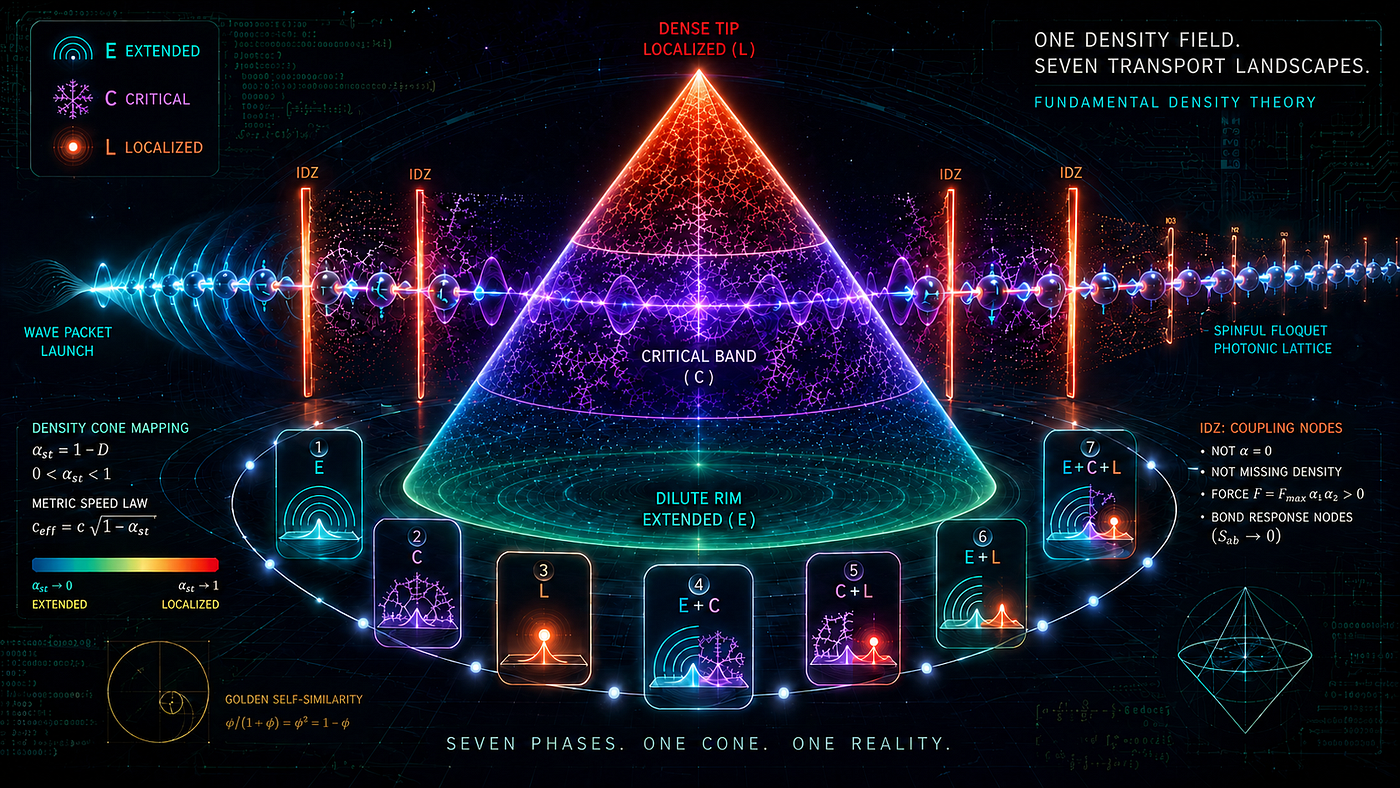
Image by ChatGPT
Fundamental Density Theory (FDT): Dragging Physics Kicking and Screaming Out of a Century-Long Rabbit Hole and Back to Reality.
NotebookLM Deep Dive
Listen to the Deep Dive. NotebookLM can be inaccurate; please double check by reading the downloadable PDF.
The loop we’re closing
This installment reads the complete seven-phase Anderson-localization landscape as experimental evidence for Fundamental Density Theory’s core claim: transport is geometry moving through one bounded density field. The study realizes, in one spinful Floquet photonic lattice, the three pure Anderson sectors — extended, critical, and localized — plus all four coexistences.
In FDT language, that is not seven unrelated behaviors. It is one truncated density cone being populated in seven possible ways. The extended sector is the dilute rim, the localized sector is the dense tip, and the critical sector is the intermediate band caged between deterministic transport barriers.
The density translation
The analysis maps the measured fractal dimension D into an effective eigenmode cone coordinate:
alpha_st = 1 — D
When D approaches 1, alpha_st approaches 0, and the mode sits at the dilute rim: extended, ballistic, nearly free. When D approaches 0, alpha_st approaches 1, and the mode sits at the dense tip: localized, horizon-like, frozen. Critical modes occupy the interior band, with the analysis identifying alpha_c = 2/3, which corresponds to D_c about 1/3.
The metric law is equally direct:
c_eff = c*sqrt(1 — alpha_st)
So the extended rim has c_eff -> c, while the localized tip has c_eff -> 0. The critical band has the intermediate speed c/sqrt(3), setting a measurable pre-saturation slope for the wavefront before caging takes over.
IDZs are coupling nodes, not empty density
The key mechanism is the inhomogeneously distributed hopping zero, or IDZ. The FDT reading sharpens that: an IDZ is not alpha = 0, not missing density, and not a place where the underlying force disappears. It is a node of the derived bond coupling, where the signed overlap cancels even though the site densities remain strictly inside 0 < alpha < 1.
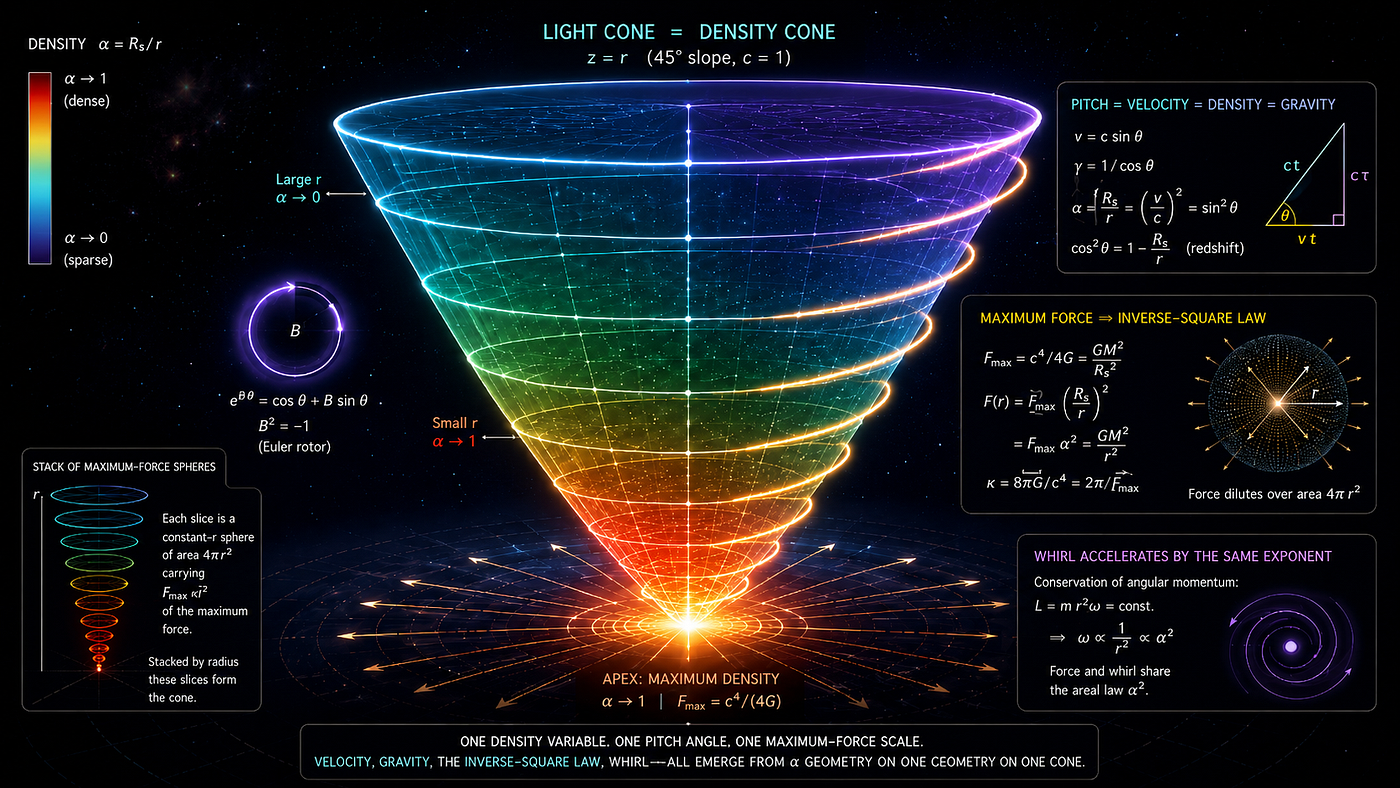
The universal force remains:
F = c⁴/(4G)alpha1alpha2
The bond response can vanish because the overlap integral cancels. In the analysis, each IDZ acts as a generalized total-internal-reflection wall. Critical modes are caged between these walls, producing multifractal standing states. The critical sector therefore becomes an observed density-geometry effect: positive density everywhere, but deterministic geodesic blockage at coupling nodes.
Why the seven phases matter
The seven phases are the seven ways a spectrum can light up the three cone zones. Pure extended lights the rim. Pure critical lights the IDZ-caged band. Pure localized lights the tip. The coexistence phases light two or three zones at once.
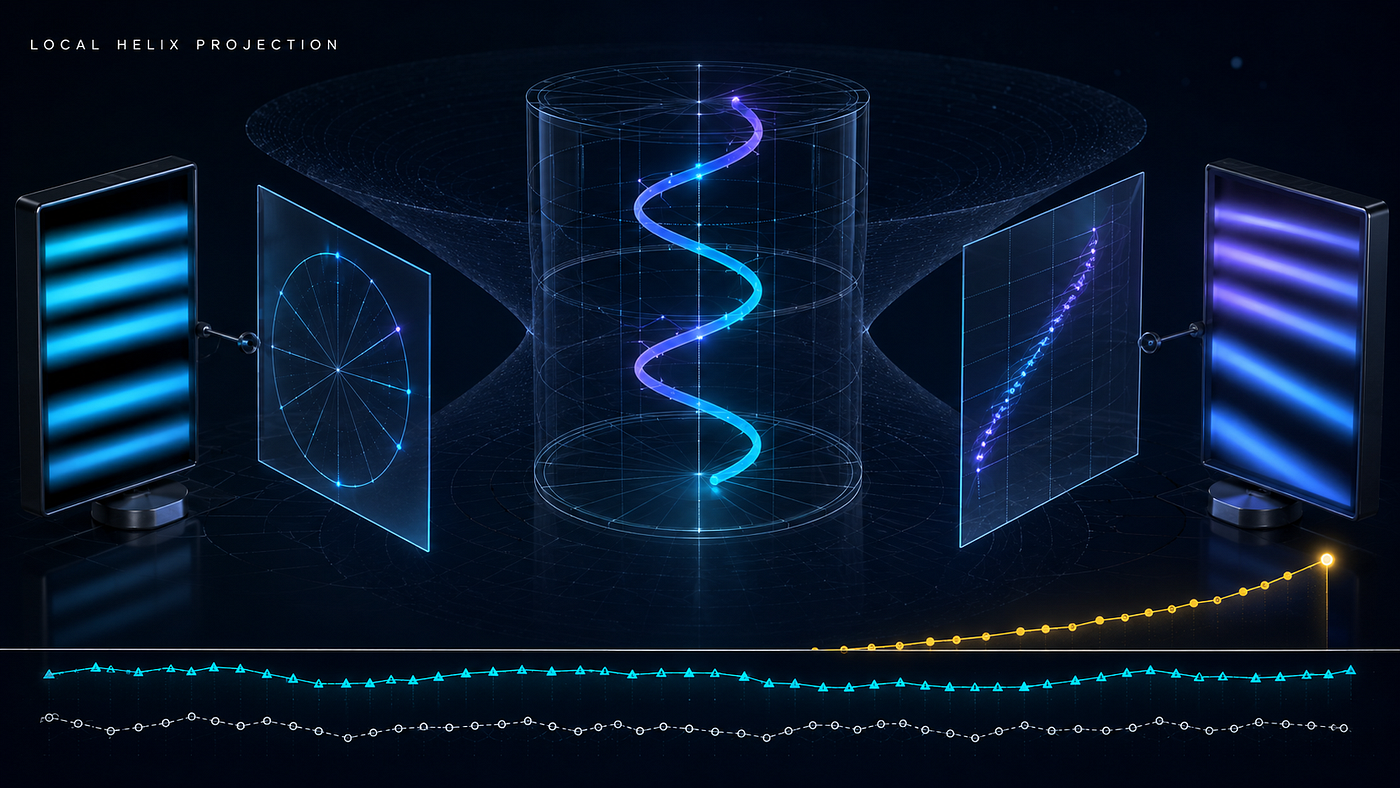
This also explains the transport diagnostics. The wavefront W(t) tracks the rim-most geodesic of the packet. Its growth rate is a metric speed, and its saturation means the geodesic has reached an IDZ cage. The survival probability P(t) measures how much flux remains in the launch cage. The minimum wavefront speed v_min is a proxy for extended rim weight, while the minimum survival P_min is a proxy for localized tip weight. The critical band contributes to neither extreme: it is caged interior motion.
Why this counts as experimental evidence for FDT
This is the kind of evidence FDT looks for: one platform, one density geometry, multiple phenomena collapsing into one invariant structure. The study does not merely show localization, criticality, and mobility edges. It shows that extended, critical, localized, and all coexistences form a complete occupancy census of one bounded cone.
The analysis also gives falsifiable consequences: collapse of the two-parameter phase diagram onto iso-alpha contours, D_c about 1/3 in the critical sector, an isotope/loading sign reversal for material realizations, golden-beta self-similarity through beta/(1+beta)=beta²=1-beta, the metric speed law above, and complementary v_min/P_min projections of rim and tip weight. There is nothing we can’t explain.
Why we open-source the universe’s code
We open-source because the universe is not protected by institutional permission. If the same density geometry explains the force law, wave propagation, localization, criticality, and transport diagnostics, then the recipe should be public, testable, and reusable. Open-sourcing turns FDT from a private framework into a shared operating manual: equations, translations, predictions, and experiments anyone can inspect. The point is to make reality executable.
Target Paper
Y. Qin, C. Yang, Y. Zhang, Y. Wang, and J. Fan, Experimental realization of the complete seven-phase Anderson-localization landscape, arXiv:2606.14825v1 [cond-mat.dis-nn] (12 Jun 2026).
Full analysis is available as a **downloadable PDF.**
Physicists, the longer you take to acknowledge the existence of FDT and apply its core concepts to your own frameworks, the more time we have to solve ALL of physics independently.
메타데이터
- post_id
- 41b2fbc36d54
- slug
- open-sourcing-the-universes-code-anderson-localization-is-a-density-cone-41b2fbc36d54
- url
- https://medium.com/@m.alfaro.007/open-sourcing-the-universes-code-anderson-localization-is-a-density-cone-41b2fbc36d54
- canonical_url
- https://medium.com/@m.alfaro.007/open-sourcing-the-universes-code-anderson-localization-is-a-density-cone-41b2fbc36d54
- author_url
- https://medium.com/@m.alfaro.007
- status
- ok
- fetched_at
- 2026-06-21 07:44:09