Semiconductors, The Journey from Sand to the Digital World
Every morning you wake up and turn off your phone alarm. You check messages. You watch videos. You scroll social media. You make calls…
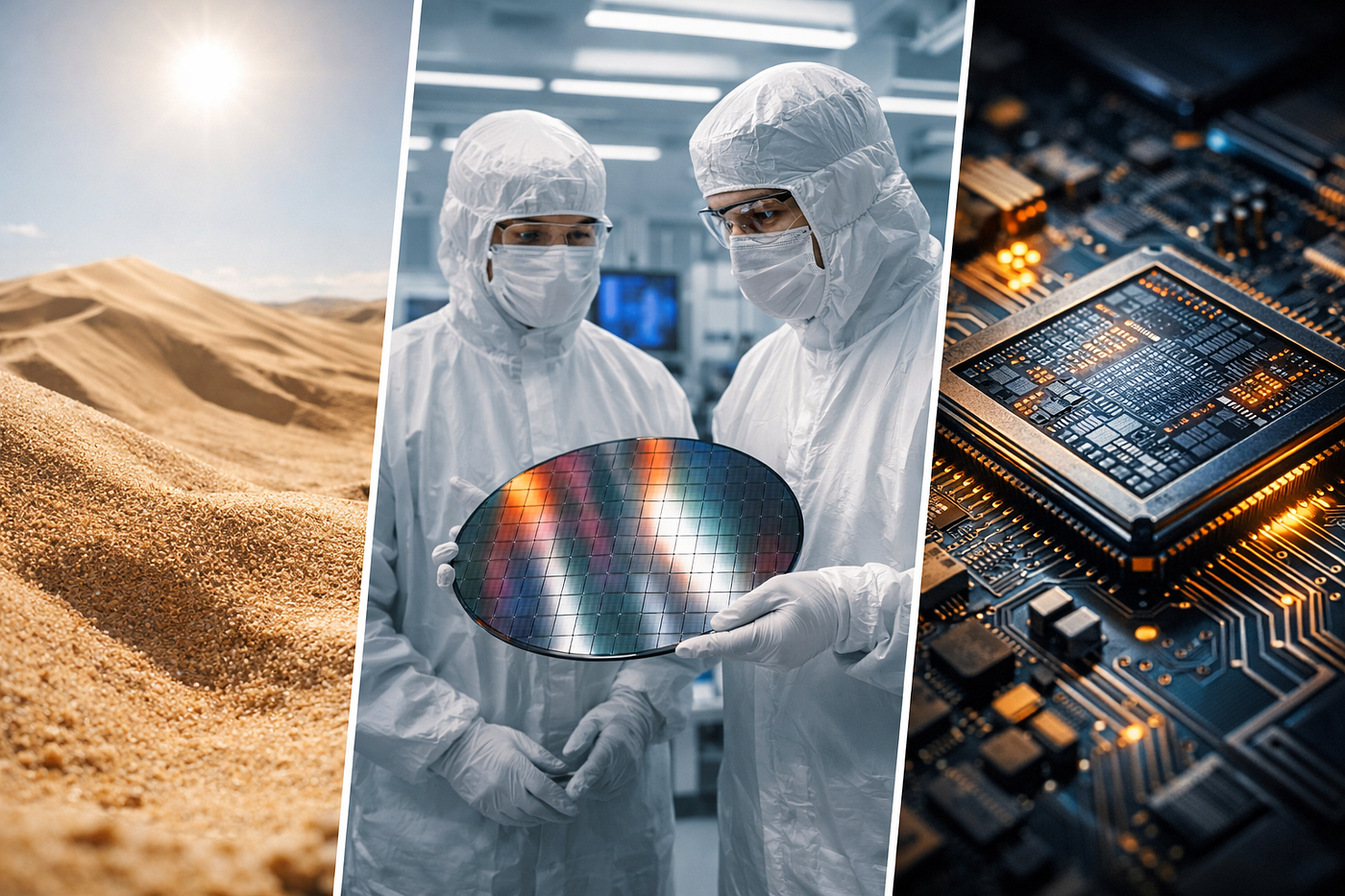
From sand to microchip: engineers turn silicon into the circuits powering our digital world.
Semiconductors, The Journey from Sand to the Digital World
Every morning you wake up and turn off your phone alarm. You check messages. You watch videos. You scroll social media. You make calls. Everything works in seconds. But have you ever thought about what makes all this possible? Inside your phone there is a small chip. That chip is made from sand. Yes, simple sand. From that sand, humans create something powerful. That small thing is called a semiconductor. Today, semiconductors run the world. If they stop working, phones stop. Internet stops. Banks stop. Planes cannot fly. Cars cannot start. Hospitals cannot run machines. Let us understand this in very simple words. What Is a Semiconductor Some materials allow electricity to pass easily. Copper is one example. Some materials block electricity. Wood and plastic are examples. A semiconductor is different. It is in the middle. It does not fully allow electricity. It does not fully block it. The most important semiconductor material is silicon. Silicon comes from sand. In its natural form, it does not conduct much electricity. But when scientists add small amounts of other materials to it, they can control how electricity flows. That control is the real power. How Computers Use Zero and One All computers work on two signals. Zero and one. On and off. Yes and no. When electricity flows, it is one. When it does not flow, it is zero. Inside every chip there are tiny switches called transistors. A transistor controls the flow of electricity. It turns it on or off. Modern chips have billions of transistors. All of them are placed in a space smaller than your fingernail. These tiny switches do all the work. They run apps. They play videos. They process photos. They power artificial intelligence. From Sand to Silicon Sand contains silicon dioxide. First, factories clean the sand and extract pure silicon. Then they heat it at very high temperatures until it melts. After that, they slowly cool it to form a solid crystal rod. This rod is sliced into very thin round pieces. These pieces are called wafers. A wafer looks like a shiny round plate. Thousands of chips are built on one wafer. The Clean Room Chips are not made in normal factories. They are made in special places called clean rooms. In a normal room, there are millions of dust particles in the air. In a clean room, the air is filtered again and again. The number of dust particles is extremely low. Why is this important? Because even a tiny dust particle can destroy a chip. The circuits inside chips are so small that a single dust particle can damage them. Workers wear special suits that cover their whole body. This prevents dust from their skin or clothes from entering the air. Photolithography, The Main Process The most important step in making chips is called photolithography. In simple words, it means using light to draw tiny patterns on the wafer. First, the wafer is cleaned carefully. Then a special chemical layer is placed on top. This chemical is called photoresist. It reacts to light. Next, a glass plate called a mask is placed above the wafer. The mask contains the circuit design. Strong ultraviolet light passes through the mask and hits the wafer. The light changes the chemical layer in certain areas. After that, the wafer is washed in a special solution. This removes selected parts of the chemical layer. Then comes etching. In this step, the exposed parts of the wafer are carefully removed to create tiny paths. This process is repeated many times. Each time, a new layer is added. A new pattern is created. Layer by layer, the full circuit is built. The Race of Nanometers Today, chip size is measured in nanometers. One nanometer is one billionth of a meter. The smaller the transistors, the more you can fit in one chip. More transistors mean higher speed and lower power use. Companies compete to make smaller and more powerful chips. Five nanometer. Three nanometer. Even smaller. Special machines are needed for this. These machines are extremely expensive. Only a few companies in the world can build them. Why Semiconductors Are So Important Your smartphone needs chips. But that is not all. Modern cars use many chips. They control the engine. They control brakes. They manage cameras and sensors. Hospitals use chips in MRI machines, ventilators, and testing equipment. Banks use chips in servers and ATM machines. Defense systems use chips in radar, drones, and guidance systems. Almost every modern industry depends on semiconductors. Global Politics and Chip Competition In the past, oil was the main source of power. Today, technology is power. And semiconductors are at the center of technology. Many advanced chips are made in Asia, especially in Taiwan and South Korea. If supply from these regions stops, the whole world feels the impact. That is why countries like the United States and Germany are building their own chip factories. They want to reduce dependence on other countries. This is not just business. It is about national security and economic strength. Germany and the Future Germany is famous for engineering and cars. Now it wants to grow in the semiconductor industry. There is a shortage of skilled workers in this field. Tens of thousands of experts are needed. The government is investing money. Training programs are growing. New factories are being built. This creates opportunities for young people. Career Opportunities in Semiconductors If you like science and technology, this field can be a strong career choice. You need basic knowledge of physics. You need understanding of chemistry. You need good math skills. You must pay attention to small details. There are three year training programs in countries like Germany. Students learn practical skills. They work with machines. They understand quality control and production steps. Salaries are good. Growth opportunities are strong. The Future of Chips The world is moving toward artificial intelligence, smart cities, electric cars, and automation. All these technologies need better and faster chips. More data means more processing power. More processing power means better semiconductors. Every new technology depends on better chips. Your Choice You can choose to only use technology. Or you can choose to build it. If you want to build it, you must learn. You must train. You must develop skills. Remember this. A simple grain of sand can become the brain of a supercomputer. That is human intelligence. Turning something simple into something powerful. Semiconductors are proof that small things can change the world. The future will belong to those who understand and build this technology. Maybe one day, a powerful chip will be designed or built by you.
메타데이터
- post_id
- 41bdfd5e81cb
- slug
- semiconductors-the-journey-from-sand-to-the-digital-world-41bdfd5e81cb
- url
- https://medium.com/@Fuzailhyd/semiconductors-the-journey-from-sand-to-the-digital-world-41bdfd5e81cb
- canonical_url
- https://medium.com/@Fuzailhyd/semiconductors-the-journey-from-sand-to-the-digital-world-41bdfd5e81cb
- author_url
- https://medium.com/@Fuzailhyd
- status
- ok
- fetched_at
- 2026-07-13 06:23:13