Stop Collecting AI Apps. Build a Student Workflow That Actually Holds Up
Two tabs stay open far longer than most students admit: one stuffed with half-read PDFs, the other with a citation generator that somehow…
Stop Collecting AI Apps. Build a Student Workflow That Actually Holds Up
Two tabs stay open far longer than most students admit: one stuffed with half-read PDFs, the other with a citation generator that somehow breaks the moment the deadline gets close. Add a chatbot into the mix, and the workload rarely becomes simpler. It just becomes more fragmented.
Every extra tool promises speed. Very few reduce the number of decisions that have to be made before the work even begins.
The Workflow Matters More Than the App
The conversation around the best AI tools for students has drifted toward quantity instead of usefulness. Lists keep getting longer, yet the daily problems remain stubbornly ordinary: locating a paper that is hidden behind poor indexing, checking whether a source is credible, organizing references before submission, or understanding the one step in a calculus problem that the lecture skipped.
That gap matters because coursework is rarely one continuous task. Research turns into note-taking. Notes become assignments. Assignments demand citations. Exams require revision instead of discovery. A single application rarely handles every stage well, despite marketing that implies otherwise. Students who move through academic work efficiently usually rely on a small collection of specialized tools rather than expecting one AI assistant to cover the entire process.
Quick Highlights
- NotebookLM works best when study material already exists in PDFs, notes, or textbooks.
- Perplexity speeds up research by attaching sources instead of presenting unsupported answers.
- Zotero quietly removes one of the most repetitive parts of academic writing.
- Wolfram Alpha explains mathematical reasoning instead of only producing results.
- Career platforms reward students who start searching months before graduation.
Research Falls Apart Long Before the Writing Starts
Most assignments do not become difficult because the writing is hard. They become difficult because finding dependable information takes longer than expected.
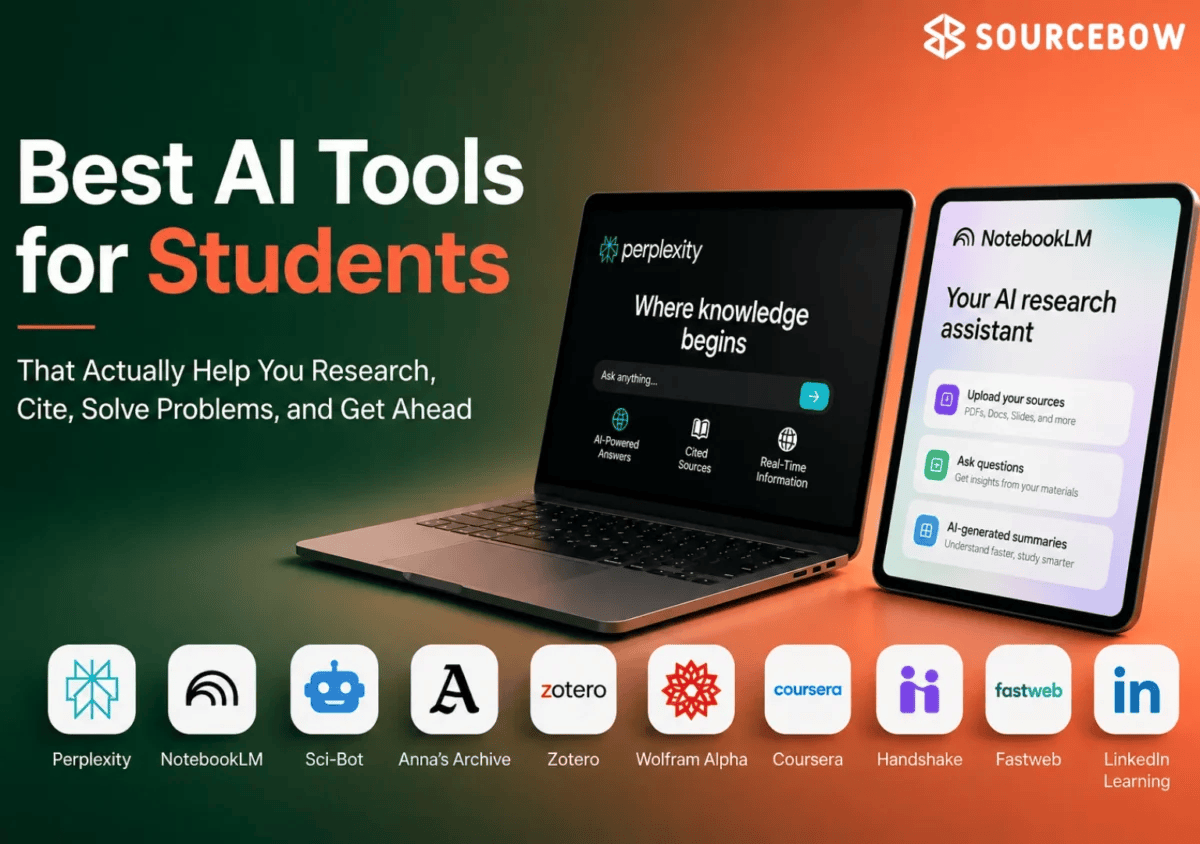
NotebookLM approaches that problem from an unusual direction. Instead of searching the internet, it works with documents already collected by the student. Lecture slides, textbook chapters, class notes, and PDFs become the knowledge base, making follow-up questions far more relevant to the course itself than a generic chatbot response.
A different job belongs to Perplexity. Rather than acting like a traditional search engine, it combines conversational answers with linked references that can be checked independently. That matters when a statistic or claim needs verification instead of blind acceptance.
Students working on research-heavy projects often need something else entirely. Sci-Bot focuses on academic literature, while Anna’s Archive functions as a broad discovery platform for books and scholarly material that can otherwise be surprisingly difficult to locate. Each fills a different gap, which exposes a common mistake: treating research as though it were a single activity instead of several connected ones.
“For a more detailed description, you can check here”
Citations and Equations Fail for Different Reasons
Nothing feels productive about manually fixing reference formatting at midnight.
Zotero has earned its reputation precisely because it avoids trying to be flashy. It stores references, captures publication details from browsers, organizes research libraries, and exports citations in styles ranging from APA to MLA with minimal effort. Hours disappear into citation management every semester, yet it remains one of the least discussed productivity gains available to students.
Mathematics creates a different kind of friction. Wolfram Alpha has long stood apart because its value lies in showing intermediate reasoning rather than only displaying the final answer. Engineering, physics, chemistry, and mathematics students frequently need to identify where their own calculations drifted off course, and step-by-step explanations make that possible.
Learning itself deserves attention too. Coursera’s Learning How to Learn course has remained popular for years because it focuses on memory, focus, and study strategies rather than another collection of facts. Plenty of students collect information effectively but struggle to retain it under exam conditions, leaving another weakness that software alone cannot solve.
The Smartest Student Tools May Not Look Academic at All
Academic success extends beyond grades surprisingly early.
Handshake connects students with internships and graduate opportunities that are often designed specifically for university applicants. Waiting until the final semester usually means entering a race that began months earlier.
Fastweb tackles another pressure point: paying for education. Scholarship matching based on personal profiles reduces the need to search manually through hundreds of unrelated listings, allowing students to focus on opportunities that actually fit their circumstances.
Then there is LinkedIn Learning, which occupies a space between formal education and professional development. Universities frequently provide free access through institutional licenses, opening thousands of courses covering software, communication, business, design, cybersecurity, project management, and technical skills. Those certificates rarely replace a degree, but they often strengthen a résumé before internship interviews begin. The interesting tension is that these platforms reward students who prepare quietly long before anyone else starts looking.
How These Tools Save Time Where It Counts
The practical advantage of choosing the right AI tool is rarely dramatic. It shows up in smaller moments that quietly accumulate over an entire semester. Ten minutes saved generating references becomes another practice problem before class. Finding a reliable paper through Perplexity or Sci-Bot avoids an hour spent chasing questionable sources. Reviewing lecture notes with NotebookLM during revision often proves faster than rereading an entire textbook chapter.
Career planning follows the same pattern. A profile completed on Handshake during the first year can surface internship opportunities that never appear on public job boards. A scholarship discovered through Fastweb may reduce tuition pressure without requiring extraordinary qualifications. Small efficiencies compound, especially when deadlines begin arriving together instead of one at a time.
Final Thoughts
The search for the best AI tools for students often turns into another form of procrastination. Installing new software feels productive because it resembles preparation, even when nothing about the underlying workflow improves.
Useful technology tends to disappear into the background after a while. NotebookLM becomes the place where lecture notes live. Zotero quietly remembers every source. Wolfram Alpha catches calculation mistakes before they become exam habits.
The strongest academic advantage may have less to do with artificial intelligence than with building a system where every tool has one job, and none of them pretend to do all of them.
메타데이터
- post_id
- 41c2f47f2bf4
- slug
- stop-collecting-ai-apps-build-a-student-workflow-that-actually-holds-up-41c2f47f2bf4
- url
- https://medium.com/@sourcebowresource/stop-collecting-ai-apps-build-a-student-workflow-that-actually-holds-up-41c2f47f2bf4
- canonical_url
- https://medium.com/@sourcebowresource/stop-collecting-ai-apps-build-a-student-workflow-that-actually-holds-up-41c2f47f2bf4
- author_url
- https://medium.com/@sourcebowresource
- status
- ok
- fetched_at
- 2026-08-05 13:08:32