Your Oat Milk Foam Looks Terrible — and It’s Probably Not Your Fault
The one temperature detail that most home espresso guides skip over, and why it quietly ruins thousands of plant-based lattes every…
Your Oat Milk Foam Looks Terrible — and It’s Probably Not Your Fault
The one temperature detail that most home espresso guides skip over, and why it quietly ruins thousands of plant-based lattes every morning.

I spent a long time assuming I was just bad at steaming.
The foam would look fine for about thirty seconds — a pale, uniform layer sitting on top of the milk — and then it would start separating. A thin crust on top. Watery liquid below. Like a disappointing science experiment I hadn’t asked to run.
I tried different pitchers. Slower wand angles. Starting with colder milk. I watched videos of baristas with beautiful microfoam and felt the particular irritation of someone who has technically followed all the steps and still can’t replicate the result.
What I didn’t know — and what I wish someone had told me directly, instead of buried in a Reddit thread at 11pm is that the problem wasn’t me. It was the temperature.
More specifically: it was that my machine wasn’t designed to hit the right temperature for oat milk. And neither are most machines in that price range, unless you know exactly what to look for on the spec sheet.
The thing about plant-based milks that most guides gloss over
Dairy milk is forgiving. Barista guides typically put the ideal steaming range somewhere between 150–155°F, and dairy holds up well across a reasonably wide window around that. You can overshoot by ten degrees and still end up with decent foam.
Oat milk doesn’t work like that. Its protein content is roughly a quarter of dairy’s — about 2–4 grams per cup compared to dairy’s 8 — which means the foam structure is already fragile before you introduce heat. It needs a longer, gentler stretch to incorporate air without creating the large, unstable bubbles that collapse immediately.
The temperature ceiling where things go wrong is around 150°F. Push past it with oat milk and the texture degrades, the flavour gets a bit weird, and the foam separates in the cup. Soy milk is even less forgiving — the common recommendation is to stop at 140°F and call it there.
That 140°F number is significant, because it’s not the same as just steaming “on a lower setting.” It’s a specific target. And whether a machine can reliably hit it — or even tell you whether it’s hitting it — turns out to be the thing that separates a good plant-milk machine from an expensive source of frustration.
Where two popular machines actually differ
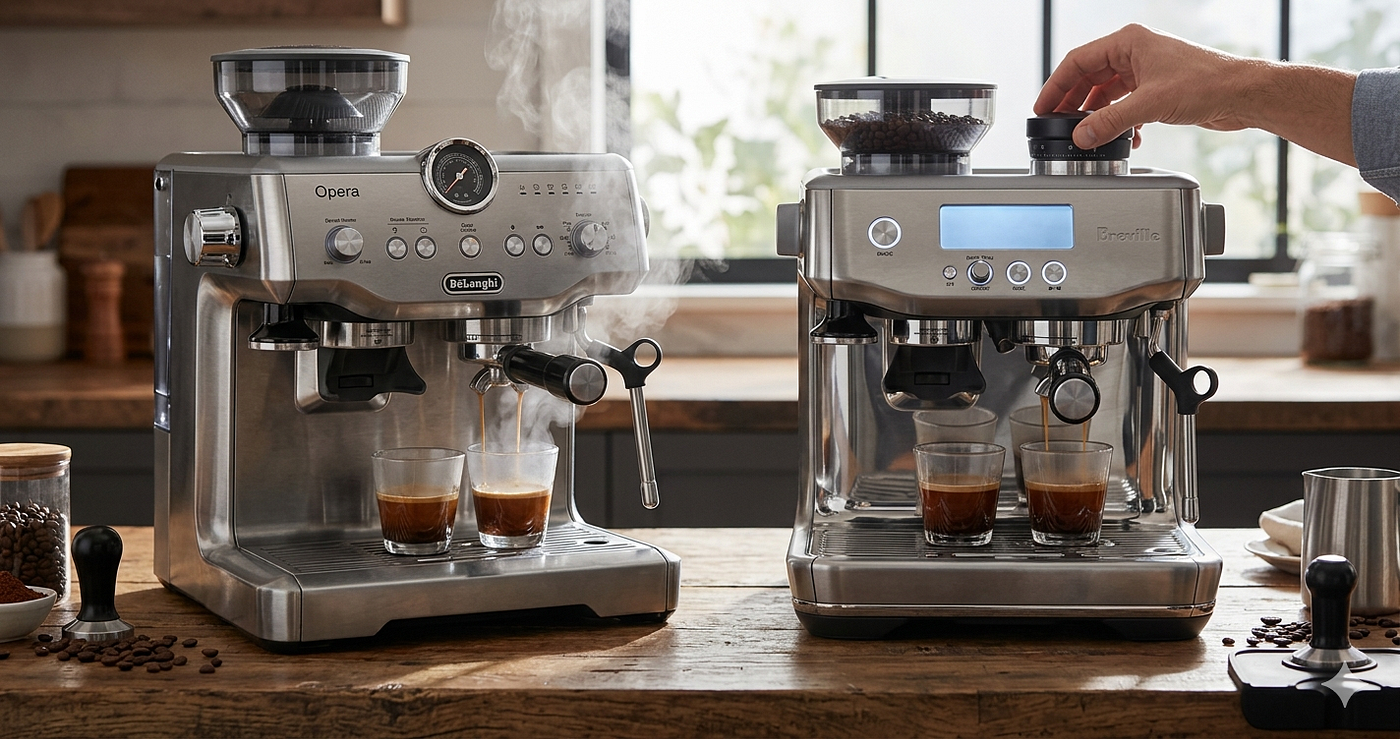
At the sub-£500 tier in the UK (call it $500–600 US), two machines come up constantly in comparison threads: the De’Longhi Dedica Maestro Plus and the Breville Bambino Plus. Both use thermoblock heating, a 54mm portafilter, and automatic frothing systems with three settings. On paper, they look similar. On plant-based milk, they aren’t.
The De’Longhi offers three selectable temperatures — 140°F, 149°F, and 158°F — and the 140°F option is described by De’Longhi on their own product listing as “the ideal temperature for plant-based drinks like oat, almond or soy.” That’s a direct manufacturer claim, attached to a specific number, verifiable by anyone who reads the listing. The temperature sensor is integrated inside the wand itself, which means it’s reading the milk directly throughout the whole steaming process.
The Breville labels its three settings “Warm,” “Ideal,” and “Hot.” Breville does not publish Fahrenheit values for these on its product pages. Independent reviewers have measured the middle “Ideal” setting at around 144°F; the “Warm” setting — the only real candidate for plant-based milks — has no confirmed published figure. The sensor is external, mounted beneath the wand assembly, reading the pitcher rather than the milk directly.
For dairy milk, an external sensor works fine. For oat milk with its narrow acceptable temperature window, that indirect measurement matters. Users on the Bambino Plus who want good plant-milk results tend to switch off the automatic system entirely and stop steaming manually at 130–140°F, using a separate thermometer. Which works — but it’s a workaround, not the product promise.
The wand thing that caught me off guard
A reasonable response to all of this might be: fine, I’ll just use manual mode. Most reviews of the Bambino Plus describe it as having a capable steam wand that experienced users can operate manually. That’s true, technically.
What those reviews sometimes don’t mention — or mention only in passing — is that the Auto MilQ housing constrains how freely the wand can move. The design required for the automatic attachment limits repositioning during manual steaming in a way that more experienced steamers find annoying. Tom’s Guide lists it explicitly as a con.
The irony is that if manual steaming is your actual priority, the standard Breville Bambino — not the Plus — has the better wand. Fully articulating, 360-degree rotation, lower price. The Bambino Plus optimises for the automatic system; the manual wand is a secondary feature, not the reason to buy it.
I mention this not to criticise the machine, which is genuinely excellent for espresso, but because this is the kind of detail that evaporates in the enthusiasm of a new purchase and resurfaces six weeks later when you’re trying to figure out why the foam keeps going wrong.
The milk matters as much as the machine
Before any of this, though: are you using Barista Edition milk?
Oatly Barista. Califia Barista. Any oat, almond, or soy milk with “barista” in the name and a slightly different ingredient list than the standard carton. These products include added emulsifiers, proteins, and fats that are specifically there to make steam performance more reliable. Standard supermarket oat milk — the kind people buy because it’s cheaper and they assume milk is milk — lacks these stabilisers and produces unpredictable results on virtually any machine, regardless of temperature control.
If you’ve been steaming standard oat milk, try swapping to Barista Edition first. The improvement is significant enough that it genuinely changes how you assess the machine.
The actual bottom line, without the hedging
If you’re buying a machine primarily to make plant-based lattes and you want the automatic frothing to just work — the De’Longhi Dedica Maestro Plus is the clearer choice. The 140°F setting is real, confirmed, and designed for exactly this. You press a button; the oat milk comes out right.
If you drink mostly dairy and want outstanding espresso quality with the option to do plant-based occasionally, the Bambino Plus is excellent. Just know that oat milk will require your active attention — a thermometer, manual mode, and willingness to stop the steam early yourself.
And if you genuinely want to develop barista skills and steam manually by feel, neither machine is really the right answer. That’s a different price tier and a different conversation.
The sad irony of the oat milk foam problem is that most people who experience it conclude they’re doing something wrong and try to fix their technique. Sometimes they are. More often, they’ve just never been told what temperature their machine actually runs — and that number, it turns out, is the whole story.
More equipment breakdowns at BrewPrecision.com.
메타데이터
- post_id
- 41cda82ba80b
- slug
- your-oat-milk-foam-looks-terrible-and-its-probably-not-your-fault-41cda82ba80b
- url
- https://medium.com/@brewprecision/your-oat-milk-foam-looks-terrible-and-its-probably-not-your-fault-41cda82ba80b
- canonical_url
- https://medium.com/@brewprecision/your-oat-milk-foam-looks-terrible-and-its-probably-not-your-fault-41cda82ba80b
- author_url
- https://medium.com/@brewprecision
- status
- ok
- fetched_at
- 2026-07-15 02:14:29