The Eye That Holds
The Strata of a Tectonic Heart
The Eye That Holds
The Strata of a Tectonic Heart
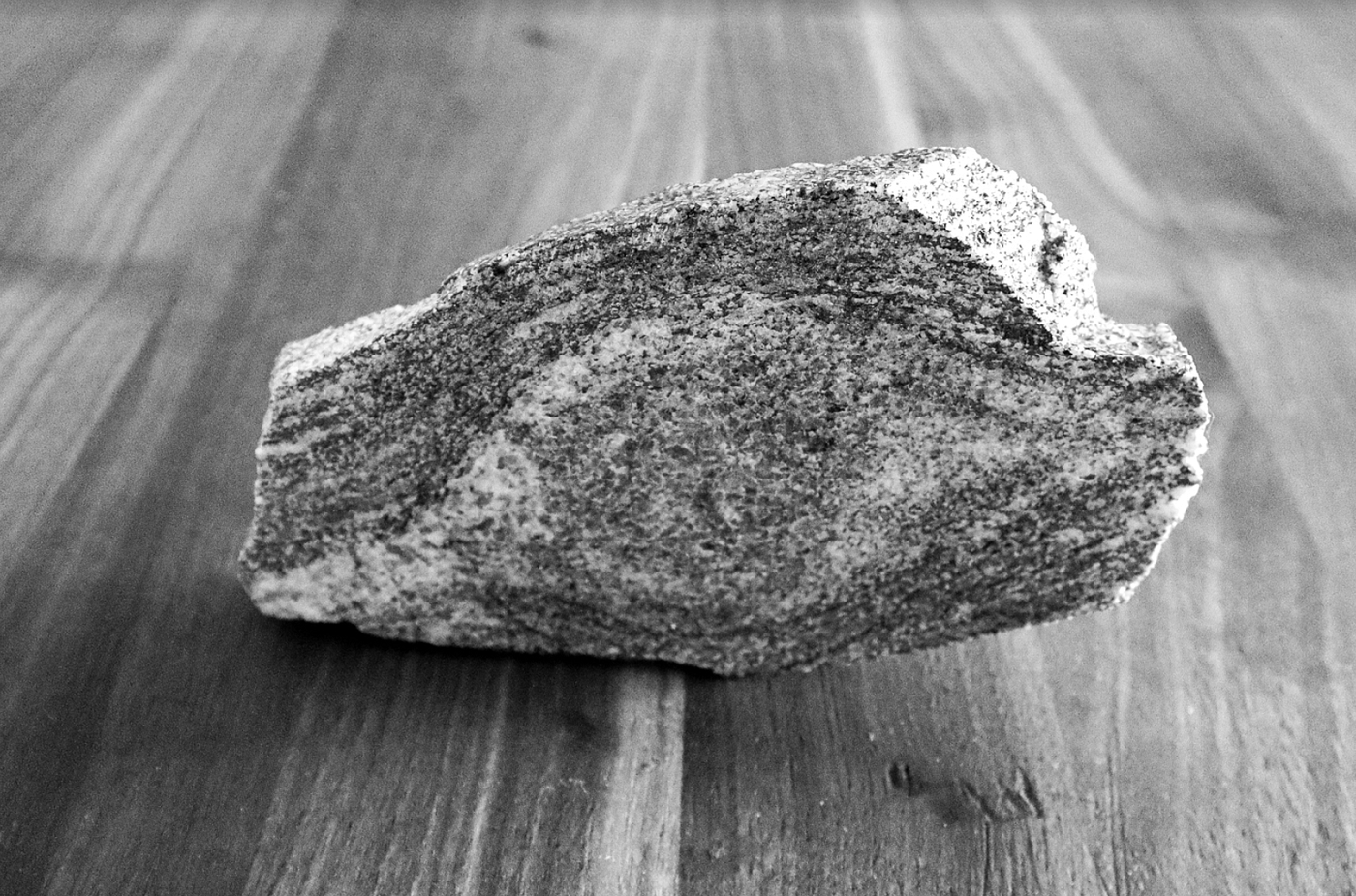
Photo: Francine Fallara: Pressure’s Beauty: A close-up black and white photograph of a metamorphic rock sample featuring a prominent, eye-shaped augen texture. The banded mineral layers curve gracefully around a dense central core. The specimen rests on a smooth wooden surface with linear grain patterns that run perpendicular to the rock’s internal structures.
We speak of pressure as an enemy, a heavy, invisible hand that seeks to flatten, to grind the sharp edges of identity into the uniform silt of the mundane. But look closely at how the darkness curves, how the silvered ribbons of feldspar and mica have been forced to learn the language of the river.
They flowed because the heat was absolute. T hey sheared because the mountains above them were moving. Yet, at the center of the storm, the eye held its ground. A stubborn inclusion that refused the melt, a knot of ancient strength around which the entire matrix had to bend.
This is the beauty born of strain: the realization that we do not have to dissolve when the tectonic plates of life begin to shift. The ribbons are elegant only because the core was firm. The pattern exists only because something inside withstood the weight of the override.
We are laid out like this specimen — resting on the quiet, organic rings of our years, marked by the horizontal lines of our slow growth, yet carrying a vertical history of deep, subterranean fire. Do not fear the compression. The pressures you carry are not there to break you; they are drawing the map of your resilience in ribbons of undeniable light.
In the field, when we trace a shear zone, we look for indicators of kinematics — the physical proof of how landmasses grind, collide, and reshape one another under the crust. The specimen in my photo is a stunning textbook example of an augen texture, named after the German word for “eyes”.
This stone has undergone intense dynamic metamorphism. Under crushing pressure and soaring temperatures deep within ancient mountain roots, the finer minerals softened and began to flow like a slow, mineral river. But the central core — the “eye” — refused to dissolve. It stood as a resilient inclusion, forcing the surrounding gneissic bands to warp and curve around its shape.
When I look at this slab through the lens, I see a precise mathematical record of stress. The asymmetry of the wings tells us exactly which direction the earth moved millions of years ago. It is a testament to the fact that rock is not entirely rigid; when subjected to enough force, even stone learns a heavy, slow sort of fluid grace.
If science maps the stress field, the soul recognizes the survival strategy. We often treat pressure as a destructive agent, something that erodes our boundaries or fractures our peace. But this stone offers a different perspective. Without the immense burden of the tectonic override, these beautiful, sweeping ribbons would never have been drawn. The eye only becomes visible because it held fast while everything else adjusted to the strain.
Placing the rough, ancient stone onto the polished grain of the wood creates a secondary dialogue. The wood grew upward toward the light, marking its years in quiet, concentric rings. The rock was compressed downward in the dark, marking its eras in squeezed, crystalline bands. Both are archives of endurance, yet they arrived at their beauty through opposite forces — one through growth, the other through pressure.
Through our “Listening Eyes,” this image becomes an icon of the inner core. It reminds us that when life shears around us, our unique “inclusions” — our eccentricities, our creative obsessions, our deepest memories — are precisely what keep us from dissolving into the background matrix.
As we curate the spaces within Nova Inklings, this metamorphic eye serves as a vital blueprint. It is easy to write from a place of unblemished clarity, but the most compelling narratives always feature a little bit of grit. They come from the parts of us that have been buried, heated, and squeezed by circumstance, yet managed to preserve their essential form.
The purpose of exploring these inclusions is not to complain about the heat or the weight of our histories, but to marvel at the patterns they leave behind. Whether we are navigating personal tectonic shifts, stepping out our weekly kilometers across changing terrain, or simply learning to slow down and hold our frame, we are constantly transforming.
We are all metamorphic. We are all carrying hidden architectures shaped by pressures the world cannot see, waiting for the right light to reveal the elegant, resilient geometry of our survival.
Inclusions: A sanctuary for the fragments that define us. Here, we look beneath the surface matrix to explore the beautiful disruptions, the ancient pressures, and the deep, resilient layers of human and geological history.
메타데이터
- post_id
- 41e272b73371
- slug
- the-eye-that-holds-41e272b73371
- url
- https://medium.com/nova-inklings/the-eye-that-holds-41e272b73371
- canonical_url
- https://medium.com/nova-inklings/the-eye-that-holds-41e272b73371
- author_url
- https://medium.com/@francinefallara
- status
- ok
- fetched_at
- 2026-06-09 15:37:30