Comme un blues — Fiona Monbet
Silence is broken. A pianist, warming up his fingers — and the room — completely envelops the atmosphere. The percussionists test their…
Comme un blues — Fiona Monbet
Silence is broken. A pianist, warming up his fingers — and the room — completely envelops the atmosphere. The percussionists test their sounds in a kind of improvisation that merely trains the listeners’ ears to catch even the slightest detail. Simultaneously, the violin and the clarinet engage in a brief quarrel, as if deciding which of them will raise the curtain. The exchange grows denser while, from afar, piano and percussion boo the two instruments locked in heated debate. At last they reach an agreement. Piano and drums announce that the piece has begun with a military-band figure played very, very softly; the piano reverberates through the room and gives the cue for the clarinet to start singing.
You are immediately transported to a dark, solitary alley in Paris. Florent Pujuila has done his job. You walk in warm clothing while the drizzle refuses to stop; dawn has caught up with you, and you have become a lone wanderer calmly admiring the beautiful architecture behind which sadness hides.
You come upon a speakeasy you cannot resist entering. The lights, low and almost extinguished, merge with Auxane Cartigny’s piano, and you simply wonder how you got here. You stare at your drink while you feel the delicacy with which clarinet and piano converse, the percussion marking the tempo of your aching heart. The double bass — thinking of itself as an independent author — converges with the melody and turns the final blend into a dry punch, as dry as the liquor you swallow.
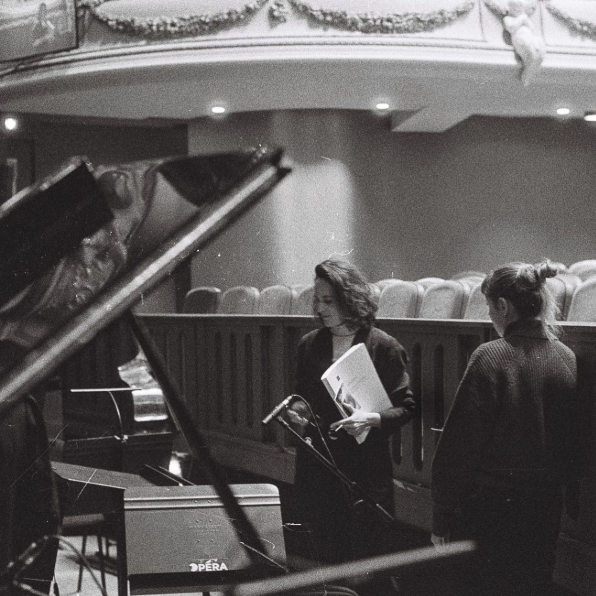
Source: Instagram @fiona_monbet
On the couches in the back, a couple kiss and caress one another intensely; they are barely visible under the dim lighting. You look toward the center of the bar and try to focus, but onstage you see only shadows swaying to the rhythm that has just begun: a piano that repeats itself without wearying, that instead soothes; it comes and goes, over and over, releasing the weight of your nostalgia while the shadows keep gyrating. Then the strings begin to shade this astonishing melody; they split and reunite, giving greater density to the moment, and, when you focus all your attention, you hear the percussion drawing lines and dots as a child would on paper, yet fitting perfectly into the sonic space.
In response, the piano answers with a strangely harmonious sequence, and the double bass reminds you why it is here. As though time were infinite, you immerse yourself in every note, in the silence each instrument offers in its own way and with its own signature. By now you have fused with the nostalgia that accompanies you while you watch the rain through a small window.
The clarinet tells a new story. The couple in the back has turned up the heat: she is on top of him. A trumpet peeks out in a tiny shaft of light; you remember Armstrong and think of that person who upended your heart this dawn. You do not smile; instead you ponder life, the night, and pain. Like a bridge leading to a chorus, the clarinet closes with cleanliness born of precision. The sway returns; the musicians in the darkness rock from side to side, but now the violin joins with greater force, demanding your attention, its presence already absolute, and…
A long note bows before your ears. You feel compelled to look at center stage; between the shadows you can see only her hair — slightly mussed, slightly arranged. She is there, but all you perceive is that intriguing silhouette, motionless until the note dies away. Now you smile, because the blues solo has clearly arrived. With a single gesture you order another drink as you listen to the notes sliding along the violin.
The notes bend again and again. The rest of the strings join in slowly, tickling your eardrum; piano, bass, and percussion seem modest, but when you look closely, you realize they are not. You glance at the table in the back: the couple has gone.
Now every instrument seems to dance to its own music, yet together they converge into a hymn to emotion. The drum kit delivers a crash cymbal that serves as the signal for each participant in this dance of sounds to offer its own version of the burden of pain that tonight has settled over Paris — over you.
The rain has reached its peak. You eye your drink, almost finished; you ask for the bill and keep your attention fully engaged. The piano paints, the bows leap, the double bass sculpts, the drums are perpetual. Everything is complete, everything is ready: you know the end is near — yours as well. You look at that silhouette once more; emotion bursts and the violin reaches its highest notes only for the sway to appear one last time, now accompanied by the intensity of the bow, an intensity that stays with you as you walk toward the door of this dark place. You do not want to stay for the finale, but you will hear it from the doorway before stepping out. The sounds consume themselves; piano and winds whisper goodbye. You have returned from Paris. The silence returns.
[embed]
Here are the EQ settings I’m using for this track — I’ve left the preamp at zero.

메타데이터
- post_id
- 41e36f1e44f3
- slug
- comme-un-blues-fiona-monbet-41e36f1e44f3
- url
- https://medium.com/@musictrends/comme-un-blues-fiona-monbet-41e36f1e44f3
- canonical_url
- https://medium.com/@musictrends/comme-un-blues-fiona-monbet-41e36f1e44f3
- author_url
- https://medium.com/@musictrends
- status
- ok
- fetched_at
- 2026-06-27 18:20:27





