Chip War| Book Review| How modern world was shaped by semiconductors
Chip War is a book that dissects the past and present of semiconductors.
Chip War| Book Review| How modern world was shaped by semiconductors
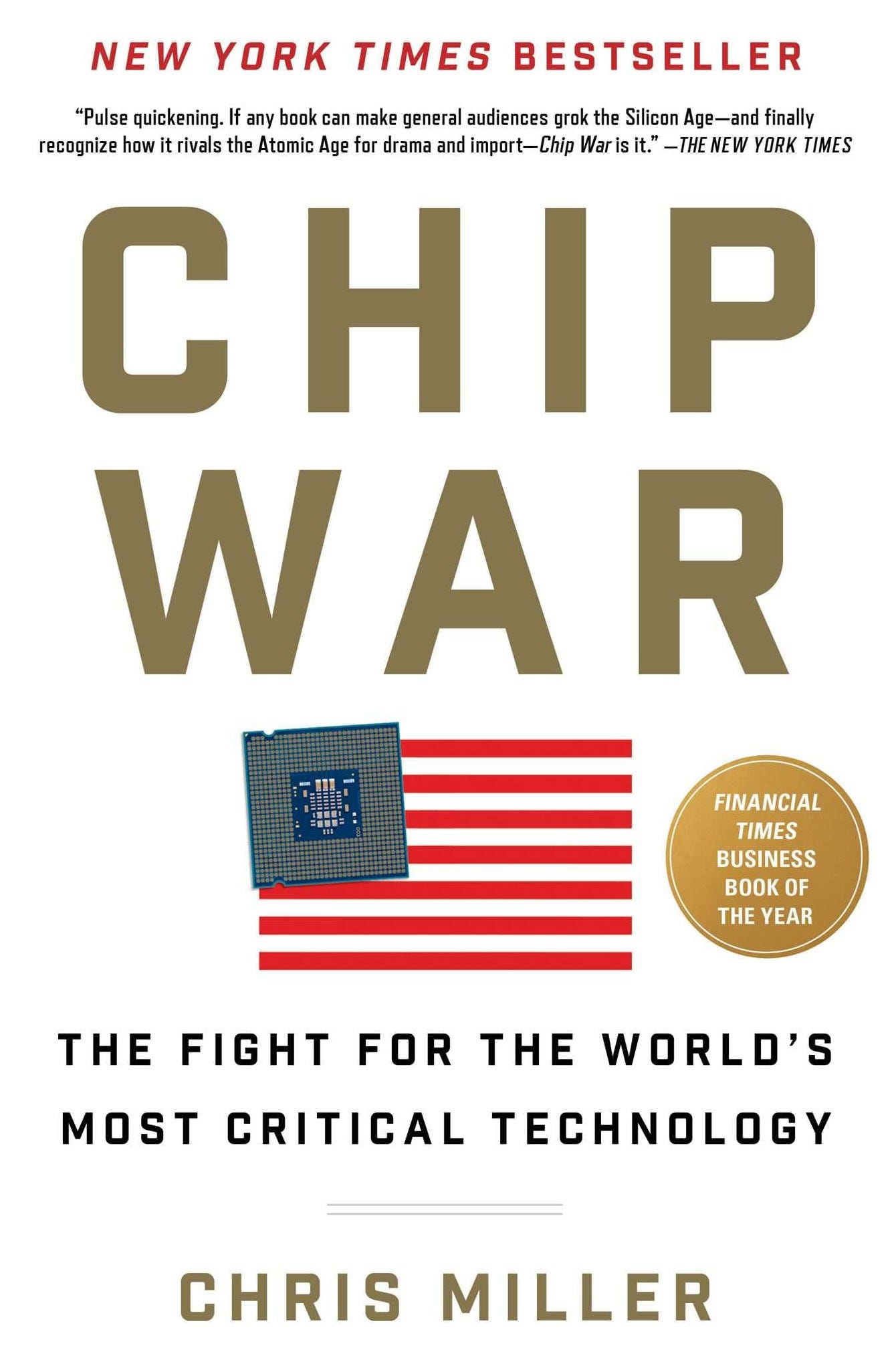
Chip War by Chris Miller
📖 This article is also available in Chinese on Vocus:
Chip War is a book that dissects the past and present of semiconductors. Author Chris Miller uses the span of one book to portray the dramatic and turbulent history of the semiconductor industry. From the United States to Japan, and then to South Korea and Taiwan, Miller weaves together the intricate interplay of international politics and the tech industry, showing us how today’s semiconductor giants were born, what setbacks they endured, and how they vied for dominance. What amazed me the most is the author’s writing style — he turns a highly technical subject into something more exciting than a novel. Miller himself probably doesn’t come from an electrical engineering background, yet he manages to explain complex electronic components in a way that is clear and engaging. I believe even readers outside this field will be able to understand it.
The Tight Bond Between War and Politics
As a student with a background in science and engineering (I majored electronics in college), I never realized how tightly technology and geopolitical struggles are intertwined. The early development of the semiconductor industry was inseparable from the political rivalry between the United States and the Soviet Union. Later, it became shaped by U.S. strategy in East Asia, and today it revolves around U.S. policy toward China.
Miller points out that the very rise of semiconductors was tied to the Cold War. When the Soviet Union launched the first artificial satellite into space, it shocked the world. Not to be left behind, the U.S. ramped up research in rockets and space exploration. A struggling startup, Fairchild Semiconductor, suddenly found its first major customer in the U.S. government.
Semiconductors Changing Warfare
As semiconductors continued to advance, they were also deployed in warfare. During the Vietnam War, the U.S. military faced difficulties in precisely targeting ground objectives. Texas Instruments’ semiconductors provided the key breakthrough, vastly improving the accuracy of U.S. bombs and turning them into devastating weapons.
It is important to note here that the semiconductor industry did not evolve solely through free-market competition. It was propelled by Cold War geopolitics. Military demand and funding from the U.S. government laid the foundation for the entire industry. This demonstrates that technological breakthroughs are often not just “laboratory victories,” but byproducts of national strategy.
America’s Asia Policy
Another crucial chapter of Chip War is how the U.S. “outsourced” parts of the semiconductor industry to Asia, thereby strengthening its geopolitical influence.
After the fall of South Vietnam, the U.S. feared that communism would sweep across Asia. Given that many East and Southeast Asian countries had large Chinese populations, Washington worried they might turn communist as well. Thus, finding allies in Asia became a top priority of U.S. foreign policy. Taiwan, Singapore, and Malaysia were industrializing at the time and offered cheap labor, so the U.S. transferred lower-value processes such as chip packaging and testing to these regions. This policy not only reduced costs for U.S. firms but also gradually integrated East Asian countries into the global semiconductor supply chain.
Over time, however, Japan surpassed the U.S. with lower costs and higher quality, gradually taking market share and shaking America’s dominance. Feeling increasingly threatened, the U.S. entered into a tech rivalry with Japan.
One U.S. strategy to counter Japan was to support South Korea, preventing Japan from monopolizing the global DRAM industry — this was also how Samsung rose to prominence. This piece of history reminds us that the rise and fall of industries worldwide is rarely just about market forces; it is often the side effect of great power competition.
TSMC
Taiwan plays a particularly crucial role in this story. Miller notes that TSMC was not a naturally emerging company but rather the product of a government initiative. At the time, K.T. Li and Morris Chang, known as the “Father of Taiwan’s Semiconductor Industry,” decided to take a path different from the U.S., Japan, and South Korea — focusing solely on pure-play foundry manufacturing.
Chang’s strategy was spot-on: TSMC would not compete with its clients in chip design but instead become the manufacturing partner for all design companies. This approach became a major attraction, encouraging Silicon Valley design firms to entrust their most advanced technologies to TSMC. As chip fabrication nodes shrank and the costs of building and maintaining fabs skyrocketed, TSMC, by focusing its investments, widened the gap with its competitors and grew into an irreplaceable global force.
This propelled Taiwan to the center of the international stage. Today, the “Silicon Shield” is not only Taiwan’s economic pillar but also a strategic linchpin of the global tech supply chain. In other words, Taiwan is no longer merely a pawn in geopolitics — it has become the board itself.
Reflections on Chip War
Although I study electronics and communications engineering, I had never thought about how these tech companies reached where they are today. Chip War gave me profound insights: beyond company capabilities, government support and international rivalries play critical roles. Without U.S. strategy in East Asia, there would have been no transfer of technology. Without Japan’s rise as a tech superpower, there would be no Samsung today.
One of the most enlightening metaphors in the book is that chips are the “modern oil.” Just as oil determined the global energy order and the outcomes of wars in the 20th century, semiconductors determine the lifeblood of the information age in the 21st century.
메타데이터
- post_id
- 41e3cd1acf37
- slug
- chip-war-book-review-how-modern-world-was-shaped-by-sem-41e3cd1acf37
- url
- https://medium.com/@novelnibbles28/chip-war-book-review-how-modern-world-was-shaped-by-sem-41e3cd1acf37
- canonical_url
- https://medium.com/@novelnibbles28/chip-war-book-review-how-modern-world-was-shaped-by-sem-41e3cd1acf37
- author_url
- https://medium.com/@novelnibbles28
- status
- ok
- fetched_at
- 2026-07-29 04:51:17





