Annual General Meeting (AGM) of a Housing Society: A Member’s Right to an Informed Decision
The Annual General Meeting (AGM) is the highest decision-making forum of a co-operative housing society. It is the occasion where the…
Annual General Meeting (AGM) of a Housing Society: A Member’s Right to an Informed Decision
The Annual General Meeting (AGM) is the highest decision-making forum of a co-operative housing society. It is the occasion where the Managing Committee presents its performance, financial position, future plans, and seeks approval from the members for important decisions. Every member has not only the right to attend the AGM but also the right to make an informed decision while exercising his or her vote.
Unfortunately, in many housing societies, members receive only the AGM notice and agenda, while the supporting documents are either shared at the last moment or only during the meeting itself. Such a practice defeats the very purpose of the AGM and weakens the democratic functioning of a co-operative society.
What is an AGM?
An Annual General Meeting is a statutory meeting of all members of a co-operative society where the Managing Committee is accountable to the General Body. The AGM provides an opportunity to:
- Review the performance of the Managing Committee.
- Consider and adopt the audited financial statements.
- Discuss the Audit Report and compliance.
- Approve the budget and future plans.
- Elect committee members, wherever applicable.
- Consider any other resolutions requiring approval of the General Body.
The AGM is therefore much more than a procedural formality — it is the forum through which members exercise control over the affairs of the society.
Legal Framework Governing AGM
1. Section 75 of the Maharashtra Co-operative Societies Act, 1960
Section 75 mandates every co-operative society to hold an Annual General Meeting within the prescribed period.
The Managing Committee is required to place before the AGM:
- Audited Balance Sheet.
- Income and Expenditure Account.
- Audit Report.
- Annual Report of the Committee.
- Budget and other statutory statements.
- Any proposal requiring approval of the General Body.
The objective is accountability and transparency.
2. Rule 61 of the Maharashtra Co-operative Societies Rules, 1961
Rule 61 prescribes the notice requirements for the AGM. The notice must contain the agenda of the meeting.
Where important resolutions are proposed, members should have reasonable access to the supporting documents before the meeting so that they can understand the implications of the proposal.
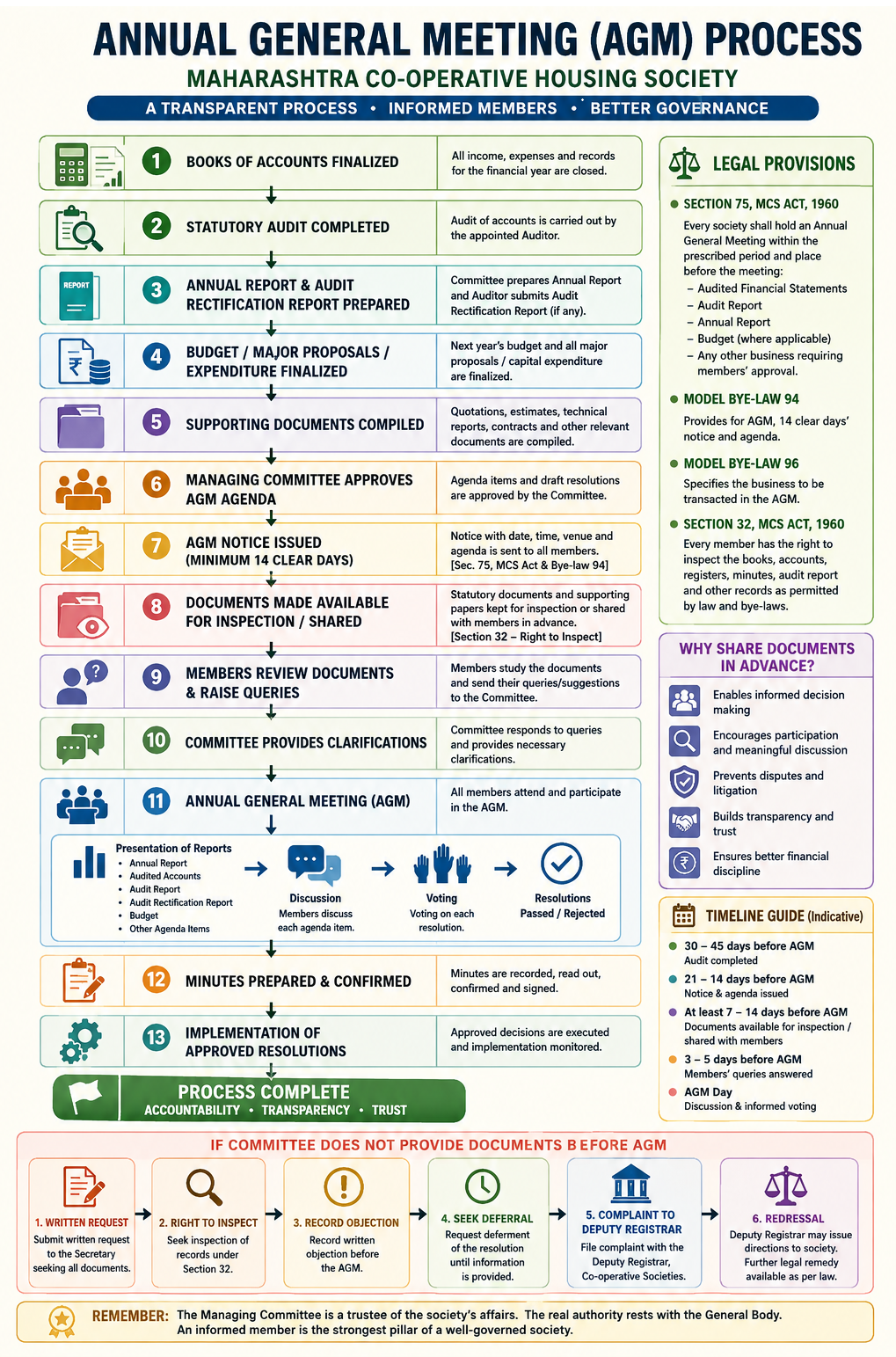
Milestones for Conducting a Proper AGM
A professionally managed society should generally follow the following sequence:
- Finalisation of annual accounts.
- Completion of statutory audit.
- Preparation of Audit Report.
- Preparation of Annual Report by the Committee.
- Finalisation of proposed budget.
- Preparation of explanatory notes for every agenda item requiring members’ approval.
- Circulation of AGM notice.
- Sharing or making available all supporting documents sufficiently before the AGM.
- Allowing members to inspect records and seek clarifications.
- Conducting the AGM and recording informed decisions.
Following these milestones improves governance and reduces disputes.
Why Should AGM Documents Be Shared Well Before the Meeting?
Many resolutions involve significant financial implications, such as:
- Installation of sensors.
- Redevelopment projects and Major repair contracts.
- Capital expenditure.
- Appointment of contractors.
- Increase in maintenance charges.
- Borrowing of funds.
Expecting members to read hundreds of pages during the meeting and immediately vote is neither practical nor democratic.
Providing documents well in advance enables members to:
- Analyse financial statements.
- Verify estimates.
- Seek expert advice where required.
- Raise meaningful questions.
- Suggest alternatives.
- Vote based on facts rather than assumptions.
Transparency builds trust; secrecy creates suspicion.
Importance of an Informed Decision
The essence of democratic governance is an informed vote.
An uninformed vote is merely a formality.
When members receive adequate information before the AGM:
- Financial irregularities can be identified.
- Inflated project costs may be questioned.
- Conflict of interest can be detected.
- Better alternatives can emerge.
- Collective wisdom leads to better governance.
Ultimately, informed participation protects both the society’s finances and the interests of all members.
Conclusion
An AGM is not merely an annual ritual. It is the cornerstone of democratic governance in a co-operative housing society.
Transparency before the meeting is as important as fairness during the meeting. Sharing documents sufficiently in advance empowers members to participate meaningfully, ask informed questions and make decisions that safeguard the long-term interests of the society.
A well-governed society is not measured by how quickly resolutions are passed but by how transparently they are debated and how confidently members cast their votes. An informed General Body is the strongest safeguard against poor governance and the foundation of a healthy co-operative movement.
메타데이터
- post_id
- 41ea018c4a9c
- slug
- annual-general-meeting-agm-of-a-housing-society-a-members-right-to-an-informed-decision-41ea018c4a9c
- url
- https://medium.com/@drpk/annual-general-meeting-agm-of-a-housing-society-a-members-right-to-an-informed-decision-41ea018c4a9c
- canonical_url
- https://medium.com/@drpk/annual-general-meeting-agm-of-a-housing-society-a-members-right-to-an-informed-decision-41ea018c4a9c
- author_url
- https://medium.com/@drpk
- status
- ok
- fetched_at
- 2026-08-21 14:10:25