Your first 90 days as a SDR
TL;DR
Your first 90 days as a SDR
TL;DR
Your first 90 days as a Sales Development Representative (SDR) aren’t about becoming the top performer overnight. They’re about building the skills, habits, and processes that will help you succeed long term. Focus on learning your product and buyers, developing consistent outreach habits, and continuously improving through feedback and data.

A Practical Guide to Success
Why the First 90 Days Matter
Starting as an SDR can feel overwhelming. You’re learning a new product, understanding a new market, mastering unfamiliar tools, and trying to generate pipeline — all at once.
The most successful SDRs don’t spend their first few months chasing quick wins. Instead, they focus on building a strong foundation. The habits you develop now will shape your future performance, whether you stay in sales or move into other revenue roles.
Think of your first 90 days as an investment period. The goal isn’t perfection. It’s progress.
Days 1–30: Learn Everything
Your first month should be focused on learning. Before you can effectively engage prospects, you need to understand what you’re selling, who you’re selling to, and how your company’s sales process works.
Learn the Product
You don’t need to memorize every feature. What matters is understanding the problem your product solves and why customers buy it.
Focus on:
- What problem does the product solve?
- Who experiences that problem?
- Why do customers choose your solution?
- What outcomes do they achieve?
To learn quickly:
- Read customer case studies
- Watch product demos
- Listen to sales calls
- Speak with Customer Success and Account Executives
Buyers care about outcomes, not feature lists.
Understand Your Ideal Customer Profile (ICP)
Great outreach starts with understanding your audience.
Learn about:
- Target industries
- Company sizes
- Buyer personas
- Common challenges
- Business goals
Ask yourself: What does this buyer care about most? The better you understand their world, the more relevant your outreach becomes.
Learn the Sales Process
Take time to understand how opportunities move through the pipeline.
Become familiar with:
- Qualification criteria
- CRM workflows
- Opportunity stages
- Handoff processes
Top SDRs understand how their work contributes to revenue — not just activity metrics.
Days 31–60: Build Your Outreach Engine
By your second month, it’s time to move from learning to execution.
You should now have enough knowledge to start developing a consistent prospecting process. The goal is not to be perfect. It’s to build momentum.
Master Your Messaging
Most buyers receive dozens of sales emails every week. Generic outreach gets ignored.
Strong messaging focuses on the prospect rather than your company.
Good outreach:
- References a relevant challenge
- Shows understanding of the buyer’s situation
- Creates curiosity
- Includes a simple next step
Avoid:
- Long introductions
- Feature-heavy pitches
- Generic templates
- Buzzword overload
Your goal is to start conversations, not close deals.
Use Multiple Channels
Modern prospecting extends beyond email.
The most effective SDRs combine:
- Phone calls
- Social engagement
- Video messages
Different buyers respond differently. Consistent, multi-channel outreach often generates the best results.
Focus on Quality Activity
Activity matters, but quality matters more.
Instead of simply tracking emails sent or calls made, pay attention to:
- Reply rates
- Positive responses
- Meetings booked
- Call connect rates
- Conversion rates
These metrics reveal what’s actually working.
Days 61–90: Optimize and Improve
By this stage, you should have enough outreach data to identify patterns and refine your approach.
Rather than trying new tactics every week, focus on improving the ones that are already producing results.
Analyze What Works
Review your performance regularly.
Look for patterns such as:
- Which personas respond most often
- Which industries convert best
- Which subject lines perform well
- Which call openings create engagement
Double down on what’s working and eliminate what isn’t.
Build Your Personal Playbook
Create a document containing:
- Best-performing emails
- Successful call openers
- Common objections
- Effective responses
- Prospecting workflows
Over time, this becomes your personal operating system for sales.
Stay Coachable
Feedback is one of the fastest ways to improve.
Regularly ask:
- What am I doing well?
- What should I improve?
- Which skills should I prioritize?
The SDRs who ramp fastest are usually the most coachable.
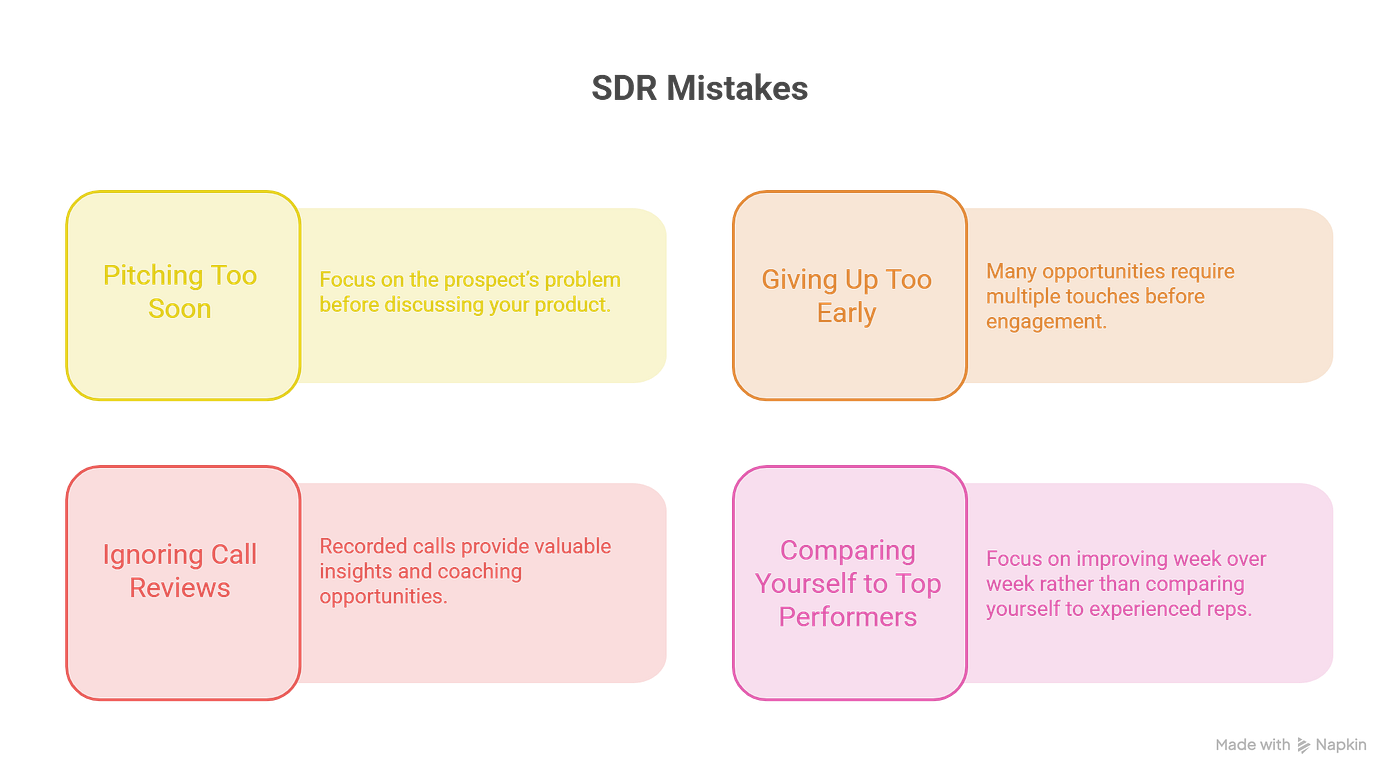
Common Mistakes New SDRs Make
Avoid these common pitfalls:
What Success Looks Like After 90 Days
By the end of your first 90 days, you should be able to:
- Explain your product confidently
- Understand your target buyers
- Run consistent outreach campaigns
- Handle common objections
- Maintain CRM hygiene
- Book meetings predictably
- Follow a repeatable prospecting process
You don’t need to be the highest performer. You need to be consistently improving.
Final Thoughts
The best SDRs aren’t necessarily the most naturally talented. They’re the ones who learn quickly, stay curious, seek feedback, and execute consistently.
Your first 90 days are about building a foundation. Invest in learning, develop strong habits, and focus on continuous improvement. The results will follow.
FAQs
How long does it take an SDR to ramp?
Most SDRs take between 60 and 120 days to become fully productive, depending on the company and market.
Should SDRs prioritize calls or emails?
Neither. A multi-channel approach that includes calls, emails, and LinkedIn generally performs best.
What’s the most important skill for a new SDR?
Understanding buyers. The better you understand their challenges and goals, the more effective your outreach becomes.
How can SDRs improve quickly?
Listen to successful sales calls, review your own performance, seek feedback, and continuously refine your messaging.
A Note on Modern Prospecting
Today’s buyers are more informed and harder to reach than ever. That’s why many revenue teams use tools like Tario to create AI-powered sales content, thought leadership, and outbound assets that help SDRs engage prospects with relevant, personalized messaging at scale. Learn more at www.tario.ai.
메타데이터
- post_id
- 423852c3fca3
- slug
- your-first-90-days-as-a-sdr-423852c3fca3
- url
- https://medium.com/@tario/your-first-90-days-as-a-sdr-423852c3fca3
- canonical_url
- https://medium.com/@tario/your-first-90-days-as-a-sdr-423852c3fca3
- author_url
- https://medium.com/@tario
- status
- ok
- fetched_at
- 2026-06-13 07:35:29