CTE: The Temporary Guest Room of SQL
Learn SQL Through Analogy — by Ramdinesh | LearnThroughAnalogy.com
CTE: The Temporary Guest Room of SQL
Learn SQL Through Analogy — by Ramdinesh | LearnThroughAnalogy.com
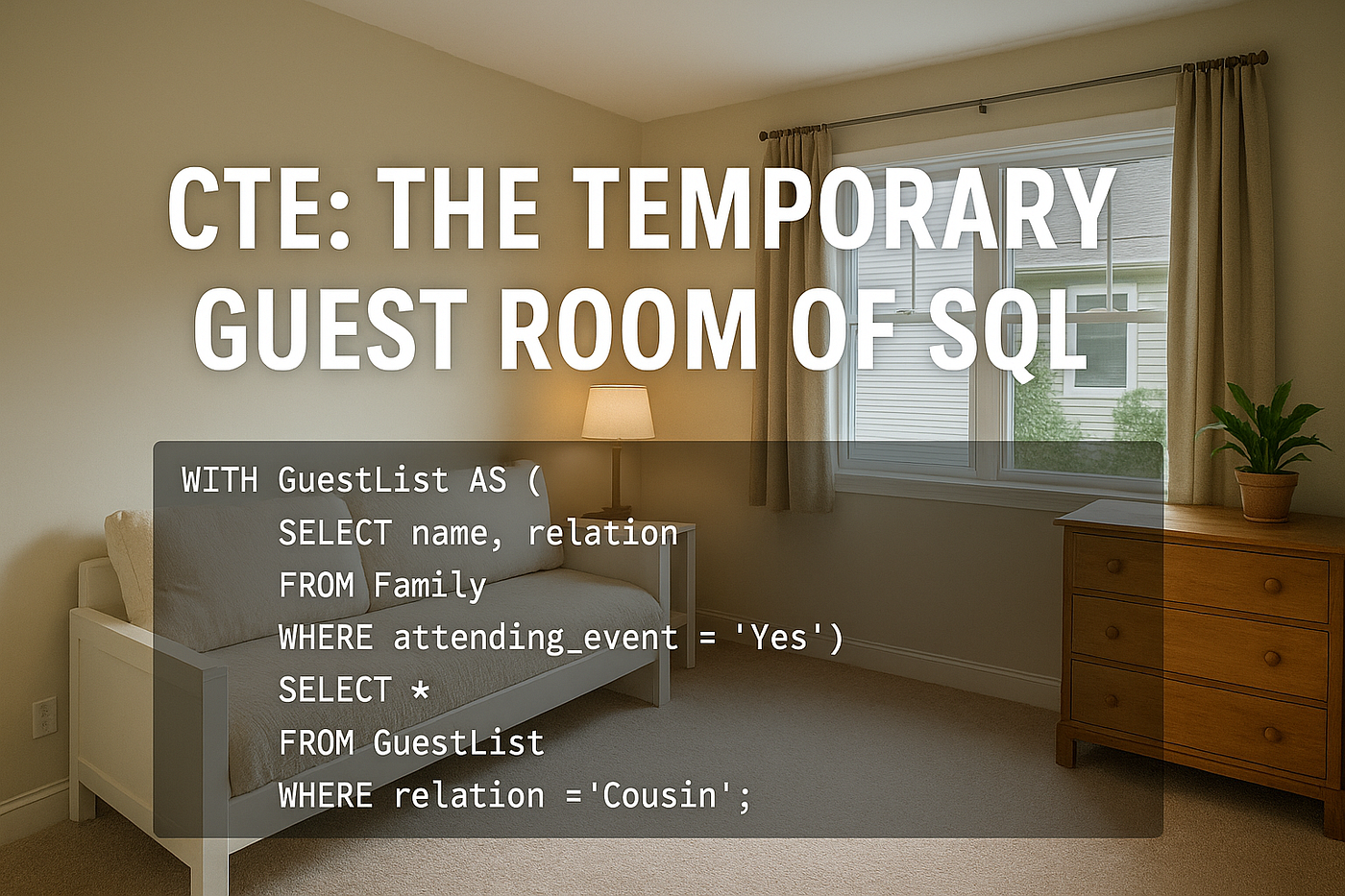
Ever hosted guests without enough rooms?
Imagine your relatives arrive suddenly for a family event. You don’t have enough bedrooms, so you quickly set up a temporary guest room using movable walls or a spare space. It’s not part of your permanent house plan, but it helps manage the crowd better — and once the event is done, you can fold it away.
That’s precisely what a Common Table Expression (CTE) does inside your SQL query.
What Is a CTE, Really?
A CTE (Common Table Expression) is a temporary named result set that exists only while your SQL query runs. It’s like creating a mini-table on the fly — just for the query you’re working on.
You declare it using the WITH keyword, use it like a regular table, and once the query finishes, it disappears — no mess left behind.
The Analogy: Your Guest Room Setup

So when you write:
WITH GuestList AS (
    SELECT name, relation
    FROM Family
    WHERE attending_event = 'Yes'
)
SELECT *
FROM GuestList
WHERE relation = 'Cousin';
You’ve just created a GuestList guest room inside your SQL house. It holds temporary members (filtered data) that you can refer to multiple times without having to rewrite the same logic.
Why Not Just Use a Subquery?
Because CTEs are like well-organized guest rooms, while subqueries are like guests sleeping on the couch — they still work, but not neatly or reusable.
With CTEs:
- Your SQL becomes cleaner and easier to read.
- You can break complex queries into smaller, understandable chunks.
- You can reference the CTE multiple times (no repeated code).
Example: Calculating Employee Bonuses
Let’s say you want to find employees who earn above-average salaries in their department.
Without a CTE (subquery couch chaos):
SELECT name, salary
FROM employees
WHERE salary > (
  SELECT AVG(salary)
  FROM employees e2
  WHERE e2.department = employees.department
);
With a CTE (temporary guest room elegance):
WITH DeptAverage AS (
    SELECT department, AVG(salary) AS avg_salary
    FROM employees
    GROUP BY department
)
SELECT e.name, e.salary, e.department
FROM employees e
JOIN DeptAverage d
  ON e.department = d.department
WHERE e.salary > d.avg_salary;
Now, your query reads like a story —
“First, I built a temporary room to store each department’s average salary. Then, I compared who’s above average in that room.”
Clean. Logical. Scalable.
Recursive CTEs: The Guest Room That Expands Itself
What if your guest room could magically expand to accommodate new relatives whenever they arrive? That’s what recursive CTEs do — they call themselves until a condition is met.
Example: finding employee hierarchy.
WITH RECURSIVE EmployeeHierarchy AS (
    SELECT id, name, manager_id
    FROM employees
    WHERE manager_id IS NULL
    UNION ALL
    SELECT e.id, e.name, e.manager_id
    FROM employees e
    INNER JOIN EmployeeHierarchy h
      ON e.manager_id = h.id
)
SELECT * FROM EmployeeHierarchy;
This is like saying:
“Start with the top boss. Keep adding their subordinates until there’s no one left.”
It’s your auto-expanding guest room — perfect for hierarchical data like org charts, file systems, or category trees.
The Takeaway
A CTE is not about saving memory — it’s about saving your sanity. It’s your temporary guest room that keeps your SQL organized, readable, and structured.
So the next time your query gets messy, don’t let data sleep on the couch — Build a guest room, call it a CTE.
Quick Recap:
- Use
WITHto define a CTE. - Great for readability and reuse.
- Can be recursive for hierarchical queries.
- Disappears once the query ends — no cleanup required.
Note:
This article is part of my “Learn Through Analogy” series — where everyday life meets tech logic. Next up: “SQL Joins: The Family Reunion Edition.”
If you found this helpful, share it — someone out there is still forcing their data to sleep on the couch.
메타데이터
- post_id
- 4240d4b08625
- slug
- cte-the-temporary-guest-room-of-sql-4240d4b08625
- url
- https://medium.com/@ramdinesh/cte-the-temporary-guest-room-of-sql-4240d4b08625
- canonical_url
- https://medium.com/@ramdinesh/cte-the-temporary-guest-room-of-sql-4240d4b08625
- author_url
- https://medium.com/@ramdinesh
- status
- ok
- fetched_at
- 2026-06-09 15:37:30