The Global Jobs Crisis: When Work Becomes Harder to Find.
Across the world, employment is becoming increasingly uncertain. Economic slowdowns, geopolitical conflicts, trade disruptions…
The Global Jobs Crisis: When Work Becomes Harder to Find.
Across the world, employment is becoming increasingly uncertain. Economic slowdowns, geopolitical conflicts, trade disruptions, technological transformation and weak investment are reshaping labour markets, leaving millions of workers and families struggling to secure stable incomes.
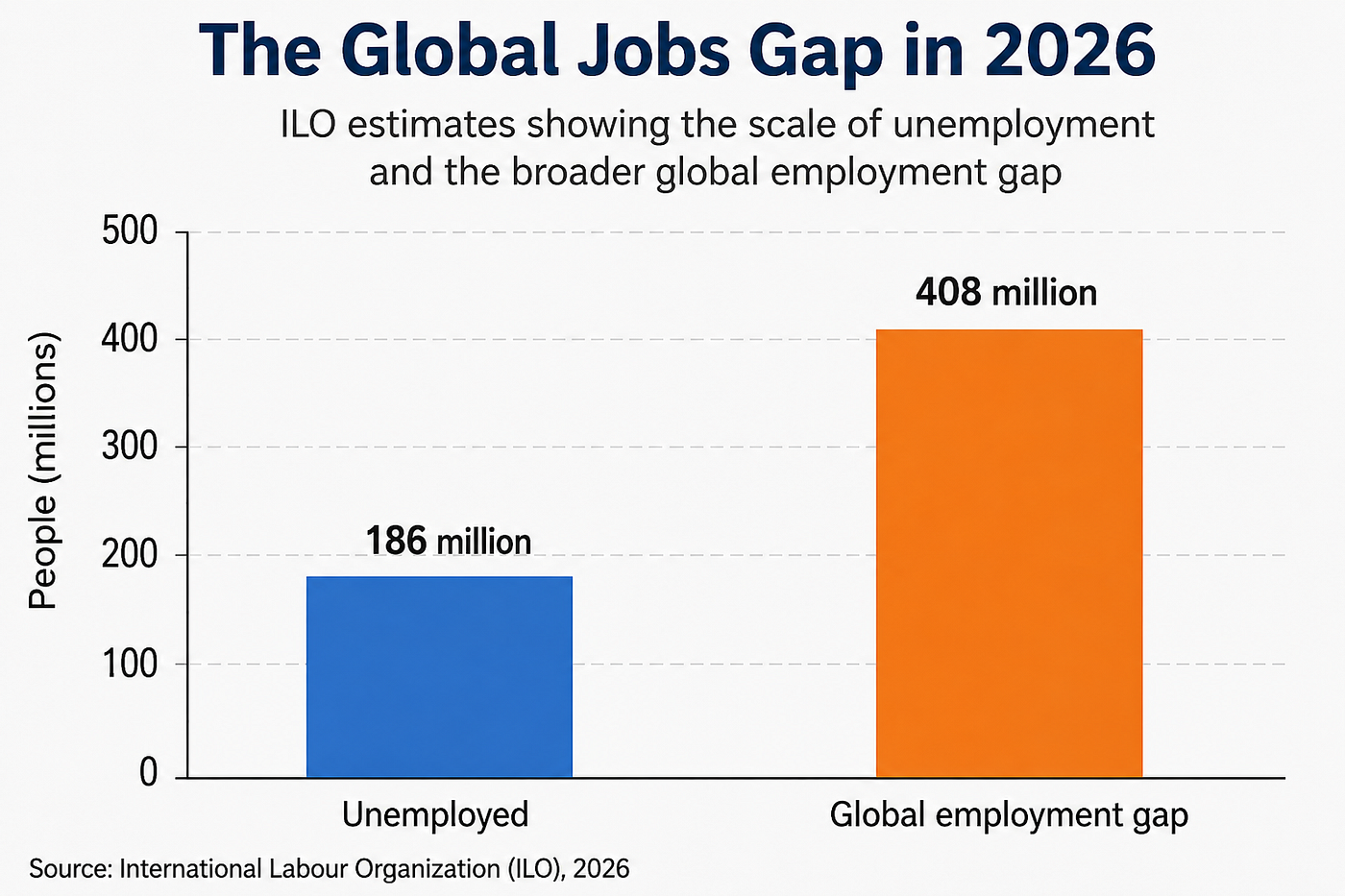
The International Labour Organization (ILO) projects the global unemployment rate to remain around 4.9% in 2026, representing approximately 186 million unemployed people. But the headline unemployment figure hides a deeper problem: the global employment gap — the number of people who want paid work but cannot obtain it — is expected to reach 408 million this year.
Job quality is also deteriorating. The ILO estimates that nearly 300 million workers remain in extreme working poverty, while around 2.1 billion people are expected to work in informal employment in 2026, often without adequate social protection or job security. Young people are particularly vulnerable as economies struggle to create enough decent jobs for new entrants to the labour market.
The broader economic environment is adding further pressure. The World Bank projects global economic growth at just 2.5% in 2026, with developing economies facing particularly weak per-capita income growth. Meanwhile, the ILO warns that higher energy costs, disrupted supply chains and geopolitical tensions are putting additional pressure on employment and household incomes.
Artificial intelligence and automation add another layer of uncertainty. While new technologies can create industries and improve productivity, workers without relevant skills may find themselves increasingly excluded from emerging opportunities.
The solution is not to resist economic and technological change, but to prepare people for it. Governments need stronger social protection, investment in education and reskilling, support for small businesses, and policies that encourage productive investment and decent employment.
Ultimately, the global jobs crisis is not simply an economic statistic. Behind every lost job is a household, a disrupted future and a struggle for dignity. Creating enough secure and meaningful work must therefore remain one of the world’s most urgent development priorities.
메타데이터
- post_id
- 425e5ae31f42
- slug
- the-global-jobs-crisis-when-work-becomes-harder-to-find-425e5ae31f42
- url
- https://medium.com/@salimjes/the-global-jobs-crisis-when-work-becomes-harder-to-find-425e5ae31f42
- canonical_url
- https://medium.com/@salimjes/the-global-jobs-crisis-when-work-becomes-harder-to-find-425e5ae31f42
- author_url
- https://medium.com/@salimjes
- status
- ok
- fetched_at
- 2026-08-11 19:16:36