Jaswant Singh Khalra: A Lamp That Challenged the Darkness
The story of a bank official who challenged an entire state apparatus armed with nothing but paper and truth
Jaswant Singh Khalra: A Lamp That Challenged the Darkness
The story of a bank official who challenged an entire state apparatus armed with nothing but paper and truth
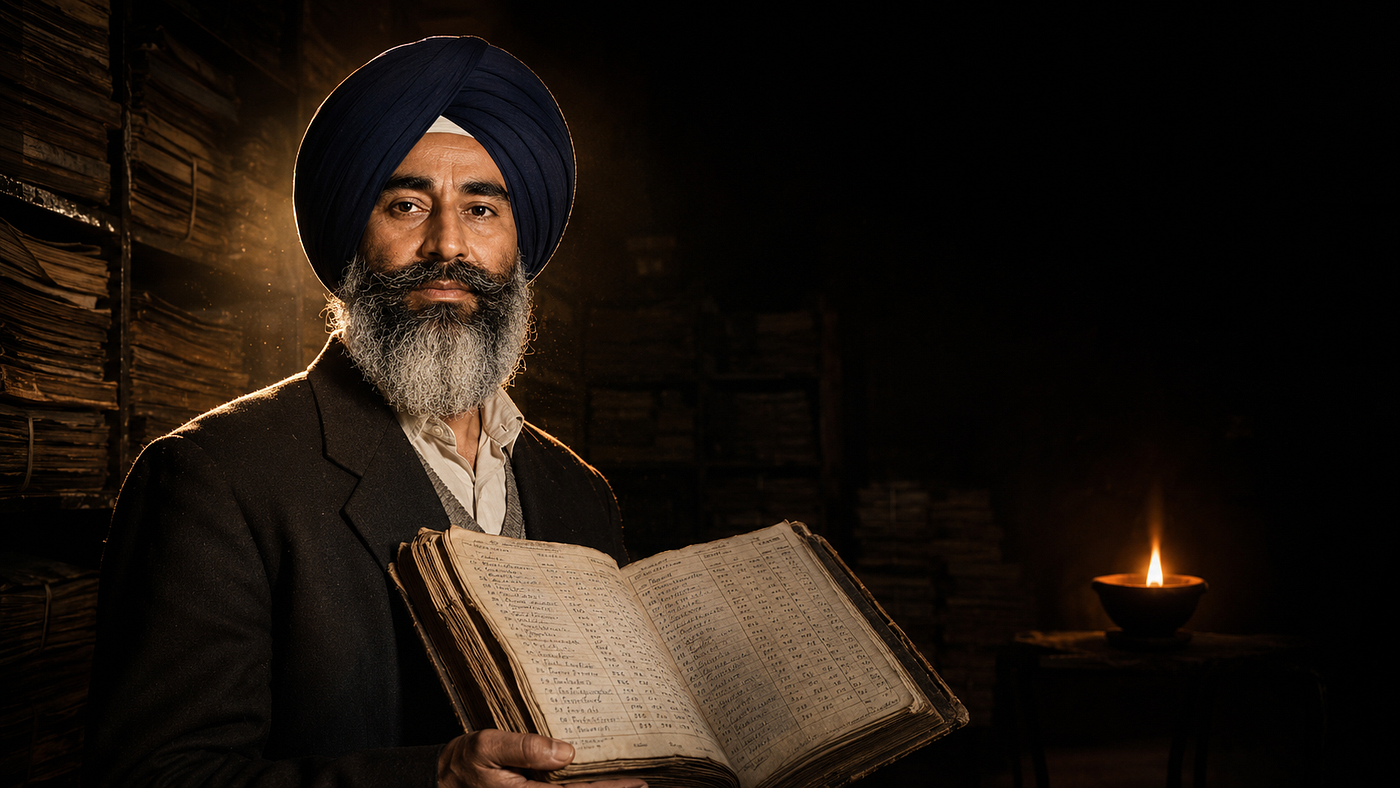
The lamp that challenged the darkness — the man whose paper trail exposed a state’s hidden crimes.
Introduction
Some people accomplish such great things in their lives that even their death cannot silence their voice. Jaswant Singh Khalra (1952–1995) is one such name. He was no great leader, nor an armed fighter. He was a director of a cooperative bank in Amritsar — an educated, calm-natured man whose greatest weapon was only paper, records, and truth.
In the early 1990s, when thousands of young men were going “missing” in Punjab and the police gave the same answer to every question — “We don’t know, he must have gone to Pakistan” — Khalra did something no one had done before. Instead of merely weeping or leveling accusations, he found proof from within the government’s own papers. By opening the cremation grounds’ municipal firewood purchase registers (records of firewood purchases), he showed that the police were quietly burning thousands of bodies by labeling them “unclaimed.”
This discovery was so dangerous that it shook the entire narrative of the Punjab Police. Khalra paid the price for this very truth with his own life. On 6 September 1995, in broad daylight, while washing his car outside his home, the police picked him up. After several weeks of torture he was killed, and his body was thrown into the Harike canal — in the very same way he himself had brought the story of thousands of others before the world.
But the government’s calculation proved wrong. They were mistaken in thinking that killing Khalra would also end his research. His martyrdom turned a scattered protest into a large, worldwide human rights movement. His wife Paramjit Kaur Khalra carried the fight forward, and finally the Supreme Court of India in 2011 upheld the sentence of the police officers who murdered him — such cases are very rare in India where the police are punished for their own crimes.
Today, even thirty years later, Khalra’s name is in the news. In 2026, the controversy surrounding the film Satluj (in which Diljit Dosanjh played his character), made about his life, once again proved that suppressing the truth is not as easy as it seems.
This article is the complete story of Jaswant Singh Khalra — from his background to his research, his martyrdom, the legal battle, and his legacy that continues to this day. The attempt is to tell this story in simple language, but with complete truth and balance.
Background: The Punjab of 1984 and the Wounds That Changed Everything
To understand Khalra’s story, one must first understand the Punjab of that time. The darkness he fought against did not arrive in a single day. Its roots lay in the two great traumas of 1984, which pushed Punjab into a decade-long period of violence.
Operation Blue Star (June 1984)
In June 1984, the government of Prime Minister Indira Gandhi launched Operation Blue Star. The purpose of this military operation was to remove Sant Jarnail Singh Bhindranwale and his armed companions from the Harmandir Sahib (Golden Temple) complex in Amritsar, where they had fortified the Akal Takht.
The army carried out this operation with full force — even tanks were used, whose shells were fired directly at the Akal Takht. Alongside this, the government imposed a complete media ban across Punjab, expelled foreign journalists, and launched Operation Woodrose in the villages, beginning to arrest hundreds of young Sikh men.
How many people were killed in this operation — there is no agreement on this even today — and this very period of “differing stories” became Punjab’s identity for the next ten years:
- According to the first White Paper of the Government of India, about 493 to 554 people were killed and 83 to 92 security personnel.
- Rajiv Gandhi later admitted that the number could be around 700.
- Independent human rights organizations and eyewitnesses said that the number of dead was between 4,000 and 10,000, because on that day, due to a religious anniversary, thousands of devotees were trapped inside.
For the Sikh community in Punjab and around the world, this was not merely a police operation — it was the desecration of their most sacred site. In Sikh history this event was soon given the name of the third Ghallughara (holocaust). The very thing this operation was carried out to suppress flared up even more — many peaceful-natured Sikhs too now began to lean toward separatism.
The Assassination of Indira Gandhi and the November 1984 Massacres
On 31 October 1984, the direct consequence of Operation Blue Star came to the fore — Indira Gandhi was shot by her two Sikh bodyguards. What happened after this was even more horrific. From 31 October to 3 November, especially in New Delhi, terrible violence took place against Sikhs.
This violence was not random — it was planned. The mobs had voter lists, with the help of which they located the homes and shops of Sikhs. People were dragged out of their homes, burned alive using tires and kerosene, women were raped, and gurdwaras were burned.
According to government figures alone, at least 2,733 Sikhs were killed in Delhi, but independent investigations revealed that this massacre took place with the collusion of several senior political leaders and the local police — and the culprits later received no punishment.
For the Sikh community, this was not merely a loss of life. It was a breaking of trust. When the state failed to protect its own citizens, and then the courts too could not punish the guilty, it became firmly settled in many people’s minds that they would not get justice within the Indian framework. This very despair went on to become the biggest root of the militant movement.
The Rise of Militancy and the State’s Crackdown
After these traumas of 1984, Punjab turned into a full-scale armed conflict. Several militant organizations — such as Khalistan Commando Force (KCF), Babbar Khalsa, Bhindranwale Tiger Force of Khalistan, Dashmesh Regiment, and Khalistan Liberation Force — became active across the state. They carried out the killings of political leaders and officers, but along with this they also targeted innocent Hindus and those Sikh citizens who were against their separatist agenda. This point must be remembered — violence came from both sides, and ordinary people were being crushed from both sides.
The central government’s response was the heavy militarization of Punjab. At the peak of the conflict, roughly 150,000 to 500,000 security personnel were deployed in the state — Punjab Police, CRPF, BSF, and the Indian Army. Under the leadership of Director General of Police (DGP) K.P.S. Gill, the state adopted a very aggressive policy, in which acts committed outside the law became commonplace. Police personnel were given cash rewards and promotions in exchange for capturing or killing suspected militants.
This was the environment in which Khalra grew up, continued to work at the bank, and eventually stood against. But this crackdown was not limited only to guns — behind it lay an entire framework of laws, which made all of this “legal.” We will discuss that framework in the next section.
The Architecture of Impunity: When the Law Itself Became a Shield
To understand how thousands of people went “missing” in Punjab, and how the police could do this on such a large scale, we must look at the laws that were in force at the time. These laws had created such an environment in Punjab where the constitutional rights of ordinary citizens had almost been eliminated.
The Laws That Gave the Police a Free Hand
During this period the Government of India made several harsh laws, which together established a kind of “state of exception” — that is, conditions where ordinary legal rules do not apply:
- Terrorist and Disruptive Activities (Prevention) Act — TADA (1985/1987): This gave the police sweeping powers to arrest without warrant and to hold people in custody for long periods. Its Section 15 was the most dangerous — it accepted even a “confessional statement” given before a police officer as evidence in court. The direct consequence of this was that terrible torture to extract statements became commonplace.
- Armed Forces (Punjab and Chandigarh) Special Powers Act — AFSPA (1983): This gave the security forces the power to “shoot to kill” on the basis of mere suspicion. According to its Section 7, to prosecute any officer, permission of the central government first had to be obtained — which was almost never granted.
- Punjab Disturbed Areas Act (1983): Its Section 6 too gave the state police protection from prosecution without government permission.
- Terrorist Affected Areas (Special Courts) Act (1984): This allowed secret trials and, most importantly, reversed the burden of proof itself. Now the accused had to prove that they were innocent.
All these laws together rendered habeas corpus (that is, the right to produce an arrested person before a court) almost ineffective. When the families of missing people went to court, the police would either make the excuse of national security, or would directly deny that the person had ever been in custody. This is why people like Khalra had to find some other, new path to prove the truth instead of the courts.
The Truth of “Encounter” and “Missing”
By the early 1990s, police action had advanced beyond fighting armed militants to become a widespread, systematic violence. The term “police encounter” actually became another name for extrajudicial execution (killing carried out outside the law).
Its method was almost always the same: policemen in plain clothes would pick up some young man — especially those who were politically active, or who were relatives of some suspected militant. Then his very presence would be denied at the police station. He would be tortured, killed, and the body disposed of secretly.
When family members asked, they would get the same kinds of answers — “He must have crossed the border and gone into a militant camp in Pakistan,” or “He must have fled abroad.” This excuse was so common that it kept thousands of families waiting for years in the hope that perhaps their son or brother might be alive somewhere.
The Biggest Question: Where Did the Bodies Go?
Here was a practical problem that later became the key to Khalra’s research. If the police were killing thousands of people, what happened to the bodies? If the bodies of those killed by torture were returned to the families, they would become direct evidence — and protest could flare up on a large scale.
This is why the state needed some way to “disappear” the bodies. The solution that emerged was that the bodies would be labeled “unclaimed” (unidentified/unclaimed), and without any post-mortem, quietly burned in the cremation grounds. This was the very place where the state made a big mistake — because although the bodies disappeared, the accounting of the firewood used to burn them got recorded in the government papers. These very papers later became the greatest testimony of the truth.
There was also another serious allegation, which Khalra himself made — that this crackdown was not limited only to ordinary people. His claim was that about 2,000 police personnel who refused to participate in these illegal killings were themselves also killed off by the state. (This allegation has to this day not been independently proven — we will discuss this in detail later.)
This was the entire framework — law, gun, reward, denial, and cremation ground — against which a bank director was about to stand, armed only with paper.
Khalra’s Roots: The Heir of a Rebel Family
Jaswant Singh Khalra was not a hero born out of a vacuum. The courage to stand against the state had come to him as an inheritance. The story of his family was itself a story of rebellion and sacrifice.
Birth and Village
Jaswant Singh Khalra was born on 2 November 1952 in the village of Khalra, which today falls in the Tarn Taran district (earlier it was part of the larger Amritsar district). This region — Majha — is known for its historical militancy, anti-imperial traditions, and Panthic (Sikh religious) identity. The very village from whose name he got his surname “Khalra” became a part of his identity.
Rebellion Received as Inheritance: Grandfather Harnam Singh
The greatest distinction of Khalra’s family was his grandfather Sardar Harnam Singh, who was a prominent leader of the Ghadar Party. The Ghadar Party was a revolutionary movement formed by Indians living in North America, whose aim was to uproot British rule from India through armed struggle.
Harnam Singh was a witness to the famous Komagata Maru incident of 1914. He was one of those 376 passengers who reached Vancouver in Canada via Hong Kong aboard the Japanese ship SS Komagata Maru (which is called Guru Nanak Jahaz in Sikh memory). Due to Canada’s racist laws, the ship was turned back.
When the ship reached Budge Budge, Calcutta in September 1914, the British authorities tried to arrest the leaders, which led to a violent clash and the police opened fire. Despite being on the core committee along with Baba Gurdit Singh, Harnam Singh escaped from that firing.
But he did not stop. He kept trying to incite rebellion in the British army. In February 1915, after a raid on the Ghadar headquarters in Lahore, he was arrested and tried in the famous Lahore Conspiracy Case. He had to serve nine years of imprisonment in Lahore Jail. Although, unlike companions such as Kartar Singh Sarabha, he was not hanged, after his release he was kept confined to his village Khalra under strict police surveillance. During this time he was married and Jaswant Singh’s father Kartar Singh was born. After the restriction was lifted in 1922, Harnam Singh went to Shanghai, China to continue his revolutionary activities and never returned to Punjab again.
This heritage is very important. The memory of a grandfather who served colonial imprisonment in exchange for his political views made resistance and courage a common thing in Khalra’s home. When Jaswant Singh faced the Indian state in the 1990s, he was already equipped with a generations-old understanding of standing up against police intimidation and oppression.
Education and the “Lawyer” Misconception
Khalra obtained his higher education from Guru Nanak Dev University (GNDU), Amritsar, where he studied especially Political Science and Law.
In media and human rights reports around the world, Khalra is often called a “human rights lawyer” — but this is not entirely correct. It is true that he was a law graduate, but he was not a lawyer practicing in court. This misconception arose because he used the legal method with great insight — he himself collected testimonies, matched municipal records with police records, and, together with practicing lawyers like R.S. Bains, filed habeas corpus petitions and PILs.
In other words, his law degree was not a professional license, but a tool of analysis. This very understanding enabled him to read the fine details of government documents and to understand the standards of judicial evidence, which would perhaps have been difficult for an ordinary activist.
The Bank Job and a Settled Life
By profession, Khalra was a fully settled, middle-class man — completely the opposite of the image of a full-time political activist. In the 1980s and early 1990s, he worked as a Bank Director and Manager at the Amritsar Central Cooperative Bank.
This job was not merely a livelihood — this very thing later became his greatest strength. In Punjab, cooperative banking is deeply connected with the rural economy. As a bank director, Khalra had a deep understanding of the government and municipal record-keeping system. He knew how government accounts are read, and where the accounting of expenditure is recorded. This very skill later came in useful for understanding the firewood-purchase records of the cremation grounds.
Family
Khalra was married to Paramjit Kaur, who later became an assistant librarian at Guru Nanak Dev University. This couple settled their family in Amritsar and raised two children — a daughter, Navkiran Kaur, and a son, Janmeet Singh. This very Paramjit Kaur later, after her husband went missing, transformed from an ordinary librarian into Punjab’s most determined human rights fighter — but we will tell that story further on.
Ideological Journey: From Marxism to Panthic Identity
Perhaps the most complex and most misunderstood aspect of Khalra’s life is his political journey. He did not remain a man of a single ideology all his life — rather, his journey passed through both extremes of 20th-century Punjabi politics: from secular, left-wing Marxism to Sikh nationalism. To understand this change is to understand the mental turmoil of many Punjabi intellectuals of that era.
The Left-Wing Student Period (1970s)
As a student at GNDU, in the late 1960s and early 1970s, the young Khalra was greatly influenced by the Naxalite (Maoist) movement and left-wing ideas that had spread in Indian universities. At that time he rejected religious fundamentalism and was drawn toward Marxism-Leninism, viewing Punjab’s problems from a class perspective rather than religion.
During this period he became actively associated with the Naujawan Bharat Sabha — this is the very organization whose roots are connected with the secular revolutionary Bhagat Singh. He was active in student politics under the banner of the Punjab Students Union (PSU) and the Bhagat Singh Union. An interesting fact is that even at the time of his marriage to Paramjit Kaur in the early 1980s, he was working for the Bhagat Singh Union, which shows his long commitment to left-wing ideas.
In the early period of the Punjab crisis, Khalra’s thinking was completely secular. When Khalistan militancy began, he took a balanced stand — he condemned the illegal atrocities of the police, and along with this also the communal killings committed by the militants (such as the killing of innocent Hindu citizens).
The Turning Point of 1984
The traumas of 1984 — Operation Blue Star and the November anti-Sikh massacres — changed the axis of Khalra’s thinking too, as it did for many Punjabi intellectuals. The systematic targeting of the Sikh community shook his old secular-Marxist perspective.
Immediately after Operation Blue Star, his attitude changed — he began going to secret meetings regardless of the military curfew, for which he was also briefly taken into custody, and it is said that he even survived a helicopter firing. For Khalra, 1984 proved that the state was not merely a tool of class oppression (as Marxism said), but that it could also carry out targeted ethnic violence and cultural repression. This is why his thinking shifted from class unity toward Panthic (Sikh) identity, human rights, and self-determination.
Liberation Khalistan and Controversial Views (1990–1992)
By the early 1990s, Khalra had become fully involved in the Sikh nationalist movement. Between 1990 and 1992 he spent some time in the United Kingdom, where he connected with the diaspora pro-Khalistan community.
In 1992, reflecting his complete ideological change, he started a monthly magazine named Liberation Khalistan, of which he himself was the chief editor and writer. His writings of this period leave no doubt that he openly supported a theocratic (religion-based), independent Sikh state.
Here it is necessary to state honestly that some of his views were highly controversial. In an article of February 1992 — “The Game of Elections — Should It Be Played Or Not?” — he rejected the Indian electoral process and called Indira Gandhi’s assassins Satwant Singh and Kehar Singh “Khalistani heeray” (diamonds of Khalistan). Later, during a tour of Canada, in an interview given to Ankhila Punjab, he described Jarnail Singh Bhindranwale as “one of the nation’s heroes in this century.”
An Important Point: Views Different, but Method Scientific
Here a very important point must be understood. Khalra’s political views, whether one likes them or not, are a separate matter — but his method of documenting human rights violations was completely scientific, fact-based, and resting on evidence.
This very thing is what makes his legacy so controversial. For the Indian state, his pro-Khalistan views made him a “threat.” For Sikh nationalists, these same views make him a martyr. But for international human rights organizations, the significance of his research is separate from his political views — because the records of the bodies being burned do not lie, whatever the politics of the one who found them may be.
This multifaceted truth is itself the greatest lesson of Khalra’s story: it is not necessary to agree with a man’s views, but the truth he brought to the fore remains the truth.
The Research: The Truth That Emerged from the Firewood Accounts
This is the most important part of Khalra’s story — the research that turned him from an ordinary bank official into a part of history, and whose price he paid with his own life.
The Beginning: A Personal Grief
Khalra’s research began not with some grand plan, but from a personal grief. In the early 1990s, a colleague of his from the bank — and the relatives of some other colleagues — went missing after being picked up by the police for questioning. The disappearance of men whom he knew personally shook him.
He flatly refused to accept the police’s rote denials. But he knew that asking the police directly for answers was useless — the records of the police stations were either false, or made with a back-date, or destroyed.
A Simple but Profound Idea
Here Khalra thought of a very simple but profound thing. He thought: the police may kill people by going outside the law, but disappearing thousands of bodies could not be entirely outside the government framework. Firewood is needed to burn bodies, and the accounting of firewood purchases is recorded somewhere.
In other words, he was searching for that place where the state’s violence collided with the government’s ordinary accounting (municipal accounting).
The Cremation Grounds and the Firewood Records
In Indian municipalities, the last rites of “unclaimed” or poor bodies are the responsibility of the local committee. For this work there is a budget for buying firewood, cloth, etc., and a record of every purchase is kept. Khalra and his companions talked to the cremation ground workers.
The workers described a terrible, systematic pattern: the police would often bring truckloads of bodies at night and demand immediate cremation. Here the division of work was clear — the police provided the bodies, and the municipality provided the firewood.
Khalra gained access to the municipality’s files, especially the firewood purchase registers and receipt books — in this way he found the truth from within the open government records, rather than from secret police records. He initially focused on three main cremation grounds: Durgiana Mandir (Amritsar), and the municipal cremation grounds of Tarn Taran and Patti.
These registers contained very detailed information: the dates of cremations, the names of the police officers or the police station who brought the bodies, the number of bodies described as “unclaimed,” and the weight of the firewood used for each cremation. These were the very solid, documentary proofs that no human rights organization had ever possessed before.
The Secret of 300 Kilograms of Firewood
Here another horrific truth came to the fore. According to the government accounts, about 300 kilograms of firewood is needed for the cremation of one complete body. But Khalra found that the police often burned several bodies together on a single pyre — in the same amount of firewood. The purpose of this was twofold: to hide the actual number of bodies, and to “save” the government budget.
Connecting the Two Sides
The firewood records alone were not enough. Khalra’s real research lay in the fact that he matched these records with the testimony of the families of the missing people. He and his companions went village to village and collected testimonies, photographs, and affidavits from those families whose loved ones the police had picked up.
This work was not easy. Many mothers and sisters were afraid to officially declare their loved ones “missing” — out of the fear that if he were still alive in secret custody, then drawing attention would get him killed. To break this fear, Khalra had to build deep trust in the villages.
When he matched the dates of the police “encounters” with the dates of bodies that suddenly arrived at the cremation grounds, the picture became clear. Although the police described the bodies as “unidentified,” sometimes the municipal clerks recorded some identification of the body (name, age, address) in the register. In this way Khalra was able to prove that those who had been called “unidentified militants” were actually the same picked-up sons, husbands, and brothers of the villages.
16 January 1995: The Truth Went Public
On 16 January 1995, Khalra, together with his companion Jaspal Singh Dhillon, issued a detailed press note. In it, it was stated that from 1 June 1984 to the end of 1994, in just the Durgiana Mandir, Patti, and Tarn Taran cremation grounds of the Amritsar district alone, about 2,000 bodies had been burned labeled as “unclaimed.”
This press note also exposed major legal violations — out of hundreds of bodies, only a few were recorded as death by gunshot, no cause of death was written for the rest, and, most importantly — no post-mortem had been done before burning, which was a direct violation of the law.
This was the moment when a bank director’s paper research became the greatest threat to the entire narrative of the Punjab Police.
The Truth of the Numbers: 2,097, 25,000 and the 2,000 Policemen
Several numbers are connected with Khalra’s research, and it is very important to understand them correctly. Here it is necessary to understand which number was proven with documents, and which was an estimate (extrapolation). To honestly state this difference is itself the key to understanding the real strength of Khalra’s research.
The Documentary Number: ~2,000 in Amritsar (Later 2,097)
The thing that was proven with solid documents was that in the Amritsar police district alone (which included sensitive areas like Tarn Taran and Majitha), about 2,000 bodies had been burned labeled as “unclaimed.” Later the CBI investigation confirmed this number and gave the definite figure of 2,097. This number is unshakeable — it is not some claim of Khalra’s, but the confirmation of the government’s own investigating agency.
The Estimate: 25,000 Across All of Punjab
Khalra argued that what happened in Amritsar was only a small sample of the pattern across all of Punjab. On this basis he calculated that if in a single district there were more than 2,000 secret cremations, then across the entire state the number of Sikhs illegally killed and burned could be more than 25,000.
This must be clearly understood: the figure of 25,000 was an estimate, not a documentary count. This figure was never formally verified by any government investigation — a major reason being that the state never allowed an investigation of the entire state to take place. Even in 2026, during the controversy over the film Satluj, a central minister challenged the filmmakers to prove the claim of 25,000.
What Later Research Showed
Although the exact figure of 25,000 was never formally proven, later independent investigations strengthened Khalra’s point that the Amritsar numbers were only a part of the full picture.
In 2017, the Punjab Documentation and Advocacy Project (PDAP), after seven years of investigation and a survey of more than 20 districts, released a report named Identifying the Unidentified. In it, 8,257 solid cases were recorded — 5,648 mass cremations of unidentified bodies, and 2,609 such cases where the victim’s identity was known. This very thing strengthens Khalra’s claim that the Amritsar numbers were only a fragment of the entire atrocity.
Similarly, an organization named Ensaaf (“justice” in Punjabi and Arabic) advanced Khalra’s method, conducted village-to-village surveys, and by 2019 had placed the profiles of more than 5,000 victims on an interactive data site. It proved that these were not the separate excesses of a few “rogue officers,” but a systematic, state-sponsored policy.
The Claim of the 2,000 Policemen
Khalra had also made another very sensitive claim — that about 2,000 police personnel who refused to participate in these illegal killings, torture, and extortion were themselves also eliminated by the state.
Here it must be stated with complete honesty: this claim, like the numbers of the bodies, does not rest on any documentary proof. Whereas the firewood records of the cremation grounds gave solid proof of the number of bodies, there is no central record of the deaths of these 2,000 policemen. To this day no inquiry commission, Supreme Court order, or CBI investigation has proven this claim. Therefore it remains a powerful, but independently unverified, claim.
Summary
In short, the strongest part of Khalra’s research — the 2,097 bodies of Amritsar — is proven by the government’s own investigation and cannot be refuted. The figures of 25,000 and the 2,000 policemen are estimates and claims, which later research partially strengthened, but did not fully verify. To understand this difference is to do justice to Khalra’s legacy — because his greatest strength was itself the accuracy of facts.
A Voice Reaching the World and the Threat Looming Overhead
Khalra knew that the Indian courts and the political framework were not prepared to hold the Punjab Police accountable. When in January 1995 he filed a petition in the Punjab and Haryana High Court, the court rejected it saying that Khalra did not have locus standi (that is, the legal right to file the case), because he was not a direct relative of those killed. This decision was legally wrong, because the Supreme Court had already (as in the S.P. Gupta and Sheela Barse cases) held that any public-spirited person could go to court on behalf of others. This rejection clearly showed Khalra that he would have to take his case outside the court, directly to the people and to the world.
The Tour of Canada and the United Kingdom (1995)
In early 1995, Khalra toured the United Kingdom and Canada at the invitation of diaspora organizations like the World Sikh Organization (WSO). In April 1995, he made the figures of the mass cremations public before a large gathering at the Dixie Gurdwara in Toronto. He also gave a detailed interview to Inderjit Singh Bal on the Ankhila Punjab (Vision TV) program, through which his evidence reached viewers around the world.
In June 1995, he went to Ottawa and presented his evidence before Canadian members of parliament on Parliament Hill. On the basis of firewood and cremation ground records, he gave a detailed account of the systematic killings and disappearances of Sikh youth.
“Challenge the Darkness” — The Story of a Lamp
During this same tour, Khalra gave his most famous speech, which is remembered today as “Challenge the Darkness.” He told the story of a single lamp that refuses to admit defeat before the growing darkness of night. His words were that he challenges the darkness, and if nothing else, then at least he will not allow this darkness to settle around him. This speech became the symbol of his life and legacy — and later this very speech inspired the dialogue of films.
Refusing Asylum
The Canadian human rights community knew that if Khalra returned to India, his life would be directly in danger. Therefore he was offered political asylum in Canada. But he flatly refused. His argument was that his work was still incomplete, and if he fled to save his own life, then it would be a betrayal of those thousands of mothers and families who were waiting for news of their missing loved ones. He returned to Punjab in late 1995.
The Support of International Organizations
Large organizations like Human Rights Watch (HRW) and Amnesty International included Khalra’s figures in their campaigns. As early as 1994, HRW had published the report Dead Silence: The Legacy of Abuses in Punjab. In July 1995, Amnesty wrote direct letters to Punjab Chief Minister Beant Singh and India’s Home Minister S.B. Chavan demanding an independent investigation — but the Government of India gave no reply.
The Threats: SSP Ajit Singh Sandhu
As Khalra’s figures spread at the international level, the Punjab Police panicked. Tarn Taran’s Senior Superintendent of Police (SSP) Ajit Singh Sandhu, in whose area most of the secret cremations had taken place, began to nurse a personal enmity with Khalra. According to court documents, Sandhu repeatedly summoned and threatened Khalra and said clearly that if he did not stop his work, he too would become an “unidentified body” on the same list.
Khalra shared these threats with his lawyers and companions. Later, lawyer Navkiran Singh and SGPC President Gurcharan Singh Tohra confirmed this in affidavits. Khalra even thought about asking the court for security, but he was in a dilemma — he feared that by asking for his own personal security, he would break the courage of the victim families.
Two Misconceptions: Geneva and Martin Ennals
Here it is necessary to clarify two misconceptions, which are often repeated in Khalra’s biographies:
- The Geneva (UN) matter: In some accounts it is said that Khalra testified before the United Nations Commission on Human Rights in Geneva. But there is no proof of this. This error perhaps occurred due to confusion with the Kashmiri lawyer Jalil Andrabi — Andrabi had indeed testified in Geneva and he too was killed in custody in 1996. Because the two men’s stories were similar, this detail got attached to Khalra’s biography. Khalra’s actual, verified campaign was in Canada and the UK.
- Martin Ennals Award: In several places it is claimed that Khalra received the prestigious Martin Ennals Award or was nominated for it. But the Foundation’s records do not confirm this — he was neither ever a winner nor a nominee.
The purpose of stating these misconceptions is not to diminish Khalra’s greatness, but rather that his story too should be told with the same factual accuracy for which he himself lived and died. The true thing is that his actual research is so great that it does not need any additional claim.
6 September 1995: Abduction in Broad Daylight
Despite the threats, Khalra did not stop his work. And finally, the Punjab Police did the very thing that was feared.
That Morning
On the morning of 6 September 1995, Khalra was standing outside his home at Kabir Park in Amritsar, washing his car. The time was around half past nine in the morning — that is, completely in broad daylight, in a residential area, where neighbors and passersby were present all around.
This point is very important — the police did not pick up Khalra in the dark of night or from some deserted place, but rather picked him up in front of everyone. This was also a kind of message — that the police were so fearless that they did not care about any witness.
The Abduction Incident
Several plainclothes policemen came in vehicles. They forcibly grabbed Khalra and pushed him into a vehicle. This entire action took place without any warrant, without any legal document, and without stating any reason.
Several officers of the Tarn Taran police were involved in the planning and execution of this abduction, led by SSP Ajit Singh Sandhu. Among the officers whose names later came to the fore in court were DSP Jaspal Singh, SI Prithipal Singh, and other lower-level personnel.
The Eyewitnesses
This case also became different because direct eyewitnesses of it were present — which was very rare in Punjab’s thousands of “missing” cases:
- Rajiv Singh — a neighbor, who saw the abduction with his own eyes.
- Kirpal Singh Randhawa — another witness, who confirmed the incident.
- Paramjit Kaur Khalra — Khalra’s wife herself, who was present at the time of the incident.
The presence of these witnesses made it very difficult for the police later to say that Khalra had never been taken into custody.
A Voice from Within the Police Station: The Walkie-Talkie Moment
The most memorable and heart-shaking moment of this entire story was when a voice from within the police itself became a witness.
After the abduction, a constable — whose name later came to the fore as Kuldip Singh — was posted at a police station. On the walkie-talkie and in the conversation inside the station, he heard the police officers talking about Khalra’s custody, torture, and finally about killing him.
This very Kuldip Singh — an ordinary policeman whose conscience awoke — later became the most important “insider” witness of the entire case. Taking the risk of his own life, he placed before the court the truth that Khalra had been killed in police custody itself. But we will tell the full story of his testimony in the next section.
From the very day of the abduction, this case was set to prove itself different from Punjab’s other thousands of “missing” cases — because this time, the man who disappeared was himself the very one who had exposed the entire system of “disappearing” people. And this time, behind him was a wife who was not one to sit silent.
Custody, Torture, and Murder
After abducting Khalra, the police did not record him in the register of any official police station. This was the very method of “secret custody” (illegal confinement) about which Khalra himself had told the world — and now he himself became a victim of that same system.
The Places of Secret Custody
According to court testimonies, Khalra was kept for several weeks at various secret locations. Mainly there is mention of him being kept at the Jhabal police station and the Kang police post, which fall in the Tarn Taran area and were under the direct control of SSP Ajit Singh Sandhu. Here he was continuously tortured.
Two Internal Witnesses: Kuldip Singh and Kikkar Singh
The greatest strength of this case was two such witnesses who were themselves from within the police framework:
Special Police Officer (SPO) Kuldip Singh — This was the very policeman whose conscience compelled him to speak the truth. His testimony became the backbone of this case. He said that he saw Khalra in custody, saw the torture being inflicted on him, and heard the police officers talking about his fate.
The most heart-trembling part of Kuldip Singh’s testimony was that conversation which he described — that when the release of Khalra was considered by citing Punjab’s DGP K.P.S. Gill, an officer said that so much had now happened that it was not possible to release him alive. Khalra too was offered that if he agreed to stop his research and go abroad, then perhaps his life would be spared — but he flatly refused.
Kikkar Singh — another witness, who confirmed Khalra being seen in custody and described his condition. The testimony of both witnesses together proved that Khalra was in police custody, even though the police continuously denied it.
The Final Time
After several weeks of torture, in late October 1995 (around approximately 27–28 October), Khalra was killed. According to the testimonies, he was shot, and his body was thrown into the Harike canal (the canal at the confluence of the Sutlej and Beas) near Harike.
Here there is a terrible irony. The man who had told the world how the police disappear bodies so that no proof remains — he himself was disappeared in that same way. His body was never recovered. Because of this the family got neither the opportunity to perform any last rites, nor was any memorial made.
Body Disappeared, but the Truth Alive
The police had perhaps thought that by disappearing the body the case too would disappear — as had happened in thousands of cases before. But this time their thinking proved wrong. This time three things were different: the eyewitnesses of the broad-daylight abduction, Kuldip Singh and Kikkar Singh who spoke the truth from within the police framework itself, and, the biggest thing — a wife, Paramjit Kaur, who was prepared to knock on every door for justice.
It was these witnesses and this courage that made Khalra’s case one of those very few cases in India where policemen were actually punished for a custodial killing.
The Legal Battle: A Journey of Sixteen Years (1995–2011)
The journey to get Khalra’s murderers punished was long, difficult, and full of dangers. This legal battle itself became the most solid proof of Khalra’s legacy.
The Early Weeks: The Wall of Denial
Immediately after Khalra’s abduction, Paramjit Kaur and companions approached the police, but the police flatly denied that Khalra was in custody. This was the very same old wall against which thousands of families had collided.
But Khalra’s companions immediately created a stir on a large scale. The Human Rights Wing of the Akali Dal and companion Jaspal Singh Dhillon took the matter to the country and abroad.
Tohra’s Telegram and the Supreme Court’s Intervention
An important step was taken by SGPC President Gurcharan Singh Tohra, who sent a warning telegram directly to India’s Prime Minister and senior officials about this abduction. This made the matter so hot that suppressing it became difficult.
Paramjit Kaur filed a habeas corpus petition directly in the Supreme Court of India, in which it was demanded that her husband be produced before the court. In November 1995, the bench of Justice Kuldip Singh and Justice S. Saghir Ahmad took this matter seriously. Seeing the situation in Punjab and the lack of trust in the police, the court took a very important decision — it handed over the investigation of this case to the Central Bureau of Investigation (CBI), that is, it completely removed the Punjab Police from the investigation.
The CBI Investigation and the Big Revelation
The CBI investigation did two big things. First — it confirmed Khalra’s custodial killing and identified the police officers involved. Second, and even bigger — while investigating Khalra’s mass cremations claim, the CBI itself admitted that in the Amritsar district alone, 2,097 bodies had been illegally burned. In this way, the government’s own agency itself proved Khalra’s research correct.
In 1996 the Supreme Court referred the larger matter of the mass cremations to the National Human Rights Commission (NHRC).
The Limited Role of the NHRC
Here it must be stated honestly that the role of the NHRC was very disappointing. Although the matter was handed over, the NHRC itself greatly limited its own scope. It kept its investigation limited only to the cases of the Amritsar district (did not extend it to all of Punjab), and it also said that it would only see whether the state had failed to protect its citizens — not that it would do the work of punishing individual culprits. Because of this, even after decades, thousands of families got only limited compensation, but most of the guilty officers never even reached punishment.
Threats to Witnesses and the Long Trial
The trial of Khalra’s murder case ran for years, and this was a very dangerous period. The witnesses, especially Kuldip Singh, continuously received threats. To make the trial fair, it was transferred to the court of Chandigarh, the capital of the neighboring state, outside Punjab, so that the pressure of the local police could decrease.
2005: The Historic Sentence
In November 2005, after a long battle of ten years, the special CBI court of Chandigarh sentenced the guilty ones among the six policemen. Initially six police personnel were held guilty.
2007: The High Court and Life Imprisonment
In 2007, the Punjab and Haryana High Court, while hearing this case, made the sentence even harsher. The court sentenced the main guilty officers — especially DSP Jaspal Singh and others — to life imprisonment.
2011: The Final Seal of the Supreme Court
Finally, in April 2011, the Supreme Court of India upheld the sentences of the guilty police officers and rejected their appeals. In this way, about sixteen years after Khalra’s abduction, the country’s highest court’s final seal was placed on the sentence of his murderers. This was one of those very few cases of custodial killing in India where the policemen were actually punished.
The Unresolved Question of K.P.S. Gill
But despite this victory, one big question remains unresolved to this day. The sentence remained limited only to the lower and middle-level officers directly involved in the abduction and murder. The top level of the police framework, which was led by DGP K.P.S. Gill, and the system under which all of this happened — accountability never reached its highest level. Despite the mention of Gill’s name in Kuldip Singh’s testimony, no senior officer was prosecuted in this case. For many people, this is itself the greatest unfinished link of this justice.
SSP Ajit Singh Sandhu himself, who was the main face of this entire conspiracy, could never face the court — in May 1997 he committed suicide by coming in front of a train. At that time he himself was surrounded by several other cases.
Paramjit Kaur Khalra: From a Wife to a Movement
Khalra’s story does not end with his death — it moves forward through his wife Paramjit Kaur Khalra. If Khalra found the truth, then Paramjit Kaur kept that truth alive and brought the fight for justice to its conclusion.
From an Ordinary Life to the Front Line
Before Khalra’s abduction, Paramjit Kaur’s life was ordinary — she was an assistant librarian at Guru Nanak Dev University and was raising her two children. She was not a political activist. But after her husband was abducted, she took a decision that required great courage — instead of sitting silent, she chose the path of fighting.
This decision was not easy. She knew that the police who had picked up her husband in broad daylight could harm her too. Even so, she took upon her shoulders the burden of taking the case up to the Supreme Court, protecting the witnesses, and fighting the long legal battle.
Khalra Mission Organisation
To give organized form to the fight for justice, Paramjit Kaur and Khalra’s companions formed the Khalra Mission Organisation (in several places also Khalra Mission Committee). The purpose of this organization was to advance Khalra’s unfinished work — that is, to document the illegal killings and enforced disappearances that took place in Punjab, and to demand justice for the victim families.
Ensaaf and PDAP: The Research to the Next Level
The work of advancing Khalra’s method did not remain limited only to Punjab. Two large organizations took this research to the scientific and international level:
- Ensaaf — This is a US-based non-governmental organization, whose co-founder was lawyer Jaskaran Kaur. Ensaaf adopted Khalra’s method and, through village-to-village surveys, video recording of testimonies, and data mapping, prepared the profiles of thousands of victims. It placed these before the world on an interactive web platform.
- Punjab Documentation and Advocacy Project (PDAP) — After seven years of research, this released the report Identifying the Unidentified in 2017, which documented more than 8,000 cases and strengthened Khalra’s claim that this atrocity was spread across all of Punjab.
Political Involvement: 2019 and 2024
Over the years, Paramjit Kaur’s fight did not remain limited only to the courts, but also reached the political arena.
In the 2019 Lok Sabha elections, she contested from the Khadoor Sahib seat on behalf of the newly formed Punjab-centric party Punjab Ekta Party. Although she could not win, her candidacy brought the human rights questions raised by Khalra into mainstream politics.
In 2024, she came into the headlines again, especially at the time when the issues of human rights and Sikh prisoners flared up again in Punjab’s politics. Her presence kept reminding people that Khalra’s fight is still incomplete.
2026: The Demand for a “People’s Commission”
Even thirty years later, the demand of Paramjit Kaur and the human rights organizations did not change. In 2026, especially in the atmosphere of the controversy over the film Satluj, the demand to form an independent “People’s Commission” arose again — that is, such a commission that would conduct a complete, impartial investigation of the illegal killings and secret cremations that took place across all of Punjab — something that the official government institutions (like the NHRC) could never fully do.
Paramjit Kaur’s entire journey — from a librarian to a determined human rights fighter — is proof that Khalra’s martyrdom did not lose merely one man, but rather inspired countless people to stand up.
Memory, Media, and the Battle of the Film Satluj
Khalra’s story remained for decades limited mainly to legal documents, Punjabi books, and human rights documentaries. But in 2026, this story became the headline of all of India — because of a film.
Books: The Work of Preserving Memory
The most prominent work on Khalra is that of Sikh historian Ajmer Singh. His Punjabi book Shaheed Jaswant Singh Khalra: Soch, Sangharsh Te Shahadat did a fine analysis of Khalra’s ideological journey — that is, from his “comrade” period to his becoming a fighter for Sikh rights. The special thing is that this book did not attempt to hide Khalra’s politics (including his sympathy with Khalistan and the Liberation Khalistan magazine), but rather presented him in full context. More than 20,000 copies of the Punjabi edition were sold. In 2025 its English version Darkness Defied: The Life and Legacy of Jaswant Singh Khalra was published, so that this story could reach international readers.
For the young generation, author Gurmeet Kaur (under the Pippal publication) in 2020 — on the 25th anniversary of Khalra’s martyrdom — released an illustrated book named The Valiant Jaswant Singh Khalra (in Punjabi Marjeewra Jaswant Singh Khalra), which was for readers over 12 years old. This effort was against the thing which activists call “memory-cide” (the systematic killing of memory) — that is, the conspiracy to make history forgotten.
Documentaries and Older Films
Several documentaries preserved Khalra’s memory, such as A Light of Justice (2015, on the 20th anniversary of his martyrdom) and The Last Killing (2014, which was centered on police whistleblower Satwant Singh Manak). Especially, the footage of Khalra’s April 1995 Canada “lamp” speech was used again and again.
Here an important point: before Satluj, Khalra’s character was never directly shown in mainstream cinema. Yes, that era was shown in films like Maachis (1996), Punjab 1984 (2014, which also had Diljit Dosanjh), Chauthi Koot (2015). Many films like Sadda Haq (2013) also faced bans. But making a direct film on Khalra was different because he was no armed militant, but rather a peaceful man who fought through constitutional means, whose research the Supreme Court itself had accepted as correct.
Satluj: The Making of the Film
The task of making a film on Khalra’s life was undertaken by director Honey Trehan, along with producers Ronnie Screwvala (RSVP Movies) and Abhishek Chaubey. Trehan wanted a Sikh actor for the lead role, and in 2021 went to Diljit Dosanjh. On hearing the story, Dosanjh was so moved that he considered it not a matter of money but a moral responsibility — and did the work taking only a token fee of one rupee (Re 1).
In the rest of the cast, Geetika Vidya Ohlyan played the character of Paramjit Kaur, Arjun Rampal the CBI officer, Kanwaljit Singh a character based on K.P.S. Gill, and Suvinder Vicky a character based on Ajit Singh Sandhu. In the film, the words of Khalra’s actual Canada speech (“I challenge the darkness…”) were also used verbatim.
The Four-Year Battle with the CBFC (2022–2026)
After the film was made, a four-year battle began with the Central Board of Film Certification (CBFC). The film’s first name was Ghallughara, which was changed first to Punjab ’95. The CBFC first demanded 21 cuts, then this number increased to a shocking 127 cuts.
These cuts were not merely about violence or profanity — they were an attempt to change history itself. The board demanded that “Punjab” be removed from the name, and that every reference to “Punjab Police” be made simply “police.” Trehan openly questioned that when these are turbaned Punjabi policemen, then how can they be shown as being from Manipur or Gujarat. In 2023 the film had to be withdrawn from the Toronto International Film Festival (TIFF) too, under pressure from Indian authorities.
The Surprise Release and 48 Hours of Freedom
After years of tug-of-war, the producers took a bold step. Because in India a CBFC certificate was not so strictly mandatory for OTT (streaming) platforms, the film was renamed Satluj (which is named after the same Harike Pattan canal where Khalra’s body was thrown) and was suddenly released on ZEE5 on 3 July 2026 (Friday), without any promotion, without a trailer — in its full, uncut form.
But this freedom was short-lived. In just 48 hours, by the evening of 5 July 2026 (Sunday), the film was removed from ZEE5’s Indian library, and by 11 July from the international library too. A government committee claimed that the film’s narrative goes against “the sovereignty and integrity of India.”
Reactions
Diljit Dosanjh, who was on a US tour at the time, said calmly on Instagram Live that this ban was bound to happen, but that he was happy that the film reached the people for 48 hours — “This is your film.” Honey Trehan, becoming emotional, said that 31 years ago Khalra was abducted by the Punjab Police, and today, 31 years later, Khalra is being abducted again.
There was also a split within the BJP. Central Minister of State Ravneet Singh Bittu called the film “one-sided,” but several Sikh leaders of the same party — such as Iqbal Singh Lalpura, H.S. Phoolka, and Vikramjit Sahney — openly opposed him. Phoolka said that Khalra’s fight for justice cannot be divided into the compartments of Hindu-Sikh, because it was the judiciary itself that proved his research correct.
Screenings in Gurdwaras: The Reverse Effect of the Ban
The effect of the government’s ban was completely the reverse — it became an example of the “Streisand Effect,” that is, the attempt to suppress something makes it even more famous. After the film was removed, its copies spread on WhatsApp and Telegram.
Even bigger — in Punjab, Haryana, Rajasthan, Delhi, and Jammu, organizations like the SGPC and DSGMC turned the courtyards of gurdwaras and the village squares into open-air cinemas. On projectors and large LED screens, thousands of people watched the uncut film. The Jathedar of the Akal Takht also performed a special Ardas at Harike Pattan, at the very place where Khalra’s body was thrown. Although the police tried to stop the screening in some places, stopping the screenings taking place in such large numbers became impossible.
This entire phenomenon proved that in the digital age it is not so easy to forcibly make history forgotten. Khalra’s message of “challenging the darkness,” even thirty years later, reached a new generation with even greater force.
Legacy, Honors, and Final Thoughts
Thirty years later, Jaswant Singh Khalra is not merely a historical name, but a living symbol. But this symbol holds different meanings for different people — and to understand this multifaceted legacy is itself true justice to his story.
Memorials and Honors
Khalra’s memory has been preserved in several ways. The Sikh community around the world built institutions in his name — such as the Jaswant Singh Khalra Khalsa School abroad, which teaches children about his legacy and the history of Punjab. The diaspora community holds scholarships, memorial events, and programs in his memory every year on 6 September.
In Amritsar, human rights organizations built memorials in Khalra’s memory, and his method of research is taught in universities around the world as a model of human rights documentation.
Three Different Narratives
To understand Khalra’s legacy it is necessary to accept that different groups view him from different perspectives:
1. Human Rights Defender: For the international human rights community — Human Rights Watch, Amnesty International, Ensaaf, and scholars around the world — Khalra is an example of peaceful, fact-based documentation. He proves that one man, armed only with paper and truth, can hold an entire state apparatus accountable.
2. Shaheed (Martyr): For the Sikh Panthic community, Khalra is a martyr — a man who sacrificed his life for the Panth (community) and the truth. In this perspective his Sikh identity and his sacrifice are at the center. Writers like Ajmer Singh presented him in this very Panthic context.
3. The State’s Perspective: For the Indian state and some political factions, Khalra’s story is inconvenient. By citing his pro-Khalistan views, some people try to raise questions about the credibility of his research, or describe his figures as “exaggerated.” The Satluj controversy was a direct expression of this very tension.
How All These Narratives Come Together
Despite these different perspectives, one thing is above all, which no one can change: truth and evidence. Khalra’s political views may be controversial, but the cremation ground records that he found were not false. The government’s own CBI investigation itself confirmed the 2,097 illegal bodies of Amritsar, and the Supreme Court punished his murderers. These facts are not dependent on any ideology.
This is itself the greatest lesson of Khalra’s story. It is not necessary to fully agree with a man’s political views — but when that man exposes human rights violations with solid evidence, then that truth cannot be rejected on the basis of his politics.
Final Thoughts: The Lamp That Challenged the Darkness
Khalra, in his famous speech, spoke of a lamp that refuses to admit defeat before the growing darkness of night. His words were that even if he cannot end the entire darkness of the night, at least he will not allow it to settle around him.
This lamp was not merely a part of a speech — it was Khalra himself. He, knowingly, even while understanding the danger to his own life, did not give up speaking the truth. He was offered asylum in Canada, and even in custody he was offered the sparing of his life in exchange for stopping his research — but he refused every time.
The state disappeared his body, but could not disappear his truth. Today, when thousands of people gather in the courtyards of gurdwaras — especially those young people who were not even born in 1995 — to watch his story, it is proven that that single lamp did not go out. He lit many other lamps in the darkness.
The story of Jaswant Singh Khalra tells us that the greatest strength of truth is not the gun, but the documents, the courage, and the stubbornness of standing firm for justice. And this very stubbornness is itself the greatest challenge to the darkness.
Timeline: At a Glance
- 1952: Born in the village of Khalra (Tarn Taran).
- June 1984: Operation Blue Star.
- October–November 1984: The assassination of Indira Gandhi and the anti-Sikh massacres.
- 1990–1992: UK tour, Liberation Khalistan magazine.
- 16 January 1995: The mass cremations press note with Jaspal Singh Dhillon.
- April–June 1995: Canada/UK tour, Parliament Hill, “Challenge the Darkness” speech.
- 6 September 1995: Abduction in broad daylight from Kabir Park, Amritsar.
- October 1995 (end): Killed in custody, body in the Harike canal.
- November 1995: The Supreme Court (Justices Kuldip Singh & Saghir Ahmad) ordered the CBI investigation.
- 1997: The suicide of SSP Ajit Singh Sandhu.
- 2005: The Chandigarh CBI court sentenced the guilty policemen.
- 2007: Life imprisonment by the Punjab & Haryana High Court.
- 2011: The sentence upheld by the Supreme Court.
- 2017: PDAP’s Identifying the Unidentified report.
- 2020: Gurmeet Kaur’s The Valiant / Marjeewra.
- 2025: Ajmer Singh’s Darkness Defied (English).
- 3 July 2026: The release of Satluj on ZEE5; removed on 5 July; gurdwara screenings begin.
A Note: Sources and Access
This article is based on detailed research material, which includes court documents, references from the CBI and the Supreme Court, reports of human rights organizations (Human Rights Watch, Amnesty International, Ensaaf, PDAP), journalistic accounts, and the books of Ajmer Singh and Gurmeet Kaur.
In writing it, special care has been taken to clearly state the difference between facts proven documentarily (such as the 2,097 bodies of Amritsar, the legal decisions) and estimates or unverified claims (such as the figure of 25,000, the claim of the 2,000 policemen, or the Geneva/Martin Ennals misconceptions). This balance is itself a respect for the very spirit of Khalra for which he lived — fact, evidence, and truth.
Recent matters like the 2026 controversy connected with the film Satluj are continuously changing; reliable news sources may be consulted for new information.
References / Sources
Primary Court Documents & Legal Records
- Paramjit Kaur v. State of Punjab (Supreme Court, habeas corpus) — https://indiankanoon.org/doc/1538237/
- Jaswant Singh Khalra murder case judgment (CBI court / appeals) — https://indiankanoon.org/doc/342168/
- Related case records — https://indiankanoon.org/doc/992503/ and https://indiankanoon.org/doc/1813801/
- Khalra case order summary (PDF) — https://cdn.prod.website-files.com/67532240c7f81eadd182badb/68b209403ba22c9d0d1a844e_KhalraOrder-Summary.pdf
Encyclopedic Overviews
- Jaswant Singh Khalra — https://en.wikipedia.org/wiki/Jaswant_Singh_Khalra
- Operation Blue Star — https://en.wikipedia.org/wiki/Operation_Blue_Star
- Operation Woodrose — https://en.wikipedia.org/wiki/Operation_Woodrose
- Insurgency in Punjab — https://en.wikipedia.org/wiki/Insurgency_in_Punjab
- Khalistan movement — https://en.wikipedia.org/wiki/Khalistan_movement
- K.P.S. Gill — https://en.wikipedia.org/wiki/Kanwar_Pal_Singh_Gill
Biography & Investigation (Journalism)
- The Hindu — How Jaswant Singh Khalra uncovered police brutality and the price he paid — https://www.thehindu.com/news/national/how-jaswant-singh-khalra-uncovered-police-brutality-in-punjab-and-what-price-he-paid-for-it/article71201131.ece
- Article-14 — The man who fought Punjab’s secret police cremations — https://article-14.com/post/the-man-who-fought-punjab-s-secret-police-cremations-6127206ca3d24
- NDTV — Who was Jaswant Singh Khalra — https://www.ndtv.com/entertainment/who-was-jaswant-singh-khalra-the-human-rights-activist-behind-diljit-dosanjhs-satluj-11728689
- Indian Express — Khalra “challenged the darkness” in last speech — https://indianexpress.com/article/entertainment/bollywood/satluj-ban-jaswant-singh-khalra-challenged-the-darkness-in-last-speech-real-life-story-10775234/
- Indian Express — A cop blew the whistle on Khalra’s torture-death — https://indianexpress.com/article/entertainment/satluj-diljit-dosanjh-a-cop-blew-the-whistle-on-jaswant-singh-khalras-torture-death-he-was-then-killed-10775632/
- SikhNet — Laawaris Laashan Da Waaris (Punjab’s forgotten human rights activist) — https://www.sikhnet.com/news/laawaris-laashan-da-waaris-punjab%E2%80%99s-forgotten-human-rights-activist
Ideology / Contested Legacy
- Newslaundry — Marxist, Akali, Khalistan sympathiser: Khalra was harder to place than Satluj admits — https://www.newslaundry.com/2026/07/13/marxist-akali-khalistan-sympathiser-jaswant-singh-khalra-was-harder-to-place-than-satluj-admits
- NDTV Opinion — When disappearance becomes the story itself — https://www.ndtv.com/opinion/satluj-jaswant-singh-khalra-and-when-disappearance-becomes-the-story-itself-11732376
Human Rights Reports & Data
- HRDAG/Ensaaf — Violent Deaths and Enforced Disappearances in Punjab (2009 report PDF) — https://hrdag.org/wp-content/uploads/2018/03/ensaaf_report_48pp_2009.pdf
- HRDAG — Punjab record-linkage analysis (2010 PDF) — https://hrdag.org/wp-content/uploads/2013/02/Punjab-RMS-for-JSM-2010.pdf
- Reduced to Ashes: The Insurgency and Human Rights in Punjab (full report) — https://dokumen.pub/reduced-to-ashes-the-insurgency-and-human-rights-in-punjab-final-report-volume-one-1-9993353574-9789993353577.html
- Harvard blog (Jaskaran Kaur) — Key witness testifies in Khalra case — https://archive.blogs.harvard.edu/jaskaran/2005/02/23/key-witness-testifies-in-jaswant-singh-khalra-case/
- Harvard blog — Punjab cops convicted of Khalra’s 1995 murder — https://archive.blogs.harvard.edu/jaskaran/2005/11/18/punjab-cops-convicted-of-1995-murder-of-activist-khalra-kps-gill-re/
- US State Department Human Rights Report (India, 1999) — https://2009-2017.state.gov/j/drl/rls/hrrpt/1999/438.htm
Legal Framework Context (TADA / confessions)
- Admissibility of confessions to police — https://indconlawphil.wordpress.com/2015/06/07/guest-post-admissibility-of-confessions-made-to-the-police-from-exception-to-the-norm-i/
- Admissibility of confession evidence in India — https://www.rostrumlegal.com/admissibility-of-confession-evidence-law-in-india/
Books
- Ajmer Singh — Shaheed Jaswant Singh Khalra: Soch, Sangharsh Te Shahadat (Punjabi) — https://www.singhbrothers.com/gu/shaheed-jaswant-singh-khalra-soch-sangharsh-te-shahadat
- Ajmer Singh — Darkness Defied: The Life and Legacy of Jaswant Singh Khalra (English) — https://www.singhbrothers.com/gu/darkness-defied-the-life-and-legacy-of-jaswant-singh-khalra
- Gurmeet Kaur — The Valiant Jaswant Singh Khalra — https://dvnetwork.org/projects/the-valiant---jaswant-singh-khalra-second-edition
The Satluj Film (2026)
- Indian Express — Why CBFC held up the film for years / shock OTT release — https://indianexpress.com/article/entertainment/bollywood/diljit-dosanjh-satluj-row-why-cbfc-held-up-film-for-years-shock-ott-release-government-anti-india-claims-10774870/
- The Hindu — 127 demanded cuts for Punjab ’95 — https://www.thehindu.com/entertainment/movies/diljit-dosanjhs-punjab-95-stuck-in-censor-board-limbo-with-127-demanded-cuts/article69655518.ece
- The Hindu — Satluj removed from ZEE5 two days after release — https://www.thehindu.com/entertainment/diljit-dosanjhs-satluj-removed-from-zee5-two-days-after-release/article71186629.ece
- India Today — Satluj removed from ZEE5 International after India takedown — https://www.indiatoday.in/entertainment/ott/story/diljit-dosanjhs-satluj-removed-from-zee5-international-after-india-takedown-2945615-2026-07-11
- India Today — Screened at gurdwaras across five states — https://www.indiatoday.in/entertainment/ott/story/diljit-dosanjhs-satluj-to-be-screened-at-gurudwaras-across-five-states-2943780-2026-07-09
- India Today — Minister questions 25,000 cremations claim — https://www.indiatoday.in/india/story/satluj-film-row-ravneet-minister-questions-25000-cremations-claim-ptag-diljit-dosanjh-2946074-2026-07-12
- The Straits Times — “Gone in 48 hours” — https://www.straitstimes.com/asia/south-asia/gone-in-48-hours-satluj-an-insurgency-film-the-indian-government-doesnt-want-you-to-see
- Indian Express — Director Honey Trehan interview — https://indianexpress.com/article/entertainment/bollywood/satluj-director-honey-trehan-interview-diljit-dosanjh-zee5-ban-cbfc-10786363/
Paramjit Kaur & Ongoing Movement
- The Hindu — Khalra’s wife urges Akal Takht to form People’s Commission — https://www.thehindu.com/news/national/amid-satluj-row-khalras-wife-paramjit-kaur-urges-akal-takht-to-form-peoples-commission/article71216903.ece
- Indian Express — Paramjit Kaur, People’s Commission, fake encounters — https://indianexpress.com/article/cities/chandigarh/paramjit-kaur-jaswant-singh-khalra-peoples-commission-fake-encounters-akal-takht-10784312/
- The Hindu — NHRC orders relief (Punjab extrajudicial killings) — https://www.thehindu.com/news/national/punjab-extrajudicial-killings-nhrc-orders-relief/article3277636.ece
Memorials / Legacy
- Sikh24 — Khalra Memorial Scholarship launched — https://www.sikh24.com/2014/09/12/jaswant-singh-khalra-memorial-scholarship-launched-by-khalis-foundation/
- FresnoLand — Jaswant Singh Khalra School — https://fresnoland.org/2025/06/27/central-unified-fresno-leaders-celebrate-jaswant-singh-khalra-school/
메타데이터
- post_id
- 426e7fbe46cc
- slug
- jaswant-singh-khalra-a-lamp-that-challenged-the-darkness-426e7fbe46cc
- url
- https://medium.com/@elenagod243/jaswant-singh-khalra-a-lamp-that-challenged-the-darkness-426e7fbe46cc
- canonical_url
- https://medium.com/@elenagod243/jaswant-singh-khalra-a-lamp-that-challenged-the-darkness-426e7fbe46cc
- author_url
- https://medium.com/@elenagod243
- status
- ok
- fetched_at
- 2026-07-20 19:09:02