DNA Flowers: Shape-Shifting Materials Bloom with Biomimetic Magic!
Researchers created shape-shifting DNA nanoflowers, that can open and close in response to their environment.
DNA Flowers: Shape-Shifting Materials Bloom with Biomimetic Magic!
This post originally appeared in Plenty of Room. Subscribe to stay up-to-date with science, one paper at a time!
I help biotech and deep tech companies transform complex research and technology into engaging content that builds credibility with investors, partners, and potential hires. Let’s chat about how I can help you! Reach me at: plentyofroom.start@gmail.com
DNA Flowers Blossom
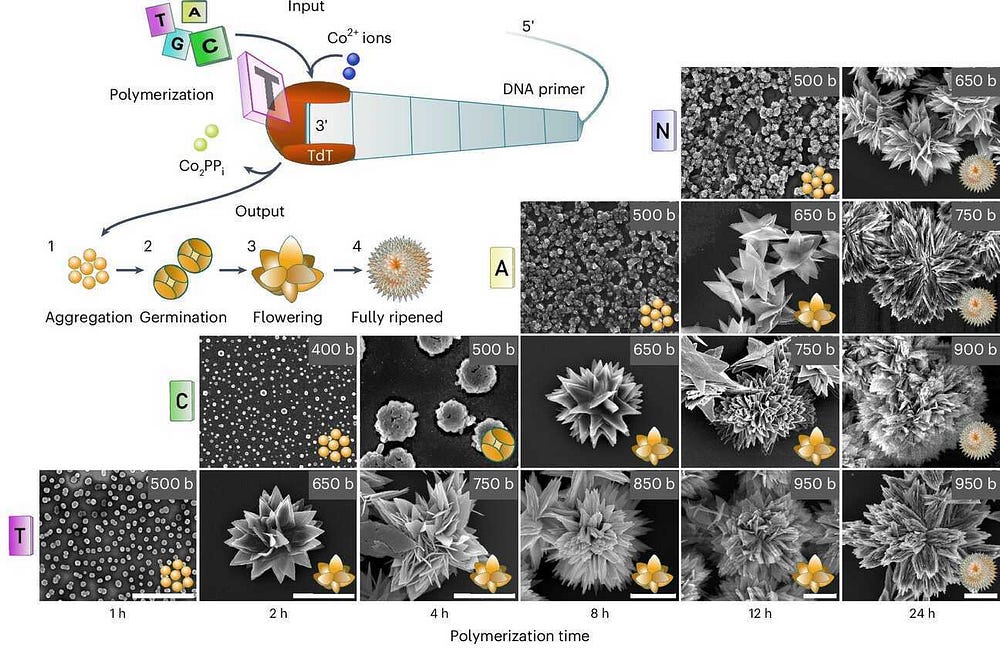
Researchers created shape-shifting DNA nanoflowers, that can open and close in response to their environment. Image credits: Nature.
Bio-Inspired Shape-Shifting Materials
Living systems are masters at turning molecular events into functional shape changes.
Tissues growing into organisms, pinecones closing to protect the seeds, and flowers blossoming when the weather is just right. They all respond to their environment and change shapes.
And scientists have been inspired by nature since, well, forever.
They have tried to replicate biology’s shape-shifting capabilities to create new, bio-inspired materials. They come in lots of varieties, with polymers, hydrogels, and crystals. They can form films or flower-like structures; they can swell, shrink, bend, twist, and fold in response to temperature, light, and pH. So much variety!
But these designs pale in comparison to the complexity and responsiveness of their biological counterparts. It’s simply tough to replicate! Especially when your goal is to go from nanoscale molecular information to microscale shape and function.
DNA: the Perfect Building Block
You know I love DNA.
And it’s the ideal candidate to re-create these responsive systems, spanning nanoscale to microscale. It’s easy to work with, programmable, and it can form structures whose behavior can easily be tuned via their sequences.
But DNA alone is soft; it doesn’t naturally give you enough rigidity, especially at the microscale. The smart move is to combine DNA with inorganic crystals, getting the programmability of DNA with the stiffness of crystalline materials. Similar to bones, teeth, or the cytoskeleton in a cell!
DNA nanoflowers are a type of DNA-organic hybrid nanomaterial. These cool-looking structures form when coupling enzymatic DNA polymerization with inorganic crystallization. The DNA creates a “template” for the crystallization, forming flower-shaped microscale structures that are both programmable and robust.
They have been used for sensing, drug delivery, and bioimaging, but their potential as reconfigurable nanomaterials is still unexplored!
DNA Flowers: Blossoming at the Nanoscale
Introducing today’s paper.
The authors built microscale DNA-inorganic flowers that can reversibly open and close in response to pH. Awesome!
The flowers are formed using TdT, a template-independent polymerase that adds nucleotides to a short DNA primer. While the DNA strands grow, the side products react with cobalt ions in solution to produce crystals that incorporate the DNA in a flower-like shape.
But these are not just pretty structures. They are also extremely programmable.
By simply changing which nucleotides they “fed” to TdT and when, the authors obtained homopolymers (made from a single repeating monomer) or copolymers (more than one type of monomer).
Feed only Ts or Cs, and you get a polyT or polyC polymer. Sequentially add different nucleotides, and you get a block copolymer inside the same flower: T→C or C→T or even T→C→T! The best part is, they all behave differently!
Shape-Shifting Flowers
Okay, so how do the flowers move? The actuation mechanism is contained in the structure-forming sequences. Cool ah?
PolyC-blocks are the pH-responsive elements (T-blocks are inert). At low pH, C-rich regions fold into i-motifs. They act like molecular springs that shorten the DNA polymer and create forces on the inorganic lattice.
So, the idea is:
- pH decreases: The folding of the i-motifs pulls the DNA together.
- pH increases again: The i-motifs relax.
This molecular shortening creates macroscopic changes. The researchers saw two behaviors:
- Shrinking: The area of the whole petal is reduced, while the shape stays similar.
- Bending: The petals curve out of plane.
The coolest part? Which mode occurs depends on the DNA sequence and spatial localization.
When the flowers are formed only by C-blocks, they mostly shrink. And it’s a big change: the flowers are up to 30% smaller at pH 5! The contraction also affects the crystalline structure, with the DNA “pulling” on the external shell. Similar to the cytoskeleton in a cell!
But the system gets more complicated when you mix C- and T-blocks.
If you start with C-blocks and then switch to T-blocks, the pH-responsive C-blocks will be equally distributed across the petal, and this will make it shrink when the pH is lowered.
If you start with T-blocks and continue with C-blocks, the distribution of C-blocks will be uneven between the top and bottom of the petal, making the petal bend, just like real flowers!
So, the order and growth pattern of the blocks at the molecular scale encode the mechanical response at the microscale!
Applications: Enzymes and Invisible Ink
The team didn’t stop to characterize their flowers; they also applied them.
They coupled the shape shift to chemistry in two systems:
- Enzyme compartmentalization and regulation Inspired by how cells activate biochemical pathways in response to shape changes, they immobilized enzymes inside the DNA flowers. Glucose oxidase (GOx) and horseradish peroxidase (HRP) form a reaction cascade, and putting them into different layers creates internal compartments in the flowers. The open/closed state of the flower modulates the reaction rate, and the team observed a 16x increase when the flowers were closed (and they were also more stable).
- Information read/erase The team embedded flowers in gels and used them as invisible (and reusable) “ink”. The closed state drives the formation of color from an enzyme that reveals the printed information; reopening stops the color production, erasing the information!
Strengths, Weaknesses, and Applications
Cool work!
I think this new method has a lot of merits:
- One-pot growth that synthesizes long DNA and crystallizes the inorganic matrix. This removes the need for (expensive) custom DNA or complex assembly. Plus, DNA is biocompatible and versatile! (The crystals a bit less)
- Molecular springs (the i-motif) inside crystals drive mesoscale shape changes. Bridging molecular-scale changes to micrometer-scale output would simplify readout for many applications.
- The system is easy to program, and different building blocks encode different behaviors. Could be useful to automate!
Now, there are limitations:
- The crystallization is based on cobalt. This is not inherently a bad thing, but the biocompatibility of cobalt is complicated.
- The fabrication is quite delicate, depending on timing and kinetics. This could create problems for scaled production, requiring careful control of the process!
- The movement is linked to pH, not the most useful trigger. But with DNA, it’s easy to extend to more useful ones, like light or ligands, so this is more of a promising avenue than a real weakness!
So, this cool work created programmable, reversible, and shape-shifting materials at the interface between DNA nanotech and nanofabrication. Awesome!
The authors highlight that the system could find application in drug delivery and such, but I’m not super convinced. I see simpler ways to use DNA in drug delivery, which especially avoid the use of cobalt.
But I think it could have a bright future in biomanufacturing! The compartmentalized enzymes show not only a higher rate, but they are also more stable, which is always a problem with industrial biotech applications.
Liked this summary? I write one every week. Join Plenty of Room for a readable take on one scientific paper each week!
메타데이터
- post_id
- 428ff4ebff5e
- slug
- dna-flowers-shape-shifting-materials-bloom-with-biomimetic-magic-428ff4ebff5e
- url
- https://medium.com/plenty-of-room/dna-flowers-shape-shifting-materials-bloom-with-biomimetic-magic-428ff4ebff5e
- canonical_url
- https://medium.com/plenty-of-room/dna-flowers-shape-shifting-materials-bloom-with-biomimetic-magic-428ff4ebff5e
- author_url
- https://medium.com/@Marcoplentyofroom
- status
- ok
- fetched_at
- 2026-07-08 21:20:17