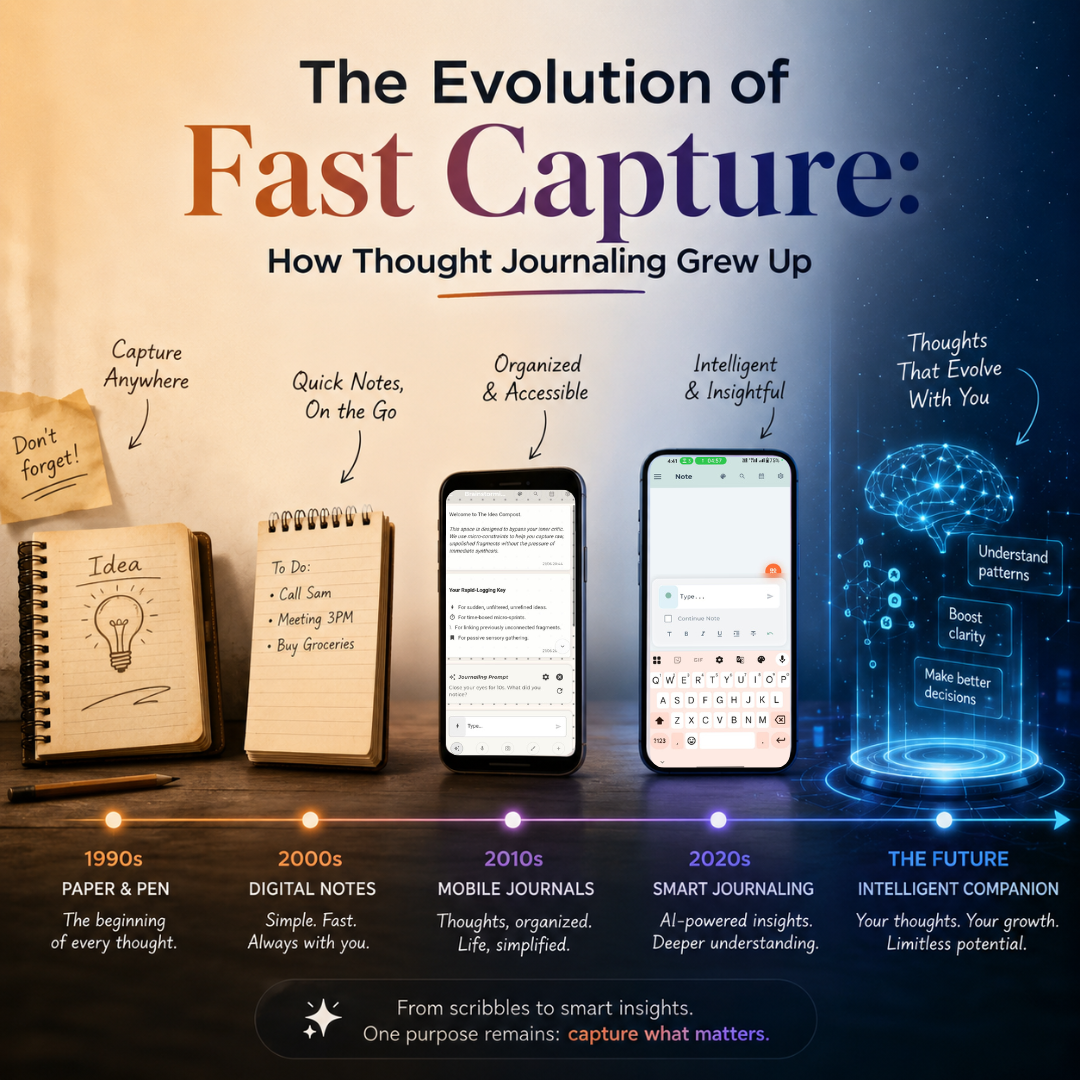
The Evolution of Fast Capture: How Thought Journaling Grew Up.
There is a particular kind of tiredness that has nothing to do with sleep.
The Evolution of Fast Capture: How Thought Journaling Grew Up.
There is a particular kind of tiredness that has nothing to do with sleep.
It is the tiredness of carrying twelve unfinished thoughts at once. A half formed idea from the shower. A name you meant to write down before you forgot it. A feeling you had on the train that you wanted to remember but didn’t have time to explain, even to yourself.
This is not laziness. It is not a focus problem you can fix with a better app icon. It is what fragmented attention actually feels like from the inside: a low hum of things left undone, scattered across notes apps, voice memos, screenshots, and the backs of receipts.
Digital clutter isn’t really about clutter. It’s about cognitive overload. Every unfinished thought takes up a small amount of mental shelf space, and most of us are out of shelf space.
Micro-journaling was never about diaries
Somewhere along the way, journaling got a reputation problem. People hear “journal” and picture a leather notebook, candlelight, and forty minutes you don’t have.
That was never the point of fast capture.
Micro-journaling isn’t diary writing shrunk down. It’s a behavioral interface, a way of meeting your own mind in the two minutes you actually have, before the thought dissolves back into the noise. You write the fragment. You move on. The thought stops costing you attention, because it finally has somewhere to live.
This is the real function of thought capture: not documentation, but relief. The goal was never a beautifully written page. It was an emptied mind.
But here’s where most fast capture tools quietly fail you. They catch the thought, then abandon it. The fragment sits there, flat and disconnected, just another item in a list. You’ve moved the clutter from your head to your phone, but you haven’t actually reduced the friction of living with your own thoughts.
That gap is what this update is built to close.
Think about how a single thought actually behaves in your life. It rarely stays still. It connects to a person, references a document, arrives with a feeling attached, and sometimes needs to leave the app entirely to be useful somewhere else. A tool that only captures the words misses almost everything that made the thought worth having.
Reducing the friction between a thought and the world
Most internal friction doesn’t come from having too few thoughts. It comes from how disconnected they are from everything else: the people in them, the documents that explain them, the context that gave them meaning in the first place.
A few updates to **Penso** are aimed directly at that gap.
People, made findable. When you mention someone in an entry, that mention now becomes a thread you can follow. A passing thought about a conversation with your sister stops being a stray sentence and becomes part of a searchable history of your relationship with her. Months later, you can find every moment she shows up in your thinking, not because you organized it, but because you simply wrote it down at the time. Fast capture turns into something closer to memory.
Attachments, kept in place. Thoughts rarely arrive alone. They come with a PDF you were reading, a document someone sent you, a file that explains exactly why this idea mattered. Previously, that context lived somewhere else: another app, another tab, another place your attention had to travel to. Now it lives inside the entry itself. The thought and its evidence stay together, the way they were together in your mind when you had them.
Custom headers and footers, for an emotional touch. Not every entry needs decoration. But some moments deserve a small mark of intention, a header that signals “this one mattered,” a footer that closes a thought the way you’d close a letter. It’s a small feature with an outsized effect: it makes an entry feel less like a database row and more like something you meant to write.
Export to PDF, for entries that outlive the app. A thought you capture today might be something you want to hold in your hands later: printed, shared with a therapist, saved outside any platform entirely. Export gives your entries permission to leave the app and become something durable. Your digital memory was never meant to be trapped behind a login screen.
Jump to top, jump to bottom, and faster loading. These sound like small things. They are not. Every extra second of scrolling, every moment of waiting for a page to load, is friction between you and the thought you’re trying to retrieve or release. A lower friction system isn’t flashy. It’s just quiet enough to stay out of your way.
Why this matters more than it sounds like it should
None of these are features in the way a spreadsheet has features. They are reductions in friction, and friction is the real enemy of mental clarity.
Every time you have to search across three apps to remember why an idea mattered, you pay a small cognitive tax. Every time a thought about a person gets lost because it wasn’t linked to anything, you lose a piece of your own history. Every time an entry feels disposable instead of intentional, you’re a little less likely to trust it with the things that actually matter to you.
Cognitive relief isn’t about having less to think about. It’s about having somewhere reliable to put what you’re already thinking, so your mind doesn’t have to keep holding onto it just in case.
There’s a reason unfinished thoughts feel heavier than finished ones. An unfinished thought is still asking something of you. It wants to be remembered, connected, or resolved, and until it gets that, some part of your attention stays quietly assigned to it. Multiply that by the dozens of fragments most of us carry on an average day, and the exhaustion stops being mysterious. It’s not that you’re thinking too much. It’s that too many of your thoughts never got anywhere to finish.
That’s the real shift here. Not more functionality, but less internal noise. Not a better tool, but a quieter one.
A natural home for your thoughts
You don’t need a new productivity system. You need somewhere your unfinished thoughts can land without becoming one more thing to manage.
That’s what fast capture was always supposed to be: not a habit you maintain, but a place that’s simply there when your mind needs to set something down.
Penso isn’t asking you to journal more. It’s offering a quieter place for the thinking you’re already doing, one fragment at a time.
Want to learn more?
Join now and start your digital journaling journey today: https://www.penso-notes.com/digital-journaling-blog
메타데이터
- post_id
- 429dbff987be
- slug
- the-evolution-of-fast-capture-how-thought-journaling-grew-up-429dbff987be
- url
- https://medium.com/@penso-notes/the-evolution-of-fast-capture-how-thought-journaling-grew-up-429dbff987be
- canonical_url
- https://medium.com/@penso-notes/the-evolution-of-fast-capture-how-thought-journaling-grew-up-429dbff987be
- author_url
- https://medium.com/@penso-notes
- status
- ok
- fetched_at
- 2026-07-22 20:11:34