Naive Bayes
The surprisingly strong baseline machine learning model with an unflattering name and false pretenses
Naive Bayes
The surprisingly strong baseline machine learning model with an unflattering name and false pretenses

Calling a model “naive” makes it sound like something you should quickly outgrow: a toy algorithm from an introductory course, useful for homework but not much else.
Naive Bayes is simple, yes. But it is also fast, interpretable, probabilistic, surprisingly effective, and one of the best baseline models you can reach for, especially when working with text, categorical features, high-dimensional sparse data, or problems where you need something that works before you build something more complex. It has powered spam filters, document classifiers, sentiment models, medical triage systems, recommendation pipelines, and countless internal classification tools.
The word “naive” actually refers to the algorithm’s core assumption that all features are conditionally independent of each other given the class label. This assumption is almost always false in the real world. Words in a sentence are related. Symptoms in a patient are related. User behaviors are related. Product attributes are related. And yet, Naive Bayes often performs shockingly well.
As a college professor once told me: “Even when its core condition is factually incorrect, somehow it just works.” That tension is what makes it interesting.
In this post, we’ll look at where Naive Bayes comes from, how it uses Bayes’ theorem, what the “naive” assumption really means, why it works so well in complex real-world cases, its main variants, its strengths and weaknesses, and why it is still one of the best baseline models in machine learning.
The Big Picture
Naive Bayes is a probabilistic classifier: given input features, it estimates the most likely class. We usually write this as:

Naive Bayes calculates the probability of class y given the observed features x.
For example:

or:

or:

Naive Bayes uses Bayes’ theorem to flip the problem around. Instead of directly asking: “Given these words, what is the probability this email is spam?” We ask: “If this email were spam, how likely would these words be?” and “If this email were not spam, how likely would these words be?” We then combine those likelihoods with the prior probability of each class.
To summarize: Naive Bayes classifies by asking which class would have been most likely to generate the evidence we observed.


The model is simple, but the implications are deeper than they first appear.
Part 1: Where Naive Bayes Comes From
Bayes’ Theorem
Naive Bayes is built on Bayes’ theorem, named after Thomas Bayes, an 18th-century statistician and minister. Bayes’ work was published posthumously in 1763 in an essay about reasoning under uncertainty. The basic idea was later extended and popularized by Pierre-Simon Laplace, who developed many of the foundations of Bayesian probability.
In machine learning notation, we usually write Bayes’ Theorem as:

Where:
- P(y|x) is the posterior probability of class y after observing features x
- P(x|y) is the likelihood of observing features x if the class is y
- P(y) is the prior probability of class y
- P(x) is the evidence, or overall probability of observing the features
Bayes’ theorem gives us a formal way to update beliefs when we see evidence: before seeing the email, we might know that 20% of emails are spam. After seeing words like “free,” “winner,” and “urgent,” we update our belief accordingly. That updated belief is the posterior.
From Bayesian Reasoning to Naive Bayes
Naive Bayes became especially popular in text classification and information retrieval because it handles large numbers of sparse features very efficiently.
A vocabulary might contain 50,000 possible words. Each document contains only a small subset of them. Most feature values are zero. That is exactly the kind of setting where many models struggle, but Naive Bayes can be surprisingly effective.
Historically, Naive Bayes became closely associated with spam filtering, document classification, and early natural language processing systems. Before deep learning, before transformers, and before massive pretrained language models, Naive Bayes was a standard tool for classifying text. Even today, it remains a strong baseline. Not because it is the most powerful model, but because it is simple, fast, and often much better than you would expect.
Part 2: Bayes’ Theorem for Classification
The Classification Goal
In classification, we want to choose the most likely class given features 𝑥. In other words, we choose the class 𝑦 with the highest posterior probability.

Using Bayes’ theorem, we derive the following formula:

We can simplify this even more because P(𝑥) does not depend on the class (it acts as a normalizing constant here). For every possible class, the observed features 𝑥 are the same. In other words, we don’t need to include it in the formula.

The solution now becomes: pick the class that was common enough beforehand (P(y)) and makes the observed evidence most likely (P(x|y)). Knowing the most common class requires knowing the priors, and the most likely class based on a set of features is called the posterior.
This is only possible because of our “naive” assumption, and by extrapolating the above formula to multiple features, we derive the core function of this model:
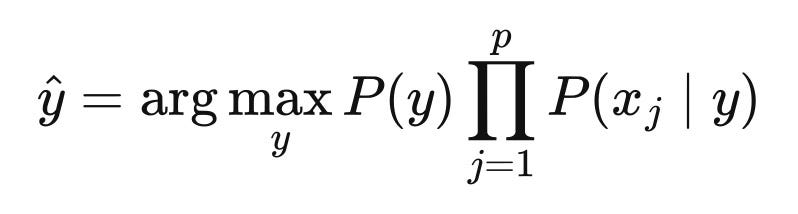
Using prior probabilities makes it unlikely to predict future probabilities precisely, yet the model has proven highly effective at making correct predictions. A model of this architecture is highly inefficient at making predictions with a vast number of features, but the naive assumption turns one impossible problem into many small, manageable problems.
The elevator pitch for Naive Bayes would be: it accepts a wrong independence assumption in exchange for a model that is simple, fast, and data-efficient.
Why We Use Logs
In real problems, we may multiply thousands of small probabilities together. That can cause numerical underflow, where the numbers become too tiny for a computer to represent accurately. So instead of multiplying probabilities, we usually add log probabilities. Thus, the decision rule becomes:

This works because logarithms turn multiplication into addition. The class with the largest product also has the largest log product. Using logs makes the computation more stable and usually easier to implement.
Part 3: Smoothing
One weakness of using word occurrences as features in a Naive Bayes model is that if a word never appeared in a given class during training, its likelihood for that class is zero. Since the model multiplies the per-word likelihoods together, that single zero forces the entire class probability to zero at inference.
The solution? Smoothing. A method used to pretend every word has been seen a small number of times, so no probability is exactly zero at inference. The result is a much more robust Naive Bayes model.
Laplace Smoothing
The most common smoothing method is Laplace smoothing, also called add-one smoothing. It looks like this:

Where:
- count(w, y) is the number of times word w appears in class y
- V is the vocabulary size
- α is the smoothing parameter
1 is a common value for α. If α is smaller than 1, smoothing is weaker.
Part 4: Main Types of Naive Bayes
Up until now, we have been discussing Naive Bayes as a singular model, but there are several variants, each designed for a different kind of feature. Below are a few of the most common variants.

Part 5: Why Naive Bayes Works Surprisingly Well
The Assumption Can Be Wrong, But the Ranking Can Be Right
The most important thing to understand is that Naive Bayes does not need perfect probability estimates to classify well. It only needs the correct class to get the highest score. The probabilities may be poorly calibrated, the independence assumption may be wrong, but if the evidence still points more strongly toward the right class than the alternatives, the classifier can work.
This is why Naive Bayes can succeed in messy, correlated, high-dimensional settings. It is often good enough at ranking classes, even when it is not perfect at estimating probabilities.
Other Strengths of Naive Bayes
- Text-based features are a perfect use case.
- The model can work well with relatively small training datasets. Because it makes such a strong independence assumption, it has far fewer quantities to estimate than a more flexible model.
- The model is adept at handling high-dimensional sparse features. The model can train faster than other models in this case because it does not need to learn interactions between every pair of features.
- It’s a great first baseline model (fast to train, easy to implement and explain, yet strong enough to reveal signal).
Final Thoughts
Naive Bayes is a simple model, but it is not trivial. It is built on one of the most important ideas in probability: Bayes’ theorem. It combines priors with evidence.
It makes a strong assumption of independence to turn an impossible probability estimation problem into a practical classifier. That assumption is usually wrong. And still, the model often works.
Especially in text classification, high-dimensional sparse data, and early-stage modeling, Naive Bayes can be shockingly competitive. Its probabilities may be imperfect. It may miss interactions. It may be too simple for the final production system. But that does not make it useless. It makes it an excellent baseline.
A good baseline should be fast, interpretable, and strong enough to keep more complex models honest. Naive Bayes does exactly that. So despite the name, there is nothing naive about understanding when and why this model works.
A quick note: we moved quickly through Bayesian probability, smoothing, text classification, calibration, and different Naive Bayes variants. Each of these can be explored in greater depth, especially the distinction between generative and discriminative models. The main takeaway is this: Naive Bayes works by combining many small pieces of evidence, and sometimes that simple strategy is much stronger than it has any right to be.
메타데이터
- post_id
- 42ca0a3d4d4b
- slug
- naive-bayes-42ca0a3d4d4b
- url
- https://medium.com/@jonathansamuelklinger/naive-bayes-42ca0a3d4d4b
- canonical_url
- https://medium.com/@jonathansamuelklinger/naive-bayes-42ca0a3d4d4b
- author_url
- https://medium.com/@jonathansamuelklinger
- status
- ok
- fetched_at
- 2026-06-21 15:33:18





