How Much Fat Do You Need for a Skinny BBL? | Dr. Oliver Chang
Understanding fat availability, candidacy, and realistic expectations for slimmer patients
How Much Fat Do You Need for a Skinny BBL? | Dr. Oliver Chang
Understanding fat availability, candidacy, and realistic expectations for slimmer patients
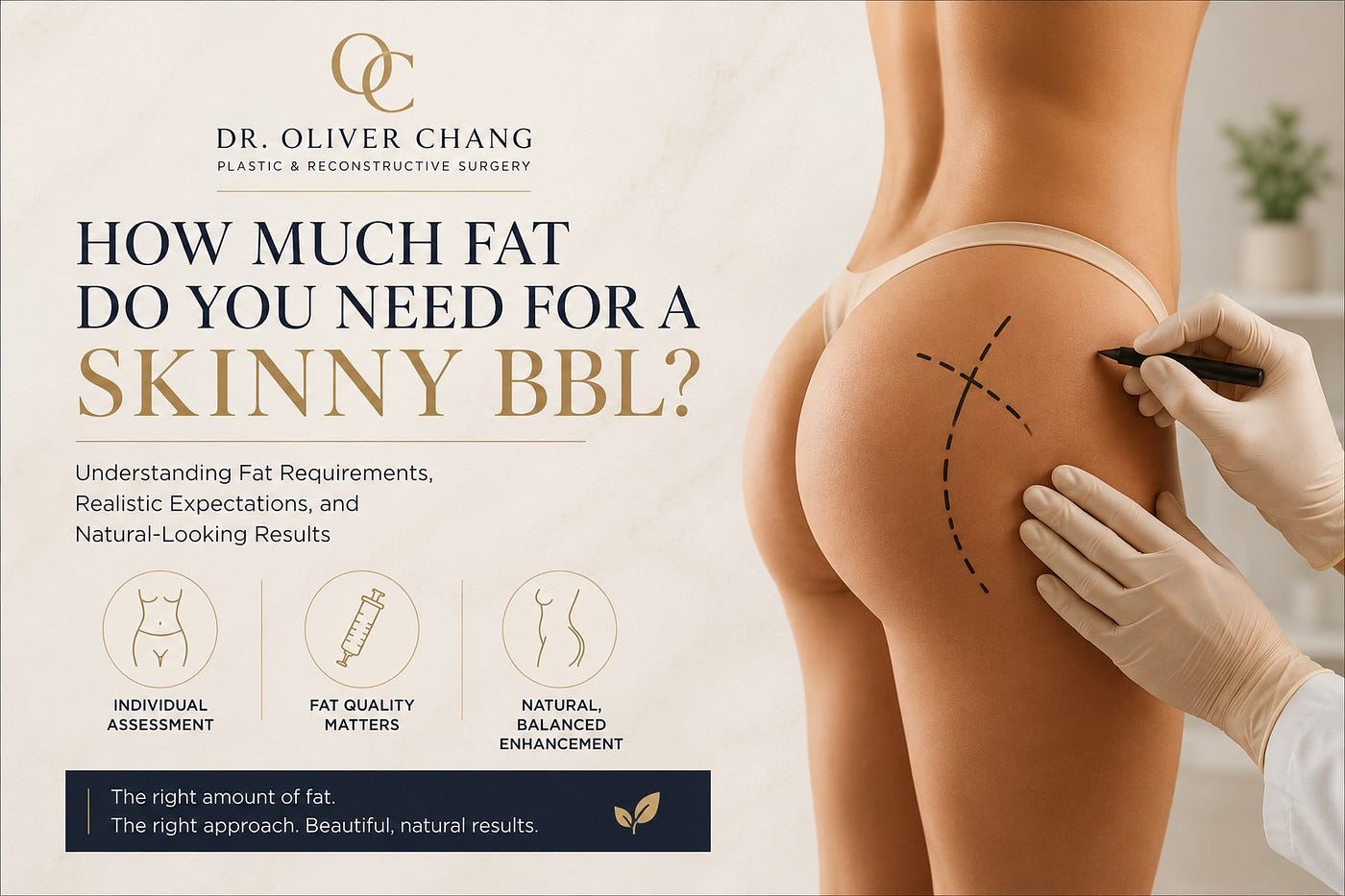
How Much Fat Do You Need for a Skinny BBL? Educational insight from Dr. Oliver Chang in Miami, Florida.
Dr. Oliver Chang is a double board-certified plastic and reconstructive surgeon based in Miami, Florida. Among the many questions patients ask when researching body contouring, one of the most common is how much fat is actually needed for a Skinny BBL. It is a practical question, and for slimmer patients, it is often the first concern. Many people assume that if they do not carry a significant amount of excess body fat, they cannot qualify for a Brazilian Butt Lift at all. In reality, the answer is more individualized. Some slim patients do have enough donor fat for a Skinny BBL, while others may not. The key is understanding that candidacy depends less on a single number and more on body composition, fat distribution, and the type of result the patient hopes to achieve.
A Skinny BBL is generally understood as a Brazilian Butt Lift approach for patients with a leaner body type and more limited donor fat. Like a traditional BBL, it involves liposuction to remove fat from selected areas of the body, purification of that fat, and transfer of the processed fat into the buttocks to improve contour, shape, and projection. What makes it different is not that it is a completely separate procedure, but that the surgical plan must be built around a slimmer frame and often more conservative fat availability. For many patients, that is exactly the point. They are not looking for exaggerated volume. They want a more balanced silhouette, subtle enhancement, and natural-looking results that suit their body.
The first thing to understand is that there is no universal amount of fat that applies to every patient. A Skinny BBL is not based on one standard measurement. Two women can look similarly slim and still have very different donor fat potential. One may have enough fat in the abdomen, flanks, lower back, or thighs to support a meaningful transfer. Another may carry less usable fat in those areas and may not be the ideal candidate for the same type of result. That is why appearance alone is never enough to answer the question. A proper evaluation looks at where fat is stored, how much of it can realistically be harvested, and whether the available amount aligns with the patient’s goals.
This is also where expectations become especially important. The better question is often not just how much fat is needed, but how much fat is needed for the specific result a patient wants. A person who wants subtle improvement in contour may be a very good candidate with a smaller amount of donor fat. A person who wants a much fuller, rounder, or more dramatic change may not be able to achieve that result on a very lean frame using fat transfer alone. In other words, the amount of fat needed depends not only on the body, but on the desired outcome. When anatomy and expectations are aligned, even a modest fat transfer can still create an attractive and noticeable improvement in proportion.
For slimmer patients, one of the advantages of a Skinny BBL is that the overall result is often shaped by more than the transferred fat alone. Liposuction of the waist, flanks, lower back, or other donor areas can significantly improve the surrounding contour. That means the body may look more sculpted and the buttocks may appear more enhanced even when the fat transfer itself is relatively modest. This is why a Skinny BBL is often best understood as a body contouring procedure rather than simply a volume procedure. The final aesthetic effect comes from the relationship between the waist, hips, buttocks, and overall silhouette.
Another important factor is that not all harvested fat is ultimately transferred in the same way. The fat must first be removed carefully, then processed so that the healthiest, most usable fat can be selected. This means that simply having some fat on the body does not automatically translate into a specific volume of transferable fat. Quality and distribution matter, not just quantity. A patient may have enough excess fat to pinch in certain areas, but whether that translates into a meaningful and aesthetically useful transfer depends on how the fat can be harvested and how well it supports the treatment plan.
Patients often search for a shortcut answer through BMI, body weight, or general size, but these do not tell the whole story. BMI can offer limited context, yet it does not show how fat is distributed or whether donor areas are sufficient for a transfer. A woman with a relatively low BMI may still have enough localized fat for a modest Skinny BBL, while another with a similar BMI may not. Weight alone is even less useful, since two people can weigh the same and have very different body composition. This is why surgical candidacy is best determined through a direct assessment rather than through a chart or a formula.
What many slim patients are really asking is whether they have enough fat for the procedure to be worth it. That is a more helpful way to frame the question. In many cases, the answer may be yes, especially if the patient values subtle enhancement rather than dramatic enlargement. A smaller amount of transferred fat can still improve the waist-to-hip transition, soften hip dips, add roundness in selected areas, and create a more balanced look overall. For a naturally lean or athletic patient, that type of refinement may actually be more desirable than a large-volume result that could look out of proportion on the frame.
At the same time, it is important to be realistic about limitations. If there is not enough donor fat to support the patient’s goals, the procedure may not be the right fit in its traditional form. This is why honest consultation matters so much. A good plan is built around what the body can realistically support, not around trend-driven expectations or comparisons to patients with very different body types. Not every slim patient is a candidate, and not every desired result is achievable through fat transfer alone. In aesthetic surgery, the best outcome is usually the one that fits the patient naturally rather than the one that tries to force a body into an unrealistic ideal.
Before and after photos can sometimes help patients understand this point. The most useful photos are usually those that show body types similar to their own. A slim patient should look for examples where the result appears balanced, natural, and proportionate, not simply large. In many of the strongest Skinny BBL results, the improvement is more about contour than about dramatic size increase. That is often what makes the result look elegant and believable. For many patients, that is the goal.
Ultimately, the answer to how much fat is needed for a Skinny BBL is that it depends on the patient’s anatomy, donor areas, and expectations. There is no single number that applies to everyone. Some lean patients have enough fat to support a meaningful and attractive improvement. Others may not. What matters most is not chasing a measurement, but understanding whether the available donor fat can create a result that is safe, balanced, and worthwhile for the individual.
For patients researching this procedure, the most important takeaway is that a Skinny BBL is highly personalized. It is not defined by one number, one body type, or one standard outcome. It is defined by careful planning, realistic expectations, and a thoughtful approach to body contouring. When those elements come together, even a modest amount of donor fat can make a visible difference. For the right patient, that difference may be exactly what they are looking for: a more refined, proportional silhouette that still feels natural to who they are.
For more information about Dr. Oliver Chang in Miami, Florida, including his background and patient-centered approach, visit his official website. You can also read more about Skinny BBL here.
메타데이터
- post_id
- 42e3ebef483d
- slug
- how-much-fat-do-you-need-for-a-skinny-bbl-dr-oliver-chang-42e3ebef483d
- url
- https://medium.com/@oliverchang1990/how-much-fat-do-you-need-for-a-skinny-bbl-dr-oliver-chang-42e3ebef483d
- canonical_url
- https://medium.com/@oliverchang1990/how-much-fat-do-you-need-for-a-skinny-bbl-dr-oliver-chang-42e3ebef483d
- author_url
- https://medium.com/@oliverchang1990
- status
- ok
- fetched_at
- 2026-07-12 00:48:14


