The Health Data You Can’t Buy Back
I have fourteen years of my own Garmin data and an AI agent that predicts my fitness every morning. The most valuable signals are the ones…
The Health Data You Can’t Buy Back
I have fourteen years of my own Garmin data and an AI agent that predicts my fitness every morning. The most valuable signals are the ones I have the least of. Here is why that should worry you, and what to do about it.
Every morning, before I have made coffee, an AI agent reads yesterday’s data off my Garmin, hands it to a model I trained, and tells me my predicted 5K time.
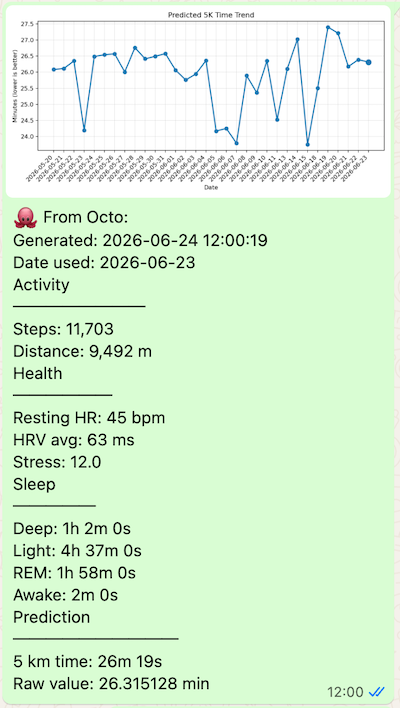
Octo, my OpenClaw AI Assistant, reads my Garmin data daily and predicts my 5km running time
I have not run a proper 5K in months. About four months ago I tore my calf, and what followed was a slow tour of physiotherapy, a moon boot, and the particular humility of being out-walked by people twice my age. I am only now back to easy walking and cycling. So the number my agent gives me every morning is not a forecast of a race I am about to run. It is something more interesting than that.
It is a proxy for my whole body, expressed in a unit I actually feel.
A number you can feel
Here is the problem with health data. Nobody feels anything when their heart rate variability reads 63 milliseconds. Nobody changes their evening when their average overnight respiration ticks up by half a breath. The signals are real, but they are abstract. They do not land.
“Your predicted 5K has drifted from 24:00 toward 26:30” lands. It lands in the gut, because it maps to something I have lived: the feeling of a body that is a little slower, a little heavier, a little less itself.
That is what the model really does. It takes a dozen quiet physiological signals and compresses them into one honest, legible scalar. A translation layer between my data and my intuition. And because it was never really about running, it kept working through every week I could not run a step.
What the model actually looks at
I pulled the feature importance from the model. It does not read like a hack. It reads like a physiology textbook.
The single most important input is basal metabolic rate, the energy my body burns just existing. Then resting heart rate. Then overall daily energy, then heart rate variability, then sleep stress. These are not running metrics. They are baseline-of-the-engine metrics, the slow-moving signals that describe the state of the machine rather than any one workout.
Then there is the detail that stopped me.
The model’s fifth most important feature is not a measurement at all. It is a flag for whether my resting heart rate exists on a given day. The flag for whether HRV exists ranks higher than HRV itself. The model has quietly learned that the absence of a signal is informative, because the presence or absence of a metric tells it which era of watch, and which era of me, it is looking at.
The absence of data is data. Hold that thought, because it is the whole point.
The signal you can never buy back
I exported every day Garmin has ever recorded for me. Fourteen and a half years. Christmas Day 2011 to last month.
Then I plotted the day each signal first appears. Look at it.
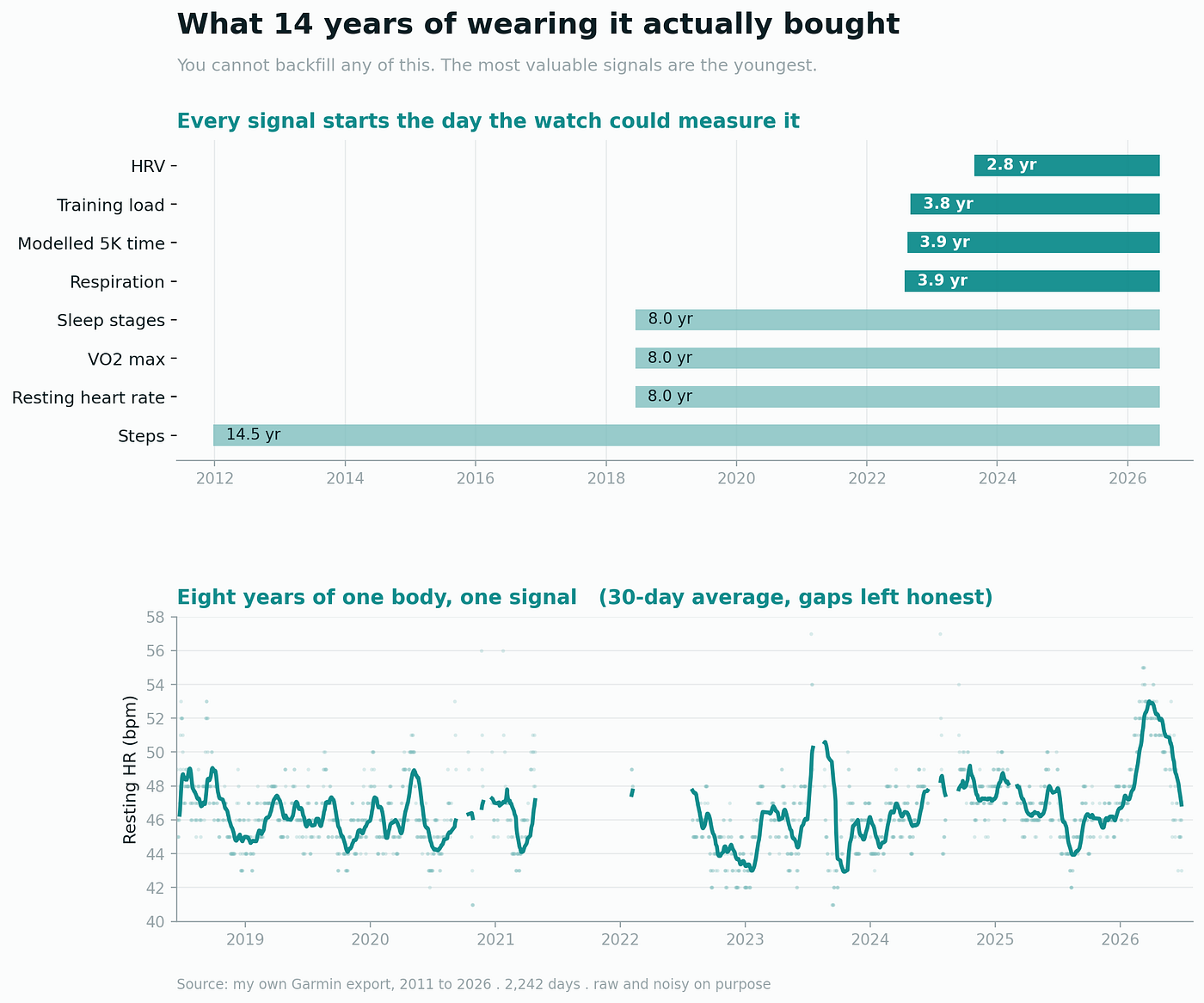
Top: The day each metric first becomes available in my own export. Steps go back to 2011. Resting heart rate, VO2 max and sleep do not start until 2018. The modelled 5K, training load and respiration arrive in 2022. HRV does not appear until August 2023, under three years ago. Bottom: eight years of one resting heart rate, the kind of personal baseline that only exists because the watch was on my wrist the whole time. Source: my own Garmin export, raw and noisy on purpose.
The cascade is the argument. Every signal starts the exact day the hardware could first measure it, and not one day earlier. You cannot backfill a single column. There is no service, no subscription, no amount of money that will sell you your own resting heart rate from 2017 if you were not wearing something that recorded it.
And notice which bars are shortest. HRV, training load, the modelled fitness estimate itself. The most valuable signals are the youngest. The richest data I own is the data I have the least of, because it depends on the newest sensors. Models will only get hungrier for exactly this kind of long, personal, longitudinal record. The one input nobody can manufacture later is time on your wrist.
That is why the missing-data flag matters so much to the model. It is reading the shape of my own history, the staggered moments each part of me became measurable.
The honest part (because it matters)
Here is where most “AI will watch over your health” articles quietly oversell. I am not going to.
So let me be clear about what this is and is not. It is not a medical device. It did not predict my calf tear and it could not have. Acute injuries are mostly mechanical accidents, not slow declines you can see coming on a chart. The value here is not a magic alert on a Tuesday. The value is the trend across years, and the quiet honesty of a baseline long enough to know what normal even means.
And yet. Look at the bottom of that chart again. Across the months I could not train, my resting heart rate drifted up from its usual low forties into the low fifties. Then, in the last few weeks, as I got back to walking and cycling, it turned and started coming home, while my HRV climbed back from the mid-fifties toward the low sixties. The decline and the recovery, both written into the data without my typing a single word. The signal arrives whether or not I am paying attention. That is the actual case for ambient monitoring, and it is a much more modest and more truthful case than the one usually made.
Why this needs infrastructure
Here is the gap. Garmin gives me a number. It does not give me a model trained on me. The watch is a superb sensor and a mediocre oracle, because the oracle it ships is trained on everyone, and I am not everyone. I am fourteen years of one specific body.
The future I actually believe in is not an assistant that watches over you like a guardian angel. It is far more practical than that. It is the ability to point an agent at your own data and have it build a model that is yours, in seconds, with no data science team and no cluster. A model that turns your decade of quiet measurement into one legible number you can finally act on.
That is the same thread I keep pulling on. AI agents are about to manage everything, and sooner or later every one of them will need to predict, not just retrieve. The same pattern is everywhere: warehouses, clinics, trading systems, factories, energy grids. Sensors collect the history, agents need the predictions, and the missing layer is the model in between. Your health is simply the most personal version of that problem. The infrastructure to turn any dataset, including the one on your wrist, into a live model is exactly what we are building at JITM.ai.
So, one piece of advice
Wear the watch. Any watch. Start the clock today, even if you have no idea what you will do with the data, because the collection is nearly free, the asset compounds, and the one thing you can never do is go back and start in 2018.
Four months ago I tore my calf. I am back to walking and cycling now, and my data holds the whole of it: the months my resting heart rate drifted the wrong way, and the last few weeks where it has started coming home. That is fourteen years of myself, measured. When the models are ready, and they are getting ready fast, that is the only thing none of us can buy back.
If you have a genuinely hard prediction problem, on health data or anything else, I would like to hear about it. JITM.ai is currently invite only. Reach me at hello@jitm.ai.
Simon Allen, founder, JITM.ai
메타데이터
- post_id
- 4304b2dbf0cd
- slug
- the-health-data-you-cant-buy-back-4304b2dbf0cd
- url
- https://medium.com/@si.allen/the-health-data-you-cant-buy-back-4304b2dbf0cd
- canonical_url
- https://medium.com/@si.allen/the-health-data-you-cant-buy-back-4304b2dbf0cd
- author_url
- https://medium.com/@si.allen
- status
- ok
- fetched_at
- 2026-07-09 13:13:48