Engagement by Design
How we built a culture of continuous learning at Fortnox
Engagement by Design
How we built a culture of continuous learning at Fortnox
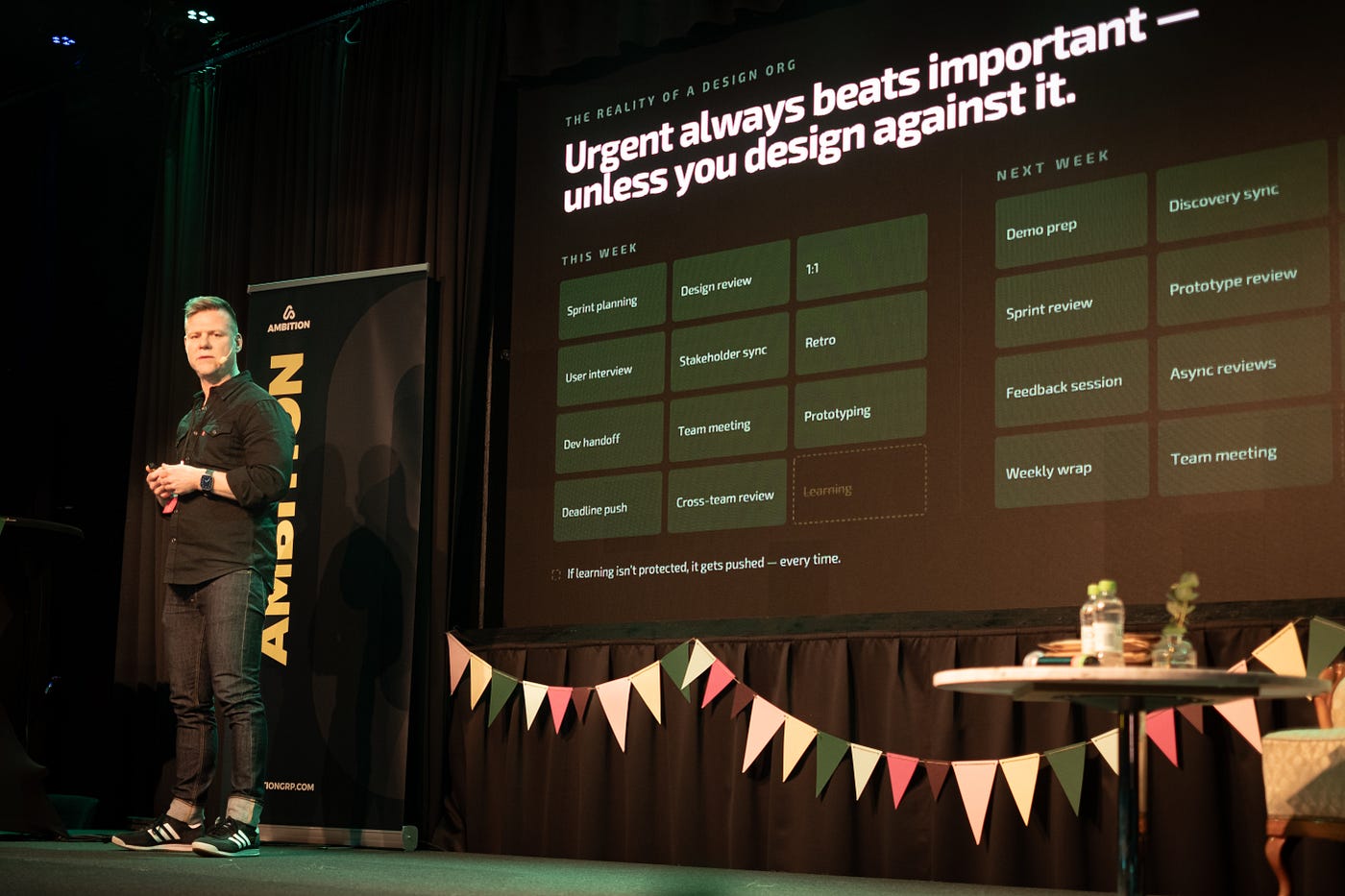
Earlier this year I spoke at Ambition Conference, where the design organization I lead at Fortnox was awarded the Ambition Award for Most Engaged Team. This article is based on that talk. Here’s what we actually did to build a learning culture across 60 designers, and what we learned along the way.
I’ve been quite passionate about continuous learning for a long time. Throughout my career, wherever I’ve worked, I’ve tried to incorporate it into the way I work. Both for myself and for the people around me. I believe that the old way of doing this by attending a course or going to a conference once a year, is far from enough to keep up. Not that there´s anything wrong with either courses or conferences. They’re great! But I believe that you also need to find ways to embed learning into the way you work.

At Fortnox, I lead a design organization of around 60 people spread across 14 teams. And we’re enrolled in a continuous learning program called Ambition Empower. It’s a program that is a mix of curated content you consume and live sessions, everything built around topics and the idea that you should spend 1 hour each week on your learning.
That program provides us with a great structure for continuous learning, but like most organizations, we struggle to keep the engagement up. Engagement is high at the start and then it slowly fades. It’s so easy to skip learning when other things feel more urgent.
So our big challenge was to make continuous learning stick over time. But it’s hard because learning is one of those things that seldom feels urgent. The immediate cost of skipping learning is near zero. But the compounding effect over time is that you lag behind, and then slowly become irrelevant and eventually maybe even unemployable.
To make it stick, you actively need to make space for growth. But how do you do that? How do you build something that works across teams, roles, and different starting points?
Engagement as a Design Problem
I strongly believe that high engagement isn’t a personality trait. It’s something that you can achieve by creating the right circumstances for it to flourish. So to build engagement around continuous learning, we treated it as a design problem to solve. That led us to 5 design decisions that have changed the way we learn as a team at Fortnox.

Decision 1: Start with a map
Before we could design for learning, we needed to understand where people actually were. So we did a skill mapping across all our designers. A structured exercise where each designer, together with their closest manager, assessed their current strengths and mapped out the direction they wanted to grow.
It gave us two things. A shared picture of where we were strong, where we had gaps, and where people were most hungry to grow. And for each designer, something more personal, a clearer sense of their own direction. A plan that shapes which topics they choose to study. Learning stops being a random pick from a menu and becomes something that connects to where you actually want to go.
Decision 2: Say it out loud
This was the simplest decision, and possibly the most underestimated. I bring up learning at every monthly meeting. As a clear signal that it’s something that we care about as an organization. I also bring it into the conversations I have with design managers, both in shared leadership meetings and in 1-on-1s. Because it’s not enough that I think that continuous learning is important. The people closest to the designers need to own it too.
Culture is shaped by what leaders talk about consistently. If I only mention learning when we launch a new program, it feels like a campaign and is soon forgotten. But if I mention it every month. It becomes part of how we think about ourselves.
Decision 3: Protect the time
To make time for learning, we booked one hour every week in everyone’s calendar. Every Thursday at three o'clock, it’s Empower Hour. Because the single biggest barrier to continuous learning isn’t motivation. It’s time, or more precisely, the feeling that there’s never a good time. There’s always a deadline, always a meeting, always something more urgent.
But I want to be honest here. Booking the time doesn’t solve everything. Getting designers to consistently show up has been one of our harder challenges. The calendar block is necessary, but it’s not enough. So the next two decisions are what make people actually want to use it.
Decision 4: Make learning visible
This decision came from a simple insight. Learning is more likely to happen when it’s visible. So we created a shared FigJam board with the full learning schedule. Each designer marks which topic they’re studying.

This system is really simple. But the effect is significant. You can instantly see who else is learning the same topic. Learning stops being lonely; instead, you’re learning in parallel with colleagues.
Visibility creates accountability and curiosity. When your colleagues can see what you’re working on, and you can see what they’re studying, it creates a quiet pull toward participation.
Decision 5: Close the loop — together
The first four decisions get learning started. But without this last one, knowledge stays with the individual. It doesn’t spread. It doesn’t get challenged. It doesn’t become part of how the team thinks.
So we made reflection mandatory. At the end of each topic, everyone who studied the same subject comes together to reflect.
These sessions bring together designers from completely different teams, all reflecting on the same topic but from very different perspectives. The conversations that come out of that are some of the richest we have. It builds bridges across the organization and helps us move toward a more coherent whole.
This last step is where individual learning becomes collective intelligence.
The principle underneath it all
Learning programs fail for predictable reasons. They’re voluntary, so they get deprioritized. Invisible, so there’s no shared momentum. And lonely, because people are doing it disconnected from the people around them.
What we’ve built is the opposite. Learning at Fortnox is expected, visible, and social. The structures do the heavy lifting, not individual motivation, not good intentions.
When you get those three things right, something shifts. People don’t just learn more. They show up differently.

High engagement doesn’t happen by itself. It’s designed deliberately, or it doesn’t happen at all.
메타데이터
- post_id
- 43116a01defd
- slug
- engagement-by-design-43116a01defd
- url
- https://medium.com/fortnox-design/engagement-by-design-43116a01defd
- canonical_url
- https://medium.com/fortnox-design/engagement-by-design-43116a01defd
- author_url
- https://medium.com/@svennerberg
- status
- ok
- fetched_at
- 2026-06-28 04:42:08



