How CVE-2026–43503 Revives the “Dirty” Vulnerability Family and What Every Linux Administrator…
For years, Linux administrators have trusted the kernel’s memory management mechanisms to enforce one of the most fundamental security…
How CVE-2026–43503 Revives the “Dirty” Vulnerability Family and What Every Linux Administrator Should Do Today
For years, Linux administrators have trusted the kernel’s memory management mechanisms to enforce one of the most fundamental security guarantees:
Unprivileged users should never be able to modify protected files or become root.
Yet history keeps reminding us that seemingly tiny mistakes inside the kernel can completely undermine that assumption.
We saw:
- Dirty COW
- Dirty Pipe
- Copy Fail
- DirtyFrag
Now, security researchers have uncovered DirtyClone (CVE-2026–43503), another privilege escalation vulnerability that allows a local user to obtain full root privileges by abusing cloned network packets inside the Linux networking stack. The flaw has a CVSS score of 8.8 and affects modern Linux kernels lacking the upstream fix. Public proof-of-concept research has already been published, making rapid patching especially important.
Unlike traditional memory corruption bugs, DirtyClone doesn’t rely on race conditions or heap spraying.
Instead, it exploits a subtle logic error.
And those are often the hardest vulnerabilities to discover.
The Evolution of the “Dirty” Family
Linux has experienced several high-profile privilege escalation vulnerabilities based on page cache corruption.
VulnerabilityYearRoot CauseDirty COW2016Copy-on-write race conditionDirty Pipe2022Page cache reference corruptionCopy Fail2026AF_ALG zero-copy write issueDirtyFrag2026ESP/RxRPC networking page corruptionDirtyClone2026Missing shared-fragment metadata during packet cloning
Each vulnerability follows a familiar pattern:
User Process
      │
      ▼
Kernel Subsystem
      │
      ▼
Unexpected write into Page Cache
      │
      ▼
Protected File Modified
      │
      ▼
Privilege Escalation
DirtyClone continues this lineage by exploiting the Linux networking subsystem rather than a race condition or cryptographic interface.
What Exactly is DirtyClone?
DirtyClone is tracked as:
CVE-2026–43503
Severity:
CVSS 8.8 (High)
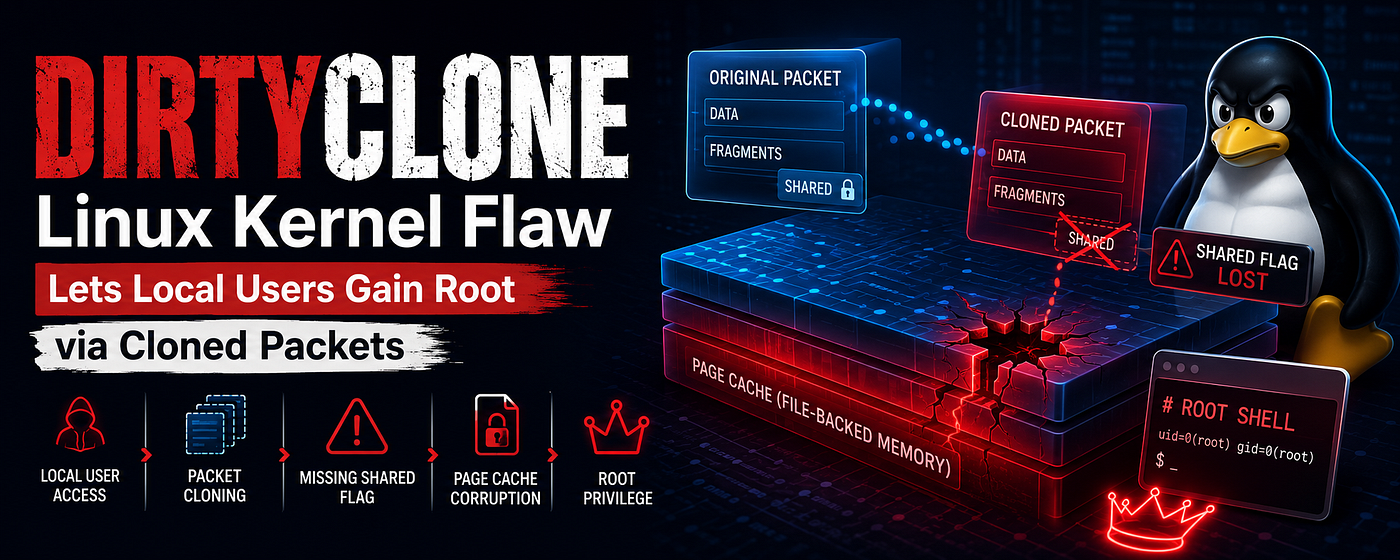
The vulnerability exists because two Linux kernel helper functions that clone or transfer packet fragments fail to preserve a safety flag indicating that the packet memory is shared with a file-backed page.
During packet cloning, the kernel should preserve metadata indicating shared fragments. Instead, the relevant helper functions drop the SKBFL_SHARED_FRAG marker. Later networking operations incorrectly treat those fragments as safe for in-place modification, enabling writes into file-backed page cache memory.
Understanding the Page Cache
Linux does not constantly read files directly from disk.
Instead:
Disk
 │
 ▼
Page Cache
 │
 ▼
Applications
The page cache dramatically improves performance.
Multiple processes may share identical cached pages.
Normally:
Read-only file
        │
        ▼
Shared Page Cache
        │
        ▼
Nobody may modify it
DirtyClone breaks this guarantee.
Where the Bug Lives
The issue exists in the Linux networking stack.
Specifically during:
- packet cloning
- fragment movement
- socket buffer manipulation
Researchers found that helper routines responsible for transferring fragments between socket buffers fail to copy a critical shared-fragment flag. As a result, later operations assume exclusive ownership and overwrite memory that actually maps to cached file pages.
Conceptually:
Original Packet
      │
      ▼
Clone Packet
      │
      ▼
Shared flag LOST
      │
      ▼
Kernel thinks:
"This memory is private."
      │
      ▼
Memory modified
      │
      ▼
Actually modifies page cache
Why This is Dangerous
Once page cache corruption becomes possible, attackers gain enormous power.
Potential targets include:
/usr/bin/su
/usr/bin/passwd
sudo
setuid binaries
authentication libraries
Instead of modifying files on disk:
Disk File
      │
      ▼
Page Cache
      ▲
      │
DirtyClone writes HERE
The file on disk appears untouched.
Traditional integrity tools may therefore miss the attack because the corruption resides in cached memory rather than the underlying file.
Simplified Attack Flow

Unprivileged User
        │
        ▼
Create crafted packet
        │
        ▼
Kernel clones packet
        │
        ▼
Shared flag disappears
        │
        ▼
Page cache becomes writable
        │
        ▼
Modify privileged binary
        │
        ▼
Execute binary
        │
        ▼
ROOT SHELL
No kernel exploit chain.
No ROP.
No race conditions.
Just a clever abuse of metadata.
Why Containers Should Pay Attention
Container environments are especially interesting.
Imagine:
Host
 ├── Container A
 ├── Container B
 └── Host Kernel
Containers share the host kernel.
If an attacker gains code execution inside a container and the environment permits the required kernel interactions, a successful local privilege escalation could compromise the host. The practical risk depends on kernel version, namespace configuration, capabilities, and other hardening controls.
Why Logic Bugs Are So Difficult
Most kernel vulnerabilities involve:
- buffer overflows
- use-after-free
- double free
- integer overflow
DirtyClone is different.
Nothing crashes.
Nothing overflows.
Instead:
Metadata
     ▼
One missing bit
     ▼
Wrong assumption
     ▼
Privilege escalation
These bugs are exceptionally difficult to detect because every individual operation appears valid.
The Patch
The upstream fix is remarkably small.
Instead of rewriting major networking components, kernel maintainers ensured the shared-fragment marker is propagated correctly during fragment transfer, preventing later code from treating shared file-backed pages as private memory.
Sometimes:
One missing flag
=
One root exploit
Detecting Exposure
Determine your kernel version:
uname -rCheck distribution advisories.
Examples:
apt update
apt list --upgradable
dnf updateinfo
yum updateinfo
zypper lp
Enterprise distributions frequently backport fixes, so the kernel version alone may not reveal whether the system is protected.
Mitigation Checklist
1. Patch Immediately
Kernel updates are the definitive remediation.
Do not rely solely on reboot schedules.
2. Restrict Local Access
DirtyClone requires local code execution.
Limit:
- SSH access
- shared accounts
- developer shells
- unnecessary sudo permissions
3. Harden Containers
Avoid:
--privilegedLimit:
- namespaces
- capabilities
- host networking
- unnecessary kernel interfaces
4. Enable Mandatory Access Controls
Use:
- SELinux
- AppArmor
While they do not eliminate kernel bugs, they can reduce post-exploitation opportunities.
5. Monitor Kernel Advisories
Subscribe to:
- vendor security advisories
- Linux mailing lists
- CISA alerts
- distribution update feeds
Kernel vulnerabilities continue to evolve rapidly.
Lessons for Platform Engineers
DirtyClone reinforces several enduring lessons:
Security Isn’t Just Memory Safety
Logic errors can be every bit as dangerous as classic memory corruption.
Metadata Matters
One dropped flag can invalidate an entire security boundary.
Zero-Copy Optimizations Need Careful Review
Performance optimizations that avoid copying memory must preserve ownership semantics and safety metadata.
Containers Are Not Security Boundaries
Containers isolate workloads, not kernels.
Kernel privilege escalation vulnerabilities can therefore threaten every workload sharing the same host kernel.
Final Thoughts
DirtyClone reminds us that Linux security isn’t only about preventing spectacular crashes.
Sometimes the most dangerous bugs are almost invisible:
- no race condition
- no heap corruption
- no segmentation fault
- no kernel panic
Just one forgotten metadata flag.
That single omission can transform an ordinary user into root.
For organizations running Kubernetes, cloud platforms, CI/CD runners, multi-user servers, or shared Linux infrastructure, this vulnerability is another reminder that kernel patch management is a foundational security control, not a maintenance task to postpone. As exploit techniques evolve, timely updates remain one of the most effective defenses against local privilege escalation.
Linux #CyberSecurity #LinuxKernel #KernelSecurity #CVE #CVE2026 #DirtyClone #InfoSec #CloudSecurity #Kubernetes #DevSecOps #PlatformEngineering #SRE #LinuxAdmin #OpenSource #ThreatIntelligence #SecurityResearch #PrivilegeEscalation #RootAccess #InfrastructureSecurity #CloudNative #ContainerSecurity #RedTeam #BlueTeam #ApplicationSecurity #CyberDefense #EthicalHacking #SecurityEngineering #TechLeadership #Medium
메타데이터
- post_id
- 433f39bcd7f4
- slug
- how-cve-2026-43503-revives-the-dirty-vulnerability-family-and-what-every-linux-administrator-433f39bcd7f4
- url
- https://medium.com/aegisops/how-cve-2026-43503-revives-the-dirty-vulnerability-family-and-what-every-linux-administrator-433f39bcd7f4
- canonical_url
- https://medium.com/aegisops/how-cve-2026-43503-revives-the-dirty-vulnerability-family-and-what-every-linux-administrator-433f39bcd7f4
- author_url
- https://medium.com/@cloudsignal
- status
- ok
- fetched_at
- 2026-07-09 05:26:43