Pisa Cathedral - The Marble Heart of Piazza dei Miracoli
The Cathedral of Santa Maria Assunta, also known as Pisa Cathedral or the Duomo di Pisa, is the spiritual center of Piazza dei Miracoli. It…
Pisa Cathedral - The Marble Heart of Piazza dei Miracoli
The Cathedral of Santa Maria Assunta, also known as Pisa Cathedral or the Duomo di Pisa, is the spiritual center of Piazza dei Miracoli. It stands between the Baptistery of San Giovanni and the Leaning Tower of Pisa, forming the core of one of Europe’s most famous medieval architectural ensembles. Although the tower attracts much of the attention, the cathedral is the main religious building of the square.
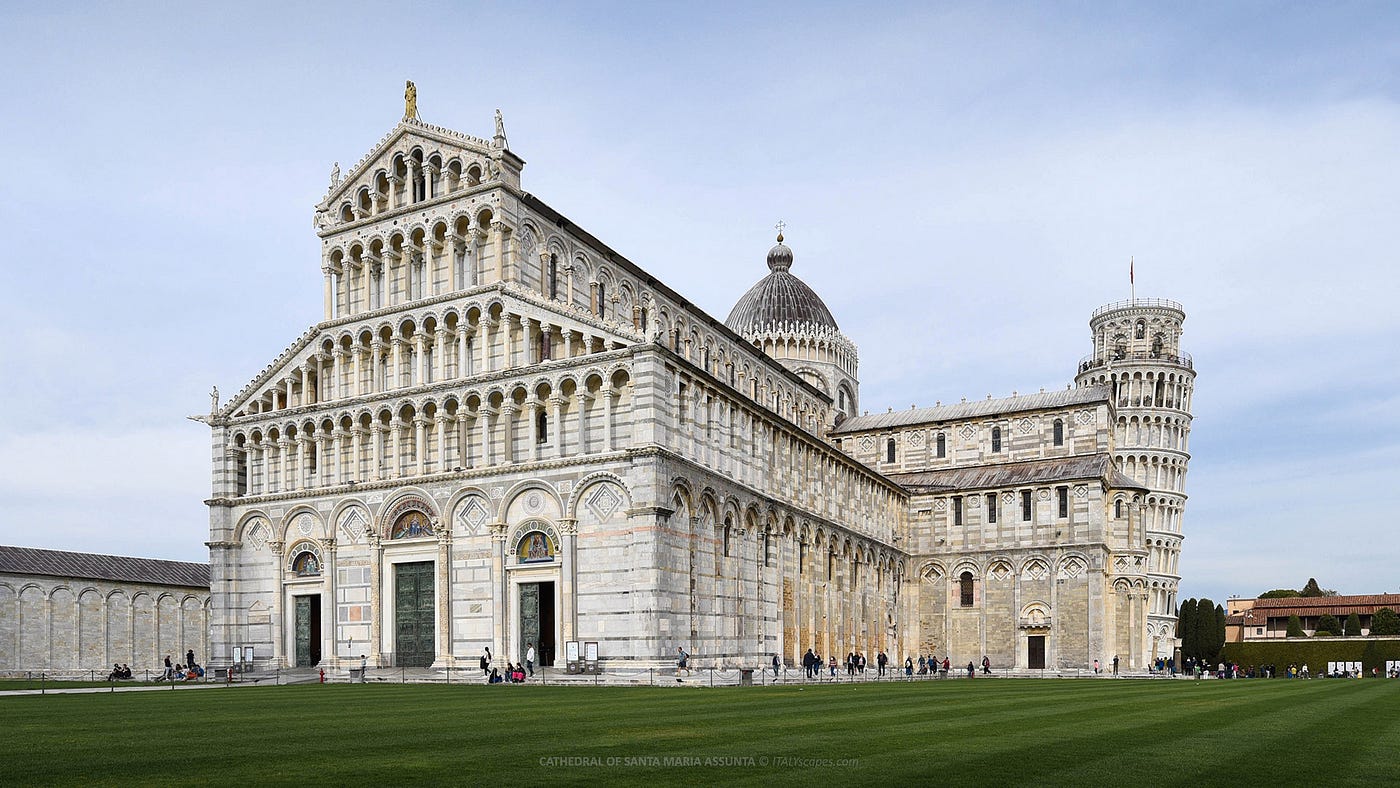
The cathedral is dedicated to the Assumption of the Virgin Mary and belongs to the Archdiocese of Pisa. It also preserves the title of primatial church, a reminder of the historic prestige once granted to the Pisan archbishop. Its position, scale, and decoration show how powerful Pisa was during the height of its maritime expansion.
Construction began in 1064, when Pisa was growing as a commercial, military, and naval power in the Mediterranean. The original design is traditionally linked to the architect Buscheto, who created a large basilican structure with a central nave, four aisles, a wide transept, and a dome above the crossing.
The project was connected with Pisa’s wider ambitions. The city had recently taken part in military action against Muslim Palermo, and part of the wealth linked to that campaign helped finance the cathedral. The church was not only a sacred building, but also a statement of civic confidence, wealth, and international influence.
The cathedral was built outside the early medieval city walls, in an area previously used as a necropolis. This choice had symbolic weight. Pisa was strong enough to place its main church outside the protected urban center, turning sacred architecture into a public declaration of power and independence.
In 1092, Pope Urban II granted the Pisan archbishop the title of primate, raising the cathedral’s ecclesiastical importance. The church was consecrated on September 26, 1118, by Pope Gelasius II. Although this marked the end of the first major phase, the building continued to grow and change during the 12th century.
The most important medieval enlargement was directed by Rainaldo. He extended the nave westward, added new bays, widened parts of the structure, and designed the façade. His work gave Pisa Cathedral the impressive public image still seen today: a broad marble front filled with arcades, columns, loggias, and sculptural decoration.
The cathedral suffered a devastating fire in 1595, which destroyed many medieval furnishings and decorative elements. The original bronze doors by Bonanno Pisano were lost, although the Porta di San Ranieri survived on the transept side. After the fire, the roof, doors, altars, paintings, and interior decoration were renewed during a long post-medieval reconstruction campaign.
Architecturally, Pisa Cathedral is one of the great masterpieces of Pisan Romanesque style. This style combines classical, Lombard, Byzantine, Islamic, and wider Mediterranean influences. The exterior is faced mainly with white and grey marble, arranged in alternating bands, with arcades, lozenges, oculi, inlaid panels, pilasters, and decorative galleries.
The building has a Latin-cross plan and measures about 100 meters long and 70 meters wide. The nave has five aisles, with a central nave flanked by two aisles on each side. The transept has three aisles, creating a broad and balanced interior plan. Above the crossing rises an elliptical dome, unusual in form and rich in symbolic presence.
The western façade is one of the cathedral’s most recognizable features. Its lower level has seven blind arches and three portals, while the upper part rises through four orders of open loggias. The façade is decorated with colored marble, carved capitals, geometric patterns, vegetal motifs, and sculptural figures.
The façade is crowned by a statue of the Madonna and Child, associated with Andrea Pisano. Figures of the Evangelists, linked to Giovanni Pisano’s workshop, appear near the corners. Many original sculptures were later moved to the Museo dell’Opera del Duomo for conservation and replaced by copies on the exterior.
Inside, the cathedral is solemn, spacious, and richly layered. Black, white, and grey marble create a strong visual rhythm. Large monolithic granite columns from the Island of Elba divide the nave, while the side aisles and galleries add depth to the interior elevation. The women’s galleries, or matronei, show clear Byzantine influence.
The ceiling seen today dates from the 17th century. It replaced the earlier wooden trusses after the 1595 fire and was created by Domenico and Bartolomeo Atticciati. Its gilded coffered decoration gives the nave a more lavish post-medieval appearance, contrasting with the older Romanesque structure below.
One of the cathedral’s most important medieval features is the floor. It includes opus alexandrinum marble inlay work from the 12th century, a type of geometric pavement more commonly associated with Rome and Lazio. This detail shows the cultural reach and artistic ambition of Pisa during the Middle Ages.
The apse contains a major mosaic of Christ enthroned between the Virgin Mary and Saint John the Evangelist. The work reflects Byzantine influence and recalls the mosaic traditions of southern Italy and Sicily. The figure of Saint John, painted by Cimabue around 1302, is especially important and survived the 1595 fire.
Another masterpiece is the pulpit by Giovanni Pisano, created between 1302 and 1310. It is one of the great works of Italian Gothic sculpture, filled with expressive figures, dramatic narrative scenes, prophets, virtues, and caryatids. After being dismantled during later works, it was reassembled in 1926.
The Chapel of San Ranieri in the right transept preserves the relics of Pisa’s patron saint. It also contains parts of the funerary monument of Emperor Henry VII of Luxembourg, sculpted by Tino di Camaino. The left transept contains the Chapel of the Blessed Sacrament, with a large silver ciborium by Giovan Battista Foggini.
The cathedral also preserves the Madonna di Sotto gli Organi, a 13th-century image of the Madonna and Child attributed to Berlinghiero Berlinghieri. This sacred image remains deeply connected with Pisa’s religious identity. Other important artworks include paintings by Andrea del Sarto, Perin del Vaga, Francesco Vanni, and Giovanni Battista Paggi.
The cathedral is also linked with tradition and science. A famous story connects Galileo Galilei with a lamp in the nave, whose movement supposedly inspired reflections on pendular motion. The building also marks solar events, including the traditional Pisan New Year on March 25, when sunlight reaches a specific marble shelf.
Pisa Cathedral remains the true heart of Piazza dei Miracoli. The Leaning Tower may be the most photographed structure in the square, but it was built as the cathedral’s bell tower. Together with the Baptistery and Camposanto, the cathedral forms a complete medieval vision of faith, civic pride, artistic exchange, and architectural grandeur.
메타데이터
- post_id
- 435e3570a3cc
- slug
- pisa-cathedral-the-marble-heart-of-piazza-dei-miracoli-435e3570a3cc
- url
- https://medium.com/@ovidiu.tutunaru/pisa-cathedral-the-marble-heart-of-piazza-dei-miracoli-435e3570a3cc
- canonical_url
- https://medium.com/@ovidiu.tutunaru/pisa-cathedral-the-marble-heart-of-piazza-dei-miracoli-435e3570a3cc
- author_url
- https://medium.com/@ovidiu.tutunaru
- status
- ok
- fetched_at
- 2026-06-20 20:29:01