Eternal Master
An article series on Horikawa Kodo‘s Eisei Meijin certificate
Eternal Master
An article series on Horikawa Kodo‘s Eisei Meijin certificate
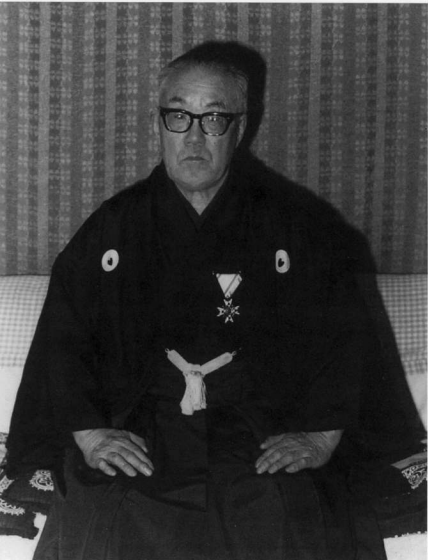
Horikawa sensei, circa 1975 (Source: Conversations with Daito-ryu Masters, Stanley Pranin)
I was contacted some months ago by a fellow amateur researcher. They had a question regarding Horikawa Taiso, an early practitioner of Daito-ryu. Born in Iwate prefecture, Taiso would move to Hokkaido and literally strike gold around 1898.
このおだやかな川を120年以上前に船でさかのぼって探検した人物がいました。その人物とは、現在の枝幸の市街地で料理店を営んでいた堀川泰宗。1898年(明治31年)6月、堀川率いる探検隊は、海岸から北見幌別川をさかのぼりました。当時の川筋はヒグマが出没し、「丈ケ七、八尺ニ及ブ」クマザサの密林。探検隊は苦難を極めましたが、ついに支流のパンケナイ川ですばらしい砂金地に到達します。「枝幸砂金」の発見です。
There was a man who explored this gentle river by boat more than 120 years ago. That person was Horikawa Taiso, who ran a restaurant in what is now the city of Esashi. In June 1898, an expedition team led by Horikawa traveled up the Kitami-Horobetsu River from the coast. In June 1898, the expedition team led by Horikawa traveled up the Horobetsu River from the coast. The expedition team faced many hardships but finally reached a wonderful gold deposit in the Pankenai River, a tributary. This was the discovery of the “Esashi Golden Sands”.
Source: Hokkaido News (北海道新聞), September 23rd 2019
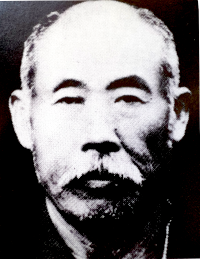
Horikawa Taiso (Source: Gekkan Hiden, February 2007)
He would later own hotels, a printing business, and even the management contract for a train station for a few years in the late 1920s. By any standards, he was a wealthy man and is still remembered in Hokkaido today.
In the West, however, he is perhaps better known for being the father of Horikawa Kotaro, later known as Kodo, to who he would teach Daito-ryu early in his life. Horikawa sensei would later go on to study under Takeda Sokaku sensei (who popularized Daito-ryu) and form his own lineage in 1950. By all accounts, he was well known as an accomplished martial artist as well as an educator.
Unfortunately for my friend, his request was regarding an area of Taiso’s life that I have yet to uncover much about. Still, the inquiry made me realize how little I knew about both Horikawa the father, and the son. This motivated me to do a bit of late-night research to further flesh out my personal notes regarding both men.
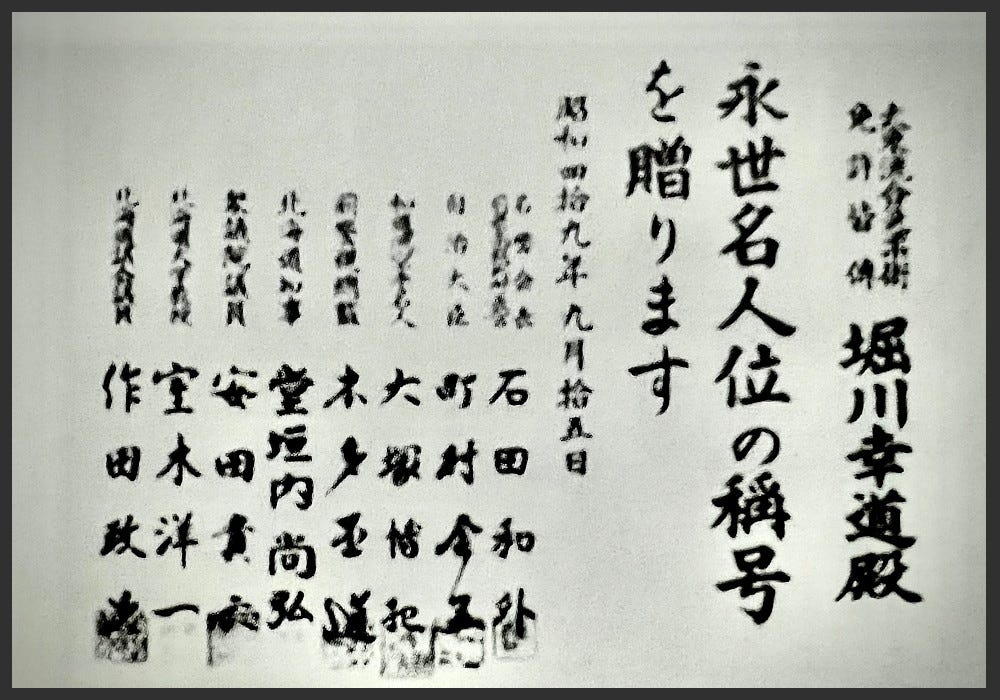
A framed copy of the Eisei Meijin certificate awarded to Horikawa sensei (Source: Budo Hiden, June 2019)
It was during that research that I first stumbled upon the above picture, displaying a certificate awarded to Horikawa sensei in September of 1974. At first glance, it looks like it bestows upon him the rank of Eisei Meijin (永世名人位, or Eternal Master), but otherwise doesn’t really provide much more information.
I had seen the title being referred to in multiple books and sites providing biographical information about Horikawa sensei (although sometimes abbreviated to Meijin), but this was the first time I had a look at the certificate itself.
And it piqued my interest.
The certificate itself is rather unique, from the number of signatories to the title being awarded itself. I decided to dig a bit further for the purpose of writing on the subject, to provide some information and context. The more I learned, the more questions popped up, and more research became necessary to gain a better understanding. Days became weeks, then months.
The result of the following research culminated in this five-part series. I’ve broken down each area of research into its own separate article so to make the information a bit easier to go through.
- 📜 Part 1: Document Analysis
- 🕰️ Part 2: Historical Context
- 🈚 Part 3: Linguistic Breakdown
- 👺 Part 4: Myths and Extrapolations
- 🙀 Part 5: Epilogue
I’ve included links in appropriate locations to help readers navigate between each article.
This article summarizes and crystallizes what the entire series covers, provides an overview of the common misconceptions regarding the title, and provides some final thoughts regarding the importance and value of accurate, in-depth historical research.
Why create this series?
Generally, I would have condensed much of what’s written here in a single article. I decided to go the opposite direction in this case because I felt that laying out the investigative process used might do some good. Certainly, it will allow for expansive criticism. I’m however hopeful that it will serve as a template for those wishing to investigate certain cultural questions pertaining to their respective martial arts.
Most cultural practices like Japanese martial arts are filled to the brim with subtleties, cultural exceptions, and idiosyncrasies. It takes much work to establish historical background and circumstances, to frame reported events, and ultimately to estimate the significance and level of truth of given statements.
I’m hoping that the information shared through this series will inspire readers in doing their own homework and that the format and processes may serve as a base for others to pursue knowledge related to their own traditions and lineages.
Part 1: Document Analysis
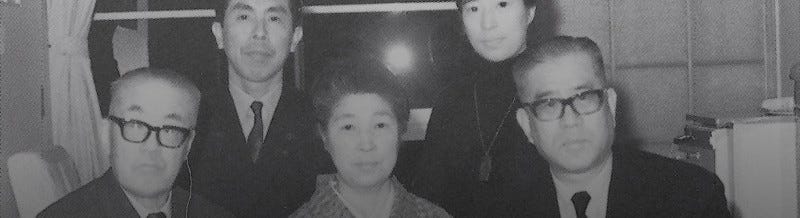
In this article, we break down the document’s content and supplement it with metadata concerning the people and titles mentioned on it.
Summary
The content of the certificate seems to indicate it was meant as the awarding of a title or rank and was either awarded by the Kodokai itself (through its honorary chairman, Ishida Kazuto) and serving as its highest honorific rank or as an independent title awarded in recognition of Horikawa sensei’s accomplishments (culturally, through his Budo practice, but also possibly in regards to his 40 years of work as an educator);
Part 2: Historical Context
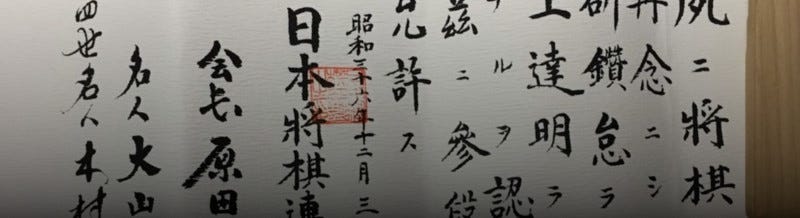
Overview
In this article, we break down the document’s content and supplement it with metadata concerning the people and titles mentioned on it.
Summary
The title of Eisei Meijin has no other use in the world of Budo; its only other known use would be in Shogi, starting in 1952. Meijin too, as a title, wasn’t used very broadly if at all in Budo, depending on the time period. The earliest confirmed usage in that context would only go back to 1952 with the Kokusai Budoin, an organization one of the signatories of Horikawa sensei’s certificate incidentally cofounded.
Part 3: Linguistic Breakdown

Overview
In this article, we dig into the meaning of the word Meijin. We go over a few definitions, a quick etymological breakdown, compare it with synonyms and similar words, and do a comparative word frequency analysis to figure out the level of popularity of each term over time and by field of interest.
Summary
Meijin on its own carries a meaning close to having made a name for oneself through skills and abilities in a field. It arguably also implies a notion of ranking or levels, in the sense that one it would normally be used to speak of a person having reached some heights in their field. Nowadays, its application isn’t limited to traditional fields, as it has found use in some sports like baseball. Traditionally, it was used in a variety of contexts, but data seems to suggest greater use in some classical martial arts and in calligraphy.
Part 4: Interpretations, Extrapolations, and Myths
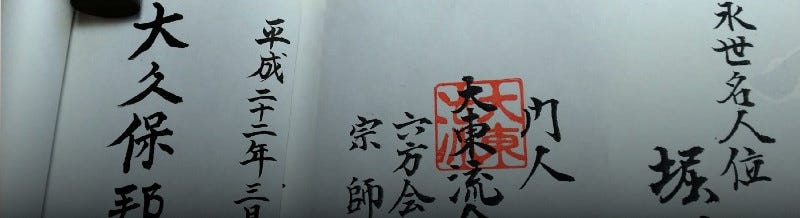
Overview
In this article, we compile the information previously gathered and suggest an interpretation. We also take a look at what others have said about the certificate and title in various publications.
Summary
There are a few mentions of the title out there. In many cases, the reported facts are incorrect or presented in a way that is hard to reconcile with the broader cultural environment and history.
Part 5: Epilogue
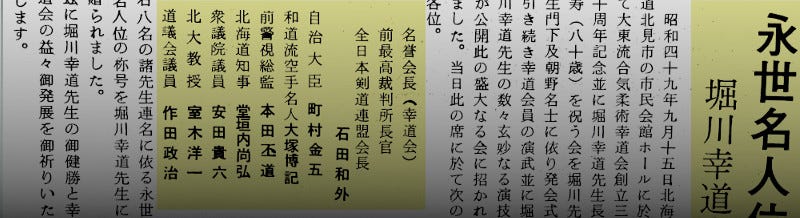
Overview
In this article, we review an article published in the Daitokan Newsletter covering the events surrounding the presenting of the Eisei Meijin title to Horikawa sensei. This article was discovered after most of the research done in the last four parts was completed; we use this opportunity to engage in a comparative study to see what we got right, what we got wrong, and how the new information we’ve gathered might have changed our understanding of things. We also take a quick look at other documents associated with this certificate, which might further contextualize its significance.
Summary
The title was awarded during a commemorative embu organized by the Kodokai to celebrate the 30th anniversary of the organization as well as Horikawa sensei’s 80th anniversary. The article states the certificate and title were awarded in recognition of Horikawa sensei’s virtues. Its content appears to corroborate the result of our research.
Some Misconceptions
Let’s now review quickly some common misconceptions regarding the title.
❌ It’s not a title
While there is a possibility that it was some form of award, the usage of the kanji for rank (位), part of the formulation referring to a title/denomination (称号), that one of the signatories held a similar sounding title, and that members and ex-members of the Kodokai use it as an honorific in discussions and on documents all points to the term being a title. At the very least, it is not used in the more colloquial sense.
❌ It’s the highest title/honor a Budoka can receive
No such thing exists, nor are there any historical precedents for this proposition. In fact, this specific title/honor has no precedents in Budo. It is only found in Shogi, and even there it’s only the highest title attached to a single tournament.
It could be the highest title of honor in a particular context — for instance, within the Kodokai — but to state or hint that it’s the highest of all is certainly incorrect and misleading.
❌ Eisei Meijin is a title part of an Order (Order of Eternal Mastership)
This is a poor and grossly incorrect translation. Nothing indicates that such order ever existed, or that Horikawa sensei and/or the signatories were part of it.
❔ This was awarded in recognition of Horikawa sensei’s Aiki (specifically, by Ishida sensei)
This cannot be substantiated using public documents as far as I could tell (although some mentions of privately archived documents were made). The Kodokai itself has made no public statements that I am aware of.
That said, I’d like to propose a certain historical course of events that may explain and contextualize this statement.
According to a source, Horikawa sensei is still sometimes referred to as Kodo Meijin by Kodokai practitioners. This makes sense given the title was awarded at an official Kodokai event, and would also explain why Mr. Okamoto elected to use this title when referring to Horikawa sensei in the transmission documents of his own offshoot.
Furthermore, it seems likely that Ishida sensei awarded this title in his capacity as honorary chairman of the Kodokai; this title is on the certificate itself, and after all, it wouldn’t make much sense for students today to keep using a title bestowed upon their teacher the teacher of a different tradition 50 years ago. If so, then I think this was most likely awarded on behalf of the Kodokai itself, and not by Ishida sensei and the other signatories personally.
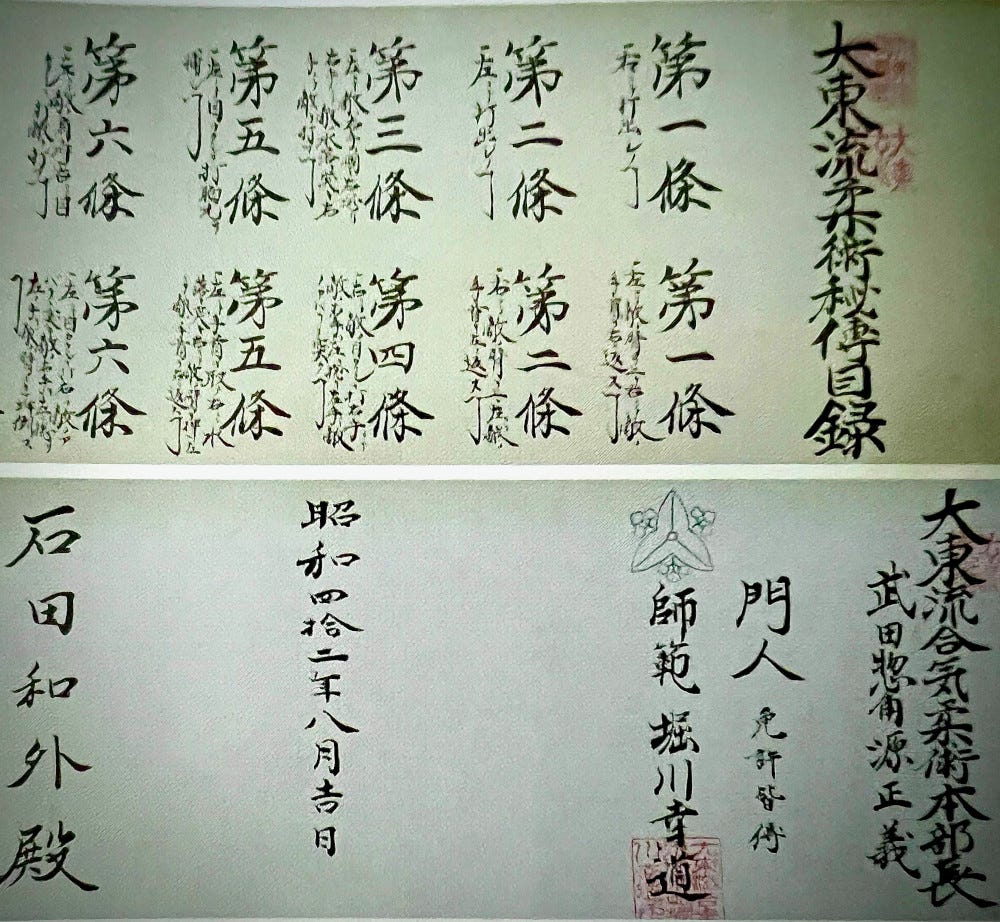
Portion of a Hiden Mokuroku awarded to Ishida sensei by Horikawa sensei, dated August 1st, 1967 (Budo Hiden, June 2019)
Given their close relationship, it’s quite possible that Horikawa sensei taught Ishida sensei about Daito-ryu, and more specifically about aiki. The above densho provides strong backing to this idea. To what degree though remains unknown, and there’s of course a big difference between familiarity and mastery; for context, the above densho doesn’t mention aiki once.
Horikawa always said, “Daito-ryu is powerful because it has aiki.” And, he would grow rather indignant, saying, “Why do people use the word aiki when they neither know what aiki means, nor understand the fundamental meaning of the techniques?”
But he was not the type to push people aside and press himself forward. He would simply say, “If only I had just one good student who wanted to know the truth of these things…”
Source: Conversations with Daito-ryu Masters, Stanley Pranin
Regardless, mastery of the concept is far from required for the above statement to hold true in some way.
Ishida sensei saw something great in Horikawa sensei from early on. When they reconnected in the 60s, he saw his old friend consistently referring to the core of his practice as aiki. It’s entirely possible he decided to use this term when discussing the greatness of the abilities he was witnessing, and his later position as honorary chairman to honor his long-time friend in a more official way.
This is pure speculation on my part. In my view, only the Kodokai could definitively confirm and/or clarify this statement, using their own archives and internal documents. While remaining unconfirmed, some version of this story seems plausible given circumstantial evidence.
The journey is the reward
Doing this kind of research and writing about the results — whatever they may end up being — is why I started this blog in the first place. Just putting ink to paper bears no intrinsic value; the product output of investigatory work does.
History keeps on walking and cares little to preserve itself. It’s why I think research work is so important. Not only is it the best way to actively show our respect to those who preceded us, but it also helps us better understand them, empathize with them, and perhaps contextualize what it is we spend so long learning and work so hard on training.
Collaboration
I have to admit though that I had some apprehension with sharing my questions, findings, and writings. I tried to the best of my ability to provide a logically sound analysis, if not a correct one, that was substantiated by facts and circumstances. But I was concerned that the series would be perceived as an attempt to belittle Horikawa sensei’s legacy.
But my fears were completely unfounded. On the contrary, I wish to commend all the people I contacted for their eloquence, depth of thoughts, and sheer dedication and willingness to discuss and share all things Daito-ryu. The comments, debates, and discussions that followed the drafts I shared were deeply enriching.
You have my sincere gratitude, and I hope we’ll get to share more in the future.
Conclusion
Horikawa sensei truly is one of the Eternal Masters of Daito-ryu. His father, a practitioner himself, taught him from an early age. He developed into a renowned martial artist, developing friendships with other great martial artists based on his talent and understanding. He was recognized nationally as an educator. His lineage still lives on today and gave birth to countless offshoots.
He was a great man and should be remembered as such.
But to say that Eisei Meijin is the highest title of honor of all Budo, or something to that effect, is nonsensical. To say it is the highest honor is supported by neither historical nor cultural context. It might be the highest title/honor awarded within a given organization—and there seems to be circumstantial evidence to that effect — but only the Kodokai’s leadership is in a position to make any official statements to that effect.
I believe misleading statements of facts do not help preserve Horikawa sensei’s memory and legacy. On the contrary, I believe it obfuscates it.
Through this series, we’ve covered how to break down documents for analysis, what historical research looks like, and have gone through various tools to help us get a better grasp of the language.
As for myself, I’ve certainly been able to learn quite a lot about Horikawa sensei — as I intended initially, though through many unforeseen detours. In fact, it has opened some new doors and avenues of research that I am eager to delve into in the future.
But those are stories for another day.
Thoughts, comments, or corrections? Make sure to leave them below in the comments!
메타데이터
- post_id
- 436487b45ddf
- slug
- eternal-master-436487b45ddf
- url
- https://daito-ryu.blog/eternal-master-436487b45ddf
- canonical_url
- https://daito-ryu.blog/eternal-master-436487b45ddf
- author_url
- https://medium.com/@marc.trudelbelisle
- status
- ok
- fetched_at
- 2026-07-27 09:39:15